Year 11
4 External Credits
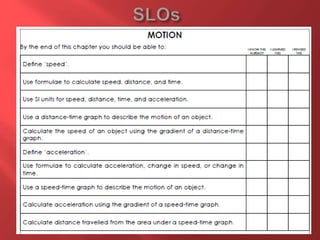
Use SI units for distance, speed, time and
acceleration.
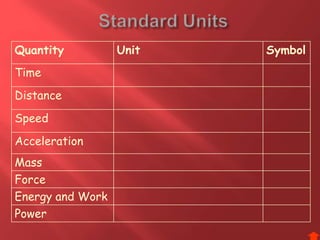
Quantity Unit Symbol
Time
Distance
Speed
Acceleration
Mass
Force
Energy and Work
Power
t
d
v



d
v
t
d
tv
d v t  d
v t

d v t  
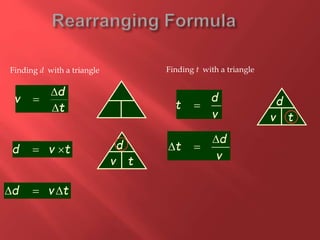
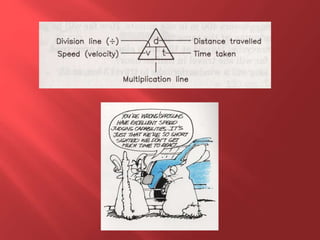
Finding d with a triangle
d
t
v
 d
tv
d
v t

d
t
v

 
Finding t with a triangle
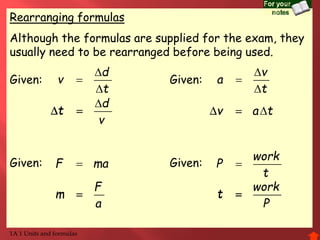
Rearranging formulas
Although the formulas are supplied for the exam, they
usually need to be rearranged before being used.
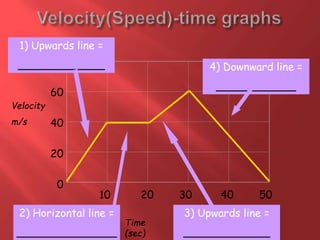
Given: Given:
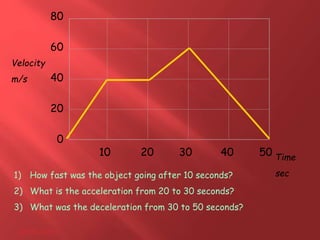
Given: Given:
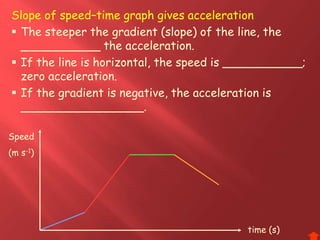
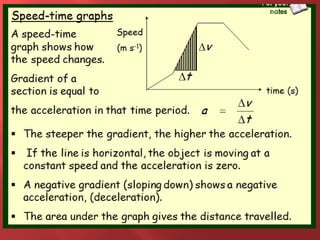
d
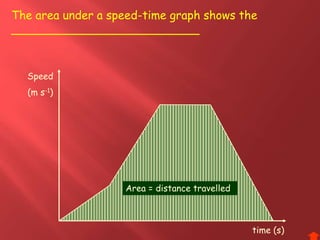
t
v

  v a t  
F
m
a

work
t
P

d
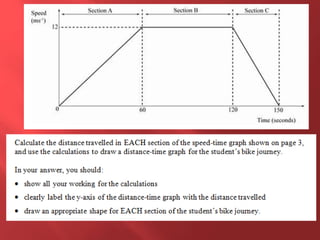
v
t



v
a
t



F ma
work
P
t

1A 1 Units and formulas
t v
tm
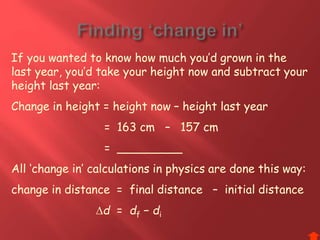
If you wanted to know how much you’d grown in the
last year, you’d take your height now and subtract your
height last year:
Change in height = height now – height last year
= 163 cm – 157 cm
= _________
All ‘change in’ calculations in physics are done this way:
change in distance = final distance – initial distance
d = df − di
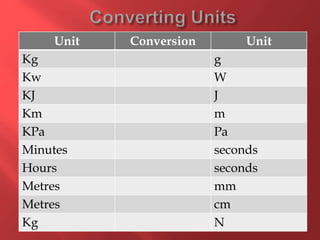
Unit Conversion Unit
Kg g
Kw W
KJ J
Km m
KPa Pa
Minutes seconds
Hours seconds
Metres mm
Metres cm
Kg N
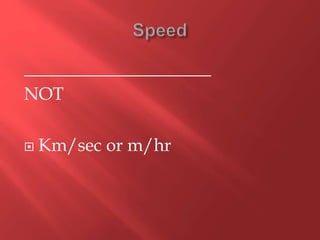
_____________________
NOT
 Km/sec or m/hr
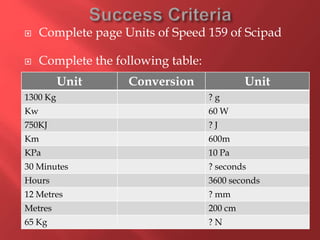
 Complete page Units of Speed 159 of Scipad
 Complete the following table:
Unit Conversion Unit
1300 Kg ? g
Kw 60 W
750KJ ? J
Km 600m
KPa 10 Pa
30 Minutes ? seconds
Hours 3600 seconds
12 Metres ? mm
Metres 200 cm
65 Kg ? N
 Define Speed
http://lgfl.skoool.co.uk/content/keystage3/phys
ics/pc/learnPathLessons/QW5/frameset.htm
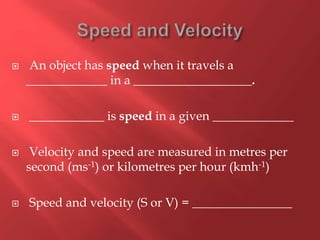
 An object has speed when it travels a
_____________ in a ___________________.
 ____________ is speed in a given _____________
 Velocity and speed are measured in metres per
second (ms-1) or kilometres per hour (kmh-1)
 Speed and velocity (S or V) = ________________
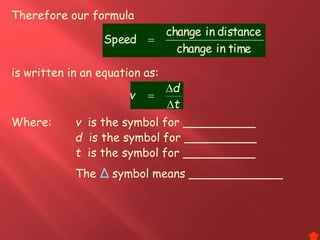
Therefore our formula
Where: v is the symbol for __________
d is the symbol for __________
t is the symbol for __________
t
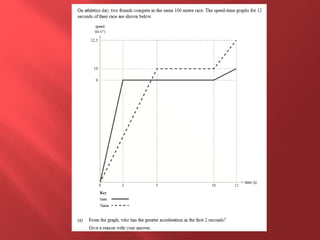
d
v



is written in an equation as:
timeinchange
distanceinchange
Speed 
The Δ symbol means _____________
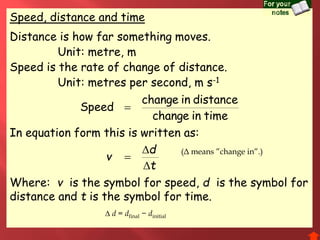
Speed, distance and time
Distance is how far something moves.
Unit: metre, m
Speed is the rate of change of distance.
Unit: metres per second, m s-1
t
d
v



In equation form this is written as:
Where: v is the symbol for speed, d is the symbol for
distance and t is the symbol for time.
timeinchange
distanceinchange
Speed 
 d = dfinal − dinitial
(Δ means ”change in”.)
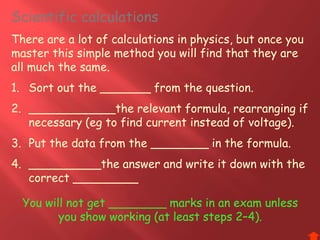
Scientific calculations
There are a lot of calculations in physics, but once you
master this simple method you will find that they are
all much the same.
1. Sort out the _______ from the question.
2. ____________the relevant formula, rearranging if
necessary (eg to find current instead of voltage).
3. Put the data from the ________ in the formula.
4. __________the answer and write it down with the
correct _________
You will not get ________ marks in an exam unless
you show working (at least steps 2–4).
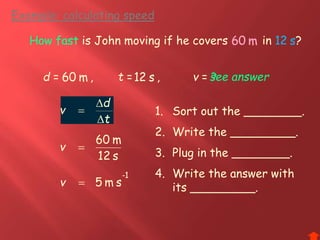
Example: calculating speed
t
d
v



How fast is John moving if he covers in ?
d = ,
s12
m60
v
1-
sm5v
t = , v =s12 s12 see answer
s12 s12
m60 m60
How fast
?
m60
v
m60
1. Sort out the ________.
2. Write the _________.
3. Plug in the ________.
4. Write the answer with
its _________.
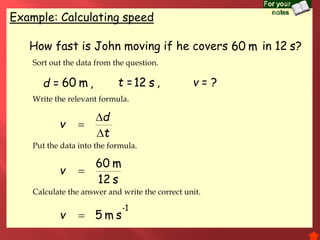
Example: Calculating speed
t
d
v



How fast is John moving if he covers in ?
d = ,
s12
m60
v
1-
sm5v
t = , v = ?s12 s12
s12
m60 m60
m60
Sort out the data from the question.
Write the relevant formula.
Put the data into the formula.
Calculate the answer and write the correct unit.
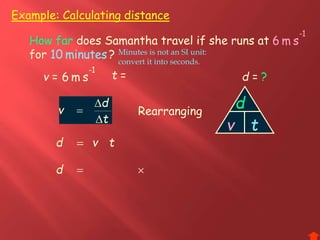
Example: Calculating distance
d =v =
1-
sm6 t =
How far does Samantha travel if she runs at
for ?
?
How far
1-
sm6
minutes10 minutes10
t
d
v


 Rearranging
d
tvv t
tvd 
d
d 
1-
sm6
Minutes is not an SI unit:
convert it into seconds.
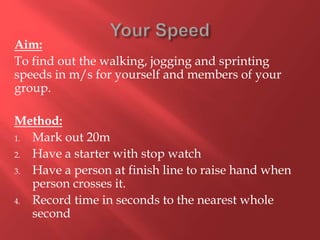
Aim:
To find out the walking, jogging and sprinting
speeds in m/s for yourself and members of your
group.
Method:
1. Mark out 20m
2. Have a starter with stop watch
3. Have a person at finish line to raise hand when
person crosses it.
4. Record time in seconds to the nearest whole
second
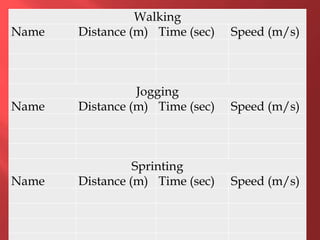
Walking
Name Distance (m) Time (sec) Speed (m/s)
Jogging
Name Distance (m) Time (sec) Speed (m/s)
Sprinting
Name Distance (m) Time (sec) Speed (m/s)
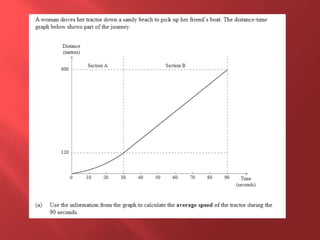
1. The parachutist falls through a distance of 400 m
during the first 60 seconds. Calculate the average
speed of the parachutist during this time.
(remember to show ALL working)
2. Complete scipad pages 160-162 Calculating Speed,
Using Triangles and More Speed Calculations
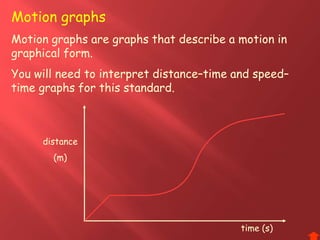
 Use distance time graph to describe the motion
of an object
 Calculate the speed of an object using the
gradient of a distance-time graph.
Motion graphs are graphs that describe a motion in
graphical form.
You will need to interpret distance–time and speed–
time graphs for this standard.
distance
(m)
time (s)
Motion graphs
28/05/2015
40
30
20
10
0
20 40 60 80 100
4) Diagonal line
downwards =
____________
3) Steeper diagonal line =
_________________
1) Diagonal line =
____________
2) Horizontal line =
____________
Distance
(metres)
Time/s
28/05/2015
40
30
20
10
0
20 40 60 80 100
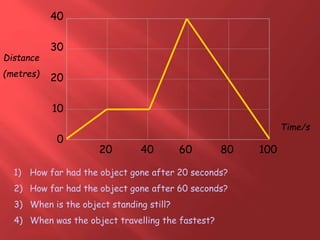
1) How far had the object gone after 20 seconds?
2) How far had the object gone after 60 seconds?
3) When is the object standing still?
4) When was the object travelling the fastest?
Distance
(metres)
Time/s
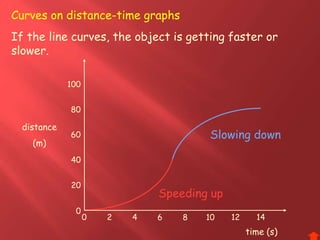
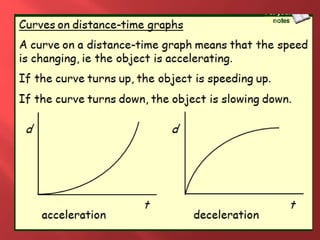
If the line curves, the object is getting faster or
slower.
Speeding up
Slowing down
0 2 4 6 8 10 12 14
20
40
60
80
100
distance
(m)
time (s)
0
Curves on distance-time graphs
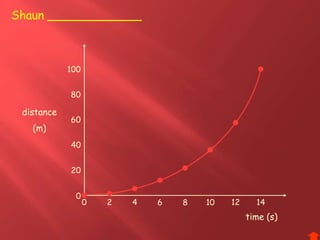
Shaun _____________
0 2 4 6 8 10 12 14
20
40
60
80
100
distance
(m)
time (s)
0
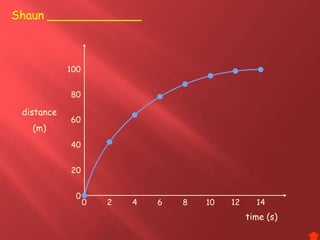
Shaun _____________
0 2 4 6 8 10 12 14
20
40
60
80
100
distance
(m)
time (s)
0
 Complete Scipad pages Distance – Time graphs
pages 163-167.
 Define acceleration
 Use formulae to calculate acceleration, change
in speed or change in time
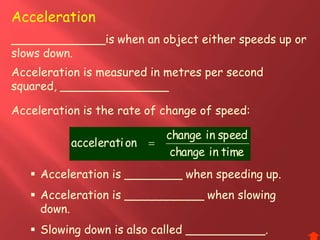
Acceleration is the rate of change of speed:
Acceleration
_____________is when an object either speeds up or
slows down.
timeinchange
speedinchange
onaccelerati 
Acceleration is measured in metres per second
squared, _______________
 Acceleration is ________ when speeding up.
 Acceleration is ___________ when slowing
down.
 Slowing down is also called ___________.
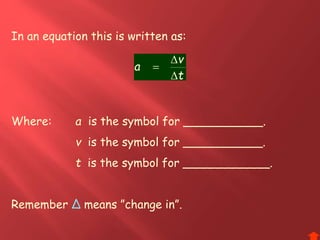
In an equation this is written as:
Where: a is the symbol for ___________.
v is the symbol for ___________.
t is the symbol for ____________.
Remember Δ means ”change in”.
t
v
a



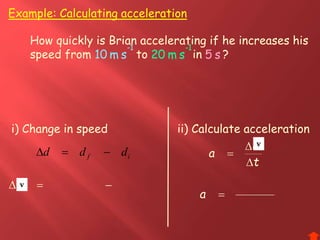
Example: Calculating acceleration
How quickly is Brian accelerating if he increases his
speed from to in ?
1-
sm10
1-
sm20 s5
1-
sm10
1-
sm20 s5
i) Change in speed
if ddd 
d 
ii) Calculate acceleration
t
d
a



a
v
v
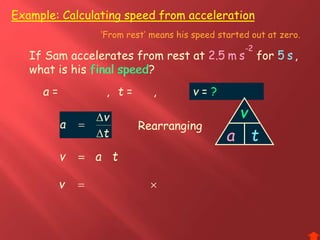
Example: Calculating speed from acceleration
t = ,a = ,
t
v
a



If Sam accelerates from rest at for ,
what is his final speed?
tav 
v
v =
Rearranging
v
ta
v
a t

?

2-
sm2.5 s5
final speed
2-
sm2.5 s5
‘From rest’ means his speed started out at zero.
 Complete page 168-169 Scipad, Acceleration
 Use speed-time graphs to describe the motion
of an object
 Calculate acceleration using the gradient of a
speed-time graph
 Calculate the distance travelled from the area
under a speed-time graph
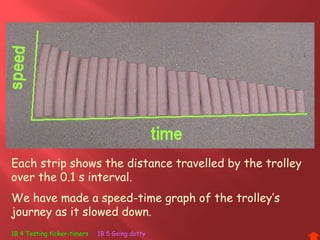
Each strip shows the distance travelled by the trolley
over the 0.1 s interval.
We have made a speed-time graph of the trolley’s
journey as it slowed down.
1B 4 Testing ticker-timers 1B 5 Going dotty
28/05/2015
80
60
40
20
0
10 20 30 40 50
Velocity
m/s
Time
(sec)
1) Upwards line =
_____________
2) Horizontal line =
_______________
3) Upwards line =
_____________
4) Downward line =
____________
28/05/2015
80
60
40
20
0
1) How fast was the object going after 10 seconds?
2) What is the acceleration from 20 to 30 seconds?
3) What was the deceleration from 30 to 50 seconds?
10 20 30 40 50
Velocity
m/s
Time
sec
Slope of speed–time graph gives acceleration
 The steeper the gradient (slope) of the line, the
___________ the acceleration.
 If the line is horizontal, the speed is ___________;
zero acceleration.
 If the gradient is negative, the acceleration is
_________________.
Speed
(m s-1)
time (s)
Speed
(m s-1)
time (s)
The area under a speed-time graph shows the
__________________________
Area = distance travelled
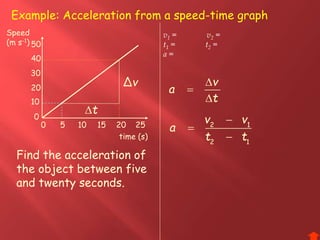
Find the acceleration of
the object between five
and twenty seconds.
v
a
t



v1 = v2 =
t1 = t2 =
a =
2 1
2 1
v v
a
t t



Speed
(m s-1)
time (s)
0
0 5 10 15
20
40
20
10
30
50
25
Δv
t
Example: Acceleration from a speed-time graph
28/05/2015
40
30
20
10
0
20 40 60 80 100
Distance
(metres)
Time/s
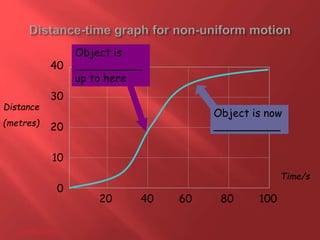
Object is
__________
up to here
Object is now
__________
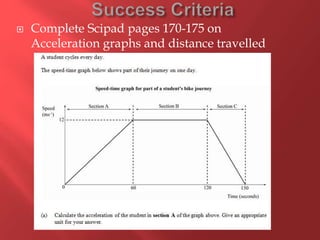
 Complete Scipad pages 170-175 on
Acceleration graphs and distance travelled
 Complete Scipad pages 176-181, 158
 Complete worksheets
 Complete purple book pages
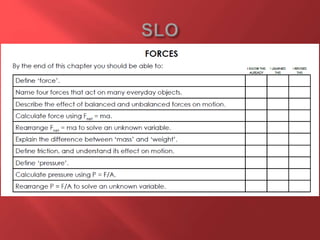
 Define Force
 Name the four forces that act on many
everyday objects
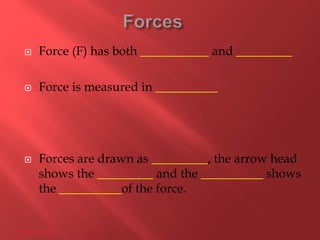
 Force (F) has both ___________ and _________
 Force is measured in __________
 Forces are drawn as _________, the arrow head
shows the _________ and the __________ shows
the __________of the force.
28/05/2015
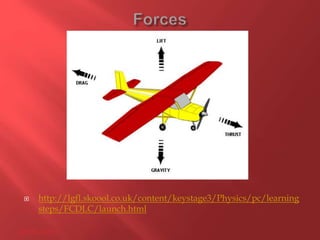
 http://lgfl.skoool.co.uk/content/keystage3/Physics/pc/learning
steps/FCDLC/launch.html
28/05/2015
28/05/2015
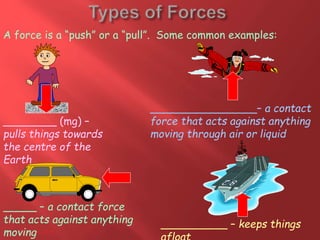
A force is a “push” or a “pull”. Some common examples:
________ (mg) –
pulls things towards
the centre of the
Earth
________________– a contact
force that acts against anything
moving through air or liquid
__________ – keeps things
_____ – a contact force
that acts against anything
moving
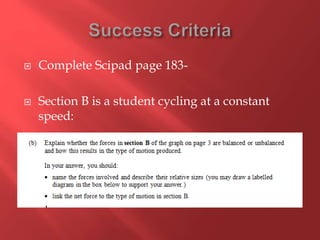
 Complete Scipad page 183-
 Section B is a student cycling at a constant
speed:
 Describe the effect of balanced and unbalanced
forces on motion
The movement or lack of it, of an object depends on
the forces acting on it.
 Balanced forces = ________________________
 Unbalanced forces = ______________________
Whatever direction the force is greatest in will be the
direction, in which the object moves.
28/05/2015
Calculate for using F=ma
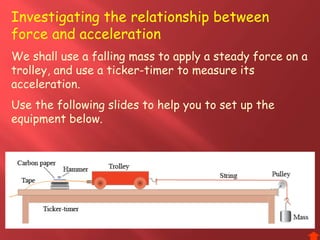
Investigating the relationship between
force and acceleration
We shall use a falling mass to apply a steady force on a
trolley, and use a ticker-timer to measure its
acceleration.
Use the following slides to help you to set up the
equipment below.
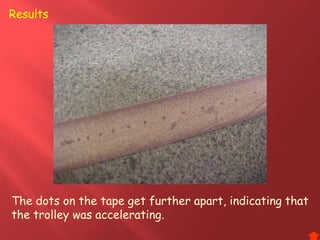
The dots on the tape get further apart, indicating that
the trolley was accelerating.
Results
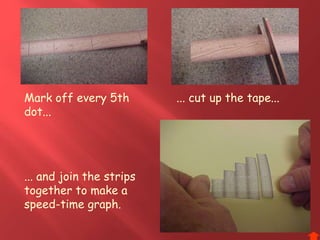
Mark off every 5th
dot...
... cut up the tape...
... and join the strips
together to make a
speed-time graph.
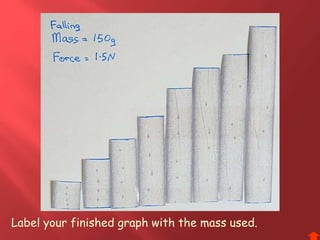
Label your finished graph with the mass used.
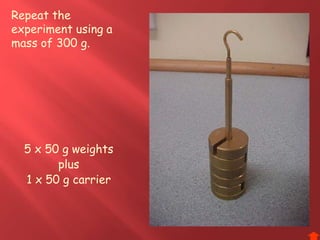
Repeat the
experiment using a
mass of 300 g.
5 x 50 g weights
plus
1 x 50 g carrier
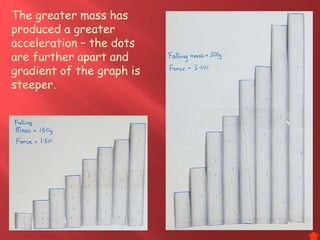
The greater mass has
produced a greater
acceleration – the dots
are further apart and
gradient of the graph is
steeper.
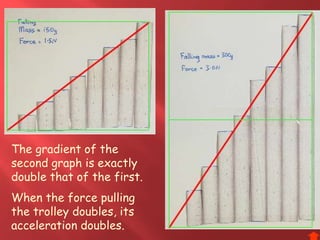
The gradient of the
second graph is exactly
double that of the first.
When the force pulling
the trolley doubles, its
acceleration doubles.
Force, acceleration and mass
An unbalanced force acting on an object will cause it to
_______________.
We know now that the acceleration produced is
proportional to the force.
We could carry on making ticker-tape graphs to show
the relationship between acceleration and mass for a
constant force.
Another way to think of the relationship between
force, mass and acceleration is to imagine pushing
cars.
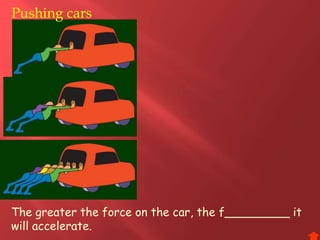
The greater the force on the car, the f_________ it
will accelerate.
Pushing cars
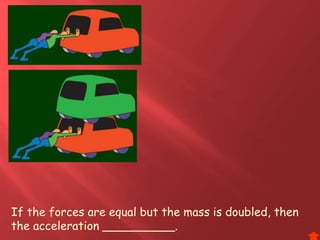
If the forces are equal but the mass is doubled, then
the acceleration __________.
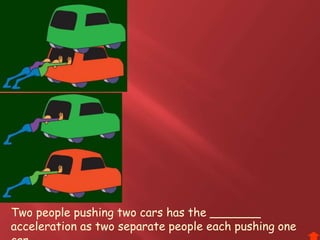
Two people pushing two cars has the _______
acceleration as two separate people each pushing one
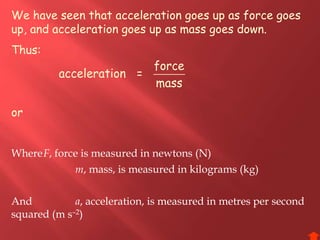
We have seen that acceleration goes up as force goes
up, and acceleration goes up as mass goes down.
Thus:
or
force
acceleration =
mass
WhereF, force is measured in newtons (N)
m, mass, is measured in kilograms (kg)
And a, acceleration, is measured in metres per second
squared (m s–2)
 http://multimedia.mcb.harvard.edu/anim_rhi
no.html
 Complete Scipad pages 186-187
Explain the Difference between mass and weight
 Mass is the bulk of an object, the amount of
__________ there is
 remains ___________ (is unaffected by gravity)
 measured in ___________________
 _______________are used to compare the mass
of two objects
 Gravity is a force which
______________(matter) together
 The bigger the masses the greater the
__________
 The acceleration due to earth’s gravitational
pull is _______________
 Weight is the force of __________ on a mass
 also known as __________ force
 measured in ________________
 varies depending on the _________acting on a
mass (greater the gravitational force, greater the
weight), which changes on different planets
 Measured with a ___________ in _________
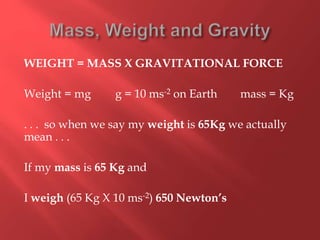
WEIGHT = MASS X GRAVITATIONAL FORCE
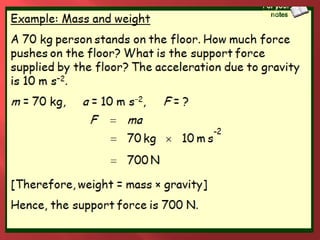
Weight = mg g = 10 ms-2 on Earth mass = Kg
. . . so when we say my weight is 65Kg we actually
mean . . .
If my mass is 65 Kg and
I weigh (65 Kg X 10 ms-2) 650 Newton’s
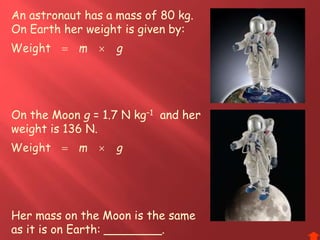
An astronaut has a mass of 80 kg.
On Earth her weight is given by:
gm Weight
On the Moon g = 1.7 N kg–1 and her
weight is 136 N.
Her mass on the Moon is the same
as it is on Earth: ________.
gm Weight
 Complete scipad page 188-189
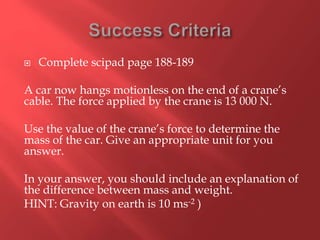
A car now hangs motionless on the end of a crane’s
cable. The force applied by the crane is 13 000 N.
Use the value of the crane’s force to determine the
mass of the car. Give an appropriate unit for you
answer.
In your answer, you should include an explanation of
the difference between mass and weight.
HINT: Gravity on earth is 10 ms-2 )
Define Friction and understand its
effect on motion
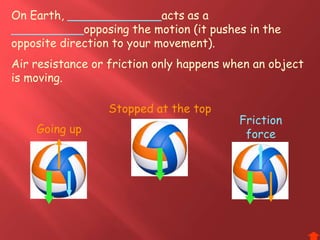
On Earth, _____________acts as a
__________opposing the motion (it pushes in the
opposite direction to your movement).
Air resistance or friction only happens when an object
is moving.
Friction
forceGoing up
Stopped at the top
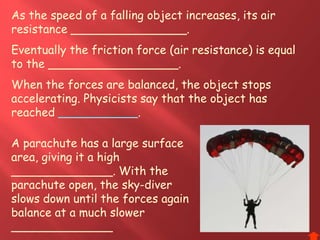
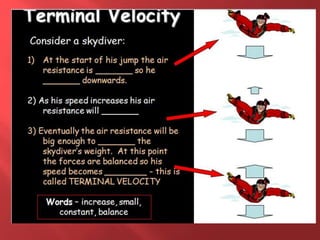
As the speed of a falling object increases, its air
resistance ________________.
Eventually the friction force (air resistance) is equal
to the __________________.
When the forces are balanced, the object stops
accelerating. Physicists say that the object has
reached ___________.
A parachute has a large surface
area, giving it a high
______________. With the
parachute open, the sky-diver
slows down until the forces again
balance at a much slower
______________
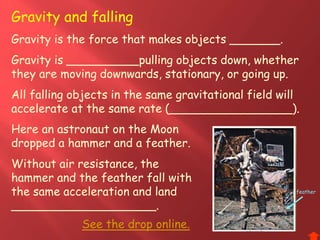
Gravity is the force that makes objects _______.
Gravity is __________pulling objects down, whether
they are moving downwards, stationary, or going up.
All falling objects in the same gravitational field will
accelerate at the same rate (_________________).
Gravity and falling
Here an astronaut on the Moon
dropped a hammer and a feather.
Without air resistance, the
hammer and the feather fall with
the same acceleration and land
____________________.
See the drop online.
feather
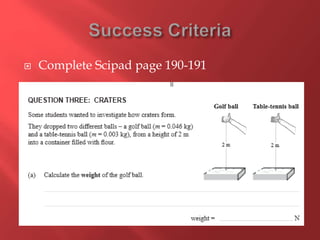
 Complete Scipad page 190-191
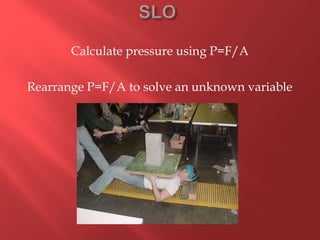
Calculate pressure using P=F/A
Rearrange P=F/A to solve an unknown variable
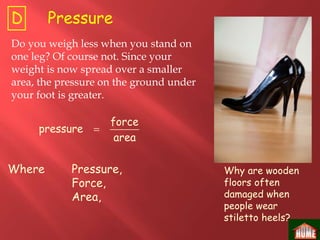
Where Pressure,
Force,
Area,
Do you weigh less when you stand on
one leg? Of course not. Since your
weight is now spread over a smaller
area, the pressure on the ground under
your foot is greater.

force
pressure
area
Why are wooden
floors often
damaged when
people wear
stiletto heels?
PressureD
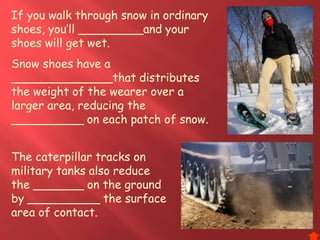
If you walk through snow in ordinary
shoes, you’ll _________and your
shoes will get wet.
Snow shoes have a
______________that distributes
the weight of the wearer over a
larger area, reducing the
__________ on each patch of snow.
The caterpillar tracks on
military tanks also reduce
the _______ on the ground
by __________ the surface
area of contact.
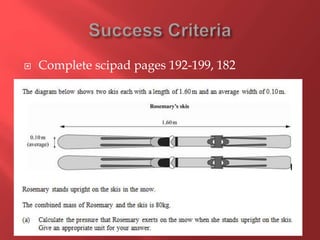
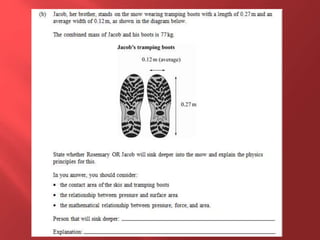
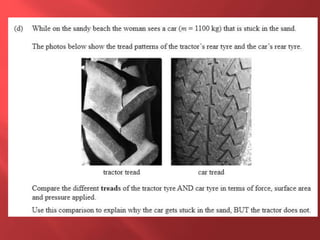
 Complete scipad pages 192-199, 182
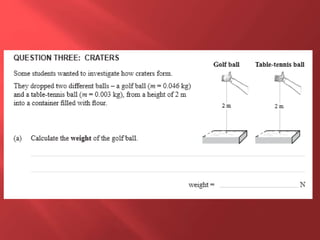
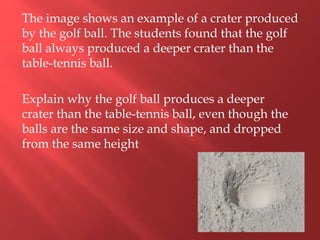
The image shows an example of a crater produced
by the golf ball. The students found that the golf
ball always produced a deeper crater than the
table-tennis ball.
Explain why the golf ball produces a deeper
crater than the table-tennis ball, even though the
balls are the same size and shape, and dropped
from the same height
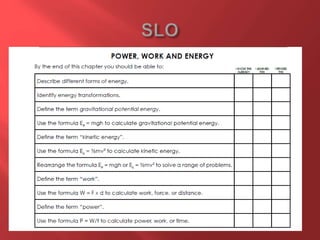
Describe different forms of energy
Identify energy Transformations
 Energy is the ability to __________
 Energy is measured in ____________
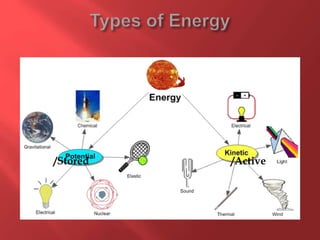
/Stored /Active
28/05/2015
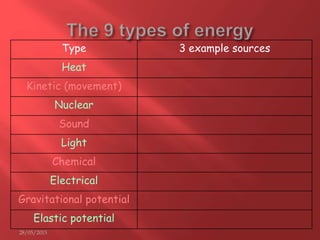
Type 3 example sources
Heat
Kinetic (movement)
Nuclear
Sound
Light
Chemical
Electrical
Gravitational potential
Elastic potential
Type 3 example sources
 Complete Scipad page 201
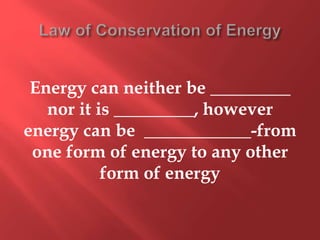
Energy can neither be _________
nor it is _________, however
energy can be ____________-from
one form of energy to any other
form of energy
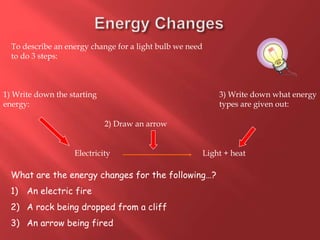
To describe an energy change for a light bulb we need
to do 3 steps:
Electricity Light + heat
1) Write down the starting
energy:
3) Write down what energy
types are given out:
2) Draw an arrow
What are the energy changes for the following…?
1) An electric fire
2) A rock being dropped from a cliff
3) An arrow being fired
What are the energy changes for the
following…?
1) An electric fire
1) A rock dropping from cliff
1) An arrow being fired?
 Complete Scipad pages 202
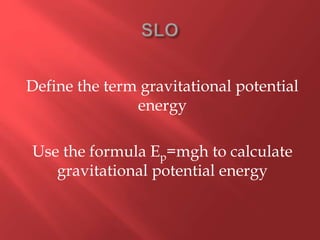
Define the term gravitational potential
energy
Use the formula Ep=mgh to calculate
gravitational potential energy
 Gravitational potential energy is the energy due to
an object’s ______________ above ground.
 To get an object off the ground, _________ must
have been done to move it
 Gravitational Potential Energy Ep
Fw = m x g (mass x gravity (10))
h = height (metres)
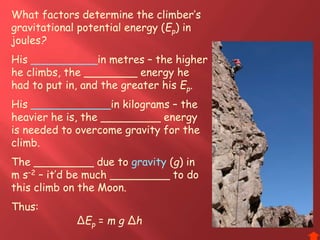
What factors determine the climber’s
gravitational potential energy (Ep) in
joules?
His __________in metres – the higher
he climbs, the ________ energy he
had to put in, and the greater his Ep.
His ____________in kilograms – the
heavier he is, the _________ energy
is needed to overcome gravity for the
climb.
The _________ due to gravity (g) in
m s–2 – it’d be much _________ to do
this climb on the Moon.
Thus:
ΔEp = m g Δh
E.g. 1
Calculate the gravitational potential energy of a
400Kg pile driver if it can fall 3 metres. G =
10NKg-1
Ep = m x g x h
=
A weightlifter lifts a 120 Kg barbell 2.4 metres above the
ground.
What is the weight of the barbell (g = 10NKg-1)
Weight Fgravity = mg
=
How much work is done lifting the barbell?
Work = Fd
=
What is the gravitational potential energy of the barbell at the
top of the lift?
Ep = m x g x h
=
 Complete Scipad page 203
Define the term kinetic energy
Use the formula Ek= 1/2mv2 to
calculate kinetic energy
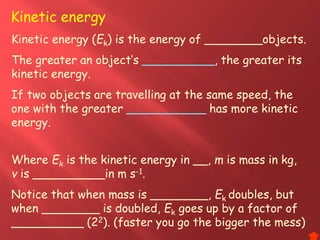
Kinetic energy (Ek) is the energy of ________objects.
The greater an object’s __________, the greater its
kinetic energy.
If two objects are travelling at the same speed, the
one with the greater ___________ has more kinetic
energy.
Where Ek is the kinetic energy in __, m is mass in kg,
v is __________in m s-1.
Notice that when mass is ________, Ek doubles, but
when ________ is doubled, Ek goes up by a factor of
__________ (22). (faster you go the bigger the mess)
Kinetic energy
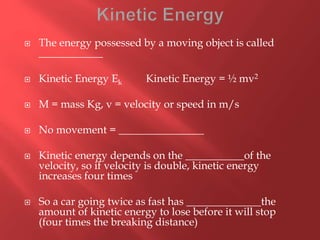
 The energy possessed by a moving object is called
____________
 Kinetic Energy Ek Kinetic Energy = ½ mv2
 M = mass Kg, v = velocity or speed in m/s
 No movement = ________________
 Kinetic energy depends on the ___________of the
velocity, so if velocity is double, kinetic energy
increases four times
 So a car going twice as fast has ______________the
amount of kinetic energy to lose before it will stop
(four times the breaking distance)
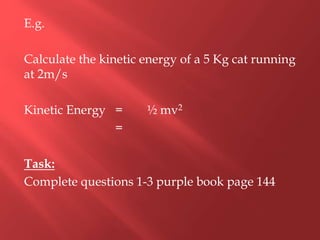
E.g.
Calculate the kinetic energy of a 5 Kg cat running
at 2m/s
Kinetic Energy = ½ mv2
=
Task:
Complete questions 1-3 purple book page 144
 Complete scipad page 204-206
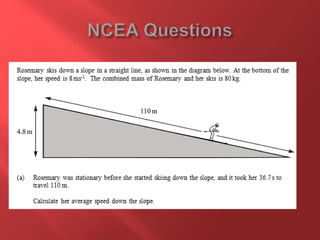
Rosemary skis down a slope in a straight line, as
shown in the diagram below. At the bottom of the
slope, her speed is 8 ms-1. The combined mass of
Rosemary and her skis is 80 kg.
Calculate the kinetic energy of Rosemary and her skis
as she reaches the bottom of the slope when she is
moving at 8 ms-1. Give an appropriate unit for your
answer.
The kinetic energy gained by Rosemary when she reached
the bottom of the slope does not equal the energy she had
when she was stationary at the top of the slope.
Explain using the principles of physics why her energy at
the top of the slope and her energy at the bottom of the
slope are not equal.
In your answer, you should:
 name the type of energy Rosemary has at the top of the
slope
 calculate the difference between her kinetic energy at
the bottom of the slope and her energy at the top of the
slope
 justify the difference between her kinetic energy at the
bottom of the slope and her
energy at the top of the slope.
Define the term work
Use the formula W=Fxd to calculate
work, force or distance
 Work is done when a _______________an object over a
distance
 If work is done to an object, then ___________is
transferred
 The gain in energy is _____________ to the work done
 Work is in joules (J), Energy is in joules (J)
 Work done = _______________
 Work done =

No movement = no work!
E.g.
Calculate the work done when a 12 N force moves an
object through 0.2 m
W = Fd
 Complete questions 1-4 on page 135 purple book
 Complete scipad page 207-208
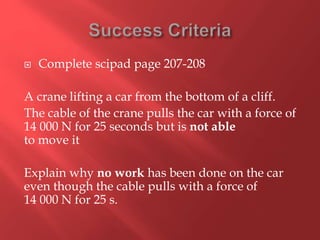
A crane lifting a car from the bottom of a cliff.
The cable of the crane pulls the car with a force of
14 000 N for 25 seconds but is not able
to move it
Explain why no work has been done on the car
even though the cable pulls with a force of
14 000 N for 25 s.
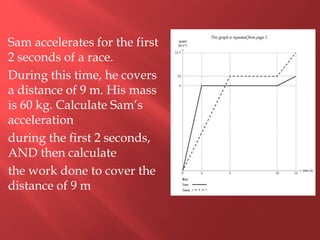
Sam accelerates for the first
2 seconds of a race.
During this time, he covers
a distance of 9 m. His mass
is 60 kg. Calculate Sam’s
acceleration
during the first 2 seconds,
AND then calculate
the work done to cover the
distance of 9 m
Define the term power
Use the formula P= W/t to calculate
power, work or time
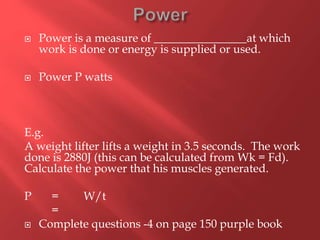
 Power is a measure of ________________at which
work is done or energy is supplied or used.
 Power P watts
E.g.
A weight lifter lifts a weight in 3.5 seconds. The work
done is 2880J (this can be calculated from Wk = Fd).
Calculate the power that his muscles generated.
P = W/t
=
 Complete questions -4 on page 150 purple book
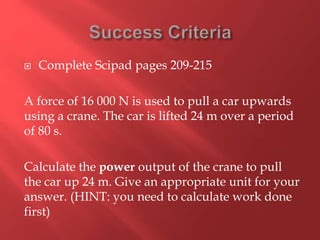
 Complete Scipad pages 209-215
A force of 16 000 N is used to pull a car upwards
using a crane. The car is lifted 24 m over a period
of 80 s.
Calculate the power output of the crane to pull
the car up 24 m. Give an appropriate unit for your
answer. (HINT: you need to calculate work done
first)

Mechanics Class Notes

  • 1.
  • 4.
    Use SI unitsfor distance, speed, time and acceleration.
  • 5.
  • 6.
    t d v    d v t d tv d v t d v t  d v t   Finding d with a triangle d t v  d tv d v t  d t v    Finding t with a triangle
  • 7.
    Rearranging formulas Although theformulas are supplied for the exam, they usually need to be rearranged before being used. Given: Given: Given: Given: d t v    v a t   F m a  work t P  d v t    v a t    F ma work P t  1A 1 Units and formulas t v tm
  • 8.
    If you wantedto know how much you’d grown in the last year, you’d take your height now and subtract your height last year: Change in height = height now – height last year = 163 cm – 157 cm = _________ All ‘change in’ calculations in physics are done this way: change in distance = final distance – initial distance d = df − di
  • 9.
    Unit Conversion Unit Kgg Kw W KJ J Km m KPa Pa Minutes seconds Hours seconds Metres mm Metres cm Kg N
  • 10.
  • 11.
     Complete pageUnits of Speed 159 of Scipad  Complete the following table: Unit Conversion Unit 1300 Kg ? g Kw 60 W 750KJ ? J Km 600m KPa 10 Pa 30 Minutes ? seconds Hours 3600 seconds 12 Metres ? mm Metres 200 cm 65 Kg ? N
  • 12.
  • 13.
     An objecthas speed when it travels a _____________ in a ___________________.  ____________ is speed in a given _____________  Velocity and speed are measured in metres per second (ms-1) or kilometres per hour (kmh-1)  Speed and velocity (S or V) = ________________
  • 15.
    Therefore our formula Where:v is the symbol for __________ d is the symbol for __________ t is the symbol for __________ t d v    is written in an equation as: timeinchange distanceinchange Speed  The Δ symbol means _____________
  • 16.
    Speed, distance andtime Distance is how far something moves. Unit: metre, m Speed is the rate of change of distance. Unit: metres per second, m s-1 t d v    In equation form this is written as: Where: v is the symbol for speed, d is the symbol for distance and t is the symbol for time. timeinchange distanceinchange Speed   d = dfinal − dinitial (Δ means ”change in”.)
  • 17.
    Scientific calculations There area lot of calculations in physics, but once you master this simple method you will find that they are all much the same. 1. Sort out the _______ from the question. 2. ____________the relevant formula, rearranging if necessary (eg to find current instead of voltage). 3. Put the data from the ________ in the formula. 4. __________the answer and write it down with the correct _________ You will not get ________ marks in an exam unless you show working (at least steps 2–4).
  • 18.
    Example: calculating speed t d v    Howfast is John moving if he covers in ? d = , s12 m60 v 1- sm5v t = , v =s12 s12 see answer s12 s12 m60 m60 How fast ? m60 v m60 1. Sort out the ________. 2. Write the _________. 3. Plug in the ________. 4. Write the answer with its _________.
  • 19.
    Example: Calculating speed t d v    Howfast is John moving if he covers in ? d = , s12 m60 v 1- sm5v t = , v = ?s12 s12 s12 m60 m60 m60 Sort out the data from the question. Write the relevant formula. Put the data into the formula. Calculate the answer and write the correct unit.
  • 20.
    Example: Calculating distance d=v = 1- sm6 t = How far does Samantha travel if she runs at for ? ? How far 1- sm6 minutes10 minutes10 t d v    Rearranging d tvv t tvd  d d  1- sm6 Minutes is not an SI unit: convert it into seconds.
  • 21.
    Aim: To find outthe walking, jogging and sprinting speeds in m/s for yourself and members of your group. Method: 1. Mark out 20m 2. Have a starter with stop watch 3. Have a person at finish line to raise hand when person crosses it. 4. Record time in seconds to the nearest whole second
  • 22.
    Walking Name Distance (m)Time (sec) Speed (m/s) Jogging Name Distance (m) Time (sec) Speed (m/s) Sprinting Name Distance (m) Time (sec) Speed (m/s)
  • 23.
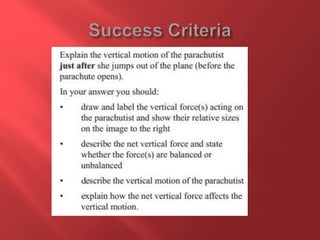
    1. The parachutistfalls through a distance of 400 m during the first 60 seconds. Calculate the average speed of the parachutist during this time. (remember to show ALL working) 2. Complete scipad pages 160-162 Calculating Speed, Using Triangles and More Speed Calculations
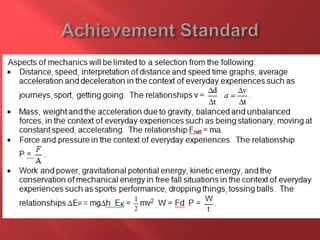
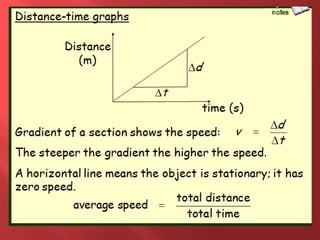
  • 26.
     Use distancetime graph to describe the motion of an object  Calculate the speed of an object using the gradient of a distance-time graph.
  • 27.
    Motion graphs aregraphs that describe a motion in graphical form. You will need to interpret distance–time and speed– time graphs for this standard. distance (m) time (s) Motion graphs
  • 28.
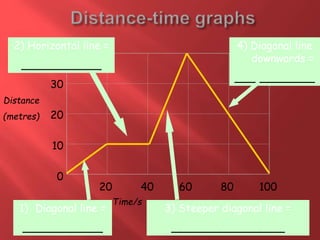
    28/05/2015 40 30 20 10 0 20 40 6080 100 4) Diagonal line downwards = ____________ 3) Steeper diagonal line = _________________ 1) Diagonal line = ____________ 2) Horizontal line = ____________ Distance (metres) Time/s
  • 29.
    28/05/2015 40 30 20 10 0 20 40 6080 100 1) How far had the object gone after 20 seconds? 2) How far had the object gone after 60 seconds? 3) When is the object standing still? 4) When was the object travelling the fastest? Distance (metres) Time/s
  • 31.
    If the linecurves, the object is getting faster or slower. Speeding up Slowing down 0 2 4 6 8 10 12 14 20 40 60 80 100 distance (m) time (s) 0 Curves on distance-time graphs
  • 32.
    Shaun _____________ 0 24 6 8 10 12 14 20 40 60 80 100 distance (m) time (s) 0
  • 33.
    Shaun _____________ 0 24 6 8 10 12 14 20 40 60 80 100 distance (m) time (s) 0
  • 35.
     Complete Scipadpages Distance – Time graphs pages 163-167.
  • 36.
     Define acceleration Use formulae to calculate acceleration, change in speed or change in time
  • 37.
    Acceleration is therate of change of speed: Acceleration _____________is when an object either speeds up or slows down. timeinchange speedinchange onaccelerati  Acceleration is measured in metres per second squared, _______________  Acceleration is ________ when speeding up.  Acceleration is ___________ when slowing down.  Slowing down is also called ___________.
  • 38.
    In an equationthis is written as: Where: a is the symbol for ___________. v is the symbol for ___________. t is the symbol for ____________. Remember Δ means ”change in”. t v a   
  • 39.
    Example: Calculating acceleration Howquickly is Brian accelerating if he increases his speed from to in ? 1- sm10 1- sm20 s5 1- sm10 1- sm20 s5 i) Change in speed if ddd  d  ii) Calculate acceleration t d a    a v v
  • 40.
    Example: Calculating speedfrom acceleration t = ,a = , t v a    If Sam accelerates from rest at for , what is his final speed? tav  v v = Rearranging v ta v a t  ?  2- sm2.5 s5 final speed 2- sm2.5 s5 ‘From rest’ means his speed started out at zero.
  • 41.
     Complete page168-169 Scipad, Acceleration
  • 42.
     Use speed-timegraphs to describe the motion of an object  Calculate acceleration using the gradient of a speed-time graph  Calculate the distance travelled from the area under a speed-time graph
  • 45.
    Each strip showsthe distance travelled by the trolley over the 0.1 s interval. We have made a speed-time graph of the trolley’s journey as it slowed down. 1B 4 Testing ticker-timers 1B 5 Going dotty
  • 46.
    28/05/2015 80 60 40 20 0 10 20 3040 50 Velocity m/s Time (sec) 1) Upwards line = _____________ 2) Horizontal line = _______________ 3) Upwards line = _____________ 4) Downward line = ____________
  • 47.
    28/05/2015 80 60 40 20 0 1) How fastwas the object going after 10 seconds? 2) What is the acceleration from 20 to 30 seconds? 3) What was the deceleration from 30 to 50 seconds? 10 20 30 40 50 Velocity m/s Time sec
  • 48.
    Slope of speed–timegraph gives acceleration  The steeper the gradient (slope) of the line, the ___________ the acceleration.  If the line is horizontal, the speed is ___________; zero acceleration.  If the gradient is negative, the acceleration is _________________. Speed (m s-1) time (s)
  • 49.
    Speed (m s-1) time (s) Thearea under a speed-time graph shows the __________________________ Area = distance travelled
  • 51.
    Find the accelerationof the object between five and twenty seconds. v a t    v1 = v2 = t1 = t2 = a = 2 1 2 1 v v a t t    Speed (m s-1) time (s) 0 0 5 10 15 20 40 20 10 30 50 25 Δv t Example: Acceleration from a speed-time graph
  • 52.
    28/05/2015 40 30 20 10 0 20 40 6080 100 Distance (metres) Time/s Object is __________ up to here Object is now __________
  • 53.
     Complete Scipadpages 170-175 on Acceleration graphs and distance travelled
  • 56.
     Complete Scipadpages 176-181, 158  Complete worksheets  Complete purple book pages
  • 58.
     Define Force Name the four forces that act on many everyday objects
  • 59.
     Force (F)has both ___________ and _________  Force is measured in __________  Forces are drawn as _________, the arrow head shows the _________ and the __________ shows the __________of the force. 28/05/2015
  • 60.
  • 61.
    28/05/2015 A force isa “push” or a “pull”. Some common examples: ________ (mg) – pulls things towards the centre of the Earth ________________– a contact force that acts against anything moving through air or liquid __________ – keeps things _____ – a contact force that acts against anything moving
  • 62.
     Complete Scipadpage 183-  Section B is a student cycling at a constant speed:
  • 63.
     Describe theeffect of balanced and unbalanced forces on motion
  • 64.
    The movement orlack of it, of an object depends on the forces acting on it.  Balanced forces = ________________________  Unbalanced forces = ______________________ Whatever direction the force is greatest in will be the direction, in which the object moves. 28/05/2015
  • 66.
  • 69.
    Investigating the relationshipbetween force and acceleration We shall use a falling mass to apply a steady force on a trolley, and use a ticker-timer to measure its acceleration. Use the following slides to help you to set up the equipment below.
  • 70.
    The dots onthe tape get further apart, indicating that the trolley was accelerating. Results
  • 71.
    Mark off every5th dot... ... cut up the tape... ... and join the strips together to make a speed-time graph.
  • 72.
    Label your finishedgraph with the mass used.
  • 73.
    Repeat the experiment usinga mass of 300 g. 5 x 50 g weights plus 1 x 50 g carrier
  • 74.
    The greater masshas produced a greater acceleration – the dots are further apart and gradient of the graph is steeper.
  • 75.
    The gradient ofthe second graph is exactly double that of the first. When the force pulling the trolley doubles, its acceleration doubles.
  • 76.
    Force, acceleration andmass An unbalanced force acting on an object will cause it to _______________. We know now that the acceleration produced is proportional to the force. We could carry on making ticker-tape graphs to show the relationship between acceleration and mass for a constant force. Another way to think of the relationship between force, mass and acceleration is to imagine pushing cars.
  • 77.
    The greater theforce on the car, the f_________ it will accelerate. Pushing cars
  • 78.
    If the forcesare equal but the mass is doubled, then the acceleration __________.
  • 79.
    Two people pushingtwo cars has the _______ acceleration as two separate people each pushing one
  • 80.
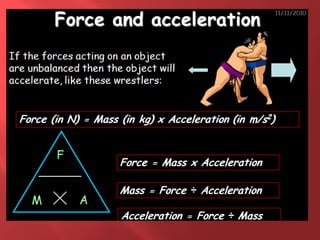
    We have seenthat acceleration goes up as force goes up, and acceleration goes up as mass goes down. Thus: or force acceleration = mass WhereF, force is measured in newtons (N) m, mass, is measured in kilograms (kg) And a, acceleration, is measured in metres per second squared (m s–2)
  • 82.
  • 83.
    Explain the Differencebetween mass and weight
  • 84.
     Mass isthe bulk of an object, the amount of __________ there is  remains ___________ (is unaffected by gravity)  measured in ___________________  _______________are used to compare the mass of two objects
  • 85.
     Gravity isa force which ______________(matter) together  The bigger the masses the greater the __________  The acceleration due to earth’s gravitational pull is _______________
  • 86.
     Weight isthe force of __________ on a mass  also known as __________ force  measured in ________________  varies depending on the _________acting on a mass (greater the gravitational force, greater the weight), which changes on different planets  Measured with a ___________ in _________
  • 87.
    WEIGHT = MASSX GRAVITATIONAL FORCE Weight = mg g = 10 ms-2 on Earth mass = Kg . . . so when we say my weight is 65Kg we actually mean . . . If my mass is 65 Kg and I weigh (65 Kg X 10 ms-2) 650 Newton’s
  • 88.
    An astronaut hasa mass of 80 kg. On Earth her weight is given by: gm Weight On the Moon g = 1.7 N kg–1 and her weight is 136 N. Her mass on the Moon is the same as it is on Earth: ________. gm Weight
  • 89.
     Complete scipadpage 188-189 A car now hangs motionless on the end of a crane’s cable. The force applied by the crane is 13 000 N. Use the value of the crane’s force to determine the mass of the car. Give an appropriate unit for you answer. In your answer, you should include an explanation of the difference between mass and weight. HINT: Gravity on earth is 10 ms-2 )
  • 91.
    Define Friction andunderstand its effect on motion
  • 92.
    On Earth, _____________actsas a __________opposing the motion (it pushes in the opposite direction to your movement). Air resistance or friction only happens when an object is moving. Friction forceGoing up Stopped at the top
  • 93.
    As the speedof a falling object increases, its air resistance ________________. Eventually the friction force (air resistance) is equal to the __________________. When the forces are balanced, the object stops accelerating. Physicists say that the object has reached ___________. A parachute has a large surface area, giving it a high ______________. With the parachute open, the sky-diver slows down until the forces again balance at a much slower ______________
  • 95.
    Gravity is theforce that makes objects _______. Gravity is __________pulling objects down, whether they are moving downwards, stationary, or going up. All falling objects in the same gravitational field will accelerate at the same rate (_________________). Gravity and falling Here an astronaut on the Moon dropped a hammer and a feather. Without air resistance, the hammer and the feather fall with the same acceleration and land ____________________. See the drop online. feather
  • 96.
     Complete Scipadpage 190-191
  • 97.
    Calculate pressure usingP=F/A Rearrange P=F/A to solve an unknown variable
  • 98.
    Where Pressure, Force, Area, Do youweigh less when you stand on one leg? Of course not. Since your weight is now spread over a smaller area, the pressure on the ground under your foot is greater.  force pressure area Why are wooden floors often damaged when people wear stiletto heels? PressureD
  • 99.
    If you walkthrough snow in ordinary shoes, you’ll _________and your shoes will get wet. Snow shoes have a ______________that distributes the weight of the wearer over a larger area, reducing the __________ on each patch of snow. The caterpillar tracks on military tanks also reduce the _______ on the ground by __________ the surface area of contact.
  • 101.
     Complete scipadpages 192-199, 182
  • 104.
    The image showsan example of a crater produced by the golf ball. The students found that the golf ball always produced a deeper crater than the table-tennis ball. Explain why the golf ball produces a deeper crater than the table-tennis ball, even though the balls are the same size and shape, and dropped from the same height
  • 106.
    Describe different formsof energy Identify energy Transformations
  • 107.
     Energy isthe ability to __________  Energy is measured in ____________
  • 108.
  • 109.
    28/05/2015 Type 3 examplesources Heat Kinetic (movement) Nuclear Sound Light Chemical Electrical Gravitational potential Elastic potential Type 3 example sources
  • 110.
  • 111.
    Energy can neitherbe _________ nor it is _________, however energy can be ____________-from one form of energy to any other form of energy
  • 112.
    To describe anenergy change for a light bulb we need to do 3 steps: Electricity Light + heat 1) Write down the starting energy: 3) Write down what energy types are given out: 2) Draw an arrow What are the energy changes for the following…? 1) An electric fire 2) A rock being dropped from a cliff 3) An arrow being fired
  • 113.
    What are theenergy changes for the following…? 1) An electric fire 1) A rock dropping from cliff 1) An arrow being fired?
  • 114.
  • 115.
    Define the termgravitational potential energy Use the formula Ep=mgh to calculate gravitational potential energy
  • 116.
     Gravitational potentialenergy is the energy due to an object’s ______________ above ground.  To get an object off the ground, _________ must have been done to move it  Gravitational Potential Energy Ep Fw = m x g (mass x gravity (10)) h = height (metres)
  • 117.
    What factors determinethe climber’s gravitational potential energy (Ep) in joules? His __________in metres – the higher he climbs, the ________ energy he had to put in, and the greater his Ep. His ____________in kilograms – the heavier he is, the _________ energy is needed to overcome gravity for the climb. The _________ due to gravity (g) in m s–2 – it’d be much _________ to do this climb on the Moon. Thus: ΔEp = m g Δh
  • 118.
    E.g. 1 Calculate thegravitational potential energy of a 400Kg pile driver if it can fall 3 metres. G = 10NKg-1 Ep = m x g x h =
  • 119.
    A weightlifter liftsa 120 Kg barbell 2.4 metres above the ground. What is the weight of the barbell (g = 10NKg-1) Weight Fgravity = mg = How much work is done lifting the barbell? Work = Fd = What is the gravitational potential energy of the barbell at the top of the lift? Ep = m x g x h =
  • 120.
  • 121.
    Define the termkinetic energy Use the formula Ek= 1/2mv2 to calculate kinetic energy
  • 122.
    Kinetic energy (Ek)is the energy of ________objects. The greater an object’s __________, the greater its kinetic energy. If two objects are travelling at the same speed, the one with the greater ___________ has more kinetic energy. Where Ek is the kinetic energy in __, m is mass in kg, v is __________in m s-1. Notice that when mass is ________, Ek doubles, but when ________ is doubled, Ek goes up by a factor of __________ (22). (faster you go the bigger the mess) Kinetic energy
  • 123.
     The energypossessed by a moving object is called ____________  Kinetic Energy Ek Kinetic Energy = ½ mv2  M = mass Kg, v = velocity or speed in m/s  No movement = ________________  Kinetic energy depends on the ___________of the velocity, so if velocity is double, kinetic energy increases four times  So a car going twice as fast has ______________the amount of kinetic energy to lose before it will stop (four times the breaking distance)
  • 124.
    E.g. Calculate the kineticenergy of a 5 Kg cat running at 2m/s Kinetic Energy = ½ mv2 = Task: Complete questions 1-3 purple book page 144
  • 125.
     Complete scipadpage 204-206 Rosemary skis down a slope in a straight line, as shown in the diagram below. At the bottom of the slope, her speed is 8 ms-1. The combined mass of Rosemary and her skis is 80 kg. Calculate the kinetic energy of Rosemary and her skis as she reaches the bottom of the slope when she is moving at 8 ms-1. Give an appropriate unit for your answer.
  • 126.
    The kinetic energygained by Rosemary when she reached the bottom of the slope does not equal the energy she had when she was stationary at the top of the slope. Explain using the principles of physics why her energy at the top of the slope and her energy at the bottom of the slope are not equal. In your answer, you should:  name the type of energy Rosemary has at the top of the slope  calculate the difference between her kinetic energy at the bottom of the slope and her energy at the top of the slope  justify the difference between her kinetic energy at the bottom of the slope and her energy at the top of the slope.
  • 127.
    Define the termwork Use the formula W=Fxd to calculate work, force or distance
  • 128.
     Work isdone when a _______________an object over a distance  If work is done to an object, then ___________is transferred  The gain in energy is _____________ to the work done  Work is in joules (J), Energy is in joules (J)  Work done = _______________  Work done =  No movement = no work!
  • 129.
    E.g. Calculate the workdone when a 12 N force moves an object through 0.2 m W = Fd  Complete questions 1-4 on page 135 purple book
  • 130.
     Complete scipadpage 207-208 A crane lifting a car from the bottom of a cliff. The cable of the crane pulls the car with a force of 14 000 N for 25 seconds but is not able to move it Explain why no work has been done on the car even though the cable pulls with a force of 14 000 N for 25 s.
  • 131.
    Sam accelerates forthe first 2 seconds of a race. During this time, he covers a distance of 9 m. His mass is 60 kg. Calculate Sam’s acceleration during the first 2 seconds, AND then calculate the work done to cover the distance of 9 m
  • 133.
    Define the termpower Use the formula P= W/t to calculate power, work or time
  • 134.
     Power isa measure of ________________at which work is done or energy is supplied or used.  Power P watts E.g. A weight lifter lifts a weight in 3.5 seconds. The work done is 2880J (this can be calculated from Wk = Fd). Calculate the power that his muscles generated. P = W/t =  Complete questions -4 on page 150 purple book
  • 135.
     Complete Scipadpages 209-215 A force of 16 000 N is used to pull a car upwards using a crane. The car is lifted 24 m over a period of 80 s. Calculate the power output of the crane to pull the car up 24 m. Give an appropriate unit for your answer. (HINT: you need to calculate work done first)

Editor's Notes

  • #54 Calculation of acceleration: a = v/t = 12/60 = 0.2 ms-2
  • #55 Calculation of distances: dA = ½ x 60 x 12 = 360 m dB = 60 x 12 = 720 m dC = ½ x 30 x 12 = 180 m Drawing of graph shapes:  
  • #60 Copy notes
  • #62 Copy notes
  • #65 Copy notes
  • #120 Task: Complete questions 1-3 purple book page 141