Air Around Us
By Karunya Rao
• What is Air?
Air is a mixture of 78% nitrogen, 21% oxygen, 0.04% carbon
dioxide and 0.96 water vapour and other gases. Air also contains
dust particles.
Nitrogen Oxygen carbon dioxide Other gases
• Where is Air?
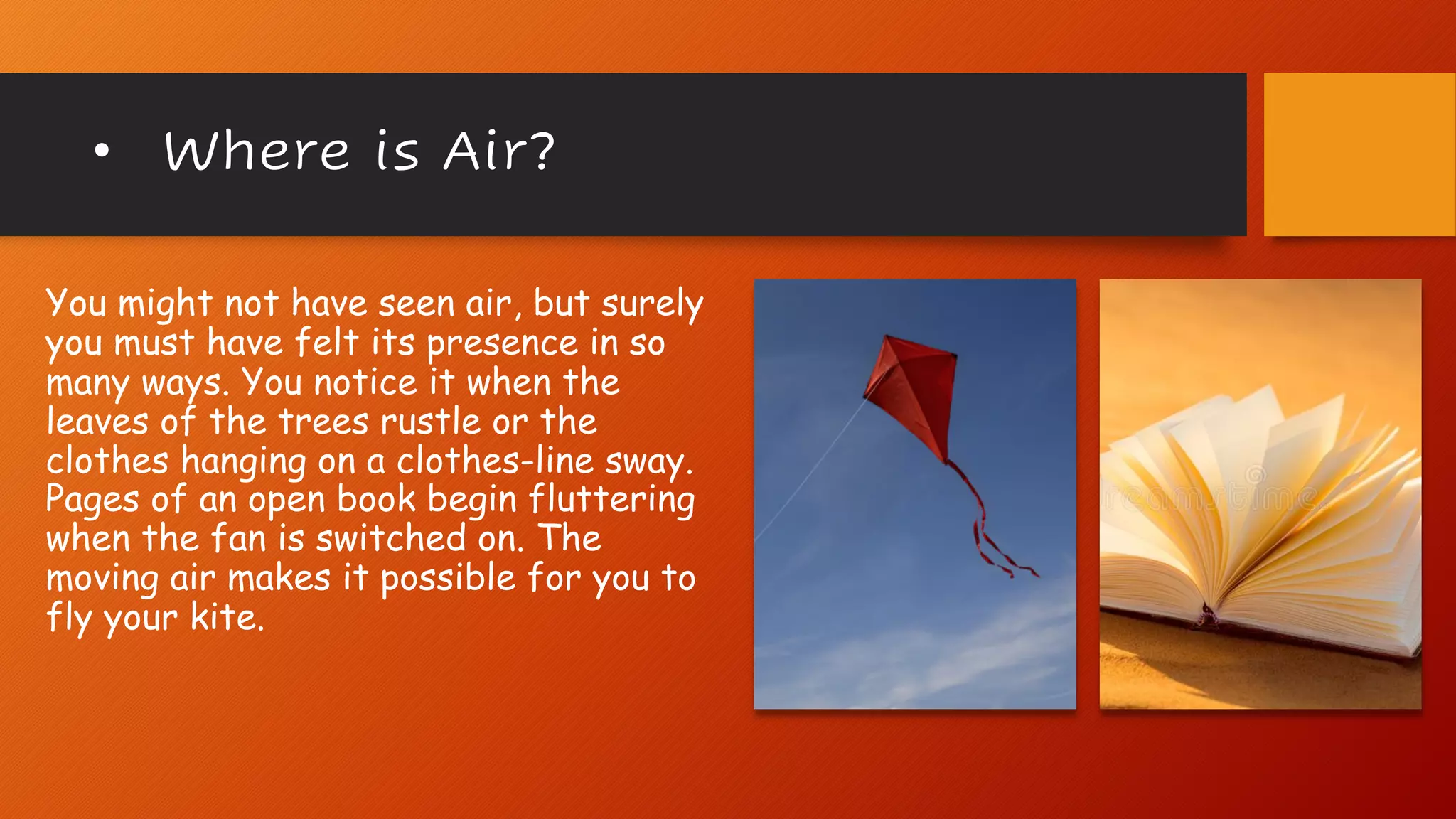
You might not have seen air, but surely
you must have felt its presence in so
many ways. You notice it when the
leaves of the trees rustle or the
clothes hanging on a clothes-line sway.
Pages of an open book begin fluttering
when the fan is switched on. The
moving air makes it possible for you to
fly your kite.
• Is Air Present Everywhere Around us?
Understand this by an activity –
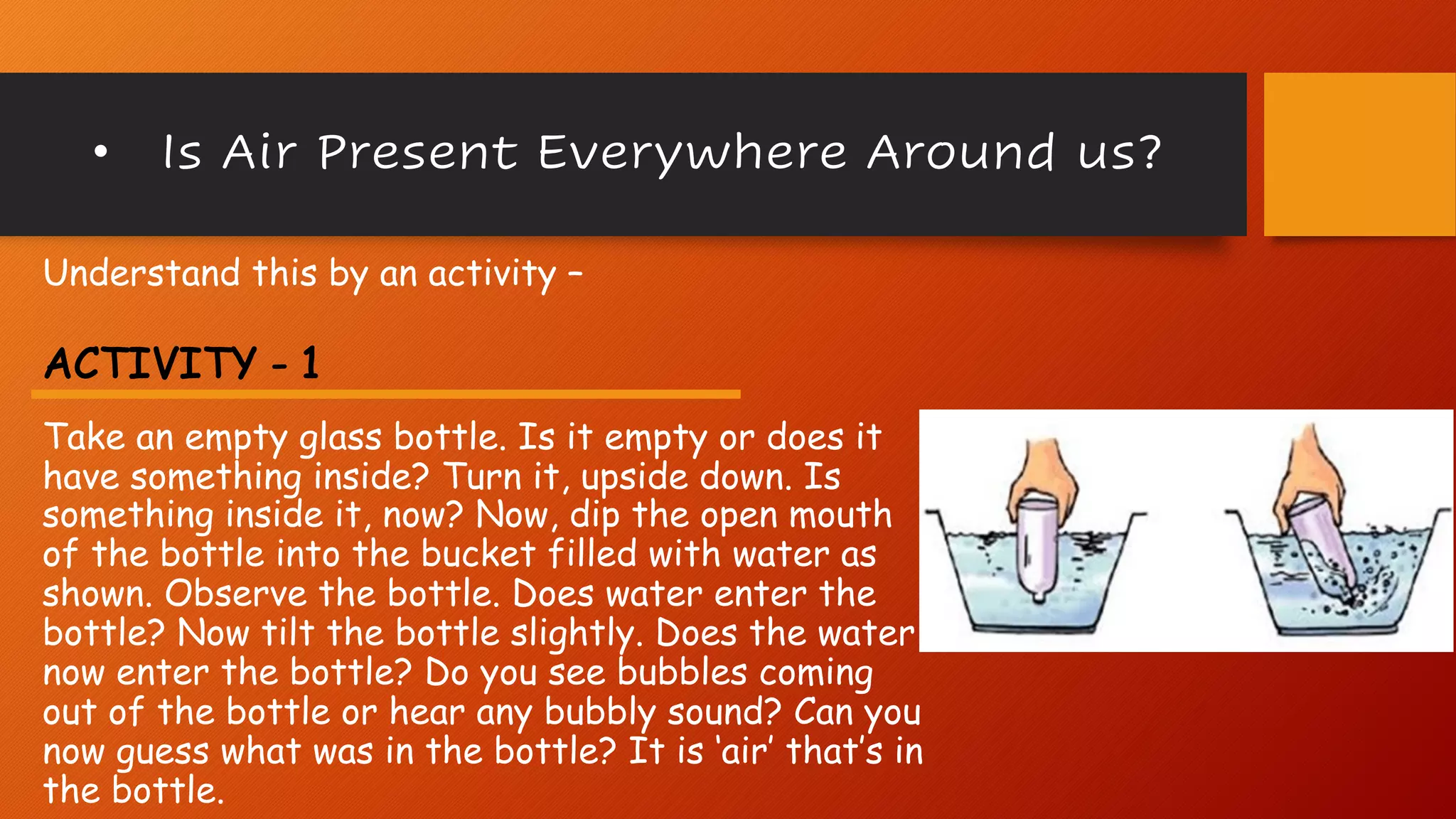
Take an empty glass bottle. Is it empty or does it
have something inside? Turn it, upside down. Is
something inside it, now? Now, dip the open mouth
of the bottle into the bucket filled with water as
shown. Observe the bottle. Does water enter the
bottle? Now tilt the bottle slightly. Does the water
now enter the bottle? Do you see bubbles coming
out of the bottle or hear any bubbly sound? Can you
now guess what was in the bottle? It is ‘air’ that’s in
the bottle.
ACTIVITY - 1
• How dose oxygen become available to plants and
animals that are living under water and soil? (Part – 1)
Understand these by two activities –
Take some water in a glass vessel or beaker. Heat it slowly
on a tripod stand. Well before the water begins to boil,
look carefully at the inner surface of the vessel. Do you
see tiny bubbles on the inside? These bubbles come from
the air dissolved in water. When you heat the water, to
begin with, the air dissolved in it escapes. As you continue
heating, the water itself turns into vapour and finally
begins to boil. As air dissolves in water, plants and animals
in the water get oxygen present in the air
ACTIVITY - 2
Take a lump of dry soil in a beaker or a glass. Add water
to it and note what happens. Do you see bubbles coming
out from soil? These bubbles indicate the presence of air
in the soil. When the water is poured on the lump of soil,
it displaces the air which is seen in the form of bubbles.
The organisms that live inside the soil and the plant roots
respire in this air.
ACTIVITY - 3
A lot of burrows and holes are formed in deep
soil by the animals living in the soil. These
burrows also make spaces available for air to
move in and out of the soil. However, when it
rains heavily, water fills up all the spaces
occupied by the air in the soil.
How
dose
oxygen
become
available
to
plants
and
animals
that
are
living
under
water
and
soil?
(Part
–
2)
• Components of Air
• Nitrogen
• Oxygen
• Carbon Dioxide
• Water Vapor
• Dust and Smake
The components of air are :-
1. Nitrogen (Part – 1)
You need two small candles of the same size, two
shallow containers, some water and an inverted glass.
Fix two small candles of the same size in the middle of
two shallow containers. Now, fill the containers with
some water. Light the candles and then cover each one
of them with an inverted glass (one much taller than
the other) as shown. Observe carefully what happens to
the burning candles and the water level. Do the candles
continue to burn or go off? Does the level of water
inside glasses remain the same?
ACTIVITY - 4
In Activity 4, did you observe that a major part of air is still
present in the glass bottle even after the candle blew out? This
indicates the presence of some component in the air, which does
not support burning. The major part of air (which does not support
burning candle) is nitrogen. It takes up nearly four-fifth of the
space that air fills.
2. Oxygen
In Activity 4, you must have observed that the candle covered
with glass tumbler got extinguished after some time, whereas the
other candle continued burning. What can be the reason for this?
Think about it. It seems that the candle got extinguished because
the component inside of the glass tumbler which supports burning,
is limited. Most of the component is used up by the burning
candles. However, the other candle is getting continued supply of
air. This component of air, which supports burning, is known as
oxygen.
3. Carbon Dioxide
In a closed room, if there is some material that is
burning, you may have felt suffocation. This is due
to excess of carbon dioxide that may be
accumulating in the room, as the burning continues.
Carbon dioxide makes up a small component of the
air around us. Plants and animals consume oxygen
for respiration and produce carbon dioxide. Plant
and animal matter on burning, also consumes oxygen
and produces mainly carbon dioxide and a few
other gasses
4. Water Vapour
When air meets a cool surface, it condenses
and drops of water appear on the cooled
surfaces. The presence of water vapour in air
is important for the water cycle in nature.
5. Dust and Smoke (Part – 1)
Smoke contains a few gases and fine dust particles and is often
harmful. That is why you see long chimneys in factories. This takes
the harmful smoke and gases away from our noses but brings it
closer to the birds flying up in the sky! Dust particles are always
present in air.
Dust
and
Smoke
(Part
–
2)
Find a sunny room in your school/ home. Close all the doors
and windows with curtains pulled down to make the room
dark. Now, open the door or a window facing the sun, just
a little, in such a way that it allows sunlight to enter the
room only through a slit. Look carefully at the incoming
beam of sunlight. Do you see some tiny shining particles
moving in the beam of sunlight ? What are these
particles?
ACTIVITY - 5
They are called dust partials. This shows that air
also contains dust particles. The presence of dust
particles in air varies from time to time, and from
place to place. We inhale air when we breathe
through our nostrils. Fine hair and mucus are
present inside the nose to prevent dust particles
from getting into the respiratory system.
Thank You

NCERT Class - 6 Science Ch - 15 Air Around Us

  • 1.
    Air Around Us ByKarunya Rao
  • 2.
    • What isAir? Air is a mixture of 78% nitrogen, 21% oxygen, 0.04% carbon dioxide and 0.96 water vapour and other gases. Air also contains dust particles. Nitrogen Oxygen carbon dioxide Other gases
  • 3.
    • Where isAir? You might not have seen air, but surely you must have felt its presence in so many ways. You notice it when the leaves of the trees rustle or the clothes hanging on a clothes-line sway. Pages of an open book begin fluttering when the fan is switched on. The moving air makes it possible for you to fly your kite.
  • 4.
    • Is AirPresent Everywhere Around us? Understand this by an activity – Take an empty glass bottle. Is it empty or does it have something inside? Turn it, upside down. Is something inside it, now? Now, dip the open mouth of the bottle into the bucket filled with water as shown. Observe the bottle. Does water enter the bottle? Now tilt the bottle slightly. Does the water now enter the bottle? Do you see bubbles coming out of the bottle or hear any bubbly sound? Can you now guess what was in the bottle? It is ‘air’ that’s in the bottle. ACTIVITY - 1
  • 5.
    • How doseoxygen become available to plants and animals that are living under water and soil? (Part – 1) Understand these by two activities – Take some water in a glass vessel or beaker. Heat it slowly on a tripod stand. Well before the water begins to boil, look carefully at the inner surface of the vessel. Do you see tiny bubbles on the inside? These bubbles come from the air dissolved in water. When you heat the water, to begin with, the air dissolved in it escapes. As you continue heating, the water itself turns into vapour and finally begins to boil. As air dissolves in water, plants and animals in the water get oxygen present in the air ACTIVITY - 2
  • 6.
    Take a lumpof dry soil in a beaker or a glass. Add water to it and note what happens. Do you see bubbles coming out from soil? These bubbles indicate the presence of air in the soil. When the water is poured on the lump of soil, it displaces the air which is seen in the form of bubbles. The organisms that live inside the soil and the plant roots respire in this air. ACTIVITY - 3 A lot of burrows and holes are formed in deep soil by the animals living in the soil. These burrows also make spaces available for air to move in and out of the soil. However, when it rains heavily, water fills up all the spaces occupied by the air in the soil. How dose oxygen become available to plants and animals that are living under water and soil? (Part – 2)
  • 7.
    • Components ofAir • Nitrogen • Oxygen • Carbon Dioxide • Water Vapor • Dust and Smake The components of air are :-
  • 8.
    1. Nitrogen (Part– 1) You need two small candles of the same size, two shallow containers, some water and an inverted glass. Fix two small candles of the same size in the middle of two shallow containers. Now, fill the containers with some water. Light the candles and then cover each one of them with an inverted glass (one much taller than the other) as shown. Observe carefully what happens to the burning candles and the water level. Do the candles continue to burn or go off? Does the level of water inside glasses remain the same? ACTIVITY - 4
  • 9.
    In Activity 4,did you observe that a major part of air is still present in the glass bottle even after the candle blew out? This indicates the presence of some component in the air, which does not support burning. The major part of air (which does not support burning candle) is nitrogen. It takes up nearly four-fifth of the space that air fills.
  • 10.
    2. Oxygen In Activity4, you must have observed that the candle covered with glass tumbler got extinguished after some time, whereas the other candle continued burning. What can be the reason for this? Think about it. It seems that the candle got extinguished because the component inside of the glass tumbler which supports burning, is limited. Most of the component is used up by the burning candles. However, the other candle is getting continued supply of air. This component of air, which supports burning, is known as oxygen.
  • 11.
    3. Carbon Dioxide Ina closed room, if there is some material that is burning, you may have felt suffocation. This is due to excess of carbon dioxide that may be accumulating in the room, as the burning continues. Carbon dioxide makes up a small component of the air around us. Plants and animals consume oxygen for respiration and produce carbon dioxide. Plant and animal matter on burning, also consumes oxygen and produces mainly carbon dioxide and a few other gasses
  • 12.
    4. Water Vapour Whenair meets a cool surface, it condenses and drops of water appear on the cooled surfaces. The presence of water vapour in air is important for the water cycle in nature.
  • 13.
    5. Dust andSmoke (Part – 1) Smoke contains a few gases and fine dust particles and is often harmful. That is why you see long chimneys in factories. This takes the harmful smoke and gases away from our noses but brings it closer to the birds flying up in the sky! Dust particles are always present in air.
  • 14.
    Dust and Smoke (Part – 2) Find a sunnyroom in your school/ home. Close all the doors and windows with curtains pulled down to make the room dark. Now, open the door or a window facing the sun, just a little, in such a way that it allows sunlight to enter the room only through a slit. Look carefully at the incoming beam of sunlight. Do you see some tiny shining particles moving in the beam of sunlight ? What are these particles? ACTIVITY - 5 They are called dust partials. This shows that air also contains dust particles. The presence of dust particles in air varies from time to time, and from place to place. We inhale air when we breathe through our nostrils. Fine hair and mucus are present inside the nose to prevent dust particles from getting into the respiratory system.
  • 15.