FOOD AND DIGESTION Starter 1. What is food? 2. List all the foods eaten over the past day or two.  3.  Try to list as many of the seven food groups as possible and classify the foods in Q1 into the seven food groups Visit our timed  class quiz and interesting activities @  www.sciencetutors.zoomshare.com   For self  assessment and peer assessment check out the activities on our website.
FOOD AND DIGESTION Outcomes At the end of this lesson I should be able to Lower tier:   List the seven food groups. Intermediate tier:  Identify why these food groups are important (ex. raw materials, growth, energy) Higher tier:  Investigate which raw materials are supplied by each food group and suggest what the body uses them for.
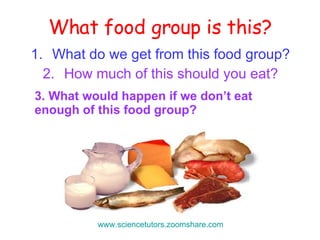
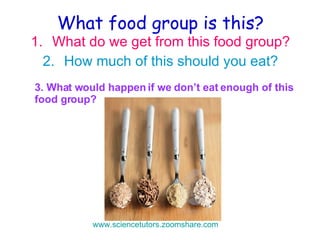
What food group is this? What do we get from this food group? How much of this should you eat? 3. What would happen if we don’t eat enough of this food group? www.sciencetutors.zoomshare.com
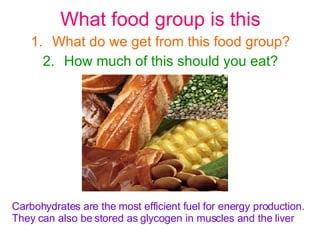
What food group is this What do we get from this food group? How much of this should you eat? Carbohydrates are the most efficient fuel for energy production.  They can also be stored as glycogen in muscles and the liver
What food group is this? What do we get from this food group? How much of this should you eat? 3. What would happen if we don’t eat enough of this food group? www.sciencetutors.zoomshare.com
What’s in Food? Use any two or three of the keywords below to make a complete sentence in your science book. Food, Proteins, Of , Mixture, Oil, Fats, a carbohydrates,  Substances, Contains,   The main ones, water, fibre,   vitamins, minerals, are Visit our timed  class quiz and interesting activities @  www.sciencetutors.zoomshare.com   For self  assessment and peer assessment check out the activities on our website.
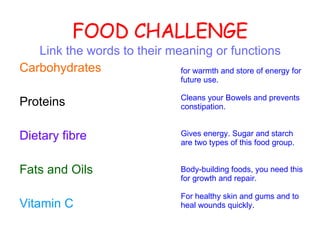
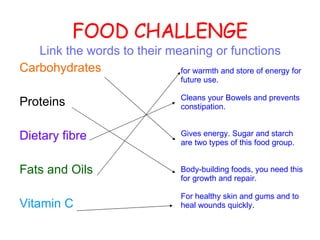
FOOD CHALLENGE Link the words to their meaning or functions Carbohydrates Proteins Dietary fibre   Fats and Oils Vitamin C  for warmth and store of energy for future use. Cleans your Bowels and prevents constipation. Gives energy. Sugar and starch are two types of this food group. Body-building foods, you need this for growth and repair. For healthy skin and gums and to heal wounds quickly.
BALANCED DIET AIMS To know what a balanced diet is To know the RDA for different people. To know the unit for energy in food.   Visit our timed  class quiz and interesting activities @  www.sciencetutors.zoomshare.com   For self  assessment and peer assessment check out the activities on our website.
BALANCED DIET A balanced diet is one which contains the right amounts of the seven food groups  {  fats and oils,  proteins ,  vitamins ,  carbohydrate ,  dietary fibre  etc } Visit our timed  class quiz and interesting activities @  www.sciencetutors.zoomshare.com   For self  assessment and peer assessment check out the activities on our website.
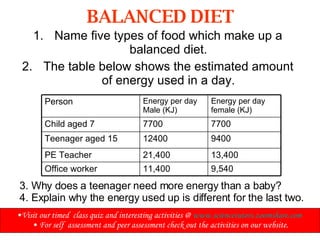
BALANCED DIET Name five types of food which make up a balanced diet. The table below shows the estimated amount of energy used in a day. 3. Why does a teenager need more energy than a baby? 4. Explain why the energy used up is different for the last two.  Visit our timed  class quiz and interesting activities @  www.sciencetutors.zoomshare.com   For self  assessment and peer assessment check out the activities on our website. 9,540 11,400 Office worker 13,400 21,400 PE Teacher 9400 12400 Teenager aged 15 7700 7700 Child aged 7 Energy per day female (KJ) Energy per day Male (KJ) Person
DIET ANALYSER Working in groups of 2 – 3, students are given a copy of the school canteen menu. They are asked to analyse the nutritional content and create set menu’s which provides the healthiest options (using MMS – diet analyser). Visit our timed  class quiz and interesting activities @  www.sciencetutors.zoomshare.com   For self  assessment and peer assessment check out the activities on our website.
DIET ANALYSER Students to create a menu card for the school canteen (could be completed for homework) Visit our timed  class quiz and interesting activities @  www.sciencetutors.zoomshare.com   For self  assessment and peer assessment check out the activities on our website.
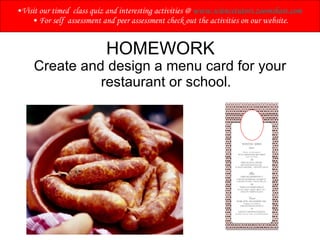
HOMEWORK Create and design a menu card for your restaurant or school. Visit our timed  class quiz and interesting activities @  www.sciencetutors.zoomshare.com   For self  assessment and peer assessment check out the activities on our website.
TEST FOR FOODS Outcomes L   List foods that are rich in protein, carbohydrates, and fats. I  Safely test samples given to see if predictions were correct. H  Create a Venn diagram to summarize which types of nutrients each food sample contained.   Visit our timed  class quiz and interesting activities @  www.sciencetutors.zoomshare.com   For self  assessment and peer assessment check out the activities on our website.
DIGESTIVE SYSTEM Copy and Answer Starter List as many places in the body where digestion occurs as you can.  If possible, put them in the order in which food passes through. Visit our timed  class quiz and interesting activities @  www.sciencetutors.zoomshare.com For self  assessment and peer assessment check out the activities on our website.

FOOD AND DIGESTION

  • 1.
    FOOD AND DIGESTIONStarter 1. What is food? 2. List all the foods eaten over the past day or two. 3. Try to list as many of the seven food groups as possible and classify the foods in Q1 into the seven food groups Visit our timed class quiz and interesting activities @ www.sciencetutors.zoomshare.com For self assessment and peer assessment check out the activities on our website.
  • 2.
    FOOD AND DIGESTIONOutcomes At the end of this lesson I should be able to Lower tier: List the seven food groups. Intermediate tier: Identify why these food groups are important (ex. raw materials, growth, energy) Higher tier: Investigate which raw materials are supplied by each food group and suggest what the body uses them for.
  • 3.
    What food groupis this? What do we get from this food group? How much of this should you eat? 3. What would happen if we don’t eat enough of this food group? www.sciencetutors.zoomshare.com
  • 4.
    What food groupis this What do we get from this food group? How much of this should you eat? Carbohydrates are the most efficient fuel for energy production. They can also be stored as glycogen in muscles and the liver
  • 5.
    What food groupis this? What do we get from this food group? How much of this should you eat? 3. What would happen if we don’t eat enough of this food group? www.sciencetutors.zoomshare.com
  • 6.
    What’s in Food?Use any two or three of the keywords below to make a complete sentence in your science book. Food, Proteins, Of , Mixture, Oil, Fats, a carbohydrates, Substances, Contains, The main ones, water, fibre, vitamins, minerals, are Visit our timed class quiz and interesting activities @ www.sciencetutors.zoomshare.com For self assessment and peer assessment check out the activities on our website.
  • 7.
    FOOD CHALLENGE Linkthe words to their meaning or functions Carbohydrates Proteins Dietary fibre Fats and Oils Vitamin C for warmth and store of energy for future use. Cleans your Bowels and prevents constipation. Gives energy. Sugar and starch are two types of this food group. Body-building foods, you need this for growth and repair. For healthy skin and gums and to heal wounds quickly.
  • 8.
    FOOD CHALLENGE Linkthe words to their meaning or functions Carbohydrates Proteins Dietary fibre Fats and Oils Vitamin C for warmth and store of energy for future use. Cleans your Bowels and prevents constipation. Gives energy. Sugar and starch are two types of this food group. Body-building foods, you need this for growth and repair. For healthy skin and gums and to heal wounds quickly.
  • 9.
    BALANCED DIET AIMSTo know what a balanced diet is To know the RDA for different people. To know the unit for energy in food. Visit our timed class quiz and interesting activities @ www.sciencetutors.zoomshare.com For self assessment and peer assessment check out the activities on our website.
  • 10.
    BALANCED DIET Abalanced diet is one which contains the right amounts of the seven food groups { fats and oils, proteins , vitamins , carbohydrate , dietary fibre etc } Visit our timed class quiz and interesting activities @ www.sciencetutors.zoomshare.com For self assessment and peer assessment check out the activities on our website.
  • 11.
    BALANCED DIET Namefive types of food which make up a balanced diet. The table below shows the estimated amount of energy used in a day. 3. Why does a teenager need more energy than a baby? 4. Explain why the energy used up is different for the last two. Visit our timed class quiz and interesting activities @ www.sciencetutors.zoomshare.com For self assessment and peer assessment check out the activities on our website. 9,540 11,400 Office worker 13,400 21,400 PE Teacher 9400 12400 Teenager aged 15 7700 7700 Child aged 7 Energy per day female (KJ) Energy per day Male (KJ) Person
  • 12.
    DIET ANALYSER Workingin groups of 2 – 3, students are given a copy of the school canteen menu. They are asked to analyse the nutritional content and create set menu’s which provides the healthiest options (using MMS – diet analyser). Visit our timed class quiz and interesting activities @ www.sciencetutors.zoomshare.com For self assessment and peer assessment check out the activities on our website.
  • 13.
    DIET ANALYSER Studentsto create a menu card for the school canteen (could be completed for homework) Visit our timed class quiz and interesting activities @ www.sciencetutors.zoomshare.com For self assessment and peer assessment check out the activities on our website.
  • 14.
    HOMEWORK Create anddesign a menu card for your restaurant or school. Visit our timed class quiz and interesting activities @ www.sciencetutors.zoomshare.com For self assessment and peer assessment check out the activities on our website.
  • 15.
    TEST FOR FOODSOutcomes L List foods that are rich in protein, carbohydrates, and fats. I Safely test samples given to see if predictions were correct. H Create a Venn diagram to summarize which types of nutrients each food sample contained. Visit our timed class quiz and interesting activities @ www.sciencetutors.zoomshare.com For self assessment and peer assessment check out the activities on our website.
  • 16.
    DIGESTIVE SYSTEM Copyand Answer Starter List as many places in the body where digestion occurs as you can. If possible, put them in the order in which food passes through. Visit our timed class quiz and interesting activities @ www.sciencetutors.zoomshare.com For self assessment and peer assessment check out the activities on our website.