ALOE VERA
• Aloe vera is a species of succulent plant that probably
originated in northern Africa. The species does not have
any naturally occurring populations, although closely
related aloes do occur in northern Africa. The species is
frequently cited as being used in herbal medicine since the
beginning of the first century AD. Extracts from Aloe vera
are widely used in the cosmetics and alternative medicine
industries, being marketed as variously having
rejuvenating, healing or soothing properties. There is,
however, little scientific evidence of the effectiveness or
safety of A. vera extracts for either cosmetic or medicinal
purposes, and what positive evidence is available is
frequently contradicted by other studies. Medical uses of
aloe vera are being investigated as well.
DESCRIPTION
• Aloe vera is a stemless or very short-stemmed succulent
plant growing to 60–100 cm (24–39 in) tall, spreading
by offsets. The leaves are thick and fleshy, green to
grey-green, with some varieties showing white flecks on
the upper and lower stem surfaces. The margin of the
leaf is serrated and has small white teeth. The flowers
are produced in summer on a spike up to 90 cm (35 in)
tall, each flower being pendulous, with a yellow tubular
corolla 2–3 cm (0.8–1.2 in) long. Like other Aloe
species, Aloe vera forms arbuscular mycorrhiza, a
symbiosis that allows the plant better access to mineral
nutrients in soil.
• The natural range of Aloe vera is unclear, as the species
has been widely cultivated throughout the world.
Naturalised stands of the species occur in the southern
half of the Arabian peninsula, through North Africa
(Morocco, Mauritania, Egypt) as well as Sudan and
neighbouring countries, along with the Canary, Cape
Verde, and Madeira Islands. This distribution is
somewhat similar to the one of Euphorbia balsamifera,
Pistacia atlantica, and a few others, suggesting that a dry
sclerophyl forest once covered large areas, but has been
dramatically reduced due to desertification in the
Sahara, leaving these few patches isolated. Several
closely related (or sometimes identical) species can be
found on the two extreme sides of the Sahara: Dragon
trees (Dracaena) and Aeonium being two of the most
representative examples.
• The species was introduced to China and
various parts of southern Europe in the
17th century. The species is widely
naturalized elsewhere, occurring in
temperate and tropical regions of
Australia, Barbados, Belize, Nigeria,
Paraguay and the United States. It has
been suggested that the actual species'
distribution is the result of human
cultivation.
• Aloe Vera has been widely grown as an ornamental
plant. The species is popular with modern gardeners as
a putatively medicinal plant and due to its interesting
flowers, form, and succulence. This succulence enables
the species to survive in areas of low natural rainfall,
making it ideal for rockeries and other low-water use
gardens. The species is hardy in zones 8–11, although it
is intolerant of very heavy frost or snow. The species is
relatively resistant to most insect pests, though spider
mites, mealy bugs, scale insects, and aphid species may
cause a decline in plant health. In pots, the species
requires well-drained sandy potting soil and bright
sunny conditions; however, in very hot and humid
tropical or subtropical climates, aloe plants should be
protected from direct sun and rain, as they will burn
and/or turn mushy easily under these conditions.
• The use of a good-quality commercial propagation mix
or pre-packaged "cacti and succulent mix" is
recommended, as they allow good drainage. Terracotta
pots are preferable as they are porous. Potted plants
should be allowed to completely dry prior to re-
watering. When potted aloes become crowded with
"pups" growing from the sides of the "mother plant,"
they should be divided and re-potted to allow room for
further growth and help prevent pest infestations.
During winter, Aloe vera may become dormant, during
which little moisture is required. In areas that receive
frost or snow, the species is best kept indoors or in
heated glasshouses. Large scale agricultural production
of Aloe vera is undertaken in Pakistan, Australia,
Bangladesh, Cuba, the Dominican Republic, China,
Mexico, India, Jamaica, Kenya and South Africa, along
with the USA to supply the cosmetics industry with Aloe
vera gel.
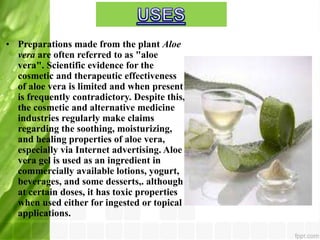
• Preparations made from the plant Aloe
vera are often referred to as "aloe
vera". Scientific evidence for the
cosmetic and therapeutic effectiveness
of aloe vera is limited and when present
is frequently contradictory. Despite this,
the cosmetic and alternative medicine
industries regularly make claims
regarding the soothing, moisturizing,
and healing properties of aloe vera,
especially via Internet advertising. Aloe
vera gel is used as an ingredient in
commercially available lotions, yogurt,
beverages, and some desserts,. although
at certain doses, it has toxic properties
when used either for ingested or topical
applications.
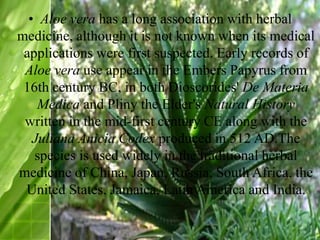
• Aloe vera has a long association with herbal
medicine, although it is not known when its medical
applications were first suspected. Early records of
Aloe vera use appear in the Embers Papyrus from
16th century BC, in both Dioscorides' De Materia
Medica and Pliny the Elder's Natural History
written in the mid-first century CE along with the
Juliana Anicia Codex produced in 512 AD.The
species is used widely in the traditional herbal
medicine of China, Japan, Russia, South Africa, the
United States, Jamaica, Latin America and India.
• Aloin, a compound found in the exudate of some Aloe
Vera species, was the common ingredient in over-the-
counter (OTC) laxative products in the United States
prior to 2003, when the Food and Drug Administration
ruled that aloin was a class III ingredient, thereby
banning its use. Aloe vera has potential toxicity, with
side-effects occurring at some dose levels both when
ingested or applied topically. Although toxicity may be
less when aloin is removed by processing, aloe vera that
contains aloin in excess amounts may induce side-effects.
A 2-year National Toxicology Program (NTP) study on
oral consumption of non-decolorized whole leaf extract
of aloe vera found evidence of carcinogenic activity in
male and female rats. The NTP says more information is
needed to determine the potential risks to humans.
• Aloe vera leaves contain
phytochemicals under study for
possible bioactivity, such as acetylated
mannans, polymannans, anthraquinone
C-glycosides, anthrones and
anthraquinones, and various lectins.
• Aloe vera may be effective in treatment of wounds. Evidence on
the effects of its sap on wound healing, however, is limited and
contradictory. Some studies, for example, show that aloe vera
promotes the rates of healing, while, in contrast, other studies
show that wounds to which aloe vera gel was applied were
significantly slower to heal than those treated with conventional
medical preparations. A 2007 review concluded that the
cumulative evidence supports the use of aloe vera for the healing
of first to second degree burns. Topical application of aloe vera
may also be effective for genital herpes and psoriasis. However, it
is not effective for the prevention of radiation-induced injuries.
Although anecdotally useful, it has not been proven to offer
protection from sunburn or suntan.[
• In a double-blind clinical trial, both the group using an aloe vera
containing dentifrice and the group using a fluoridated dentifrice
had a reduction of gingivitis and plaque, but no statistically
significant difference was found between the two.
• There is preliminary evidence that A. vera extracts may be useful
in the treatment of diabetes and elevated blood lipids in humans.
These positive effects are thought to be due to the presence of
compounds such as mannans, anthraquinones and lectins.Internal
intake of aloe vera has been linked in preliminary research with
improved blood glucose levels in diabetics, although it has been
suggested by the NTP that aloe may lower blood glucose levels. It
has also been linked with lower blood lipids in hyperlipidaemic
patients, but also with acute hepatitis (liver disease). In other
diseases, preliminary studies have suggested oral aloe vera gel may
reduce symptoms and inflammation in patients with ulcerative
colitis. Abdominal cramps and diarrhea have been reported with
oral use of aloe vera. Diarrhea, caused by the laxative effect of oral
aloe vera, can decrease the absorption of many drugs. Compounds
extracted from aloe vera have been used as an immunostimulant
that aids in fighting cancers in cats and dogs; however, this
treatment has not been scientifically tested in humans.
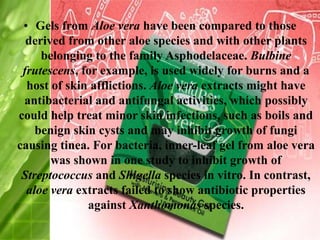
• Gels from Aloe vera have been compared to those
derived from other aloe species and with other plants
belonging to the family Asphodelaceae. Bulbine
frutescens, for example, is used widely for burns and a
host of skin afflictions. Aloe vera extracts might have
antibacterial and antifungal activities, which possibly
could help treat minor skin infections, such as boils and
benign skin cysts and may inhibit growth of fungi
causing tinea. For bacteria, inner-leaf gel from aloe vera
was shown in one study to inhibit growth of
Streptococcus and Shigella species in vitro. In contrast,
aloe vera extracts failed to show antibiotic properties
against Xanthomonas species.
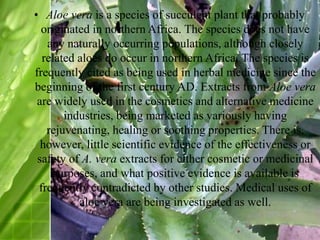
• Aloe vera is a species of succulent plant that probably
originated in northern Africa. The species does not have
any naturally occurring populations, although closely
related aloes do occur in northern Africa. The species is
frequently cited as being used in herbal medicine since the
beginning of the first century AD. Extracts from Aloe vera
are widely used in the cosmetics and alternative medicine
industries, being marketed as variously having
rejuvenating, healing or soothing properties. There is,
however, little scientific evidence of the effectiveness or
safety of A. vera extracts for either cosmetic or medicinal
purposes, and what positive evidence is available is
frequently contradicted by other studies. Medical uses of
aloe vera are being investigated as well.
Alovera

Alovera

  • 1.
  • 2.
    • Aloe verais a species of succulent plant that probably originated in northern Africa. The species does not have any naturally occurring populations, although closely related aloes do occur in northern Africa. The species is frequently cited as being used in herbal medicine since the beginning of the first century AD. Extracts from Aloe vera are widely used in the cosmetics and alternative medicine industries, being marketed as variously having rejuvenating, healing or soothing properties. There is, however, little scientific evidence of the effectiveness or safety of A. vera extracts for either cosmetic or medicinal purposes, and what positive evidence is available is frequently contradicted by other studies. Medical uses of aloe vera are being investigated as well.
  • 3.
    DESCRIPTION • Aloe verais a stemless or very short-stemmed succulent plant growing to 60–100 cm (24–39 in) tall, spreading by offsets. The leaves are thick and fleshy, green to grey-green, with some varieties showing white flecks on the upper and lower stem surfaces. The margin of the leaf is serrated and has small white teeth. The flowers are produced in summer on a spike up to 90 cm (35 in) tall, each flower being pendulous, with a yellow tubular corolla 2–3 cm (0.8–1.2 in) long. Like other Aloe species, Aloe vera forms arbuscular mycorrhiza, a symbiosis that allows the plant better access to mineral nutrients in soil.
  • 5.
    • The naturalrange of Aloe vera is unclear, as the species has been widely cultivated throughout the world. Naturalised stands of the species occur in the southern half of the Arabian peninsula, through North Africa (Morocco, Mauritania, Egypt) as well as Sudan and neighbouring countries, along with the Canary, Cape Verde, and Madeira Islands. This distribution is somewhat similar to the one of Euphorbia balsamifera, Pistacia atlantica, and a few others, suggesting that a dry sclerophyl forest once covered large areas, but has been dramatically reduced due to desertification in the Sahara, leaving these few patches isolated. Several closely related (or sometimes identical) species can be found on the two extreme sides of the Sahara: Dragon trees (Dracaena) and Aeonium being two of the most representative examples.
  • 6.
    • The specieswas introduced to China and various parts of southern Europe in the 17th century. The species is widely naturalized elsewhere, occurring in temperate and tropical regions of Australia, Barbados, Belize, Nigeria, Paraguay and the United States. It has been suggested that the actual species' distribution is the result of human cultivation.
  • 8.
    • Aloe Verahas been widely grown as an ornamental plant. The species is popular with modern gardeners as a putatively medicinal plant and due to its interesting flowers, form, and succulence. This succulence enables the species to survive in areas of low natural rainfall, making it ideal for rockeries and other low-water use gardens. The species is hardy in zones 8–11, although it is intolerant of very heavy frost or snow. The species is relatively resistant to most insect pests, though spider mites, mealy bugs, scale insects, and aphid species may cause a decline in plant health. In pots, the species requires well-drained sandy potting soil and bright sunny conditions; however, in very hot and humid tropical or subtropical climates, aloe plants should be protected from direct sun and rain, as they will burn and/or turn mushy easily under these conditions.
  • 9.
    • The useof a good-quality commercial propagation mix or pre-packaged "cacti and succulent mix" is recommended, as they allow good drainage. Terracotta pots are preferable as they are porous. Potted plants should be allowed to completely dry prior to re- watering. When potted aloes become crowded with "pups" growing from the sides of the "mother plant," they should be divided and re-potted to allow room for further growth and help prevent pest infestations. During winter, Aloe vera may become dormant, during which little moisture is required. In areas that receive frost or snow, the species is best kept indoors or in heated glasshouses. Large scale agricultural production of Aloe vera is undertaken in Pakistan, Australia, Bangladesh, Cuba, the Dominican Republic, China, Mexico, India, Jamaica, Kenya and South Africa, along with the USA to supply the cosmetics industry with Aloe vera gel.
  • 10.
    • Preparations madefrom the plant Aloe vera are often referred to as "aloe vera". Scientific evidence for the cosmetic and therapeutic effectiveness of aloe vera is limited and when present is frequently contradictory. Despite this, the cosmetic and alternative medicine industries regularly make claims regarding the soothing, moisturizing, and healing properties of aloe vera, especially via Internet advertising. Aloe vera gel is used as an ingredient in commercially available lotions, yogurt, beverages, and some desserts,. although at certain doses, it has toxic properties when used either for ingested or topical applications.
  • 12.
    • Aloe verahas a long association with herbal medicine, although it is not known when its medical applications were first suspected. Early records of Aloe vera use appear in the Embers Papyrus from 16th century BC, in both Dioscorides' De Materia Medica and Pliny the Elder's Natural History written in the mid-first century CE along with the Juliana Anicia Codex produced in 512 AD.The species is used widely in the traditional herbal medicine of China, Japan, Russia, South Africa, the United States, Jamaica, Latin America and India.
  • 13.
    • Aloin, acompound found in the exudate of some Aloe Vera species, was the common ingredient in over-the- counter (OTC) laxative products in the United States prior to 2003, when the Food and Drug Administration ruled that aloin was a class III ingredient, thereby banning its use. Aloe vera has potential toxicity, with side-effects occurring at some dose levels both when ingested or applied topically. Although toxicity may be less when aloin is removed by processing, aloe vera that contains aloin in excess amounts may induce side-effects. A 2-year National Toxicology Program (NTP) study on oral consumption of non-decolorized whole leaf extract of aloe vera found evidence of carcinogenic activity in male and female rats. The NTP says more information is needed to determine the potential risks to humans.
  • 14.
    • Aloe veraleaves contain phytochemicals under study for possible bioactivity, such as acetylated mannans, polymannans, anthraquinone C-glycosides, anthrones and anthraquinones, and various lectins.
  • 15.
    • Aloe veramay be effective in treatment of wounds. Evidence on the effects of its sap on wound healing, however, is limited and contradictory. Some studies, for example, show that aloe vera promotes the rates of healing, while, in contrast, other studies show that wounds to which aloe vera gel was applied were significantly slower to heal than those treated with conventional medical preparations. A 2007 review concluded that the cumulative evidence supports the use of aloe vera for the healing of first to second degree burns. Topical application of aloe vera may also be effective for genital herpes and psoriasis. However, it is not effective for the prevention of radiation-induced injuries. Although anecdotally useful, it has not been proven to offer protection from sunburn or suntan.[ • In a double-blind clinical trial, both the group using an aloe vera containing dentifrice and the group using a fluoridated dentifrice had a reduction of gingivitis and plaque, but no statistically significant difference was found between the two.
  • 16.
    • There ispreliminary evidence that A. vera extracts may be useful in the treatment of diabetes and elevated blood lipids in humans. These positive effects are thought to be due to the presence of compounds such as mannans, anthraquinones and lectins.Internal intake of aloe vera has been linked in preliminary research with improved blood glucose levels in diabetics, although it has been suggested by the NTP that aloe may lower blood glucose levels. It has also been linked with lower blood lipids in hyperlipidaemic patients, but also with acute hepatitis (liver disease). In other diseases, preliminary studies have suggested oral aloe vera gel may reduce symptoms and inflammation in patients with ulcerative colitis. Abdominal cramps and diarrhea have been reported with oral use of aloe vera. Diarrhea, caused by the laxative effect of oral aloe vera, can decrease the absorption of many drugs. Compounds extracted from aloe vera have been used as an immunostimulant that aids in fighting cancers in cats and dogs; however, this treatment has not been scientifically tested in humans.
  • 17.
    • Gels fromAloe vera have been compared to those derived from other aloe species and with other plants belonging to the family Asphodelaceae. Bulbine frutescens, for example, is used widely for burns and a host of skin afflictions. Aloe vera extracts might have antibacterial and antifungal activities, which possibly could help treat minor skin infections, such as boils and benign skin cysts and may inhibit growth of fungi causing tinea. For bacteria, inner-leaf gel from aloe vera was shown in one study to inhibit growth of Streptococcus and Shigella species in vitro. In contrast, aloe vera extracts failed to show antibiotic properties against Xanthomonas species.
  • 18.
    • Aloe verais a species of succulent plant that probably originated in northern Africa. The species does not have any naturally occurring populations, although closely related aloes do occur in northern Africa. The species is frequently cited as being used in herbal medicine since the beginning of the first century AD. Extracts from Aloe vera are widely used in the cosmetics and alternative medicine industries, being marketed as variously having rejuvenating, healing or soothing properties. There is, however, little scientific evidence of the effectiveness or safety of A. vera extracts for either cosmetic or medicinal purposes, and what positive evidence is available is frequently contradicted by other studies. Medical uses of aloe vera are being investigated as well.