FOETAL DEVELOPMENT
LINTU THOMAS
LECTURER,
GANGA INSTITUTE OF
HEALTH SCIENCES
COIMBATORE
INTRODUCTION
THE FOETAL PERIOD
 Beginning of the third month up to the termination of
pregnancy.
6 week
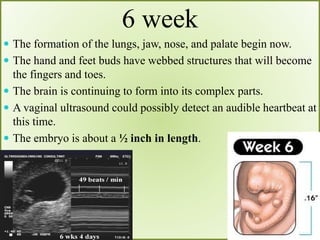
 The formation of the lungs, jaw, nose, and palate begin now.
 The hand and feet buds have webbed structures that will become
the fingers and toes.
 The brain is continuing to form into its complex parts.
 A vaginal ultrasound could possibly detect an audible heartbeat at
this time.
 The embryo is about a ½ inch in length.
8WEEKS
 13 mm in length (1/2inch).
 Lungs begin to form.
 Brain continue to develop.
 Arms & legs are lengthen, foot and hand
areas are distinguishable.
 Lymphatic system begins to develop.
 Development of external genitalia
started.
9WEEK
 The embryo measures 18 mm (3/4 inch) in length.
 Fetal heart tone (the sound of the heart beat) can be heard using
Doppler.
 Nipples and hair follicles begin to form.
 Location of the elbows and toes are visible.
 Spontaneous limb movements may be detected by ultrasound.
 The vitelline duct normally closes
10 -12 WEEK
 Embryo measures 30–80 mm (1.2–3.2 inches) in length.
 Ventral and dorsal pancreatic buds fuse during the 8th week
 Intestines rotate.
 Facial features continue to develop.
 The eyelids are more developed.
 The external features of the ear begin to take their final shape.
 The head comprises nearly half of the fetus' size.
 The face is well formed
10-12 WEEK
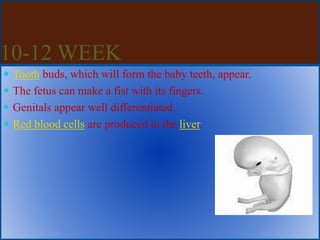
 Tooth buds, which will form the baby teeth, appear.
 The fetus can make a fist with its fingers.
 Genitals appear well differentiated.
 Red blood cells are produced in the liver.
9-12 WEEK
.
 End of 12th week crown rump length almost doubles.
 During 9th week ,the face is broad, eyes get widely separated,
ears are low set and eye lids get fused.
 By 11th week intestine return to abdomen.
13 -16 WEEK
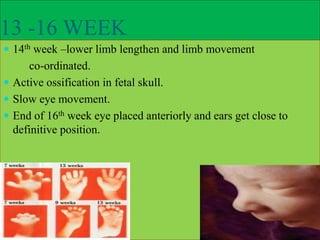
 14th week –lower limb lengthen and limb movement
co-ordinated.
 Active ossification in fetal skull.
 Slow eye movement.
 End of 16th week eye placed anteriorly and ears get close to
definitive position.
13-16 WEEK
 The fetus reaches a length of about 15 cm (6 inches).
 A fine hair called lanugo develops on the head.
 The fetus makes active movements.
 Sucking motions are made with the mouth.
 Meconium is made in the intestinal tract.
 The liver and pancreas produce fluid secretions.
 From week 13, sex prediction by obstetric ultrasonography
is almost 100% accurate.
17 -20 WEEK
 Limbs reached their final relative proportion & mother feels
quickening.
 By 20th week eye brows & hair
Appears & also lanugo developed.
 By 18th week uterus is formed & canalization of vagina has
begun.
 By 20th week testis begin to descend
& reach posterior abdominal wall.
 Nails appeared in the finger toe.
 Heart beat can be heard using stethoscope.
23RD WEEK
 The fetus reaches a length of 28 cm (11.2 inches).
 The fetus weighs about 925g.
 Eyebrows and eyelashes are well formed.
 All the of eye components are developed.
 The fetus has a hand and startle reflex.
 Footprints and fingerprints continue forming.
 Alveoli (air sacs) are forming in lungs.
UPTO 25 WEEK
 Weight gaining continuous.
 21th week rapid eye movement begin.
 By 24th week type 2 pneumocytes begin to secret surfactant
that maintains patency of developing alveoli of lungs.
27 WEEK
 The fetus reaches a length of 38 cm (15 inches).
 The fetus weighs about 1.2 kg (2 lb 11 oz).
 The brain develops rapidly.
 The nervous system develops enough to control some body
functions.
 The eyelids open and close.
 The respiratory system, while immature, has developed to
the point where gas exchange is possible.
26-29 WEEK
 Lungs &pulmonary vasculature develops.
 Central nervous system matures &control temperature.
 Eye lid opens in 26th week.
 Toe nails visible.
 The cochleae are now developed,
Though the myelin sheaths in neural
Portion of the auditory system will
Continue to develop until 18 months after birth.
31 WEEK
 The fetus reaches a length of about 38–43 cm (15–17 inches).
 The fetus weighs about 1.5 kg (3 lb 0 oz).
 The amount of body fat rapidly increases.
 Rhythmic breathing movements occur, but lungs are not fully
mature.
 Thalamic brain connections, which mediate sensory input, form.
 Bones are fully developed, but are still soft and pliable.
 The fetus begins storing a lot of iron, calcium and phosphorus.
30-34 WEEK
 At 30th week pupillary light reflex can be elicited.
 Skin pink & smooth.
 Limb appears chubby
35 week
 The fetus reaches a length of about 40–48 cm (16–19 inches).
 The fetus weighs about 2.5 to 3 kg .
 Lanugo begins to disappear.
 Body fat increases.
 Fingernails reach the end of the fingertips.
 A baby born at 36 weeks has a high chance of survival, but may
require medical interventions.
35-38 WEEK
 Spontaneous orientation to light.
 By 36 week head &abdominal circumference are equal.
 Chest is prominent & breast protrude in both sexes.
 Testes are usually in the scrotum in full term male baby.
RESEARCH
Foetal development   gihs

Foetal development gihs

  • 1.
    FOETAL DEVELOPMENT LINTU THOMAS LECTURER, GANGAINSTITUTE OF HEALTH SCIENCES COIMBATORE
  • 4.
  • 7.
    THE FOETAL PERIOD Beginning of the third month up to the termination of pregnancy.
  • 9.
    6 week  Theformation of the lungs, jaw, nose, and palate begin now.  The hand and feet buds have webbed structures that will become the fingers and toes.  The brain is continuing to form into its complex parts.  A vaginal ultrasound could possibly detect an audible heartbeat at this time.  The embryo is about a ½ inch in length.
  • 10.
    8WEEKS  13 mmin length (1/2inch).  Lungs begin to form.  Brain continue to develop.  Arms & legs are lengthen, foot and hand areas are distinguishable.  Lymphatic system begins to develop.  Development of external genitalia started.
  • 11.
    9WEEK  The embryomeasures 18 mm (3/4 inch) in length.  Fetal heart tone (the sound of the heart beat) can be heard using Doppler.  Nipples and hair follicles begin to form.  Location of the elbows and toes are visible.  Spontaneous limb movements may be detected by ultrasound.  The vitelline duct normally closes
  • 12.
    10 -12 WEEK Embryo measures 30–80 mm (1.2–3.2 inches) in length.  Ventral and dorsal pancreatic buds fuse during the 8th week  Intestines rotate.  Facial features continue to develop.  The eyelids are more developed.  The external features of the ear begin to take their final shape.  The head comprises nearly half of the fetus' size.  The face is well formed
  • 13.
    10-12 WEEK  Toothbuds, which will form the baby teeth, appear.  The fetus can make a fist with its fingers.  Genitals appear well differentiated.  Red blood cells are produced in the liver.
  • 14.
    9-12 WEEK .  Endof 12th week crown rump length almost doubles.  During 9th week ,the face is broad, eyes get widely separated, ears are low set and eye lids get fused.  By 11th week intestine return to abdomen.
  • 15.
    13 -16 WEEK 14th week –lower limb lengthen and limb movement co-ordinated.  Active ossification in fetal skull.  Slow eye movement.  End of 16th week eye placed anteriorly and ears get close to definitive position.
  • 17.
    13-16 WEEK  Thefetus reaches a length of about 15 cm (6 inches).  A fine hair called lanugo develops on the head.  The fetus makes active movements.  Sucking motions are made with the mouth.  Meconium is made in the intestinal tract.  The liver and pancreas produce fluid secretions.  From week 13, sex prediction by obstetric ultrasonography is almost 100% accurate.
  • 18.
    17 -20 WEEK Limbs reached their final relative proportion & mother feels quickening.  By 20th week eye brows & hair Appears & also lanugo developed.  By 18th week uterus is formed & canalization of vagina has begun.  By 20th week testis begin to descend & reach posterior abdominal wall.  Nails appeared in the finger toe.  Heart beat can be heard using stethoscope.
  • 19.
    23RD WEEK  Thefetus reaches a length of 28 cm (11.2 inches).  The fetus weighs about 925g.  Eyebrows and eyelashes are well formed.  All the of eye components are developed.  The fetus has a hand and startle reflex.  Footprints and fingerprints continue forming.  Alveoli (air sacs) are forming in lungs.
  • 20.
    UPTO 25 WEEK Weight gaining continuous.  21th week rapid eye movement begin.  By 24th week type 2 pneumocytes begin to secret surfactant that maintains patency of developing alveoli of lungs.
  • 21.
    27 WEEK  Thefetus reaches a length of 38 cm (15 inches).  The fetus weighs about 1.2 kg (2 lb 11 oz).  The brain develops rapidly.  The nervous system develops enough to control some body functions.  The eyelids open and close.  The respiratory system, while immature, has developed to the point where gas exchange is possible.
  • 22.
    26-29 WEEK  Lungs&pulmonary vasculature develops.  Central nervous system matures &control temperature.  Eye lid opens in 26th week.  Toe nails visible.  The cochleae are now developed, Though the myelin sheaths in neural Portion of the auditory system will Continue to develop until 18 months after birth.
  • 23.
    31 WEEK  Thefetus reaches a length of about 38–43 cm (15–17 inches).  The fetus weighs about 1.5 kg (3 lb 0 oz).  The amount of body fat rapidly increases.  Rhythmic breathing movements occur, but lungs are not fully mature.  Thalamic brain connections, which mediate sensory input, form.  Bones are fully developed, but are still soft and pliable.  The fetus begins storing a lot of iron, calcium and phosphorus.
  • 24.
    30-34 WEEK  At30th week pupillary light reflex can be elicited.  Skin pink & smooth.  Limb appears chubby
  • 25.
    35 week  Thefetus reaches a length of about 40–48 cm (16–19 inches).  The fetus weighs about 2.5 to 3 kg .  Lanugo begins to disappear.  Body fat increases.  Fingernails reach the end of the fingertips.  A baby born at 36 weeks has a high chance of survival, but may require medical interventions.
  • 26.
    35-38 WEEK  Spontaneousorientation to light.  By 36 week head &abdominal circumference are equal.  Chest is prominent & breast protrude in both sexes.  Testes are usually in the scrotum in full term male baby.
  • 27.