Prenatal or antenataldevelopment is the process
in which embryo or fetus gestates during
pregnancy from fertilization until birth.
It is also known as fetal development or
embryology.
Development biology is the study of the sequences
of events from the fertilization of a secondary
oocyte by a sperm cell to the formation of an
adult organism.
4.
Age of thefetus –
Gestational age is the duration of pregnancy
calculated from the first day of last menstrual
period (LMP).
It is greater than the post conception (fertilization)
age by 2 weeks.
5.
Pre embryonic period
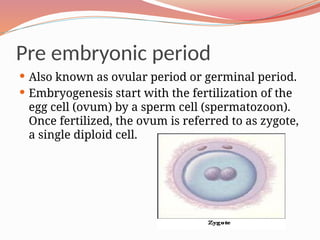
Also known as ovular period or germinal period.
Embryogenesis start with the fertilization of the
egg cell (ovum) by a sperm cell (spermatozoon).
Once fertilized, the ovum is referred to as zygote,
a single diploid cell.
6.
Fertilization
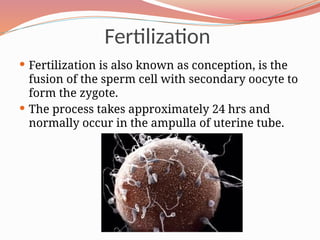
Fertilization isalso known as conception, is the
fusion of the sperm cell with secondary oocyte to
form the zygote.
The process takes approximately 24 hrs and
normally occur in the ampulla of uterine tube.
8.
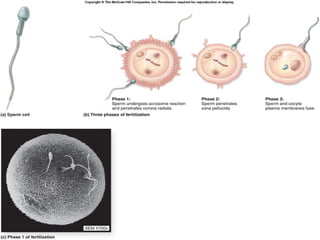
The acrosomallayer of the sperm secrete the
enzyme hyaluronidase which disperse the
corona radiata (outermost layer of oocyte)
allowing assess to zona pellucida.
The sperm reaches to the zona pellucida and
penetrates it. Upon penetration a chemical
reaction known as the cortical reaction, which
alters the zona pellucida making it impermiable
to other sperm.
The plasma membranes of the sperm and oocyte
fuse, each pronucleus containing 23
chromosomes refered as haploid, and become
diploid having 46 numbers of chromosomes. This
new cell is called zygote.
9.
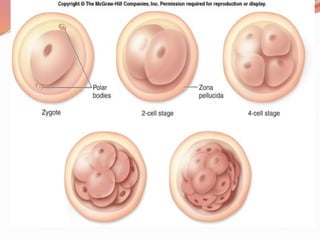
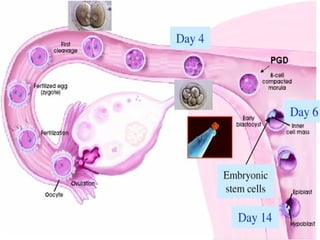
During thefirst week the zygote travels along the
uterine tube towards the uterus, the zona
pellucida surrounds the zygote. It nourished by
glycogen secreted by globlet cell of uterine tube
and later the secretory cells of uterus.
The zygote undergoes mitotic cellular replication
refered as cleavage, resulting into the formation
of smaller cells known as blastomeres.
11.
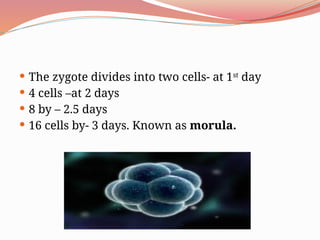
The zygotedivides into two cells- at 1st
day
4 cells –at 2 days
8 by – 2.5 days
16 cells by- 3 days. Known as morula.
12.
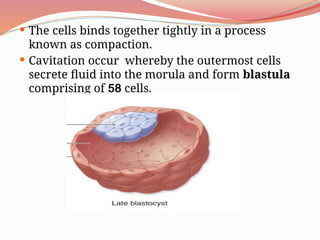
The cellsbinds together tightly in a process
known as compaction.
Cavitation occur whereby the outermost cells
secrete fluid into the morula and form blastula
comprising of 58 cells.
14.
Nidation
Implantation occurs inthe endometrium of the
anterior or posterior wall of the body near the
fundus on 6th
day.
The blastocyst possesses an inner cell mass or
embryoblast and outer cell mass or trophoblast.
Trophoblast- becomes the placenta and chorion.
Embryoblast- become embryo, amnion and
umbilical cord.
Embryoblast
Develops the embryo,and differentiate into two
types of cells-
Epiblast- epiblast have three layers, which
forms the particular parts of the embryo. The
first appearance of these layers, collectively
known as the primitive streak is around 15
days.
Hypoblast- the hypoblast cell migrate along
with inner cytotrophoblastic lining secreting
extracellular tissue which becomes the yolk
sac.
17.
Changes or developmentby weeks of
gestation
1. Pre embryonic period-
Week 1-2 – no developments occurs since
fertilization hasn’t actually occurred.
Week 3- from 15-21 days, embryonic 5-7 days.
Fertilization occur and form zygote.
The embryo hatches from its protein shell and
perform implantation (5-6 days).
18.
Week 4th
–days 22-28 from LMP
embryonic age 2 weeks-
Events-
Trophoblast cells surrounding the embryonic
cells proliferate and invade deeper into uterine
lining.
Eventually form placenta and embryonic
membrane.
Formation of yolk sac.
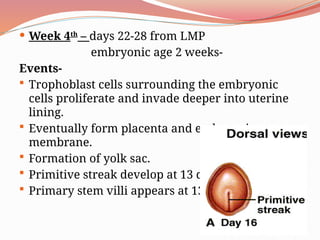
Primitive streak develop at 13 days.
Primary stem villi appears at 13 days
19.
Week 5
Gestationalage: 4 weeks
Embryonic age: Week no. 3
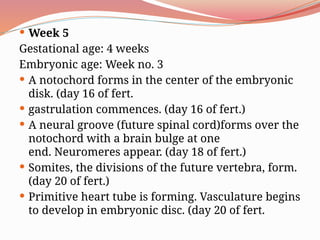
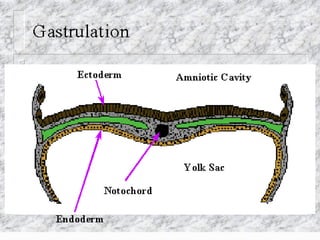
A notochord forms in the center of the embryonic
disk. (day 16 of fert.
gastrulation commences. (day 16 of fert.)
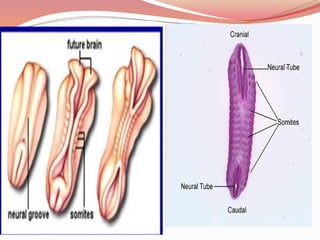
A neural groove (future spinal cord)forms over the
notochord with a brain bulge at one
end. Neuromeres appear. (day 18 of fert.)
Somites, the divisions of the future vertebra, form.
(day 20 of fert.)
Primitive heart tube is forming. Vasculature begins
to develop in embryonic disc. (day 20 of fert.
22.
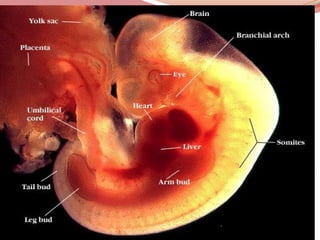
Week 6- gestationalage-5 week
embryonic age 4 weeks
Events –
Embryo measures 4 mm
The heart bulge, n begins to beat in a regular rhythem.
The neural tube closes.
Arm buds and tail are visible.
Pulmonary primordium appear
Hepatic plate appear
Buccopharyngeal membrane ruptures. This form the
future mouth.
Anterior and posterior horns differentiate in the
spinal cord.
24.
Week 7-
embryonic age5 week
Events-
Length is 9 mm
Lens pits and optic cups develops
Nasal pits form
Brain divides into 5 vessicles including the early
telencephalon.
Leg buds form.
The metanephros, precursor of kidney start to
develop.
Stomach differentiation begins.
26.
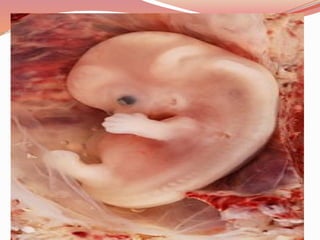
Week 8-
Theembryo measures 13 mm (1/2 inch) in
length.
Lungs begin to form.
The brain continues to develop.
Arms and legs have lengthened
with foot and hand areas distinguishable.
The hands and feet have digits, but may still be
webbed.
The gonadal ridge begins to be perceptible.
The lymphatic system begins to develop.
Main development of external genitalia starts.
27.
Week 9-
Theembryo measures 18 mm (3/4 inch) in
length.
Fetal heart tone (the sound of the heart beat) can
be heard using doppler
Nipples and hair follicles begin to form.
Location of the elbows and toes are visible.
Spontaneous limb movements may be detected
by ultrasound.
All essential organs have at least begun.
The vitelline duct normally closes
28.
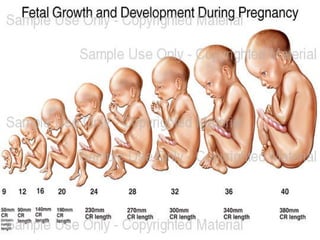
Fetal development
Fromthe 10 weeks of gestation (8th
week of
embryogenic) the developing organism is called
fetus.
All the major structures are already formed in
the fetus but they continue to grow.
29.
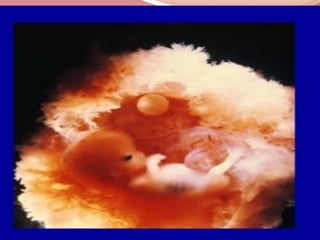
Week 10 -12
Embryo measures 30–80 mm (1.2–3.2 inches) in length.
Intestines rotate.
Facial features continue to develop.
The eyelids are more developed.
The external features of the ear begin to take their final
shape.
The head comprises nearly half of the fetus' size.
The face is well formed
The eyelids close and will not reopen until about the 28th
week.
Tooth buds appear.
The fetus can make a fist with its fingers.
Genitals appear well differentiated.
Red blood cells are produced in the liver
31.
Week 13-16-
Thefetus reaches a length of about 15 cm (6 inches).
A fine hair called lanugo develops on the head.
Fetal skin is almost transparent.
More muscle tissue and bones have developed, and
the bones become harder.
Sucking motions are made with the mouth.
Meconium is made in the intestinal tract.
The liver and pancreas produce fluid secretions.
From week 13, sex prediction
At week 15, main development of external genitalia is
finished
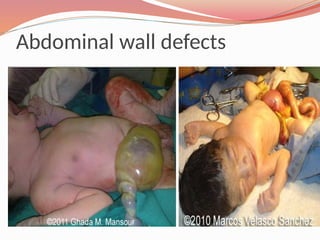
Abdominal wall closes.
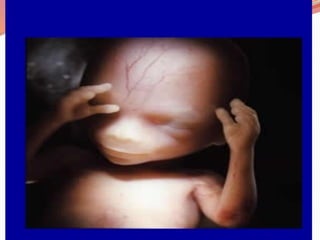
Week 17-21
Thefetus reaches a length of 20 cm (8 inches).
Lanugo covers the entire body.
Eyebrows and eyelashes appear.
Nails appear on fingers and toes.
The fetus is more active with increased muscle
development.
"Quickening" usually occurs (the mother and
others can feel the fetus moving).
The fetal heartbeat can be heard with
a stethoscope.
36.
Week 23-
Thefetus reaches a length of 28 cm (11.2 inches).
The fetus weighs about 925g.
Eyebrows and eyelashes are well formed.
All of the eye components are developed.
The fetus has a hand and startle reflex.
Footprints and fingerprints continue forming.
Alveoli (air sacs) are forming in lungs.
37.
Week 27
Thefetus reaches a length of 38 cm (15 inches).
The fetus weighs about 1.2 kg.
The brain develops rapidly.
The nervous system develops enough to control
some body functions.
The eyelids open and close.
The respiratory system, while immature, has
developed to the point where gas exchange is
possible.
39.
Week 31
Thefetus reaches a length of about 38–43 cm (15–
17 inches).
The fetus weighs about 1.5 kg (3 lb 0 oz).
The amount of body fat rapidly increases.
Rhythmic breathing movements occur, but lungs are
not fully mature.
Thalamic brain connections, which mediate sensory
input, form.
Bones are fully developed, but are still soft and pliable.
The fetus begins storing a lot
of iron, calcium and phosphorus
40.
Week 35
Thefetus reaches a length of about 40–48 cm
(16–19 inches).
The fetus weighs about 2.5 to 3 kg (5 lb 12 oz to
6 lb 12 oz).
Lanugo begins to disappear.
Body fat increases.
Fingernails reach the end of the fingertips.
A baby born at 36 weeks has a high chance of
survival, but may require medical interventions
41.
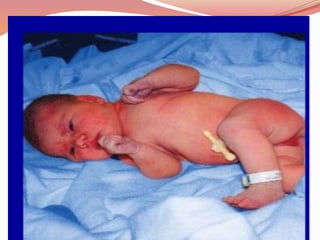
Week 36-40
Thefetus is considered full-term at the end of the
39th week of gestational age.
It may be 48 to 53 cm (19 to 21 inches) in length.
The lanugo is gone except on the upper arms and
shoulders.
Fingernails extend beyond fingertips.
Small breast buds are present on both sexes.
Head hair is now coarse and thickest





![BYGU's case study on how they started and failed[1].pptx](https://cdn.slidesharecdn.com/ss_thumbnails/byguscasestudy1-240314133257-240cd2d5-thumbnail.jpg?width=640&height=640&fit=bounds)


