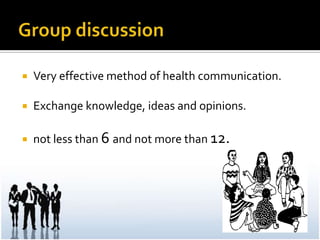
   Very effective method of health communication.

   Exchange knowledge, ideas and opinions.

   not less than 6 and not more than 12.
   Identify the major objective of the meeting.

   Carefully develop five to six questions.

   Plan your session.

   Call potential members to invite them to the meeting.
   Scheduling.
   Setting and Refreshments .
   Ground Rules.
   Membership .
   Plan to record the session with either an audio or audio-
    video recorder.


   Collect useful information to meet goal of meeting.
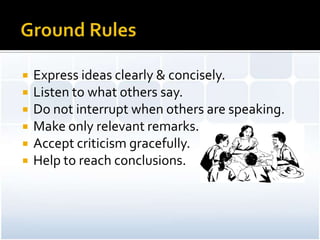
   Express ideas clearly & concisely.
   Listen to what others say.
   Do not interrupt when others are speaking.
   Make only relevant remarks.
   Accept criticism gracefully.
   Help to reach conclusions.
   A focus group is a form of qualitative research.

   Group discussion, conducted several times until
    similar trends and patterns in perception,
    attitudes, ideas are shown.

   Focus groups rely on interaction within the
    group based on topics that are supplied by the
    researcher.
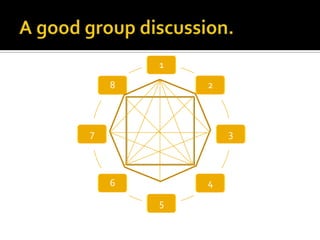
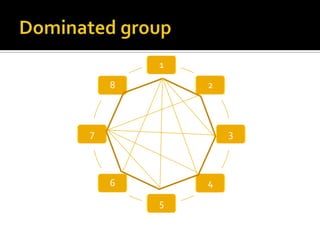
1
    8       2


7               3


    6       4
        5
   Easy to set up.
   Fast and relatively inexpensive.
   Stimulates dialogue and new ideas
    (                       )
   opportunity for disclosure among similar .
   Generates ideas for evaluation questions to be
    included in other survey methods.
   Very flexible.
   Socially oriented “synergism”.
   “Snowballing” of ideas.
•   Focus groups vary (talkative, quiet, dull).
•   Deviates from the subject.
•   Shy.
•   Some may dominate.
•   Can’t generalize to the target population.
•   Discussion must be in an environment conducive to
    conversation.
•   observer dependency
•   Difficult to assemble.
•   Capturing major issues can be difficult
1
    8       2


7               3


    6       4
        5
   Planning program design.
   Generate information for questionnaires.
   Pilot programs.
   Testing programs currently used.
   Follow-up of a mail survey.
   Changing attitudes & health behaviour of people.
Focus group discussion

Focus group discussion

  • 2.
    Very effective method of health communication.  Exchange knowledge, ideas and opinions.  not less than 6 and not more than 12.
  • 3.
    Identify the major objective of the meeting.  Carefully develop five to six questions.  Plan your session.  Call potential members to invite them to the meeting.
  • 4.
    Scheduling.  Setting and Refreshments .  Ground Rules.  Membership .  Plan to record the session with either an audio or audio- video recorder.  Collect useful information to meet goal of meeting.
  • 5.
    Express ideas clearly & concisely.  Listen to what others say.  Do not interrupt when others are speaking.  Make only relevant remarks.  Accept criticism gracefully.  Help to reach conclusions.
  • 6.
    A focus group is a form of qualitative research.  Group discussion, conducted several times until similar trends and patterns in perception, attitudes, ideas are shown.  Focus groups rely on interaction within the group based on topics that are supplied by the researcher.
  • 7.
    1 8 2 7 3 6 4 5
  • 8.
    Easy to set up.  Fast and relatively inexpensive.  Stimulates dialogue and new ideas ( )  opportunity for disclosure among similar .  Generates ideas for evaluation questions to be included in other survey methods.  Very flexible.  Socially oriented “synergism”.  “Snowballing” of ideas.
  • 9.
    Focus groups vary (talkative, quiet, dull). • Deviates from the subject. • Shy. • Some may dominate. • Can’t generalize to the target population. • Discussion must be in an environment conducive to conversation. • observer dependency • Difficult to assemble. • Capturing major issues can be difficult
  • 10.
    1 8 2 7 3 6 4 5
  • 11.
    Planning program design.  Generate information for questionnaires.  Pilot programs.  Testing programs currently used.  Follow-up of a mail survey.  Changing attitudes & health behaviour of people.