Focus Groups
Pamela Glynn,
Máire Shanahan,
Deirdre Duggan
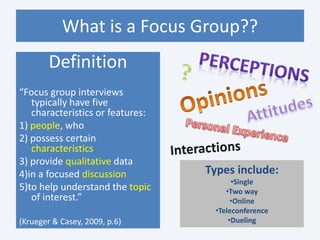
Definition
“Focus group interviews
typically have five
characteristics or features:
1) people, who
2) possess certain
characteristics
3) provide qualitative data
4)in a focused discussion
5)to help understand the topic
of interest.”
(Krueger & Casey, 2009, p.6)
What is a Focus Group??
Types include:
•Single
•Two way
•Online
•Teleconference
•Dueling
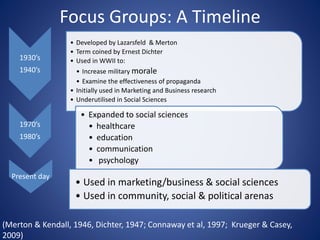
Focus Groups: A Timeline
1930’s
1940’s
• Developed by Lazarsfeld & Merton
• Term coined by Ernest Dichter
• Used in WWII to:
• Increase military morale
• Examine the effectiveness of propaganda
• Initially used in Marketing and Business research
• Underutilised in Social Sciences
1970’s
1980’s
• Expanded to social sciences
• healthcare
• education
• communication
• psychology
Present day
• Used in marketing/business & social sciences
• Used in community, social & political arenas
(Merton & Kendall, 1946, Dichter, 1947; Connaway et al, 1997; Krueger & Casey,
2009)
When to use focus groups??
Depending on type of study:
• Gather/explore ideas and feelings people have on
a topic
• Identify differences in perspectives
• Identify common language/behaviour
• Pilot test / generate ideas & policies
*Information gathering for large scale quantitative
study
(Kegler et al, 2008, Wilkinson, 2008; Krueger & Casey, 2009)
Plan the process...
• Identify goals/objectives
• Identify questions/hypotheses
• Identify people (participants & moderator)
– Does size matter??
• Select time, place/environment
• Conduct research
• Evaluate findings/data
• Report
(Morgan, 1988; Bertrand et al, 1992)
Moderator: What they do?
• Facilitate
• Observe
• Encourage
• Challenge
• Direct/guide/explore
• Listen
• Time-keeping
• Objective
(Morgan, 1988; Krueger & Casey, 2009)
Food for thought:
Personal Capacities of a
Leader
“empathy and positive
regard are critical qualities
of the moderator” (Krueger
& Casey, 2009, p.86)
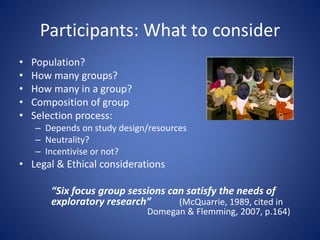
Participants: What to consider
• Population?
• How many groups?
• How many in a group?
• Composition of group
• Selection process:
– Depends on study design/resources
– Neutrality?
– Incentivise or not?
• Legal & Ethical considerations
“Six focus group sessions can satisfy the needs of
exploratory research” (McQuarrie, 1989, cited in
Domegan & Flemming, 2007, p.164)
Questions
• Opening
• Introducing
• Transition
• Key Questions
• Ending Questions Avoid
Leading Questions
Yes/No Questions
Asking for examples
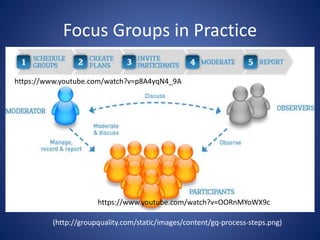
Focus Groups in Practice
(http://groupquality.com/static/images/content/gq-process-steps.png)
https://www.youtube.com/watch?v=OORnMYoWX9c
https://www.youtube.com/watch?v=p8A4yqN4_9A
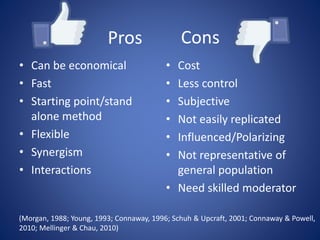
Cons
• Can be economical
• Fast
• Starting point/stand
alone method
• Flexible
• Synergism
• Interactions
• Cost
• Less control
• Subjective
• Not easily replicated
• Influenced/Polarizing
• Not representative of
general population
• Need skilled moderator
(Morgan, 1988; Young, 1993; Connaway, 1996; Schuh & Upcraft, 2001; Connaway & Powell,
2010; Mellinger & Chau, 2010)
Pros
Focus groups in existing L&M research
• Does exist but not widely represented
• Tends to be used as part of mixed methods research
• Used to identify themes, indicators & insights
• Not used in wholly quantitative research
– May be used to develop hypotheses for quantitative
studies
• Some literature identified benefits to participants
(O’ Brien, 2002; Sullivan, 2007; Kegler et al, 2008; Palmer et al, 2010;
Ladegard & Gjerde, 2014)
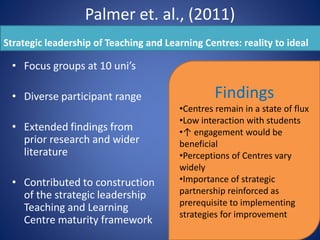
Palmer et. al., (2011)
Strategic leadership of Teaching and Learning Centres: reality to ideal
• Focus groups at 10 uni’s
• Diverse participant range
• Extended findings from
prior research and wider
literature
• Contributed to construction
of the strategic leadership
Teaching and Learning
Centre maturity framework
Findings
•Centres remain in a state of flux
•Low interaction with students
•↑ engagement would be
beneficial
•Perceptions of Centres vary
widely
•Importance of strategic
partnership reinforced as
prerequisite to implementing
strategies for improvement
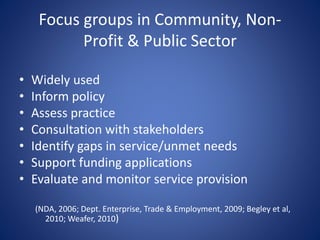
Focus groups in Community, Non-
Profit & Public Sector
• Widely used
• Inform policy
• Assess practice
• Consultation with stakeholders
• Identify gaps in service/unmet needs
• Support funding applications
• Evaluate and monitor service provision
(NDA, 2006; Dept. Enterprise, Trade & Employment, 2009; Begley et al,
2010; Weafer, 2010)
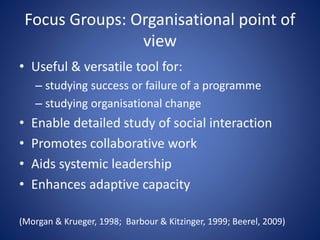
Focus Groups: Organisational point of
view
• Useful & versatile tool for:
– studying success or failure of a programme
– studying organisational change
• Enable detailed study of social interaction
• Promotes collaborative work
• Aids systemic leadership
• Enhances adaptive capacity
(Morgan & Krueger, 1998; Barbour & Kitzinger, 1999; Beerel, 2009)
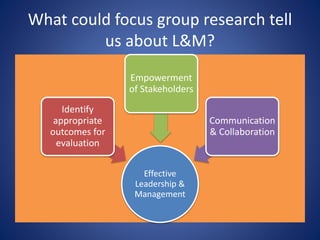
What could focus group research tell
us about L&M?
Effective
Leadership &
Management
Identify
appropriate
outcomes for
evaluation
Empowerment
of Stakeholders
Communication
& Collaboration
Conclusion
“Focus group interviews typically have five characteristics or
features: people, who possess certain characteristics, and
provide qualitative data in a focused discussion to help
understand the topic of interest.”
(Krueger & Casey, 2009, p.6)
•Limited practical information on systematic analysis of results
(Bertrand et al, 1992)
•Wider use of focus group research may benefit Leadership &
Management sector
“Leadership is about getting people to do their own work in an
environment where they are suitably focused, encouraged and
supported.” (Beerel, 2009, p. 93)

Focus groups presentation

  • 1.
    Focus Groups Pamela Glynn, MáireShanahan, Deirdre Duggan
  • 2.
    Definition “Focus group interviews typicallyhave five characteristics or features: 1) people, who 2) possess certain characteristics 3) provide qualitative data 4)in a focused discussion 5)to help understand the topic of interest.” (Krueger & Casey, 2009, p.6) What is a Focus Group?? Types include: •Single •Two way •Online •Teleconference •Dueling
  • 3.
    Focus Groups: ATimeline 1930’s 1940’s • Developed by Lazarsfeld & Merton • Term coined by Ernest Dichter • Used in WWII to: • Increase military morale • Examine the effectiveness of propaganda • Initially used in Marketing and Business research • Underutilised in Social Sciences 1970’s 1980’s • Expanded to social sciences • healthcare • education • communication • psychology Present day • Used in marketing/business & social sciences • Used in community, social & political arenas (Merton & Kendall, 1946, Dichter, 1947; Connaway et al, 1997; Krueger & Casey, 2009)
  • 4.
    When to usefocus groups?? Depending on type of study: • Gather/explore ideas and feelings people have on a topic • Identify differences in perspectives • Identify common language/behaviour • Pilot test / generate ideas & policies *Information gathering for large scale quantitative study (Kegler et al, 2008, Wilkinson, 2008; Krueger & Casey, 2009)
  • 5.
    Plan the process... •Identify goals/objectives • Identify questions/hypotheses • Identify people (participants & moderator) – Does size matter?? • Select time, place/environment • Conduct research • Evaluate findings/data • Report (Morgan, 1988; Bertrand et al, 1992)
  • 6.
    Moderator: What theydo? • Facilitate • Observe • Encourage • Challenge • Direct/guide/explore • Listen • Time-keeping • Objective (Morgan, 1988; Krueger & Casey, 2009) Food for thought: Personal Capacities of a Leader “empathy and positive regard are critical qualities of the moderator” (Krueger & Casey, 2009, p.86)
  • 7.
    Participants: What toconsider • Population? • How many groups? • How many in a group? • Composition of group • Selection process: – Depends on study design/resources – Neutrality? – Incentivise or not? • Legal & Ethical considerations “Six focus group sessions can satisfy the needs of exploratory research” (McQuarrie, 1989, cited in Domegan & Flemming, 2007, p.164)
  • 8.
    Questions • Opening • Introducing •Transition • Key Questions • Ending Questions Avoid Leading Questions Yes/No Questions Asking for examples
  • 9.
    Focus Groups inPractice (http://groupquality.com/static/images/content/gq-process-steps.png) https://www.youtube.com/watch?v=OORnMYoWX9c https://www.youtube.com/watch?v=p8A4yqN4_9A
  • 10.
    Cons • Can beeconomical • Fast • Starting point/stand alone method • Flexible • Synergism • Interactions • Cost • Less control • Subjective • Not easily replicated • Influenced/Polarizing • Not representative of general population • Need skilled moderator (Morgan, 1988; Young, 1993; Connaway, 1996; Schuh & Upcraft, 2001; Connaway & Powell, 2010; Mellinger & Chau, 2010) Pros
  • 11.
    Focus groups inexisting L&M research • Does exist but not widely represented • Tends to be used as part of mixed methods research • Used to identify themes, indicators & insights • Not used in wholly quantitative research – May be used to develop hypotheses for quantitative studies • Some literature identified benefits to participants (O’ Brien, 2002; Sullivan, 2007; Kegler et al, 2008; Palmer et al, 2010; Ladegard & Gjerde, 2014)
  • 12.
    Palmer et. al.,(2011) Strategic leadership of Teaching and Learning Centres: reality to ideal • Focus groups at 10 uni’s • Diverse participant range • Extended findings from prior research and wider literature • Contributed to construction of the strategic leadership Teaching and Learning Centre maturity framework Findings •Centres remain in a state of flux •Low interaction with students •↑ engagement would be beneficial •Perceptions of Centres vary widely •Importance of strategic partnership reinforced as prerequisite to implementing strategies for improvement
  • 13.
    Focus groups inCommunity, Non- Profit & Public Sector • Widely used • Inform policy • Assess practice • Consultation with stakeholders • Identify gaps in service/unmet needs • Support funding applications • Evaluate and monitor service provision (NDA, 2006; Dept. Enterprise, Trade & Employment, 2009; Begley et al, 2010; Weafer, 2010)
  • 14.
    Focus Groups: Organisationalpoint of view • Useful & versatile tool for: – studying success or failure of a programme – studying organisational change • Enable detailed study of social interaction • Promotes collaborative work • Aids systemic leadership • Enhances adaptive capacity (Morgan & Krueger, 1998; Barbour & Kitzinger, 1999; Beerel, 2009)
  • 15.
    What could focusgroup research tell us about L&M? Effective Leadership & Management Identify appropriate outcomes for evaluation Empowerment of Stakeholders Communication & Collaboration
  • 16.
    Conclusion “Focus group interviewstypically have five characteristics or features: people, who possess certain characteristics, and provide qualitative data in a focused discussion to help understand the topic of interest.” (Krueger & Casey, 2009, p.6) •Limited practical information on systematic analysis of results (Bertrand et al, 1992) •Wider use of focus group research may benefit Leadership & Management sector “Leadership is about getting people to do their own work in an environment where they are suitably focused, encouraged and supported.” (Beerel, 2009, p. 93)

Editor's Notes

  • #3  “group interview” “emphasis being on questions and responses” “rely on interaction” (Morgan, 1997) Deirdre: add word art...opinions, attitudes, beliefs, personal experience, interaction, feelings, emotions, questions, responses.. ?? Pictures Make page white, bluue text box
  • #4  Dichter coined term in 1947 Look up Lazarsfeld...
  • #10  link to phone focus group clip over moderator (1 min max) Link to stone age focus group video over participants
  • #12 Tie mixed methods into wider group presentations
  • #13 Importance of a strategic partnership reinforced as a prerequisite for implementing identified high-impact strategies for improvement in teaching and learning. (between the University’s Senior Executive, the Centre and faculties)
  • #16 Positive benefits for participants of focus groups (Kegler et al., 2008; Palmer et. al., 2010) Effective leaders Empower stakeholders Measuring non-tangible outcomes is achievable and important Effective leaders identify appropriate Outcomes for evaluation Communication is key (Palmer et al., 2010) Effective leaders Foster environments that promote collaboration and communication. Effective communication strategy in place.