Presented by
Saroj Baral
MPH 2023 batch
 Focus group
 Appropriate condition of focus group
 Data collecting techniques
 Practical issues to be considered running group
discussions
 Analyzing group discussion
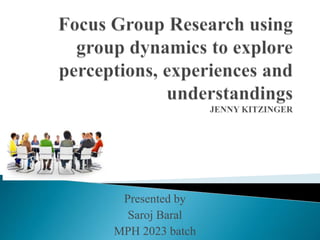
 Focus groups are group discussions organized to
explore a particular set of issues.
 Nominal groups, consensus group, exert panel, delphi
groups are common groups but are not necessarily
examples in focus group
Nominal groups
 A focus group is ‘a research encounter which aims to
generate discussion on a particular topic or range of
topics, with the emphasis being on interaction between
participants’ (Kitzinger 1994a: 103).
 The group is focused in the sense that it involves some
kind of collective activity such as debating a particular
set of questions, reflecting on common experiences or
examining a single health education campaign. The
groups may be nominal grous, consensus group, expert
panel who can do the discussion with knowledge
 Focus groups are ideal for exploring people’s talk, experiences,
opinions, beliefs, wishes and concerns. The method is
particularly useful for allowing participants to generate their own
questions, frames and concepts and to pursue their own priorities
on their own terms, in their own vocabulary.
 Focus groups can be used, for example, for:
1. The development or evaluation of a health education
campaign.
2. The improvement of health services provision or outreach.
3. In-depth exploration of the experience of a diagnosis, diseases
or treatment.

4. Examination of professional identities and role or responses to
institutional changes (e.g. Barbour 1999).
5. For Analysis of the role of the mass media or broader
cultural representations in shaping understandings of
a disease (or profession, or stigmatized group) (e.g.
Miller et al. 1998).
6. Gaining insights into broad public understandings of
and responses to, issues such as biomedical ethics,
new biotechnologies, health services, health policies
or health inequalities
7. Focus groups contribute to a comprehensive
understanding of research topics, particularly those
with sensitive issues such as STDs
 Focus group research is different from individual
interviews because research participants talk to the
researcher as a group, and most importantly, discuss the
issues with one another.
 Focus groups deviate from observational methods or
ethnography, which focus on spontaneous actions in
natural settings. The researcher initiates the focus
group, often involving existing groups in their usual
environment.
 The researcher plays a central role in prompting and
directing the discussion within the focus group. The
discussions are centered around specific issues identified by
the researcher.
 Focus groups are described as "invaluable" for a thorough
examination of diverse aspects such as knowledge, ideas,
storytelling, self-presentation, and linguistic exchanges
within a cultural context
 In overall focus groups offer a holistic approach to
studying cultural elements, providing insights into how
people express themselves, share stories, and navigate their
experiences within a specific cultural framework.
 Focus groups are qualitatively oriented, distinct from
quantitative methods like survey questionnaires. While
surveys prioritize representativeness and breadth, focus
groups emphasize the depth of experience and opinion.
 Surveys identify gaps between knowledge and
behavior, but only qualitative methods like focus
groups can delve into the reasons behind these gaps.
Focus groups are effective in explaining why
disparities exist, providing insights that quantitative
methods may not capture.
 Generalizations about the superiority of one method
over another are cautioned against; no single technique
is inherently "better“. The effectiveness depends on the
research question's objectives and the practical
application of each method. Combining different data
collection techniques in a single project can be highly
productive, allowing for a more comprehensive
understanding.
 Focus groups can be combined with in-depth
ethnographic work or interviews where Ethnographic
work may enhance the sensitivity of focus groups, and
interviews combined with focus groups can access
different aspects of people's experiences.
 People may not necessarily be more 'honest' in
interviews or groups, but they may communicate
differently, revealing distinct aspects of their
experiences.
 Focus groups can be complemented with questionnaires
completed before or after the session. Questionnaires,
even if qualitative, can provide background information
and offer participants a platform for expressing
thoughts they might be hesitant to share in the group.
 Focus groups play a role in designing or interpreting
major survey. They assist in constructing
questionnaires, understanding key issues, and refining
question phrasing. Focus groups are valuable for
eliciting anecdotal material, generating vignettes for
use in questionnaires.
 Focus groups are useful in later stages of
predominantly quantitative projects which help to
explain surprising or anomalous findings and interpret
outliers identified by quantitative approaches like
scattergrams or box and whisker plots.
 Focus groups not only complement data collected via
other methods but may challenge how such data are
interpreted. They reveal different ways of interpreting
survey findings by exposing the readings, facts, and
value systems that inform respondents' answers.
 Focus group can be used from wide variety of
theoritical perspective from straightforward positivist
aproaches, approaches using phenomenology. Narrative
analysis, discourse or conversation analysis.
 Focus groups are used in traditional top– down research
which are very popular within commercial marketing
and proven very fruitful in client centered, action
research or feminist research (Wilkinson 1999)
 One of the advantages of focus groups is that they
allow participants to become an active part of the
analysis process, which can empower them. Group
dynamics can also allow for a shift from personal self-
blaming psychological explanations to the exploration
of structural solutions
 Some researchers have also noted that group
discussions can generate more critical comments than
interviews.
 Using a method that facilitates the expression of
criticism and the exploration of different types of
solutions can be invaluable when seeking to improve
services.
 This is especially true when working with particular
disempowered ‘patient’ populations who may be
reluctant to give negative feedback or may feel that any
problems result from their own inadequacies.
1. The size of the group
2. Group composition
3. The number and range of groups
4. Location of the focus group session
5. It’ll be all right on the night . . . or will it?
6. Preparing material for the session
7. Reflecting on some ethical issues
8. Running the session
9. Recording the discussion
10. Analysis and writing up
A group between the size of four and eight is usually
ideal. However, it is necessary to over-recruit, as not
everyone may be able to turn up on the day
 The group may be homogenous or heterogeneous
which depends on the research question and the
perspectives you aim to capture considering hierarchy
within the group.
 selecting pre-existing groups who share common
experiences, such as individuals from the same
background, profession, or with similar life
experiences. This can foster a sense of familiarity and
openness.
 Groups of strangers to ensure that participants will talk
without fear
 Diverse Learning Disability:
 The number of groups conducted can consist of
anything between just a couple of groups to over fifty
groups, depending on the aims of the project and the
resources available, most studies consist between six
and fifteen
 In focus group participants are selected to reflect a
range of the total population , reflecting demograhic
diversity or to test particular hypothesis.
 The imaginative sampling is crucial for research
purposes. While age, class, and ethnicity are important
variables to consider, it is also worth exploring other
variables .
Focus group sessions should be conducted in a place
easily accessible to potential participants (and familiar
to them). However, sometimes it is useful to run
sessions outside people’s institutional setting, away
from their place of work or institution, so that they can
talk more freely and be away from interruptions or
observation.
 The letter of invitation to participants, including a (very
brief) outline of the research and what they can expect
from the session, and
 Guidelines for the researcher (or the session facilitator)
outilining some questions that might be addressed by
the group. In addition some researchers like to take
along some group materials, prompts, games or
exercises.
 informed consent
 information should be treated with respect and
confidentiality
 set ground rules prior to the session
 Politely interrupt and acknowledge the contribution,
then encourage others to share their thoughts.
 Relaxed atmosphere through elements like refreshments
and a circular seating arrangement
 Sessions, lasting one to two hours or more, are designed to
encourage participants to engage in group discussion rather
than direct responses to the researcher
 The facilitator initiates the session by having participants
introduce themselves, and group activities or games may be
employed initially, with the facilitator adopting a more
passive role
 .
 The facilitator may become more interventionist,
prompting continued debate and encouraging
participants to explore inconsistencies in their views as
the progression of session
 Disagreements within the group are seen as
opportunities to elucidate individual perspectives and
clarify reasoning, a process that distinguishes focus
group research from individual interviews
 Tape-recorded, and some even like to videotape
sessions with consent
 discussions on similar themes will be compared,
examination of their relationship to sample population
variables, and emphasizes the need to avoid presenting
percentages in focus group reports
 Highlight or make notes on themes that emerge from
the discussions. Look for consensus or divergence
among participants. Pay attention to any unexpected or
deviant cases that might provide unique insights.
 The author have provided example on a focus group
discussionn with elderly people in hospital residential
care evaluating the service and seeking suggestions for
improvements, and it captures the participants' thoughts
and experiences regarding independence and life in
their current living situation
 The segment of the focus group captures a range of
emotions and experiences related to independence,
home, social connections, and dignity, providing
insights into the participants' perspectives within their
living environment.
Another focus group in a community with very low rates
of breastfeeding and involved a group of teenage
mothers
samantha's Perspective: Samantha emphasizes the
normalcy of breastfeeding and views it as a natural act.
Her reasons for wanting to breastfeed include potential
health benefits for the baby and emotional bonding.
Other Participants' Perspectives: Some participants
express negative views:
Overall Tone: In the presence of diverse opinions and
potential stigma surrounding breastfeeding in public
Samantha's stance advocates for normalization and
acceptance of breastfeeding.
 This chapter has presented the factors to consider when
designing or evaluating a focus group study. In
particular, it has drawn attention to the overt
exploitation and exploration of interactions in focus
group discussion.
Focus Group Research in qualitative study

Focus Group Research in qualitative study

  • 2.
  • 3.
     Focus group Appropriate condition of focus group  Data collecting techniques  Practical issues to be considered running group discussions  Analyzing group discussion
  • 4.
     Focus groupsare group discussions organized to explore a particular set of issues.  Nominal groups, consensus group, exert panel, delphi groups are common groups but are not necessarily examples in focus group Nominal groups
  • 5.
     A focusgroup is ‘a research encounter which aims to generate discussion on a particular topic or range of topics, with the emphasis being on interaction between participants’ (Kitzinger 1994a: 103).  The group is focused in the sense that it involves some kind of collective activity such as debating a particular set of questions, reflecting on common experiences or examining a single health education campaign. The groups may be nominal grous, consensus group, expert panel who can do the discussion with knowledge
  • 6.
     Focus groupsare ideal for exploring people’s talk, experiences, opinions, beliefs, wishes and concerns. The method is particularly useful for allowing participants to generate their own questions, frames and concepts and to pursue their own priorities on their own terms, in their own vocabulary.  Focus groups can be used, for example, for: 1. The development or evaluation of a health education campaign. 2. The improvement of health services provision or outreach. 3. In-depth exploration of the experience of a diagnosis, diseases or treatment. 4. Examination of professional identities and role or responses to institutional changes (e.g. Barbour 1999).
  • 7.
    5. For Analysisof the role of the mass media or broader cultural representations in shaping understandings of a disease (or profession, or stigmatized group) (e.g. Miller et al. 1998). 6. Gaining insights into broad public understandings of and responses to, issues such as biomedical ethics, new biotechnologies, health services, health policies or health inequalities 7. Focus groups contribute to a comprehensive understanding of research topics, particularly those with sensitive issues such as STDs
  • 8.
     Focus groupresearch is different from individual interviews because research participants talk to the researcher as a group, and most importantly, discuss the issues with one another.  Focus groups deviate from observational methods or ethnography, which focus on spontaneous actions in natural settings. The researcher initiates the focus group, often involving existing groups in their usual environment.
  • 9.
     The researcherplays a central role in prompting and directing the discussion within the focus group. The discussions are centered around specific issues identified by the researcher.  Focus groups are described as "invaluable" for a thorough examination of diverse aspects such as knowledge, ideas, storytelling, self-presentation, and linguistic exchanges within a cultural context  In overall focus groups offer a holistic approach to studying cultural elements, providing insights into how people express themselves, share stories, and navigate their experiences within a specific cultural framework.
  • 10.
     Focus groupsare qualitatively oriented, distinct from quantitative methods like survey questionnaires. While surveys prioritize representativeness and breadth, focus groups emphasize the depth of experience and opinion.  Surveys identify gaps between knowledge and behavior, but only qualitative methods like focus groups can delve into the reasons behind these gaps. Focus groups are effective in explaining why disparities exist, providing insights that quantitative methods may not capture.
  • 11.
     Generalizations aboutthe superiority of one method over another are cautioned against; no single technique is inherently "better“. The effectiveness depends on the research question's objectives and the practical application of each method. Combining different data collection techniques in a single project can be highly productive, allowing for a more comprehensive understanding.
  • 12.
     Focus groupscan be combined with in-depth ethnographic work or interviews where Ethnographic work may enhance the sensitivity of focus groups, and interviews combined with focus groups can access different aspects of people's experiences.  People may not necessarily be more 'honest' in interviews or groups, but they may communicate differently, revealing distinct aspects of their experiences.
  • 13.
     Focus groupscan be complemented with questionnaires completed before or after the session. Questionnaires, even if qualitative, can provide background information and offer participants a platform for expressing thoughts they might be hesitant to share in the group.  Focus groups play a role in designing or interpreting major survey. They assist in constructing questionnaires, understanding key issues, and refining question phrasing. Focus groups are valuable for eliciting anecdotal material, generating vignettes for use in questionnaires.
  • 14.
     Focus groupsare useful in later stages of predominantly quantitative projects which help to explain surprising or anomalous findings and interpret outliers identified by quantitative approaches like scattergrams or box and whisker plots.  Focus groups not only complement data collected via other methods but may challenge how such data are interpreted. They reveal different ways of interpreting survey findings by exposing the readings, facts, and value systems that inform respondents' answers.
  • 15.
     Focus groupcan be used from wide variety of theoritical perspective from straightforward positivist aproaches, approaches using phenomenology. Narrative analysis, discourse or conversation analysis.  Focus groups are used in traditional top– down research which are very popular within commercial marketing and proven very fruitful in client centered, action research or feminist research (Wilkinson 1999)
  • 16.
     One ofthe advantages of focus groups is that they allow participants to become an active part of the analysis process, which can empower them. Group dynamics can also allow for a shift from personal self- blaming psychological explanations to the exploration of structural solutions
  • 17.
     Some researchershave also noted that group discussions can generate more critical comments than interviews.
  • 18.
     Using amethod that facilitates the expression of criticism and the exploration of different types of solutions can be invaluable when seeking to improve services.  This is especially true when working with particular disempowered ‘patient’ populations who may be reluctant to give negative feedback or may feel that any problems result from their own inadequacies.
  • 19.
    1. The sizeof the group 2. Group composition 3. The number and range of groups 4. Location of the focus group session 5. It’ll be all right on the night . . . or will it? 6. Preparing material for the session 7. Reflecting on some ethical issues 8. Running the session 9. Recording the discussion 10. Analysis and writing up
  • 20.
    A group betweenthe size of four and eight is usually ideal. However, it is necessary to over-recruit, as not everyone may be able to turn up on the day
  • 21.
     The groupmay be homogenous or heterogeneous which depends on the research question and the perspectives you aim to capture considering hierarchy within the group.  selecting pre-existing groups who share common experiences, such as individuals from the same background, profession, or with similar life experiences. This can foster a sense of familiarity and openness.
  • 22.
     Groups ofstrangers to ensure that participants will talk without fear  Diverse Learning Disability:
  • 23.
     The numberof groups conducted can consist of anything between just a couple of groups to over fifty groups, depending on the aims of the project and the resources available, most studies consist between six and fifteen  In focus group participants are selected to reflect a range of the total population , reflecting demograhic diversity or to test particular hypothesis.
  • 24.
     The imaginativesampling is crucial for research purposes. While age, class, and ethnicity are important variables to consider, it is also worth exploring other variables .
  • 25.
    Focus group sessionsshould be conducted in a place easily accessible to potential participants (and familiar to them). However, sometimes it is useful to run sessions outside people’s institutional setting, away from their place of work or institution, so that they can talk more freely and be away from interruptions or observation.
  • 26.
     The letterof invitation to participants, including a (very brief) outline of the research and what they can expect from the session, and  Guidelines for the researcher (or the session facilitator) outilining some questions that might be addressed by the group. In addition some researchers like to take along some group materials, prompts, games or exercises.
  • 27.
     informed consent information should be treated with respect and confidentiality  set ground rules prior to the session  Politely interrupt and acknowledge the contribution, then encourage others to share their thoughts.
  • 28.
     Relaxed atmospherethrough elements like refreshments and a circular seating arrangement  Sessions, lasting one to two hours or more, are designed to encourage participants to engage in group discussion rather than direct responses to the researcher  The facilitator initiates the session by having participants introduce themselves, and group activities or games may be employed initially, with the facilitator adopting a more passive role  .
  • 29.
     The facilitatormay become more interventionist, prompting continued debate and encouraging participants to explore inconsistencies in their views as the progression of session  Disagreements within the group are seen as opportunities to elucidate individual perspectives and clarify reasoning, a process that distinguishes focus group research from individual interviews
  • 30.
     Tape-recorded, andsome even like to videotape sessions with consent
  • 31.
     discussions onsimilar themes will be compared, examination of their relationship to sample population variables, and emphasizes the need to avoid presenting percentages in focus group reports  Highlight or make notes on themes that emerge from the discussions. Look for consensus or divergence among participants. Pay attention to any unexpected or deviant cases that might provide unique insights.
  • 32.
     The authorhave provided example on a focus group discussionn with elderly people in hospital residential care evaluating the service and seeking suggestions for improvements, and it captures the participants' thoughts and experiences regarding independence and life in their current living situation  The segment of the focus group captures a range of emotions and experiences related to independence, home, social connections, and dignity, providing insights into the participants' perspectives within their living environment.
  • 33.
    Another focus groupin a community with very low rates of breastfeeding and involved a group of teenage mothers samantha's Perspective: Samantha emphasizes the normalcy of breastfeeding and views it as a natural act. Her reasons for wanting to breastfeed include potential health benefits for the baby and emotional bonding. Other Participants' Perspectives: Some participants express negative views: Overall Tone: In the presence of diverse opinions and potential stigma surrounding breastfeeding in public Samantha's stance advocates for normalization and acceptance of breastfeeding.
  • 34.
     This chapterhas presented the factors to consider when designing or evaluating a focus group study. In particular, it has drawn attention to the overt exploitation and exploration of interactions in focus group discussion.

Editor's Notes

  • #2 JENNY KITZINGER
  • #3 JENNY KITZINGER Professor of Media and Communication Research at the Cardiff School of Journalism, Media and Cultural Studies, Cardiff University. She is co-editor of Developing Focus Group Research: politics, theory and practice (Sage, 1999). Her most recent book, Framing Abuse: media influence and public understanding of sexual violence against children was published by Pluto Press (2004). Besides writing and co-writing books, Professor Kitzinger has also published over 100 chapters and articles in well known journals.
  • #5 nominal group is a group of words that represents or describes an entity, such as a person, place, or thing The Delphi method is a structured communication technique that relies on a panel of experts to make decisions or forecasts
  • #14 elicit anecdotal material means encouraging participants to share personal stories, experiences, or anecdotes related to the research topic which can add richness, depth, and a qualitative understanding to the data Generating vignettes: a short descriptive scketch
  • #16 The phenomenology approach :The researcher conducts in-depth interviews with the individuals who experience the same thing to find common themes among the experiences. Narrative analysis, discourse or conversation analysis.: used to examine how language is used to construct identity.
  • #17 For example, if a group of people has felt confused about what they have been told, having a leaflet or being able to take away a tape-recording of the consultation could help.
  • #18 For example, Geis and his colleagues found that there were more angry comments about the medical community in the group discussions than in the individual interviews
  • #19 After childbirth, for example, many women may be grateful to have a healthy baby, and be unwilling to make criticisms of how they were treated when interviewed one-to-one, but may be more able to make constructive suggestions for improvements when involved in a group discussion
  • #22 Example of hierarchy : a nursing auxiliary is likely to be inhibited by the presence of a consultant from the same hospital. friends and colleagues can relate each other’s comments to actual incidents in their shared daily lives.
  • #23 1 ex For example in case of specific medical condition, such as a rare disease. Participants are strangers to each other but share a common health challenge. The anonymity within the group may encourage more open discussions about personal experiences, treatments, and emotional struggles 2. Ex Selecting parents whose children have different types of learning disabilities to capture a range of experiences related to various challenges and support needs.
  • #24 If researchers are examining people’s views on AIDS they might wish to include people who have tested HIV positive and those who have tested HIV negative; if exploring experiences of breast cancer researchers might wish to talk with women at different stages of their treatment, and include a group of men with breast cancer
  • #25 For example, when studying women’s experiences of maternity care or cervical smears, it may be advisable to include groups of lesbians or women who were sexually abused as children . This can help researchers gain a more comprehensive understanding of the topic at hand.
  • #28 Ground rules are standards set by a team to help them function in the future . Ground rules define how team members can support and communicate with each other
  • #30 Elucidate;make (something) clear
  • #34  breastfeeding is not a reflection of masculinity or femininity, but rather a natural process that provides optimal nutrition for babies and promotes bonding between mothers and their children 2. Masculinity refers to the set of attributes, behaviors, and roles traditionally associated with men in a given culture or society.