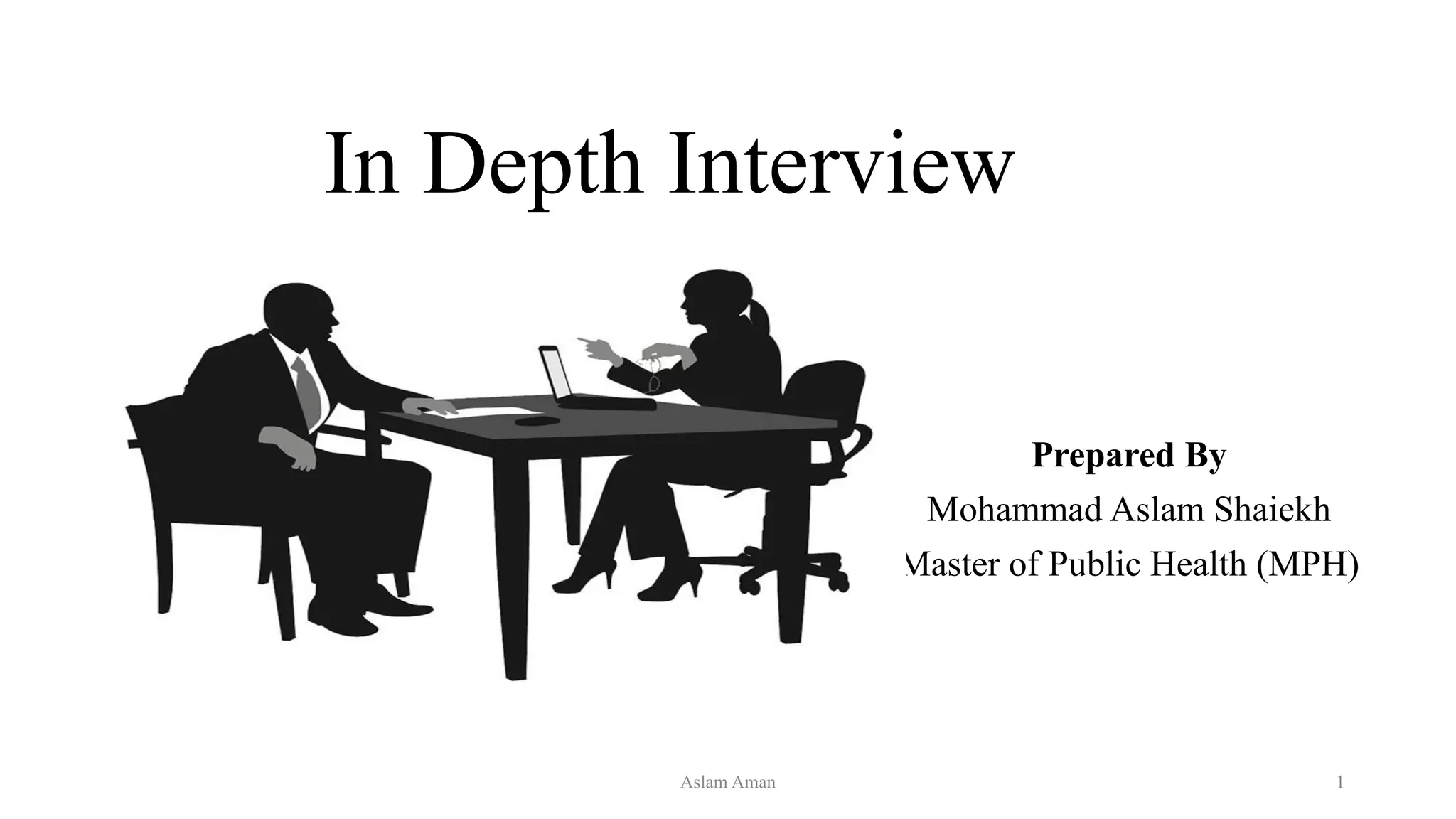
In Depth Interview
Prepared By
Mohammad Aslam Shaiekh
Master of Public Health (MPH)
Aslam Aman 1
Introduction
• An in-depth interview is a qualitative research technique that
allows person to person discussion. It can lead to increased
insight into people's thoughts, feelings, and behavior on
important issues. This type of interview is often unstructured
and therefore permits the interviewer to encourage an
informant (respondent) to talk at length about the topic of
interest.
Aslam Aman 2
Cont…
• In-depth interviews offer the opportunity to capture rich,
descriptive data about people‟s behaviors, attitudes and
perceptions, and unfolding complex processes.
• The in-depth interview uses a flexible interview approach. It
aims to ask questions to explain the reasons underlying a
problem or practice in a target group.
Aslam Aman 3
In depth interview
• Various kinds and purposes
• Open-ended questions
• Looking for meaning and context and information in
respondents‟ own words
• Combine structure with flexibility
• Interactive
• Follow new lines of inquiry as they arise
• Explore a topic in-depth with follow-ups and probes: whys,
hows, examples, etc.
Aslam Aman 4
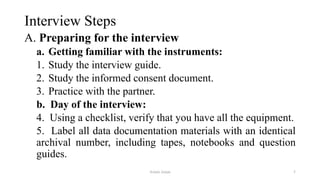
Interview Steps
A. Preparing for the interview
a. Getting familiar with the instruments:
1. Study the interview guide.
2. Study the informed consent document.
3. Practice with the partner.
b. Day of the interview:
4. Using a checklist, verify that you have all the equipment.
5. Label all data documentation materials with an identical
archival number, including tapes, notebooks and question
guides.
Aslam Aman 5
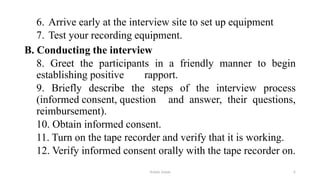
6. Arrive early at the interview site to set up equipment
7. Test your recording equipment.
B. Conducting the interview
8. Greet the participants in a friendly manner to begin
establishing positive rapport.
9. Briefly describe the steps of the interview process
(informed consent, question and answer, their questions,
reimbursement).
10. Obtain informed consent.
11. Turn on the tape recorder and verify that it is working.
12. Verify informed consent orally with the tape recorder on.
Aslam Aman 6
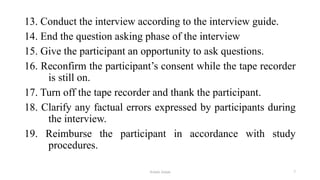
13. Conduct the interview according to the interview guide.
14. End the question asking phase of the interview
15. Give the participant an opportunity to ask questions.
16. Reconfirm the participant‟s consent while the tape recorder
is still on.
17. Turn off the tape recorder and thank the participant.
18. Clarify any factual errors expressed by participants during
the interview.
19. Reimburse the participant in accordance with study
procedures.
Aslam Aman 7
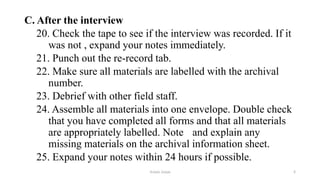
C. After the interview
20. Check the tape to see if the interview was recorded. If it
was not , expand your notes immediately.
21. Punch out the re-record tab.
22. Make sure all materials are labelled with the archival
number.
23. Debrief with other field staff.
24. Assemble all materials into one envelope. Double check
that you have completed all forms and that all materials
are appropriately labelled. Note and explain any
missing materials on the archival information sheet.
25. Expand your notes within 24 hours if possible.
Aslam Aman 8
Interview Checklist
A. Interview Checklist
• Private setting for interview site.
• Transportation of staff to interview site.
• Transportation of participants to interview site.
• Refreshments for participants (if applicable)
B. What to take to the interview
a. Equipment
• 1 voice recorder (plus 1 extra, if available)
• 1 extra storage device per interview
• Spare batteries
• Field notebook and pens Aslam Aman 9
b. Interview packet
• 1 large, heavy-duty envelope
• Archival information sheet with archival number
• 1 copy of interview guide (in the appropriate language for
participants)
• 2 informed consent forms (1 for interview, 1 for
participant, in the appropriate language)
• Participant reimbursement (if applicable)
• Reimbursement form (if applicable)
Aslam Aman 10
c. What to place in the envelope after the interview
• Completed archival information sheet
• Signed informed consent form (signed only by interviewer
if oral, by participant and interviewer if written)
• Labelled interview guide with notes
• Field notes
• Labelled cassette tapes, re-record tabs punched out
• Signed reimbursement form (if applicable)
Aslam Aman 11
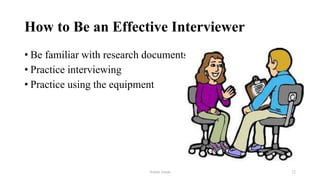
How to Be an Effective Interviewer
• Be familiar with research documents
• Practice interviewing
• Practice using the equipment
Aslam Aman 12
Key skills for in-depth interviewing
• Rapport-building
• Be friendly, smile, use a pleasant tone of voice, use relaxed body
language, incorporate humor, be humble, do not scold, coerce, or
cajole participants, be patient
• Emphasizing the participant‟s perspective
• Treating the participant as the expert
• Keeping the participant from interviewing you
• Balancing deference to the participant with control over the
interview
• Being an engaged listener
• Demonstrating a neutral attitude
Aslam Aman 13
•Adapting to different personalities and emotional
states
• Quickly adjust your style to suit each individual
participant. By adopting an appropriate behavior for each
individual, the interviewer can help the participant be
comfortable enough to speak freely about the research
topic.
• Know how to tone down heightened emotions, such as
when a participant starts crying or becomes belligerent.
Aslam Aman 14
Techniques for effective questioning
• Keep track of which questions have and have not been asked
and answered
• Know how to phrase questions that encourage participants to
provide elaborate, detailed (rather than brief) responses;
• Ask questions that elicit the participant‟s own views and
experiences as opposed to reflecting the convictions of the
interviewer.
• Ask one question at a time, verifying unclear responses,
• Ask open-ended questions, avoiding leading questions, and
using follow-ups and probes
Aslam Aman 15
Tips for taking interview notes
• Begin each notebook entry with the date, time, place, and
type of data collection event.
• Leave space on the page for expanding your notes, or plan to
expand them on a separate page.
• Take notes strategically. It is usually practical to make only
brief notes during data collection. Direct quotes can be
especially hard to write down accurately. Rather than try to
document every detail or quote, write down key words and
phrases that will trigger your memory when you expand
notes.
Aslam Aman 16
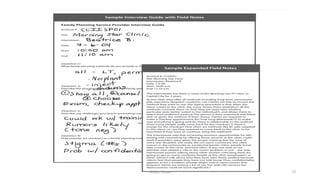
• Use shorthand. Because you will expand and type your notes
soon after you write them, it does not matter if you are the
only person who can understand your shorthand system. Use
abbreviations and acronyms to quickly note what is
happening and being said.
• Write on the interview question guide. Save time by
writing notes directly in the question guide under the relevant
question. If it is not possible to record direct quotations, write
down key words and phrases.
Aslam Aman 17
• Distinguish clearly between participant comments and
your own observations. You could use your own initials or
“MO” to indicate “my observation.” For example: "MO –
embarrassed by empty beer bottles in room.” This documents
the researcher‟s observation that the participant seemed
embarrassed about the empty beer bottles in the room.
• Cover a range of observations: body language, moods, or
attitudes; the general environment; and other information that
could be relevant.
Aslam Aman 18
Expanding the notes
• Scheduling time to expand your notes, preferably within 24
hours of the interview.
• Expanding your shorthand into sentences so that anyone can
read and understand your notes.
• Composing a descriptive narrative from your shorthand and
key words.
• Identifying questions for follow-up.
• Reviewing your expanded notes and adding any final
comments.
Aslam Aman 19
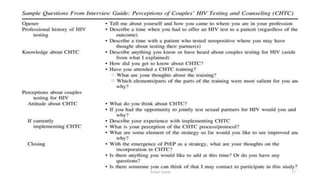
Aslam Aman 20
Aslam Aman 21
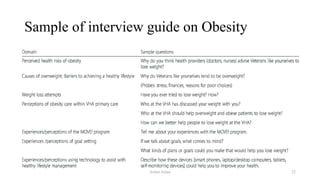
Sample of interview guide on Obesity
Aslam Aman 22
The "Do’s"
• Begin interview with a friendly and familiar greeting.
• Listen with attention to capture every piece of information
from respondents.
• Explore key words, phrases, terms as they occur in the
discussion.
• Listen to impressions, topics avoided by informant, deliberate
distortions and misconceptions or misunderstandings. Take
prompt action to explore each of these. Where appropriate,
use "probes."
Aslam Aman 23
• Ensure a natural flow of discussion by guiding informant
from one topic to the next.
• "Play dumb"(be silent) to give the respondent plenty of room
to talk.
• Be open to unexpected information.
Aslam Aman 24
The “Don'ts”
• Influence or bias responses by introducing one's own
perceptions or asking leading questions which encourage a
particular response.
• Move too quickly from one topic to the next
• Interrupt the informant.
• Do not mislead about the subject matter in order to obtain
information.
Aslam Aman 25
Advantages
• Interviewers can establish rapport with participants to make
them feel more comfortable and at-ease, which can generate
more insightful responses – especially regarding sensitive
topics.
• Interviewers have much more opportunity to ask follow-up
questions, probe for additional information.
• Interviewers can monitor changes to tone and word choice to
get a deeper understanding (and if the in-depth interview is
face-to-face, researchers can also focus on body language).
Aslam Aman 26
• Researchers need fewer participants to get useful and relevant
insights.
• There are none of the potential distractions or peer pressure
dynamics that can sometimes emerge in focus groups.
• Because in-depth interviews can potentially be so insightful,
it is possible to identify highly valuable finding very quickly -
- and sometimes in the first interview.
Aslam Aman 27
Disadvantages
• In-depth interviews are quite time consuming, as interviews
must be transcribed, organized, analyzed and reported.
• If the interviewer is not highly skilled and experienced, the
entire process can be undermined.
• The process can be relatively costly compared to other
methods (however, telephone in-depth interviews vs. in-
person can significantly reduce the costs).
Aslam Aman 28
• Participants must carefully chosen to avoid bias, and this can
result in a longer vetting process.
• Participants typically expect an incentive to participate, and
this must be carefully selected to avoid bias.
Aslam Aman 29
Bibliography
• Collector, D. and Module, F. G. „In-Depth Interviews‟.
• Boyce, C. and Associate, E. (2006) „CONDUCTING IN-DEPTH
INTERVIEWS : A Guide for Designing and Conducting In-Depth
Interviews‟, (May).
• https://www.cfrinc.net/cfrblog/in-depth-interviewing
• Kumar, R., 2017. Research Methodology. s.l.:SAGE text.
Aslam Aman 30
Aslam Aman 31

In Depth Interview (IDI)

  • 1.
    In Depth Interview PreparedBy Mohammad Aslam Shaiekh Master of Public Health (MPH) Aslam Aman 1
  • 2.
    Introduction • An in-depthinterview is a qualitative research technique that allows person to person discussion. It can lead to increased insight into people's thoughts, feelings, and behavior on important issues. This type of interview is often unstructured and therefore permits the interviewer to encourage an informant (respondent) to talk at length about the topic of interest. Aslam Aman 2
  • 3.
    Cont… • In-depth interviewsoffer the opportunity to capture rich, descriptive data about people‟s behaviors, attitudes and perceptions, and unfolding complex processes. • The in-depth interview uses a flexible interview approach. It aims to ask questions to explain the reasons underlying a problem or practice in a target group. Aslam Aman 3
  • 4.
    In depth interview •Various kinds and purposes • Open-ended questions • Looking for meaning and context and information in respondents‟ own words • Combine structure with flexibility • Interactive • Follow new lines of inquiry as they arise • Explore a topic in-depth with follow-ups and probes: whys, hows, examples, etc. Aslam Aman 4
  • 5.
    Interview Steps A. Preparingfor the interview a. Getting familiar with the instruments: 1. Study the interview guide. 2. Study the informed consent document. 3. Practice with the partner. b. Day of the interview: 4. Using a checklist, verify that you have all the equipment. 5. Label all data documentation materials with an identical archival number, including tapes, notebooks and question guides. Aslam Aman 5
  • 6.
    6. Arrive earlyat the interview site to set up equipment 7. Test your recording equipment. B. Conducting the interview 8. Greet the participants in a friendly manner to begin establishing positive rapport. 9. Briefly describe the steps of the interview process (informed consent, question and answer, their questions, reimbursement). 10. Obtain informed consent. 11. Turn on the tape recorder and verify that it is working. 12. Verify informed consent orally with the tape recorder on. Aslam Aman 6
  • 7.
    13. Conduct theinterview according to the interview guide. 14. End the question asking phase of the interview 15. Give the participant an opportunity to ask questions. 16. Reconfirm the participant‟s consent while the tape recorder is still on. 17. Turn off the tape recorder and thank the participant. 18. Clarify any factual errors expressed by participants during the interview. 19. Reimburse the participant in accordance with study procedures. Aslam Aman 7
  • 8.
    C. After theinterview 20. Check the tape to see if the interview was recorded. If it was not , expand your notes immediately. 21. Punch out the re-record tab. 22. Make sure all materials are labelled with the archival number. 23. Debrief with other field staff. 24. Assemble all materials into one envelope. Double check that you have completed all forms and that all materials are appropriately labelled. Note and explain any missing materials on the archival information sheet. 25. Expand your notes within 24 hours if possible. Aslam Aman 8
  • 9.
    Interview Checklist A. InterviewChecklist • Private setting for interview site. • Transportation of staff to interview site. • Transportation of participants to interview site. • Refreshments for participants (if applicable) B. What to take to the interview a. Equipment • 1 voice recorder (plus 1 extra, if available) • 1 extra storage device per interview • Spare batteries • Field notebook and pens Aslam Aman 9
  • 10.
    b. Interview packet •1 large, heavy-duty envelope • Archival information sheet with archival number • 1 copy of interview guide (in the appropriate language for participants) • 2 informed consent forms (1 for interview, 1 for participant, in the appropriate language) • Participant reimbursement (if applicable) • Reimbursement form (if applicable) Aslam Aman 10
  • 11.
    c. What toplace in the envelope after the interview • Completed archival information sheet • Signed informed consent form (signed only by interviewer if oral, by participant and interviewer if written) • Labelled interview guide with notes • Field notes • Labelled cassette tapes, re-record tabs punched out • Signed reimbursement form (if applicable) Aslam Aman 11
  • 12.
    How to Bean Effective Interviewer • Be familiar with research documents • Practice interviewing • Practice using the equipment Aslam Aman 12
  • 13.
    Key skills forin-depth interviewing • Rapport-building • Be friendly, smile, use a pleasant tone of voice, use relaxed body language, incorporate humor, be humble, do not scold, coerce, or cajole participants, be patient • Emphasizing the participant‟s perspective • Treating the participant as the expert • Keeping the participant from interviewing you • Balancing deference to the participant with control over the interview • Being an engaged listener • Demonstrating a neutral attitude Aslam Aman 13
  • 14.
    •Adapting to differentpersonalities and emotional states • Quickly adjust your style to suit each individual participant. By adopting an appropriate behavior for each individual, the interviewer can help the participant be comfortable enough to speak freely about the research topic. • Know how to tone down heightened emotions, such as when a participant starts crying or becomes belligerent. Aslam Aman 14
  • 15.
    Techniques for effectivequestioning • Keep track of which questions have and have not been asked and answered • Know how to phrase questions that encourage participants to provide elaborate, detailed (rather than brief) responses; • Ask questions that elicit the participant‟s own views and experiences as opposed to reflecting the convictions of the interviewer. • Ask one question at a time, verifying unclear responses, • Ask open-ended questions, avoiding leading questions, and using follow-ups and probes Aslam Aman 15
  • 16.
    Tips for takinginterview notes • Begin each notebook entry with the date, time, place, and type of data collection event. • Leave space on the page for expanding your notes, or plan to expand them on a separate page. • Take notes strategically. It is usually practical to make only brief notes during data collection. Direct quotes can be especially hard to write down accurately. Rather than try to document every detail or quote, write down key words and phrases that will trigger your memory when you expand notes. Aslam Aman 16
  • 17.
    • Use shorthand.Because you will expand and type your notes soon after you write them, it does not matter if you are the only person who can understand your shorthand system. Use abbreviations and acronyms to quickly note what is happening and being said. • Write on the interview question guide. Save time by writing notes directly in the question guide under the relevant question. If it is not possible to record direct quotations, write down key words and phrases. Aslam Aman 17
  • 18.
    • Distinguish clearlybetween participant comments and your own observations. You could use your own initials or “MO” to indicate “my observation.” For example: "MO – embarrassed by empty beer bottles in room.” This documents the researcher‟s observation that the participant seemed embarrassed about the empty beer bottles in the room. • Cover a range of observations: body language, moods, or attitudes; the general environment; and other information that could be relevant. Aslam Aman 18
  • 19.
    Expanding the notes •Scheduling time to expand your notes, preferably within 24 hours of the interview. • Expanding your shorthand into sentences so that anyone can read and understand your notes. • Composing a descriptive narrative from your shorthand and key words. • Identifying questions for follow-up. • Reviewing your expanded notes and adding any final comments. Aslam Aman 19
  • 20.
  • 21.
  • 22.
    Sample of interviewguide on Obesity Aslam Aman 22
  • 23.
    The "Do’s" • Begininterview with a friendly and familiar greeting. • Listen with attention to capture every piece of information from respondents. • Explore key words, phrases, terms as they occur in the discussion. • Listen to impressions, topics avoided by informant, deliberate distortions and misconceptions or misunderstandings. Take prompt action to explore each of these. Where appropriate, use "probes." Aslam Aman 23
  • 24.
    • Ensure anatural flow of discussion by guiding informant from one topic to the next. • "Play dumb"(be silent) to give the respondent plenty of room to talk. • Be open to unexpected information. Aslam Aman 24
  • 25.
    The “Don'ts” • Influenceor bias responses by introducing one's own perceptions or asking leading questions which encourage a particular response. • Move too quickly from one topic to the next • Interrupt the informant. • Do not mislead about the subject matter in order to obtain information. Aslam Aman 25
  • 26.
    Advantages • Interviewers canestablish rapport with participants to make them feel more comfortable and at-ease, which can generate more insightful responses – especially regarding sensitive topics. • Interviewers have much more opportunity to ask follow-up questions, probe for additional information. • Interviewers can monitor changes to tone and word choice to get a deeper understanding (and if the in-depth interview is face-to-face, researchers can also focus on body language). Aslam Aman 26
  • 27.
    • Researchers needfewer participants to get useful and relevant insights. • There are none of the potential distractions or peer pressure dynamics that can sometimes emerge in focus groups. • Because in-depth interviews can potentially be so insightful, it is possible to identify highly valuable finding very quickly - - and sometimes in the first interview. Aslam Aman 27
  • 28.
    Disadvantages • In-depth interviewsare quite time consuming, as interviews must be transcribed, organized, analyzed and reported. • If the interviewer is not highly skilled and experienced, the entire process can be undermined. • The process can be relatively costly compared to other methods (however, telephone in-depth interviews vs. in- person can significantly reduce the costs). Aslam Aman 28
  • 29.
    • Participants mustcarefully chosen to avoid bias, and this can result in a longer vetting process. • Participants typically expect an incentive to participate, and this must be carefully selected to avoid bias. Aslam Aman 29
  • 30.
    Bibliography • Collector, D.and Module, F. G. „In-Depth Interviews‟. • Boyce, C. and Associate, E. (2006) „CONDUCTING IN-DEPTH INTERVIEWS : A Guide for Designing and Conducting In-Depth Interviews‟, (May). • https://www.cfrinc.net/cfrblog/in-depth-interviewing • Kumar, R., 2017. Research Methodology. s.l.:SAGE text. Aslam Aman 30
  • 31.