1
2
FOCUS
GROUP
Presented By
Mahjabeen Awan
Asma Maqsood
Presented to
Ma’am Shabana Asghar
.
3
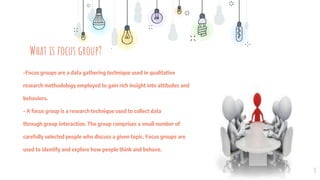
What is focus group?
-Focus groups are a data gathering technique used in qualitative
research methodology employed to gain rich insight into attitudes and
behaviors.
- A focus group is a research technique used to collect data
through group interaction. The group comprises a small number of
carefully selected people who discuss a given topic. Focus groups are
used to identify and explore how people think and behave.
4
• Formerly it was referred as “focused interviews.”
• The focus group as a technique was first developed in the 1920s, mainly to help develop
survey questionnaires, although also for other purposes of social research.
• In the 1940s, Robert Merton and Paul Lazarfield used the technique for group
interviewing people about their reactions to war time (world war II) radio programs.
• From that time until the 1970s, focus groups were mainly used in market research, for
such matters as brand images, packaging and product choice.
definitions
Henderson, Naomi R., 2009
“A focus group is a form of qualitative research in which a group of people are asked
about their perceptions, opinions, beliefs and attitudes towards a product, a service,
concept, advertisement, idea, or packaging”
Focus Groups: A Practical Guide for Applied Research by Krueger
“Focus group interviews typically have five characteristics or features: (a) people, who
(b) possess certain characteristics, (c) provide data (d) of a qualitative nature (e) in a
focused discussion.”
5
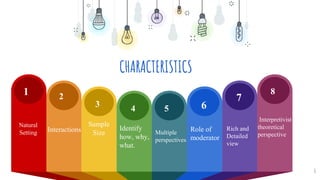
CHARACTERISTICS
6
1 2
3 4 5 6
7
8
Natural
Setting Interactions
Sample
Size
Identify
how, why,
what.
Multiple
perspectives
Role of
moderator
Rich and
Detailed
view
Interpretivist
theoretical
perspective
“
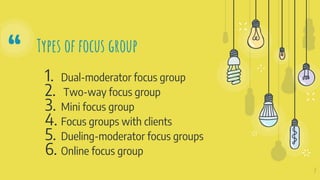
1. Dual-moderator focus group
2. Two-way focus group
3. Mini focus group
4. Focus groups with clients
5. Dueling-moderator focus groups
6. Online focus group
7
Types of focus group
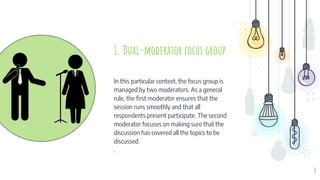
1. Dual-moderator focus group
In this particular context, the focus group is
managed by two moderators. As a general
rule, the first moderator ensures that the
session runs smoothly and that all
respondents present participate. The second
moderator focuses on making sure that the
discussion has covered all the topics to be
discussed.
.
8
2. Two-way focus group
This method consists of conducting
two focus groups simultaneously,
each with its moderator. The first
group explores a given topic, while
the second group observes the first
group and comments on the
interactions.
9
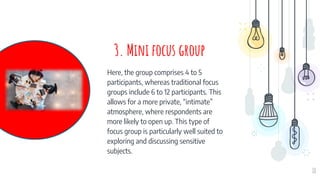
3. Mini focus group
Here, the group comprises 4 to 5
participants, whereas traditional focus
groups include 6 to 12 participants. This
allows for a more private, “intimate”
atmosphere, where respondents are
more likely to open up. This type of
focus group is particularly well suited to
exploring and discussing sensitive
subjects.
10
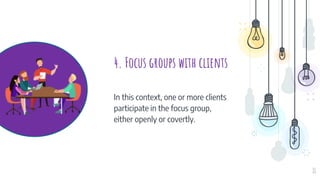
4. Focus groups with clients
In this context, one or more clients
participate in the focus group,
either openly or covertly.
11
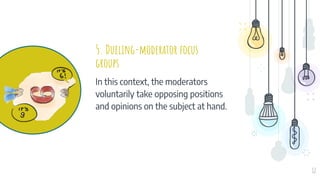
5. Dueling-moderator focus
groups
In this context, the moderators
voluntarily take opposing positions
and opinions on the subject at hand.
12
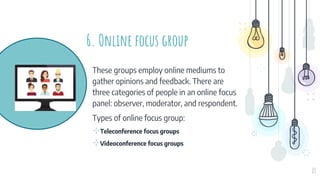
6. Online focus group
These groups employ online mediums to
gather opinions and feedback. There are
three categories of people in an online focus
panel: observer, moderator, and respondent.
Types of online focus group:
⊹Teleconference focus groups
⊹Videoconference focus groups
13
Steps for conducting
Focus Group
1) Identify purpose/information needed
2) Define your target audience
3) Develop 5-6 broad, open-ended questions
4) Recruit (& confirm) participants
5) Location, time, potential incentives
6) Conduct the focus groups
7) Analyze and summarize data
Before you can start gathering
participants, it’s important to
understand why you’re
organizing the focus group.
15
1) Identify purpose/information
needed
Demographics to consider
include gender, age range,
ethnicity, sexual orientation,
postcode, religion,
relationship and family status,
education level, income level,
and hobbies.
16
2) Define your
The purpose of a focus group discussion is
to stimulate rich conversation so it’s
important to ensure engagement
questions for focus groups are open-
ended, with no particular answer implied.
17
3) Develop 5-6 broad, open-
ended questions
4) Recruit (& confirm) participants
The ideal size for a focus group is 10 to 15 people –
any more than that and not everyone will have
the chance to provide proper input.
5) Location, time, potential incentives
One does not require a fancy venue for your focus
group – simply somewhere that is easy to find
and access.
6) Conduct the focus groups
Now it is the time to conduct the focus
group discussion. Every step should be
followed to get the ideal results.
7) Analyze and summarize data
After the event, conduct your focus group
data collection by transcribing the answers
from the recording, cutting out anything
unnecessary.
Finally, you should write a report outlining
the major findings and conclusions, as well
as the subsequent recommendations for
your event or product.
Advantages
⊹ Wider range of information
⊹ Snowballing – One person’s comments trigger a
response from another person.
⊹ Security
⊹ Ideas may arise out of the blue.
⊹ Specialization – use of highly trained interviewer.
⊹ Flexibility in the topics covered.
22
Disadvantages
23
1. Misuse
2. Misjudge
3. Difficult to code, analyze and interpret.
4. Not representative of the general population
5. Personal opinions may distort the result.
6. Restricting
7. Dominant point of view.
24
25
26

Focus Group

  • 1.
  • 2.
    2 FOCUS GROUP Presented By Mahjabeen Awan AsmaMaqsood Presented to Ma’am Shabana Asghar
  • 3.
    . 3 What is focusgroup? -Focus groups are a data gathering technique used in qualitative research methodology employed to gain rich insight into attitudes and behaviors. - A focus group is a research technique used to collect data through group interaction. The group comprises a small number of carefully selected people who discuss a given topic. Focus groups are used to identify and explore how people think and behave.
  • 4.
    4 • Formerly itwas referred as “focused interviews.” • The focus group as a technique was first developed in the 1920s, mainly to help develop survey questionnaires, although also for other purposes of social research. • In the 1940s, Robert Merton and Paul Lazarfield used the technique for group interviewing people about their reactions to war time (world war II) radio programs. • From that time until the 1970s, focus groups were mainly used in market research, for such matters as brand images, packaging and product choice.
  • 5.
    definitions Henderson, Naomi R.,2009 “A focus group is a form of qualitative research in which a group of people are asked about their perceptions, opinions, beliefs and attitudes towards a product, a service, concept, advertisement, idea, or packaging” Focus Groups: A Practical Guide for Applied Research by Krueger “Focus group interviews typically have five characteristics or features: (a) people, who (b) possess certain characteristics, (c) provide data (d) of a qualitative nature (e) in a focused discussion.” 5
  • 6.
    CHARACTERISTICS 6 1 2 3 45 6 7 8 Natural Setting Interactions Sample Size Identify how, why, what. Multiple perspectives Role of moderator Rich and Detailed view Interpretivist theoretical perspective
  • 7.
    “ 1. Dual-moderator focusgroup 2. Two-way focus group 3. Mini focus group 4. Focus groups with clients 5. Dueling-moderator focus groups 6. Online focus group 7 Types of focus group
  • 8.
    1. Dual-moderator focusgroup In this particular context, the focus group is managed by two moderators. As a general rule, the first moderator ensures that the session runs smoothly and that all respondents present participate. The second moderator focuses on making sure that the discussion has covered all the topics to be discussed. . 8
  • 9.
    2. Two-way focusgroup This method consists of conducting two focus groups simultaneously, each with its moderator. The first group explores a given topic, while the second group observes the first group and comments on the interactions. 9
  • 10.
    3. Mini focusgroup Here, the group comprises 4 to 5 participants, whereas traditional focus groups include 6 to 12 participants. This allows for a more private, “intimate” atmosphere, where respondents are more likely to open up. This type of focus group is particularly well suited to exploring and discussing sensitive subjects. 10
  • 11.
    4. Focus groupswith clients In this context, one or more clients participate in the focus group, either openly or covertly. 11
  • 12.
    5. Dueling-moderator focus groups Inthis context, the moderators voluntarily take opposing positions and opinions on the subject at hand. 12
  • 13.
    6. Online focusgroup These groups employ online mediums to gather opinions and feedback. There are three categories of people in an online focus panel: observer, moderator, and respondent. Types of online focus group: ⊹Teleconference focus groups ⊹Videoconference focus groups 13
  • 14.
    Steps for conducting FocusGroup 1) Identify purpose/information needed 2) Define your target audience 3) Develop 5-6 broad, open-ended questions 4) Recruit (& confirm) participants 5) Location, time, potential incentives 6) Conduct the focus groups 7) Analyze and summarize data
  • 15.
    Before you canstart gathering participants, it’s important to understand why you’re organizing the focus group. 15 1) Identify purpose/information needed
  • 16.
    Demographics to consider includegender, age range, ethnicity, sexual orientation, postcode, religion, relationship and family status, education level, income level, and hobbies. 16 2) Define your
  • 17.
    The purpose ofa focus group discussion is to stimulate rich conversation so it’s important to ensure engagement questions for focus groups are open- ended, with no particular answer implied. 17 3) Develop 5-6 broad, open- ended questions
  • 18.
    4) Recruit (&confirm) participants The ideal size for a focus group is 10 to 15 people – any more than that and not everyone will have the chance to provide proper input.
  • 19.
    5) Location, time,potential incentives One does not require a fancy venue for your focus group – simply somewhere that is easy to find and access.
  • 20.
    6) Conduct thefocus groups Now it is the time to conduct the focus group discussion. Every step should be followed to get the ideal results.
  • 21.
    7) Analyze andsummarize data After the event, conduct your focus group data collection by transcribing the answers from the recording, cutting out anything unnecessary. Finally, you should write a report outlining the major findings and conclusions, as well as the subsequent recommendations for your event or product.
  • 22.
    Advantages ⊹ Wider rangeof information ⊹ Snowballing – One person’s comments trigger a response from another person. ⊹ Security ⊹ Ideas may arise out of the blue. ⊹ Specialization – use of highly trained interviewer. ⊹ Flexibility in the topics covered. 22
  • 23.
    Disadvantages 23 1. Misuse 2. Misjudge 3.Difficult to code, analyze and interpret. 4. Not representative of the general population 5. Personal opinions may distort the result. 6. Restricting 7. Dominant point of view.
  • 24.
  • 25.
  • 26.