Survey methods
Moderator : Sri. M. D. Mallapur
Presenters :
Dr Anil Bilimale
Topics
 Introduction
 Purpose & definition
 Types
 Information from surveys
 Steps of surveys
 Study population & Sampling
 Questionnaires
 Interviews & schedule
 Advantages & limitations
Introduction
 In many occasions it becomes essential
to have information other than routine
for some definite purpose.
 Surveys are the means of data
collection in such cases.
 Surveys may be carried out on total
population or on a sample.
 Surveys may differ in their purpose,
size, design, scope, content & method.
Surveys are the scientific studies carried
out to obtain information on health
condition of a population or to plan,
prioritise,monitor or evaluate a health
programme or to carry out comparisons.
 The purpose of these studies in
community medicine is to collect
information that will provide basis for
action, immediately or in long run.
 A survey can be a means to stimulate
public interest in a particular topic and
then to community action.
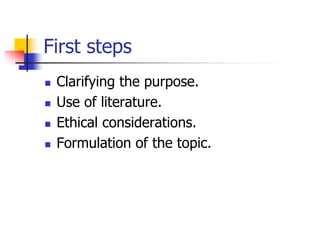
First steps
 Clarifying the purpose.
 Use of literature.
 Ethical considerations.
 Formulation of the topic.
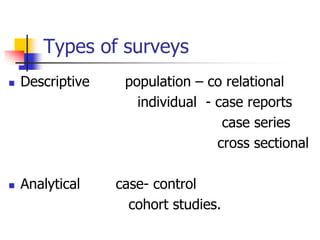
Types of surveys
 Descriptive population – co relational
individual - case reports
case series
cross sectional
 Analytical case- control
cohort studies.
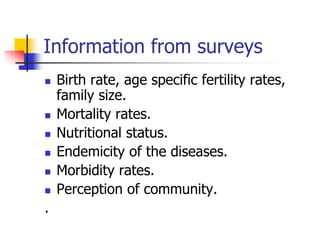
Information from surveys
 Birth rate, age specific fertility rates,
family size.
 Mortality rates.
 Nutritional status.
 Endemicity of the diseases.
 Morbidity rates.
 Perception of community.
.
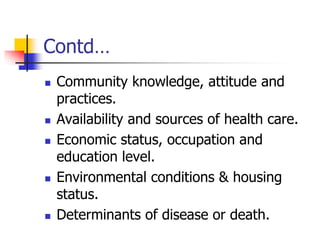
Contd…
 Community knowledge, attitude and
practices.
 Availability and sources of health care.
 Economic status, occupation and
education level.
 Environmental conditions & housing
status.
 Determinants of disease or death.
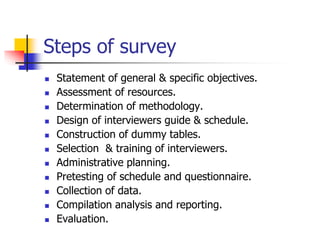
Steps of survey
 Statement of general & specific objectives.
 Assessment of resources.
 Determination of methodology.
 Design of interviewers guide & schedule.
 Construction of dummy tables.
 Selection & training of interviewers.
 Administrative planning.
 Pretesting of schedule and questionnaire.
 Collection of data.
 Compilation analysis and reporting.
 Evaluation.
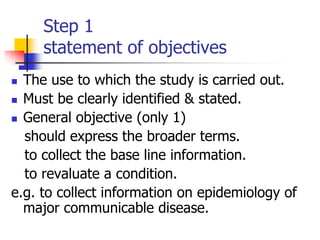
Step 1
statement of objectives
 The use to which the study is carried out.
 Must be clearly identified & stated.
 General objective (only 1)
should express the broader terms.
to collect the base line information.
to revaluate a condition.
e.g. to collect information on epidemiology of
major communicable disease.
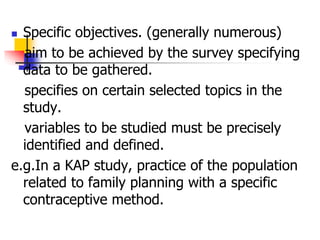
 Specific objectives. (generally numerous)
aim to be achieved by the survey specifying
data to be gathered.
specifies on certain selected topics in the
study.
variables to be studied must be precisely
identified and defined.
e.g.In a KAP study, practice of the population
related to family planning with a specific
contraceptive method.
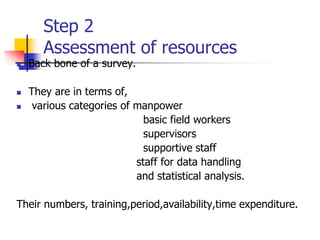
Step 2
Assessment of resources
 Back bone of a survey.
 They are in terms of,
 various categories of manpower
basic field workers
supervisors
supportive staff
staff for data handling
and statistical analysis.
Their numbers, training,period,availability,time expenditure.
Contd...
 Resources in terms of transport, stationary,
duplicating machines, electronic data
handling machines and equipments for clinical
and lab examinations are to be assessed.
 Additional resources need to be calculated.
 Match between resources available and
expectation from a survey should be
practical.
STEP 3
Determination of methodology
 Methodology depends upon objectives,
type of data to be collected and
characteristics of the population.
 Collection of data can be done by using,
an interview schedule or
a questionnaire.
Interview
Objective :
Exchange of ideas or experiences, eliciting of
information pertaining to a wide range of
data in which the interviewee may wish to
rehearse his part, define his present and
canvass his future possibilities.
 Task of the interviewer is to ascertain
opinions, attitudes, values that are on the
surface.
 Explore personality forces in the subject’s
unconsciousness.
A Schedule
 Schedule is a programme to conduct an
interview.
 Its an instrument to be filled in by an
interviewer.
 Most common method.
e.g. face to face interview with woman
of reproductive age group.
 Data on large number of items are
collected in this way.
Questionnaire
 A series of preset questions designed to
elicit the required information.
 To be filled in by respondent.
 Ways of obtaining response:
1.By mailing the questionnaire.
2.By asking directly (Interview).
 Types:
Structured :
Closed – MCQ type
Open -- Blank type
Unstructured : Flexibility is the main
advantage.
No limitations imposed.
Non additive & non comparable
data may be accumulated.
How to prepare….
 Limit the length & scope.
 Limit the time for a max of 30 minutes.
 Give more detailed experience of inquiry.
 Now max about the problem before structuring.
 Include all relevant & delete unnecessary.
 Simple wording, avoid personal & embarrassing.
 Maintain uniformity & move from inside to outward of
the problem.
 Try to awaken the interest of the respondent.
Advantages
 Economical.
 Covers large population scattered over a wide area.
 Mailed questionnaire saves the time, ensures privacy,
freedom to express.
 Analysis & interpretation can be done quickly.
 Sufficient leisure time.
Disadvantages
 Illiteracy.
 Not suitable for spontaneous answers.
 Lack of flexibility.
 Skipping questions possible.
STEP 4
Construction of dummy tables
 Constructed at planning stage.
 Clarity of analytical methods results from
such an exercise.
 Modification needed becomes obvious at
this stage itself.
STEP 5
Selection& training of interviewers
 Obviously literates, speak local language,
have field experience, good social contact &
be acceptable to the population.
 Purpose – to achieve uniformity, eliminate
sampling errors ( bais,skill,approach).
 Use general technique, clear concept,
motivate the subject.
 Entertain demonstration, group discussion.
 Prepare interviewers guide.
STEP 6
Administrative planning
 For recruitment, training & supervision.
 Administrators may be health service
personnel or temporarily assigned ones
like students/volunteers.
 Use local calendars to finalize the dates.
Step 7
Pretesting
 Applied in field on a small scale (pilot study).
 Ensures that methodology fulfills the
objectives.
 Variability in response can be identified.
 Checks the hurdles at initial stage.
 Eases any problems that are likely to arise by
filling dummy tables at early stage.
Step 8
Collection of data
 Advanced publicity is given.
 Meeting community leaders.
 Timing of the survey convenient to respondents
E.g,Early morning survey.
Method :
 Identify himself, explain the purpose of visit & assure
confidentiality.
 Confirm that household is included in the sample.
 Develop a favorable climate & establish rapport to
win the confidence.
 Items in the data are asked.
 Current & consecutive supervision of the survey.
Step 9
Compilation,analysis & reporting
 Arrangement of data depending on the scope
& magnitude of the survey.
 Done manually or by using electronic
processing systems.
 Analysis is done as per original intention of
the survey by filling dummy tables.
 Report should satisfy the needs of objectives.
 Reasons for non coverage of target
population should be stated.
Step 10
Evaluation
 It denotes the stability and consistency of
information.
i.e, extent of correspondence & similarity
when data is collected again.
 Reliability can be evaluated by comparing one
data with another.
E,g, dietary consumption can be cross
checked with income, standard of living etc
 Evaluation helps to strengthen the evidence
for the survey.
Advantages
 Provides information on health aspects about which
information is not otherwise available from any
source.
 Information pertaining to numerator as well as
denominator becomes available, rates & ratios can be
calculated.
 Association between them can be identified.
 Groups who need more attention can be identified.
 Data will be reliable, accurate and complete.
 Sampling reduces the cost and increases accuracy.
 Information on health related behavior can be
obtained.
Limitations
 Information collected is subjected to errors.
(sampling & non sampling errors).
 Efficiency of workers can be fluctuating.
 Unwillingness to participate and inability to
understand questions.
 Non-availability of respondents at the time of
survey.
 Large geographical area coverage will need
more recourses.
 Survey procedure is expensive in terms of man
power & other costs.
SURVEY RESEARCH
 TYPES OF SURVEYS
 SELECTING THE SURVEY METHOD
 CONSTRUCTING THE SURVEY
 ADVANTAGES & DISADVANTAGES
TYPES OF SURVEYS
 Two broad categories :
 1. Questionnaire
 2. Interview
Some examples
 Automated telephone surveys
 Computerised kiosks in public places
 Hotel room – Customer satisfaction
survey
 Website survey
Questionnaires
 Mail survey
 Group administered questionnaires
 Household drop-off survey
Interviews
 Personal Interview
 Telephone Interview
SELECTING THE SURVEY
METHOD
 Population Issues
 Sampling Issues
 Question Issues
 Content Issues
 Bias Issues
 Administrative Issues
Population Issues
 Can the population be enumerated?
 Is the population literate?
 Are there language issues?
 Will the population cooperate?
 What are the geographical restrictions?
Sampling Issues
 What data is available?
 Can respondents be found?
 Who is the respondent?
 Can all members of the population be
sampled?
 Are response rates likely to be a
problem?
Question Issues
 What types of questions can be asked?
 How complex will the questions be?
 Will screening questions be needed?
 Can question sequence be controlled?
 Will lengthy questions be asked?
 Will long response scales be used?
Content Issues
 Can the respondents be expected to
know about the issue?
 Will respondent need to consult
records?
Bias Issues
 Can social desirability be avoided?
 Can interviewer distortion and
subversion be controlled?
 Can false respondents be avoided?
Administrative Issues
 Costs
 Facilities
 Time
 Personnel
Constructing the Survey
 Content
 Wording
 Format
 Placement
Writing a question
 Determining the question content,
scope and purpose
 Choosing the response format that we
use for collecting information from the
respondent
 Figuring out how to word the question
to get at the issue of interest
 How best to place them in our survey.
Types of questions
 1. Structured
 2. Unstructured
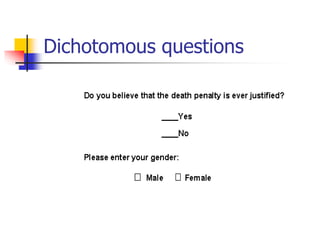
Dichotomous questions
Questions based on level of
Measurement
 Nominal
 Ordinal
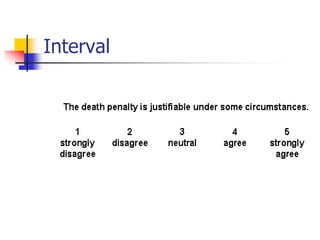
 Interval
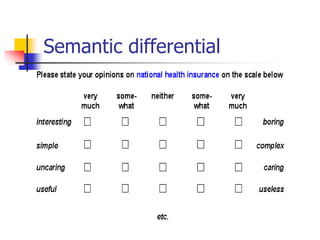
 Semantic differential
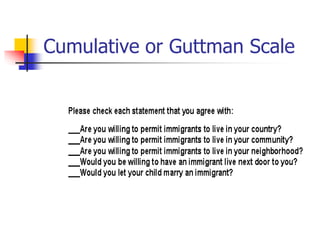
 Cumulative or Guttman Scale
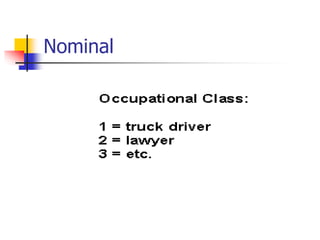
Nominal
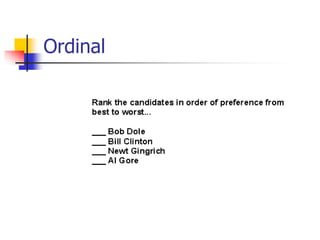
Ordinal
Interval
Semantic differential
Cumulative or Guttman Scale
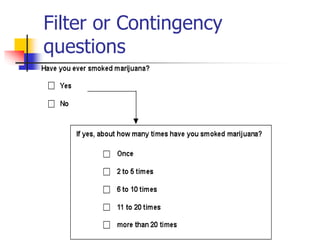
Filter or Contingency
questions
Multiple filter questions
 Avoid having more than 3 levels [2
jumps] for a question
 If only 2 levels, use graphic to jump[
eg. Arrow & box]
 If possible jump to a new page
 “If yes turn to page 4” is better than “
If yes ,please go to question 38”
Question content
Is the question necessary/useful?
 Do you need the age of each child or
just the number of children under 16?
 Do you need to ask income or can you
estimate?
Are several questions needed?
 Double barreled question
- What are your feelings towards African-Americans
and Hispanic-Americans?
- What do you think of proposed changes in benefits
and hours?
- Does not cover all possibilities
- Eg. Earnings
- Does not give you enough context
- Eg. Attitude towards catholics
- Does not determine the intensity
- Eg. Support Public TV
- Do respondents have needed
information?
- Does the question needs to be more
specific?
- Is question sufficiently general?
- Is question biased or loaded?
- Will respondents answer truthfully?
Response format
 Structured response format
 Unstructured response format
Question Wording
 Can the question be misunderstood?
 What assumptions does the question make?
 Is the time frame specified?
 How personal is the wording?
 Is the wording too direct?
 Does the question contain difficult or unclear
terminology?
 Does the question make each alternative explicit?
 Is the wording objectionable?
 Is the wording loaded or slanted?
Question Placement
 Decisions about Placement
 Is the answer influenced by prior questions?
 Does question come too early or too late to
arouse interest?
 Does the question receive sufficient
attention?
 The opening questions
 Sensitive questions
A checklist of considerations
 Start with easy, nonthreatening questions
 Put more difficult, threatening questions near end
 Never start a mail survey with an open-ended
question
 For historical demographics, follow chronological
order
 Ask about one topic at a time
 When switching topics, use a transition
 Reduce response set (the tendency of respondent to
just keep checking the same response)
 For filter or contingency questions, make a flowchart
The Golden Rule :
 Thank the respondent at the beginning for allowing
you to conduct your study
 Keep your survey as short as possible -- only include
what is absolutely necessary
 Be sensitive to the needs of the respondent
 Be alert for any sign that the respondent is
uncomfortable
 Thank the respondent at the end for participating
 Assure the respondent that you will send a copy of
the final results
Interviews
Interviews are among the most
challenging and rewarding forms of
measurement. They require a personal
sensitivity and adaptability as well as
the ability to stay within the bounds of
the designed protocol.
Preparation
 The role of the Interviewer
 Locate and enlist cooperation of
respondents
 Motivate respondents to do good job
 Clarify any confusion/concerns
 Observe quality of responses
 Conduct a good interview
Training the Interviewers
 Describe the entire study
 State who is sponsor of research
 Teach enough about survey research
 Explain the sampling logic and process
 Explain interviewer bias
 Walk through" the interview
 Explain respondent selection procedures, including
 1.Reading maps
 2.Identifying households
 3.Identify respondents
 4.Rehearse interview
 5.Explain supervision
 6.Explain scheduling
The Interviewer's Kit
 A "professional-looking" 3-ring notebook (this
might even have the logo of the company or
organization conducting the interviews)
 Maps
 Sufficient copies of the survey instrument
 Official identification (preferable a picture ID)
 A cover letter from the Principal Investigator
or Sponsor
 A phone number the respondent can call to
verify the interviewer's authenticity
The Interview
 Opening Remarks
1. Gaining entry
2. Doorstep technique
3. Introduction
4. Explaining the study
Asking the questions
 Use questionnaire carefully, but
informally
 Ask questions exactly as written
 Follow the order given
 Ask every question
 Don't finish sentences
Obtaining Adequate Responses
- The Probe
 Silent probe
 Overt encouragement
 Elaboration
 Ask for clarification
 Repetition
Recording the Response
 Record responses immediately
 Include all probes
 Use abbreviations where possible
Concluding the Interview
 Thank the respondent
 Tell them when you expect to send
results
 Don't be brusque or hasty
 Immediately after leaving -- write down
any notes about how the interview went
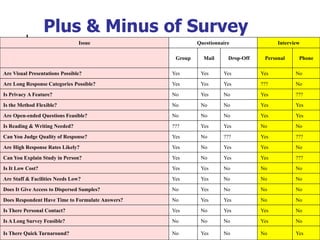
Plus & Minus of Survey
Methods
Issue Questionnaire Interview
Group Mail Drop-Off Personal Phone
Are Visual Presentations Possible? Yes Yes Yes Yes No
Are Long Response Categories Possible? Yes Yes Yes ??? No
Is Privacy A Feature? No Yes No Yes ???
Is the Method Flexible? No No No Yes Yes
Are Open-ended Questions Feasible? No No No Yes Yes
Is Reading & Writing Needed? ??? Yes Yes No No
Can You Judge Quality of Response? Yes No ??? Yes ???
Are High Response Rates Likely? Yes No Yes Yes No
Can You Explain Study in Person? Yes No Yes Yes ???
Is It Low Cost? Yes Yes No No No
Are Staff & Facilities Needs Low? Yes Yes No No No
Does It Give Access to Dispersed Samples? No Yes No No No
Does Respondent Have Time to Formulate Answers? No Yes Yes No No
Is There Personal Contact? Yes No Yes Yes No
Is A Long Survey Feasible? No No No Yes No
Is There Quick Turnaround? No Yes No No Yes
REFERENCES
 1.DOME presentations by Dr.Padmaja
Walvekar and Dr.C.S.Metgud
 2.K.PARK,Text book of Community
Medicine,18th edition
 Text Book of Survey Methods,Abramson,5th
ed
 Text book of Sociology,Shakar Rao 3rd ed
 Text book of Epidemiology tools,Sathe &
Sathe 2nd ed
 www.socialresearchmethods.net
THANK YOU…..

survey method.ppt community medicine psm

  • 1.
    Survey methods Moderator :Sri. M. D. Mallapur Presenters : Dr Anil Bilimale
  • 2.
    Topics  Introduction  Purpose& definition  Types  Information from surveys  Steps of surveys  Study population & Sampling  Questionnaires  Interviews & schedule  Advantages & limitations
  • 3.
    Introduction  In manyoccasions it becomes essential to have information other than routine for some definite purpose.  Surveys are the means of data collection in such cases.  Surveys may be carried out on total population or on a sample.  Surveys may differ in their purpose, size, design, scope, content & method.
  • 4.
    Surveys are thescientific studies carried out to obtain information on health condition of a population or to plan, prioritise,monitor or evaluate a health programme or to carry out comparisons.
  • 5.
     The purposeof these studies in community medicine is to collect information that will provide basis for action, immediately or in long run.  A survey can be a means to stimulate public interest in a particular topic and then to community action.
  • 6.
    First steps  Clarifyingthe purpose.  Use of literature.  Ethical considerations.  Formulation of the topic.
  • 7.
    Types of surveys Descriptive population – co relational individual - case reports case series cross sectional  Analytical case- control cohort studies.
  • 8.
    Information from surveys Birth rate, age specific fertility rates, family size.  Mortality rates.  Nutritional status.  Endemicity of the diseases.  Morbidity rates.  Perception of community. .
  • 9.
    Contd…  Community knowledge,attitude and practices.  Availability and sources of health care.  Economic status, occupation and education level.  Environmental conditions & housing status.  Determinants of disease or death.
  • 10.
    Steps of survey Statement of general & specific objectives.  Assessment of resources.  Determination of methodology.  Design of interviewers guide & schedule.  Construction of dummy tables.  Selection & training of interviewers.  Administrative planning.  Pretesting of schedule and questionnaire.  Collection of data.  Compilation analysis and reporting.  Evaluation.
  • 11.
    Step 1 statement ofobjectives  The use to which the study is carried out.  Must be clearly identified & stated.  General objective (only 1) should express the broader terms. to collect the base line information. to revaluate a condition. e.g. to collect information on epidemiology of major communicable disease.
  • 12.
     Specific objectives.(generally numerous) aim to be achieved by the survey specifying data to be gathered. specifies on certain selected topics in the study. variables to be studied must be precisely identified and defined. e.g.In a KAP study, practice of the population related to family planning with a specific contraceptive method.
  • 13.
    Step 2 Assessment ofresources  Back bone of a survey.  They are in terms of,  various categories of manpower basic field workers supervisors supportive staff staff for data handling and statistical analysis. Their numbers, training,period,availability,time expenditure.
  • 14.
    Contd...  Resources interms of transport, stationary, duplicating machines, electronic data handling machines and equipments for clinical and lab examinations are to be assessed.  Additional resources need to be calculated.  Match between resources available and expectation from a survey should be practical.
  • 15.
    STEP 3 Determination ofmethodology  Methodology depends upon objectives, type of data to be collected and characteristics of the population.  Collection of data can be done by using, an interview schedule or a questionnaire.
  • 16.
    Interview Objective : Exchange ofideas or experiences, eliciting of information pertaining to a wide range of data in which the interviewee may wish to rehearse his part, define his present and canvass his future possibilities.  Task of the interviewer is to ascertain opinions, attitudes, values that are on the surface.  Explore personality forces in the subject’s unconsciousness.
  • 17.
    A Schedule  Scheduleis a programme to conduct an interview.  Its an instrument to be filled in by an interviewer.  Most common method. e.g. face to face interview with woman of reproductive age group.  Data on large number of items are collected in this way.
  • 18.
    Questionnaire  A seriesof preset questions designed to elicit the required information.  To be filled in by respondent.  Ways of obtaining response: 1.By mailing the questionnaire. 2.By asking directly (Interview).
  • 19.
     Types: Structured : Closed– MCQ type Open -- Blank type Unstructured : Flexibility is the main advantage. No limitations imposed. Non additive & non comparable data may be accumulated.
  • 20.
    How to prepare…. Limit the length & scope.  Limit the time for a max of 30 minutes.  Give more detailed experience of inquiry.  Now max about the problem before structuring.  Include all relevant & delete unnecessary.  Simple wording, avoid personal & embarrassing.  Maintain uniformity & move from inside to outward of the problem.  Try to awaken the interest of the respondent.
  • 21.
    Advantages  Economical.  Coverslarge population scattered over a wide area.  Mailed questionnaire saves the time, ensures privacy, freedom to express.  Analysis & interpretation can be done quickly.  Sufficient leisure time. Disadvantages  Illiteracy.  Not suitable for spontaneous answers.  Lack of flexibility.  Skipping questions possible.
  • 22.
    STEP 4 Construction ofdummy tables  Constructed at planning stage.  Clarity of analytical methods results from such an exercise.  Modification needed becomes obvious at this stage itself.
  • 23.
    STEP 5 Selection& trainingof interviewers  Obviously literates, speak local language, have field experience, good social contact & be acceptable to the population.  Purpose – to achieve uniformity, eliminate sampling errors ( bais,skill,approach).  Use general technique, clear concept, motivate the subject.  Entertain demonstration, group discussion.  Prepare interviewers guide.
  • 24.
    STEP 6 Administrative planning For recruitment, training & supervision.  Administrators may be health service personnel or temporarily assigned ones like students/volunteers.  Use local calendars to finalize the dates.
  • 25.
    Step 7 Pretesting  Appliedin field on a small scale (pilot study).  Ensures that methodology fulfills the objectives.  Variability in response can be identified.  Checks the hurdles at initial stage.  Eases any problems that are likely to arise by filling dummy tables at early stage.
  • 26.
    Step 8 Collection ofdata  Advanced publicity is given.  Meeting community leaders.  Timing of the survey convenient to respondents E.g,Early morning survey. Method :  Identify himself, explain the purpose of visit & assure confidentiality.  Confirm that household is included in the sample.  Develop a favorable climate & establish rapport to win the confidence.  Items in the data are asked.  Current & consecutive supervision of the survey.
  • 27.
    Step 9 Compilation,analysis &reporting  Arrangement of data depending on the scope & magnitude of the survey.  Done manually or by using electronic processing systems.  Analysis is done as per original intention of the survey by filling dummy tables.  Report should satisfy the needs of objectives.  Reasons for non coverage of target population should be stated.
  • 28.
    Step 10 Evaluation  Itdenotes the stability and consistency of information. i.e, extent of correspondence & similarity when data is collected again.  Reliability can be evaluated by comparing one data with another. E,g, dietary consumption can be cross checked with income, standard of living etc  Evaluation helps to strengthen the evidence for the survey.
  • 29.
    Advantages  Provides informationon health aspects about which information is not otherwise available from any source.  Information pertaining to numerator as well as denominator becomes available, rates & ratios can be calculated.  Association between them can be identified.  Groups who need more attention can be identified.  Data will be reliable, accurate and complete.  Sampling reduces the cost and increases accuracy.  Information on health related behavior can be obtained.
  • 30.
    Limitations  Information collectedis subjected to errors. (sampling & non sampling errors).  Efficiency of workers can be fluctuating.  Unwillingness to participate and inability to understand questions.  Non-availability of respondents at the time of survey.  Large geographical area coverage will need more recourses.  Survey procedure is expensive in terms of man power & other costs.
  • 31.
    SURVEY RESEARCH  TYPESOF SURVEYS  SELECTING THE SURVEY METHOD  CONSTRUCTING THE SURVEY  ADVANTAGES & DISADVANTAGES
  • 32.
    TYPES OF SURVEYS Two broad categories :  1. Questionnaire  2. Interview
  • 33.
    Some examples  Automatedtelephone surveys  Computerised kiosks in public places  Hotel room – Customer satisfaction survey  Website survey
  • 34.
    Questionnaires  Mail survey Group administered questionnaires  Household drop-off survey
  • 35.
  • 36.
    SELECTING THE SURVEY METHOD Population Issues  Sampling Issues  Question Issues  Content Issues  Bias Issues  Administrative Issues
  • 37.
    Population Issues  Canthe population be enumerated?  Is the population literate?  Are there language issues?  Will the population cooperate?  What are the geographical restrictions?
  • 38.
    Sampling Issues  Whatdata is available?  Can respondents be found?  Who is the respondent?  Can all members of the population be sampled?  Are response rates likely to be a problem?
  • 39.
    Question Issues  Whattypes of questions can be asked?  How complex will the questions be?  Will screening questions be needed?  Can question sequence be controlled?  Will lengthy questions be asked?  Will long response scales be used?
  • 40.
    Content Issues  Canthe respondents be expected to know about the issue?  Will respondent need to consult records?
  • 41.
    Bias Issues  Cansocial desirability be avoided?  Can interviewer distortion and subversion be controlled?  Can false respondents be avoided?
  • 42.
    Administrative Issues  Costs Facilities  Time  Personnel
  • 43.
    Constructing the Survey Content  Wording  Format  Placement
  • 44.
    Writing a question Determining the question content, scope and purpose  Choosing the response format that we use for collecting information from the respondent  Figuring out how to word the question to get at the issue of interest  How best to place them in our survey.
  • 45.
    Types of questions 1. Structured  2. Unstructured
  • 46.
  • 47.
    Questions based onlevel of Measurement  Nominal  Ordinal  Interval  Semantic differential  Cumulative or Guttman Scale
  • 48.
  • 49.
  • 50.
  • 51.
  • 52.
  • 53.
  • 54.
    Multiple filter questions Avoid having more than 3 levels [2 jumps] for a question  If only 2 levels, use graphic to jump[ eg. Arrow & box]  If possible jump to a new page  “If yes turn to page 4” is better than “ If yes ,please go to question 38”
  • 55.
    Question content Is thequestion necessary/useful?  Do you need the age of each child or just the number of children under 16?  Do you need to ask income or can you estimate?
  • 56.
    Are several questionsneeded?  Double barreled question - What are your feelings towards African-Americans and Hispanic-Americans? - What do you think of proposed changes in benefits and hours? - Does not cover all possibilities - Eg. Earnings - Does not give you enough context - Eg. Attitude towards catholics - Does not determine the intensity - Eg. Support Public TV
  • 57.
    - Do respondentshave needed information? - Does the question needs to be more specific? - Is question sufficiently general? - Is question biased or loaded? - Will respondents answer truthfully?
  • 58.
    Response format  Structuredresponse format  Unstructured response format
  • 59.
    Question Wording  Canthe question be misunderstood?  What assumptions does the question make?  Is the time frame specified?  How personal is the wording?  Is the wording too direct?  Does the question contain difficult or unclear terminology?  Does the question make each alternative explicit?  Is the wording objectionable?  Is the wording loaded or slanted?
  • 60.
    Question Placement  Decisionsabout Placement  Is the answer influenced by prior questions?  Does question come too early or too late to arouse interest?  Does the question receive sufficient attention?  The opening questions  Sensitive questions
  • 61.
    A checklist ofconsiderations  Start with easy, nonthreatening questions  Put more difficult, threatening questions near end  Never start a mail survey with an open-ended question  For historical demographics, follow chronological order  Ask about one topic at a time  When switching topics, use a transition  Reduce response set (the tendency of respondent to just keep checking the same response)  For filter or contingency questions, make a flowchart
  • 62.
    The Golden Rule:  Thank the respondent at the beginning for allowing you to conduct your study  Keep your survey as short as possible -- only include what is absolutely necessary  Be sensitive to the needs of the respondent  Be alert for any sign that the respondent is uncomfortable  Thank the respondent at the end for participating  Assure the respondent that you will send a copy of the final results
  • 63.
    Interviews Interviews are amongthe most challenging and rewarding forms of measurement. They require a personal sensitivity and adaptability as well as the ability to stay within the bounds of the designed protocol.
  • 64.
    Preparation  The roleof the Interviewer  Locate and enlist cooperation of respondents  Motivate respondents to do good job  Clarify any confusion/concerns  Observe quality of responses  Conduct a good interview
  • 65.
    Training the Interviewers Describe the entire study  State who is sponsor of research  Teach enough about survey research  Explain the sampling logic and process  Explain interviewer bias  Walk through" the interview  Explain respondent selection procedures, including  1.Reading maps  2.Identifying households  3.Identify respondents  4.Rehearse interview  5.Explain supervision  6.Explain scheduling
  • 66.
    The Interviewer's Kit A "professional-looking" 3-ring notebook (this might even have the logo of the company or organization conducting the interviews)  Maps  Sufficient copies of the survey instrument  Official identification (preferable a picture ID)  A cover letter from the Principal Investigator or Sponsor  A phone number the respondent can call to verify the interviewer's authenticity
  • 67.
    The Interview  OpeningRemarks 1. Gaining entry 2. Doorstep technique 3. Introduction 4. Explaining the study
  • 68.
    Asking the questions Use questionnaire carefully, but informally  Ask questions exactly as written  Follow the order given  Ask every question  Don't finish sentences
  • 69.
    Obtaining Adequate Responses -The Probe  Silent probe  Overt encouragement  Elaboration  Ask for clarification  Repetition
  • 70.
    Recording the Response Record responses immediately  Include all probes  Use abbreviations where possible
  • 71.
    Concluding the Interview Thank the respondent  Tell them when you expect to send results  Don't be brusque or hasty  Immediately after leaving -- write down any notes about how the interview went
  • 72.
    Plus & Minusof Survey Methods Issue Questionnaire Interview Group Mail Drop-Off Personal Phone Are Visual Presentations Possible? Yes Yes Yes Yes No Are Long Response Categories Possible? Yes Yes Yes ??? No Is Privacy A Feature? No Yes No Yes ??? Is the Method Flexible? No No No Yes Yes Are Open-ended Questions Feasible? No No No Yes Yes Is Reading & Writing Needed? ??? Yes Yes No No Can You Judge Quality of Response? Yes No ??? Yes ??? Are High Response Rates Likely? Yes No Yes Yes No Can You Explain Study in Person? Yes No Yes Yes ??? Is It Low Cost? Yes Yes No No No Are Staff & Facilities Needs Low? Yes Yes No No No Does It Give Access to Dispersed Samples? No Yes No No No Does Respondent Have Time to Formulate Answers? No Yes Yes No No Is There Personal Contact? Yes No Yes Yes No Is A Long Survey Feasible? No No No Yes No Is There Quick Turnaround? No Yes No No Yes
  • 73.
    REFERENCES  1.DOME presentationsby Dr.Padmaja Walvekar and Dr.C.S.Metgud  2.K.PARK,Text book of Community Medicine,18th edition  Text Book of Survey Methods,Abramson,5th ed  Text book of Sociology,Shakar Rao 3rd ed  Text book of Epidemiology tools,Sathe & Sathe 2nd ed  www.socialresearchmethods.net
  • 74.