FLUORIMETRY
By: Joshua george
3rd PharmD
DEFINATION
• Luminescence is the emission of light by a
substance. It occurs when an electron returns
to the electronic ground state from an excited
state and loses its excess energy as a photon.
It is of 3 types.
• Fluorescence spectroscopy.
• Phosphorescence spectroscopy.
• Chemiluminescence spectroscopy
• FLUORESCENCE: It is a phenomenon of
emission of radiation when the molecules are
exited by radiation at certain wavelength.
• FLUORIMETRY:- It is measurement of
fluorescence intensity at a particular
wavelength with the help of a filter
fluorimeter or a spectrofluorimeter.
APPLICATIONS
• Determination of inorganic substances. Al3+,Li+,ZN2+
• Determination of thiamine Hcl.
• Detemination of phenytoin.
• Determination of indoles, phenols, & phenothiazines
• Determination of napthols, proteins, plant pigments and
steroids.
• Fluorimetry ,nowadays can be used in detection of
impurities in nanogram level better than absorbance
spectrophotometer with special emphasis in determining
components of sample at the end of chromatographic or
capillary column.
• Determination of boron in steel, aluminum in alloys ETC
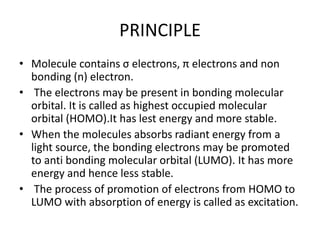
PRINCIPLE
• Molecule contains σ electrons, π electrons and non
bonding (n) electron.
• The electrons may be present in bonding molecular
orbital. It is called as highest occupied molecular
orbital (HOMO).It has lest energy and more stable.
• When the molecules absorbs radiant energy from a
light source, the bonding electrons may be promoted
to anti bonding molecular orbital (LUMO). It has more
energy and hence less stable.
• The process of promotion of electrons from HOMO to
LUMO with absorption of energy is called as excitation.
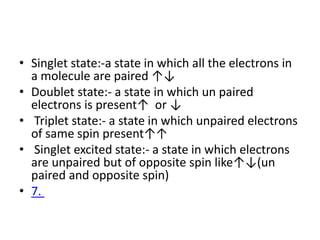
• Singlet state:-a state in which all the electrons in
a molecule are paired ↑↓
• Doublet state:- a state in which un paired
electrons is present↑ or ↓
• Triplet state:- a state in which unpaired electrons
of same spin present↑↑
• Singlet excited state:- a state in which electrons
are unpaired but of opposite spin like↑↓(un
paired and opposite spin)
• 7.
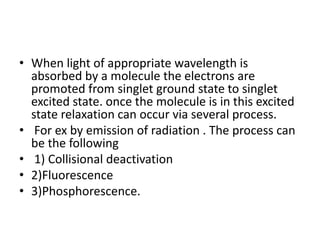
• When light of appropriate wavelength is
absorbed by a molecule the electrons are
promoted from singlet ground state to singlet
excited state. once the molecule is in this excited
state relaxation can occur via several process.
• For ex by emission of radiation . The process can
be the following
• 1) Collisional deactivation
• 2)Fluorescence
• 3)Phosphorescence.
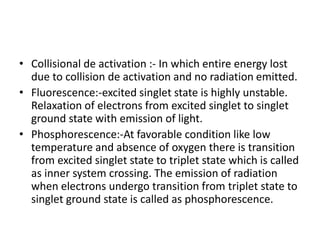
• Collisional de activation :- In which entire energy lost
due to collision de activation and no radiation emitted.
• Fluorescence:-excited singlet state is highly unstable.
Relaxation of electrons from excited singlet to singlet
ground state with emission of light.
• Phosphorescence:-At favorable condition like low
temperature and absence of oxygen there is transition
from excited singlet state to triplet state which is called
as inner system crossing. The emission of radiation
when electrons undergo transition from triplet state to
singlet ground state is called as phosphorescence.
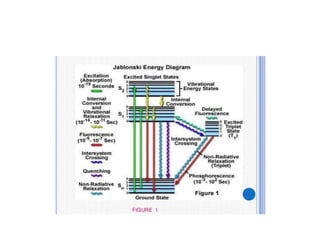
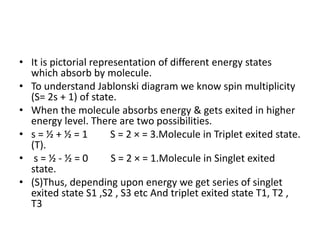
• It is pictorial representation of different energy states
which absorb by molecule.
• To understand Jablonski diagram we know spin multiplicity
(S= 2s + 1) of state.
• When the molecule absorbs energy & gets exited in higher
energy level. There are two possibilities.
• s = ½ + ½ = 1 S = 2 × = 3.Molecule in Triplet exited state.
(T).
• s = ½ - ½ = 0 S = 2 × = 1.Molecule in Singlet exited
state.
• (S)Thus, depending upon energy we get series of singlet
exited state S1 ,S2 , S3 etc And triplet exited state T1, T2 ,
T3
• Absorbance:The first transition in the Jablonski diagrams is
the absorbance of a photon of a particular energy by the
molecule of interest.Absorbance is the method by which an
electron is excited from a lower energy level to a higher
energy level.
• The excited species can return to the ground state by
losing all of its excess energy by any one of the following
absorption;
• Non-Radiative Process
• Radiative Process
• Non- radiative transition:-
It involves transition from , S2 → S1 or S3 → S1 Or T2 → T1
or T3 → T1 . It does not involve emission of any radiation
hence called Non- radiative transition.
• It only involves emission of heat.
• 1. Internal Conversion (IC):-In this process energy loss in the
form of heat. It involves transition from, S3 → S2 or S2 →
S1 Or T3 → T2 or T2 → T1 .It occurs in less than second.
• 2. Intersystem Crossing (ISC):-It involves transition from
S3→ T3 , S2→ T2 Or S1→ T1 Both these transitions are
forbidden.
• Radiative transition:-
It involves transition from S1→ S0 or T1→ T0 .
It involves emission of transition.Two process
comes under this radiative transition
• Fluorescence: The emission of transition from
S1→ S0 is called Fluorescence.
• Phosphorescence: The emission of transition
from T1→ S0 is called Phosphorescence.It is
forbidden transition.
• Quenching of Fluorescence
If the excited molecules are deactivated and the
fluorescence stops, the phenomenon is called
‘Quenching’.When the activated molecules
undergo a change from a singlet excited state to
triplet excited state. This is called ‘internal
quenching’.When the activated molecules collide
with the other molecules/quenchers which are
the externally added species and transfer their
energy to those molecules. This is called ‘external
quenching’.
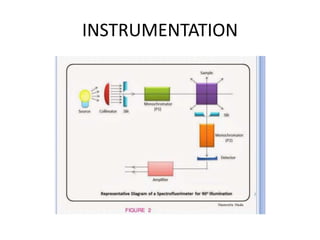
INSTRUMENTATION
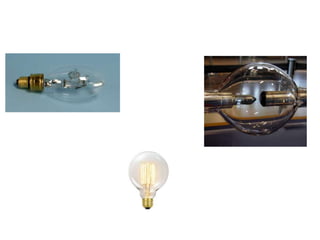
• 1)SOURCE OF LIGHT:- mercury vapour lamp: Mercury
vapour at high pressure give intense lines on
continuous background above 350nm.low pressure
mercury vapour gives an additional line at 254nm.it is
used in filter fluorimeter.
• xenon arc lamp: It give more intense radiation than
mercury vapour lamp. it is used in spectrofluorimeter.
• tungsten lamp:- If excitation has to be done in visible
region this can be used. It is used in low cost
instruments
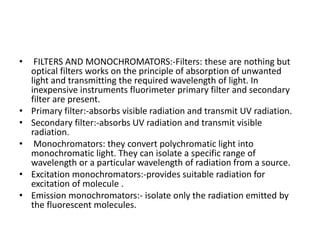
• FILTERS AND MONOCHROMATORS:-Filters: these are nothing but
optical filters works on the principle of absorption of unwanted
light and transmitting the required wavelength of light. In
inexpensive instruments fluorimeter primary filter and secondary
filter are present.
• Primary filter:-absorbs visible radiation and transmit UV radiation.
• Secondary filter:-absorbs UV radiation and transmit visible
radiation.
• Monochromators: they convert polychromatic light into
monochromatic light. They can isolate a specific range of
wavelength or a particular wavelength of radiation from a source.
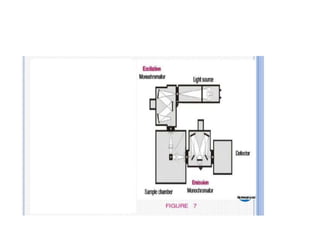
• Excitation monochromators:-provides suitable radiation for
excitation of molecule .
• Emission monochromators:- isolate only the radiation emitted by
the fluorescent molecules.
• Sample cells: These are ment for holding
liquid samples. These are made up of quartz
and can have various shapes ex: cylindrical or
rectangular etc.
• Detectors: Photometric detectors are used
they are:
• Barrier layer cell/Photo voltaic cells
• Photomultiplier cells
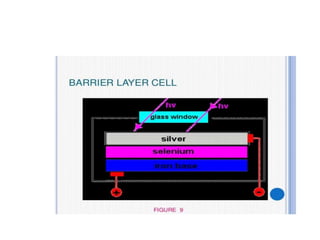
• Barrier layer cell/Photo voltaic cells:
• It consists of a copper plate coated with a thin layer of cuprous
oxide (Cu2o). A semi transparent film of silver is laid on this plate to
provide good contact.
• When external light falls on the oxide layer, the electrons emitted
from the oxide layer move into the copper plate.
• Then oxide layer becomes positive and copper plate becomes
negative.
• Hence an emf develops between the oxide layer and copper plate
and behaves like a voltaic cell. So it is called photovoltaic cell.
• A galvanometer is connected externally between silver film and
copper plate and the deflection in the galvanometer shows the
current flow through it. The amount of current is found to be
proportional to the intensity of incident light
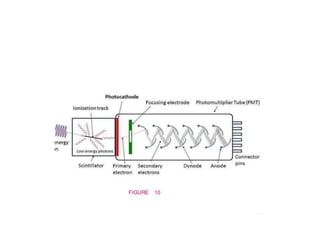
• Photomultiplier tubes: These are incorporated in expensive instruments
like spectrofluorimeter.
• Its sensitivity is high due to measuring weak intensity of light.
• The principle employed in this detector Is that, multiplication of
photoelectrons by secondary emission of electrons.
• This is achieved by using a photo cathode and a series of anodes
(Dyanodes). Up to 10 dyanodes are used. Each dyanode is maintained at
75- 100Vhigher than the preceding one.
• At each stage, the electron emission is multiplied by a factor of 4 to 5 due
to secondary emission of electrons and hence an overall factor of 106 is
achieved.
• PMT can detect very weak signals, even 200 times weaker than that could
be done using photovoltaic cell. Hence it is useful in fluorescence
measurements.
• PMT should be shielded from stray light in order to have accurate results. .
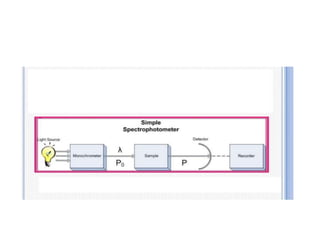
• SINGLE BEAM FILTER FLUROMETRY : It contains tungsten
lamp as a source of light and has an optical system consists
of primary filter.
• The emitted radiations is measured at 900 by using a
secondary filter and detector. Primary filter absorbs visible
radiation and transmit uv radiation which excites the
molecule present in sample cell.
• In stead of 90 if we use 180 geometry as in colorimetry
secondary filter has to be highly efficient other wise both
the unabsorbed uv radiation and fluorescent radiation will
produce detector response and give false result.
• Single beam instruments are simple in construction
cheaper and easy to operate.
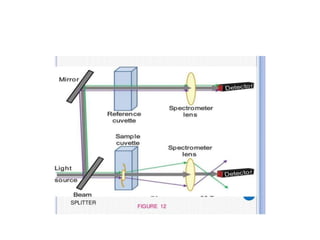
• DOUBLE BEAM FILTER FLUROMETRY: it is
similar to single beam except that the two
incident beams from a single light source pass
through primary filters separately and fall on
the another reference solution. Then the
emitted radiations from the sample or
reference sample pass separately through
secondary filter and produce response
combinly on a detector.
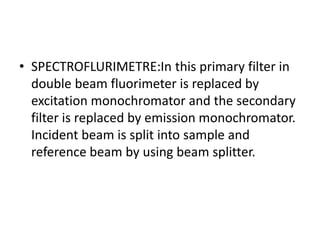
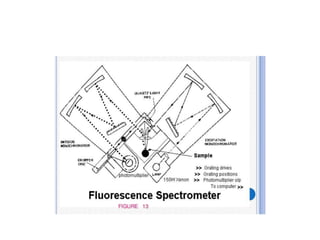
• SPECTROFLURIMETRE:In this primary filter in
double beam fluorimeter is replaced by
excitation monochromator and the secondary
filter is replaced by emission monochromator.
Incident beam is split into sample and
reference beam by using beam splitter.
FACTORS AFFECTING
• 1. Concentration
• 2. Quantum yield of fluorescence
• 3. Intensity of incident light
• 4. Adsorption
• 5. Oxygen
• 6. Ph
• 7. Temperature& viscosity
• 8. Photodecomposition
• 9. Quenchers
• 10. Scatter
ADVANTAGES AND DISADVANTAGES
• ADVANTAGE
• Sensitivity :- it is give accurate result even sample is present in
microgram concentration in solution.
• Precision :- upto 1 % can be achieved easily.
• Specificity :- This method is more specific than absorption method.
• Range of Application :- wide range of compound are used.
• DISADVANTAGES :-
• Change in pH effect fluroscence
• oxygen may decrease fluroscence.
• Heavy metal presence are also decrease fluroscence.
• When uv radiation is passed out some time it is reacted with
sample
Fluorimetry

Fluorimetry

  • 1.
  • 2.
    DEFINATION • Luminescence isthe emission of light by a substance. It occurs when an electron returns to the electronic ground state from an excited state and loses its excess energy as a photon. It is of 3 types. • Fluorescence spectroscopy. • Phosphorescence spectroscopy. • Chemiluminescence spectroscopy
  • 3.
    • FLUORESCENCE: Itis a phenomenon of emission of radiation when the molecules are exited by radiation at certain wavelength. • FLUORIMETRY:- It is measurement of fluorescence intensity at a particular wavelength with the help of a filter fluorimeter or a spectrofluorimeter.
  • 4.
    APPLICATIONS • Determination ofinorganic substances. Al3+,Li+,ZN2+ • Determination of thiamine Hcl. • Detemination of phenytoin. • Determination of indoles, phenols, & phenothiazines • Determination of napthols, proteins, plant pigments and steroids. • Fluorimetry ,nowadays can be used in detection of impurities in nanogram level better than absorbance spectrophotometer with special emphasis in determining components of sample at the end of chromatographic or capillary column. • Determination of boron in steel, aluminum in alloys ETC
  • 5.
    PRINCIPLE • Molecule containsσ electrons, π electrons and non bonding (n) electron. • The electrons may be present in bonding molecular orbital. It is called as highest occupied molecular orbital (HOMO).It has lest energy and more stable. • When the molecules absorbs radiant energy from a light source, the bonding electrons may be promoted to anti bonding molecular orbital (LUMO). It has more energy and hence less stable. • The process of promotion of electrons from HOMO to LUMO with absorption of energy is called as excitation.
  • 6.
    • Singlet state:-astate in which all the electrons in a molecule are paired ↑↓ • Doublet state:- a state in which un paired electrons is present↑ or ↓ • Triplet state:- a state in which unpaired electrons of same spin present↑↑ • Singlet excited state:- a state in which electrons are unpaired but of opposite spin like↑↓(un paired and opposite spin) • 7.
  • 7.
    • When lightof appropriate wavelength is absorbed by a molecule the electrons are promoted from singlet ground state to singlet excited state. once the molecule is in this excited state relaxation can occur via several process. • For ex by emission of radiation . The process can be the following • 1) Collisional deactivation • 2)Fluorescence • 3)Phosphorescence.
  • 8.
    • Collisional deactivation :- In which entire energy lost due to collision de activation and no radiation emitted. • Fluorescence:-excited singlet state is highly unstable. Relaxation of electrons from excited singlet to singlet ground state with emission of light. • Phosphorescence:-At favorable condition like low temperature and absence of oxygen there is transition from excited singlet state to triplet state which is called as inner system crossing. The emission of radiation when electrons undergo transition from triplet state to singlet ground state is called as phosphorescence.
  • 10.
    • It ispictorial representation of different energy states which absorb by molecule. • To understand Jablonski diagram we know spin multiplicity (S= 2s + 1) of state. • When the molecule absorbs energy & gets exited in higher energy level. There are two possibilities. • s = ½ + ½ = 1 S = 2 × = 3.Molecule in Triplet exited state. (T). • s = ½ - ½ = 0 S = 2 × = 1.Molecule in Singlet exited state. • (S)Thus, depending upon energy we get series of singlet exited state S1 ,S2 , S3 etc And triplet exited state T1, T2 , T3
  • 11.
    • Absorbance:The firsttransition in the Jablonski diagrams is the absorbance of a photon of a particular energy by the molecule of interest.Absorbance is the method by which an electron is excited from a lower energy level to a higher energy level. • The excited species can return to the ground state by losing all of its excess energy by any one of the following absorption; • Non-Radiative Process • Radiative Process
  • 12.
    • Non- radiativetransition:- It involves transition from , S2 → S1 or S3 → S1 Or T2 → T1 or T3 → T1 . It does not involve emission of any radiation hence called Non- radiative transition. • It only involves emission of heat. • 1. Internal Conversion (IC):-In this process energy loss in the form of heat. It involves transition from, S3 → S2 or S2 → S1 Or T3 → T2 or T2 → T1 .It occurs in less than second. • 2. Intersystem Crossing (ISC):-It involves transition from S3→ T3 , S2→ T2 Or S1→ T1 Both these transitions are forbidden.
  • 13.
    • Radiative transition:- Itinvolves transition from S1→ S0 or T1→ T0 . It involves emission of transition.Two process comes under this radiative transition • Fluorescence: The emission of transition from S1→ S0 is called Fluorescence. • Phosphorescence: The emission of transition from T1→ S0 is called Phosphorescence.It is forbidden transition.
  • 14.
    • Quenching ofFluorescence If the excited molecules are deactivated and the fluorescence stops, the phenomenon is called ‘Quenching’.When the activated molecules undergo a change from a singlet excited state to triplet excited state. This is called ‘internal quenching’.When the activated molecules collide with the other molecules/quenchers which are the externally added species and transfer their energy to those molecules. This is called ‘external quenching’.
  • 15.
  • 16.
    • 1)SOURCE OFLIGHT:- mercury vapour lamp: Mercury vapour at high pressure give intense lines on continuous background above 350nm.low pressure mercury vapour gives an additional line at 254nm.it is used in filter fluorimeter. • xenon arc lamp: It give more intense radiation than mercury vapour lamp. it is used in spectrofluorimeter. • tungsten lamp:- If excitation has to be done in visible region this can be used. It is used in low cost instruments
  • 18.
    • FILTERS ANDMONOCHROMATORS:-Filters: these are nothing but optical filters works on the principle of absorption of unwanted light and transmitting the required wavelength of light. In inexpensive instruments fluorimeter primary filter and secondary filter are present. • Primary filter:-absorbs visible radiation and transmit UV radiation. • Secondary filter:-absorbs UV radiation and transmit visible radiation. • Monochromators: they convert polychromatic light into monochromatic light. They can isolate a specific range of wavelength or a particular wavelength of radiation from a source. • Excitation monochromators:-provides suitable radiation for excitation of molecule . • Emission monochromators:- isolate only the radiation emitted by the fluorescent molecules.
  • 20.
    • Sample cells:These are ment for holding liquid samples. These are made up of quartz and can have various shapes ex: cylindrical or rectangular etc. • Detectors: Photometric detectors are used they are: • Barrier layer cell/Photo voltaic cells • Photomultiplier cells
  • 21.
    • Barrier layercell/Photo voltaic cells: • It consists of a copper plate coated with a thin layer of cuprous oxide (Cu2o). A semi transparent film of silver is laid on this plate to provide good contact. • When external light falls on the oxide layer, the electrons emitted from the oxide layer move into the copper plate. • Then oxide layer becomes positive and copper plate becomes negative. • Hence an emf develops between the oxide layer and copper plate and behaves like a voltaic cell. So it is called photovoltaic cell. • A galvanometer is connected externally between silver film and copper plate and the deflection in the galvanometer shows the current flow through it. The amount of current is found to be proportional to the intensity of incident light
  • 22.
    • Photomultiplier tubes:These are incorporated in expensive instruments like spectrofluorimeter. • Its sensitivity is high due to measuring weak intensity of light. • The principle employed in this detector Is that, multiplication of photoelectrons by secondary emission of electrons. • This is achieved by using a photo cathode and a series of anodes (Dyanodes). Up to 10 dyanodes are used. Each dyanode is maintained at 75- 100Vhigher than the preceding one. • At each stage, the electron emission is multiplied by a factor of 4 to 5 due to secondary emission of electrons and hence an overall factor of 106 is achieved. • PMT can detect very weak signals, even 200 times weaker than that could be done using photovoltaic cell. Hence it is useful in fluorescence measurements. • PMT should be shielded from stray light in order to have accurate results. .
  • 25.
    • SINGLE BEAMFILTER FLUROMETRY : It contains tungsten lamp as a source of light and has an optical system consists of primary filter. • The emitted radiations is measured at 900 by using a secondary filter and detector. Primary filter absorbs visible radiation and transmit uv radiation which excites the molecule present in sample cell. • In stead of 90 if we use 180 geometry as in colorimetry secondary filter has to be highly efficient other wise both the unabsorbed uv radiation and fluorescent radiation will produce detector response and give false result. • Single beam instruments are simple in construction cheaper and easy to operate.
  • 27.
    • DOUBLE BEAMFILTER FLUROMETRY: it is similar to single beam except that the two incident beams from a single light source pass through primary filters separately and fall on the another reference solution. Then the emitted radiations from the sample or reference sample pass separately through secondary filter and produce response combinly on a detector.
  • 29.
    • SPECTROFLURIMETRE:In thisprimary filter in double beam fluorimeter is replaced by excitation monochromator and the secondary filter is replaced by emission monochromator. Incident beam is split into sample and reference beam by using beam splitter.
  • 31.
    FACTORS AFFECTING • 1.Concentration • 2. Quantum yield of fluorescence • 3. Intensity of incident light • 4. Adsorption • 5. Oxygen • 6. Ph • 7. Temperature& viscosity • 8. Photodecomposition • 9. Quenchers • 10. Scatter
  • 32.
    ADVANTAGES AND DISADVANTAGES •ADVANTAGE • Sensitivity :- it is give accurate result even sample is present in microgram concentration in solution. • Precision :- upto 1 % can be achieved easily. • Specificity :- This method is more specific than absorption method. • Range of Application :- wide range of compound are used. • DISADVANTAGES :- • Change in pH effect fluroscence • oxygen may decrease fluroscence. • Heavy metal presence are also decrease fluroscence. • When uv radiation is passed out some time it is reacted with sample