An Undergraduate Course in Chemical Engineering
By
D S V J P Koteswari
Assistant Professor
RGUKT-RK Valley
What is mass transfer?
What is flux?
What is Molar flux and Mass flux?
What is Fick’s law
What are the governing laws for molecular
diffusion?
Diffusivity-Measurement and Prediction
Porous Solids
◦ Fick’s diffusion
◦ Knudsen Diffusion
◦ Surface Diffusion
Polymers
Cellular Solids
Crystalline Solids
◦ Interstitial Mechanism
◦ Vacancy Mechanism
◦ Interstitialcy Mechanism
◦ Diffusion through grain boundaries
◦ Crowd-ion Mechanism
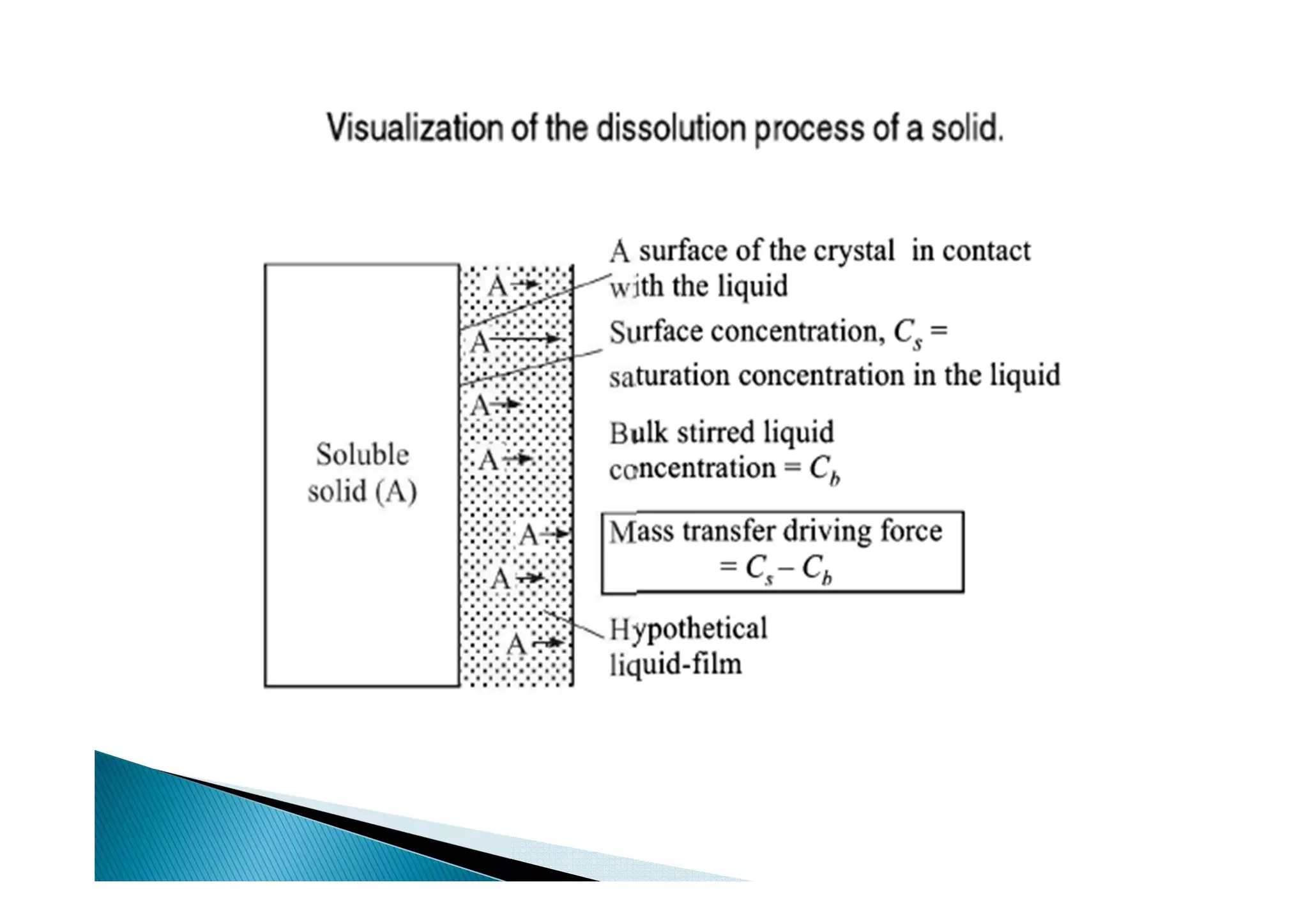
◦ What is Convective Mass Transfer?
Mass Transfer occurring under the influence of
motion in fluid medium
Eg:Sugar crystal dissolution in water
◦ Modes of convective mass transfer
Forced Convection mass transfer – Fluid motion by
external agency
Free Convection Mass transfer – Fluid motion by
difference in density
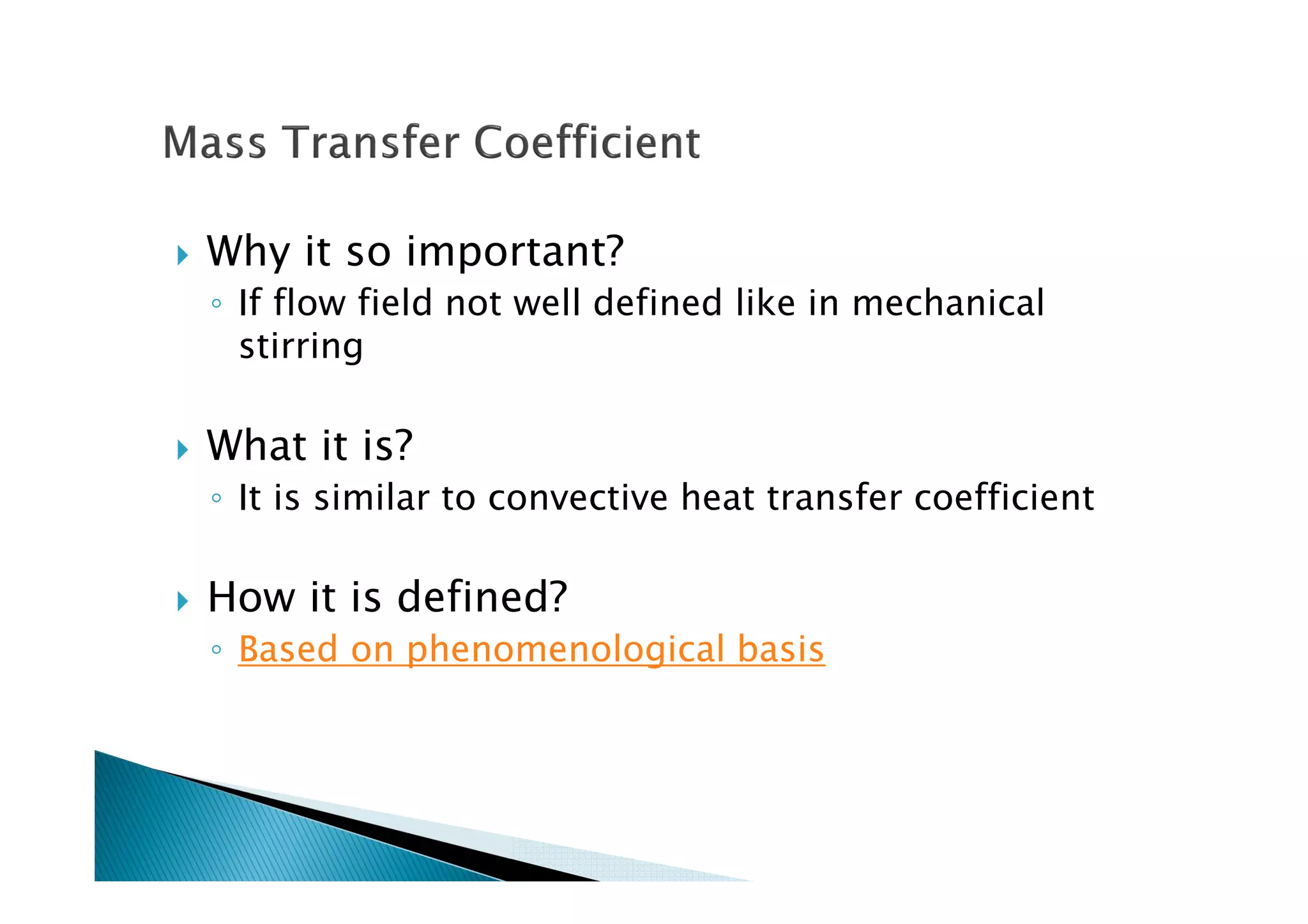
Why it so important?
◦ If flow field not well defined like in mechanical
stirring
What it is?
◦ It is similar to convective heat transfer coefficient
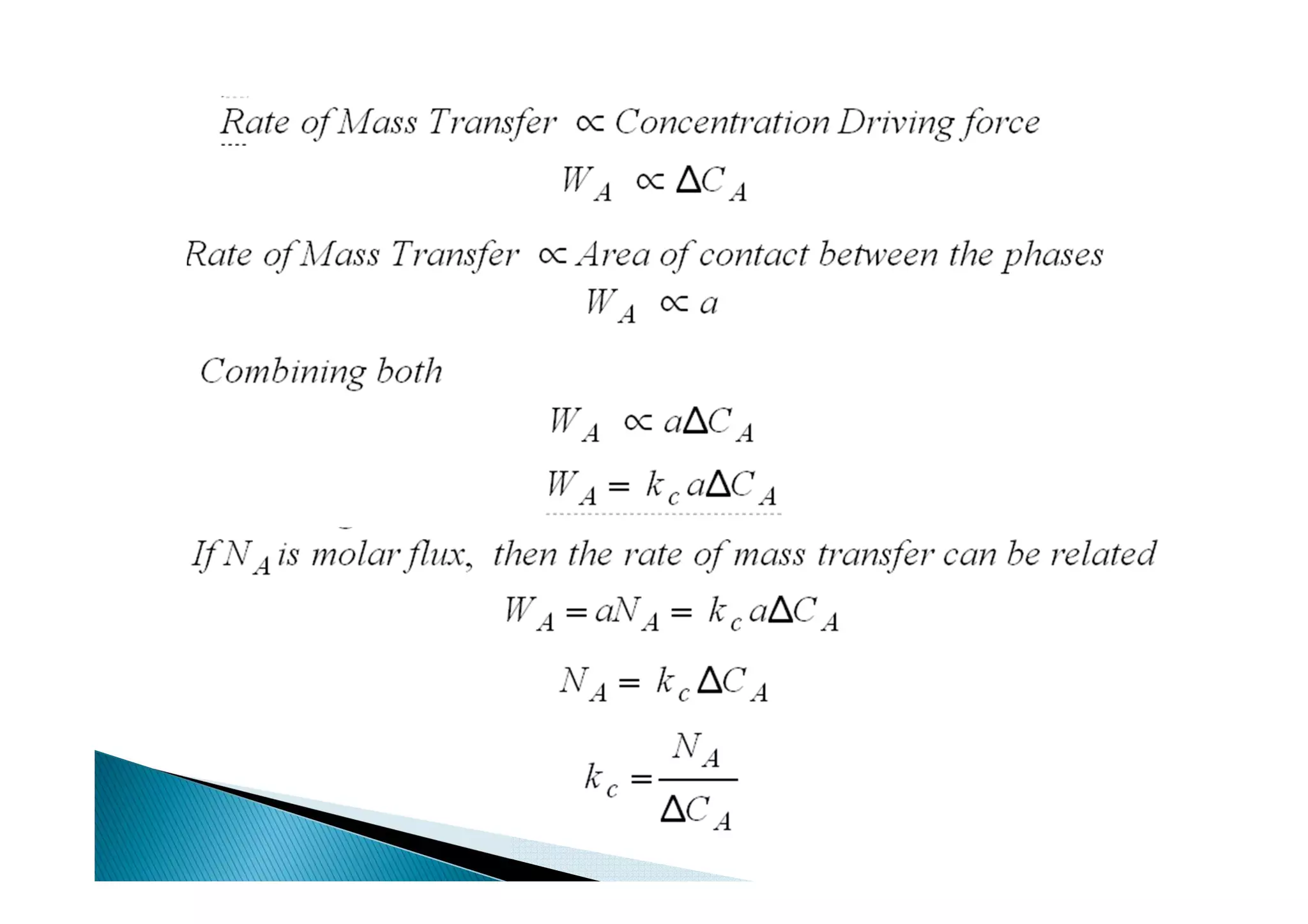
How it is defined?
◦ Based on phenomenological basis
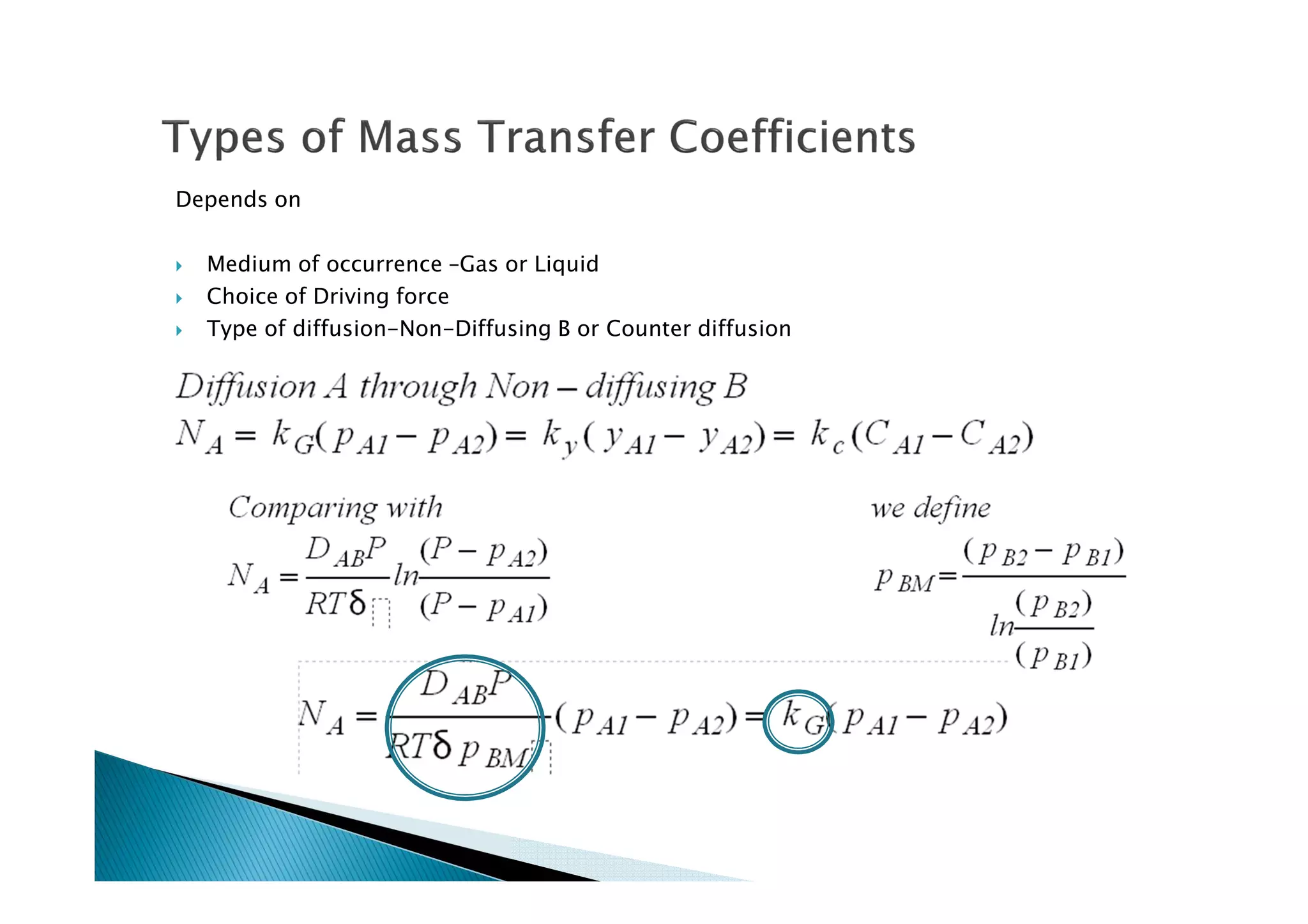
Depends on
Medium of occurrence –Gas or Liquid
Choice of Driving force
Type of diffusion-Non-Diffusing B or Counter diffusion
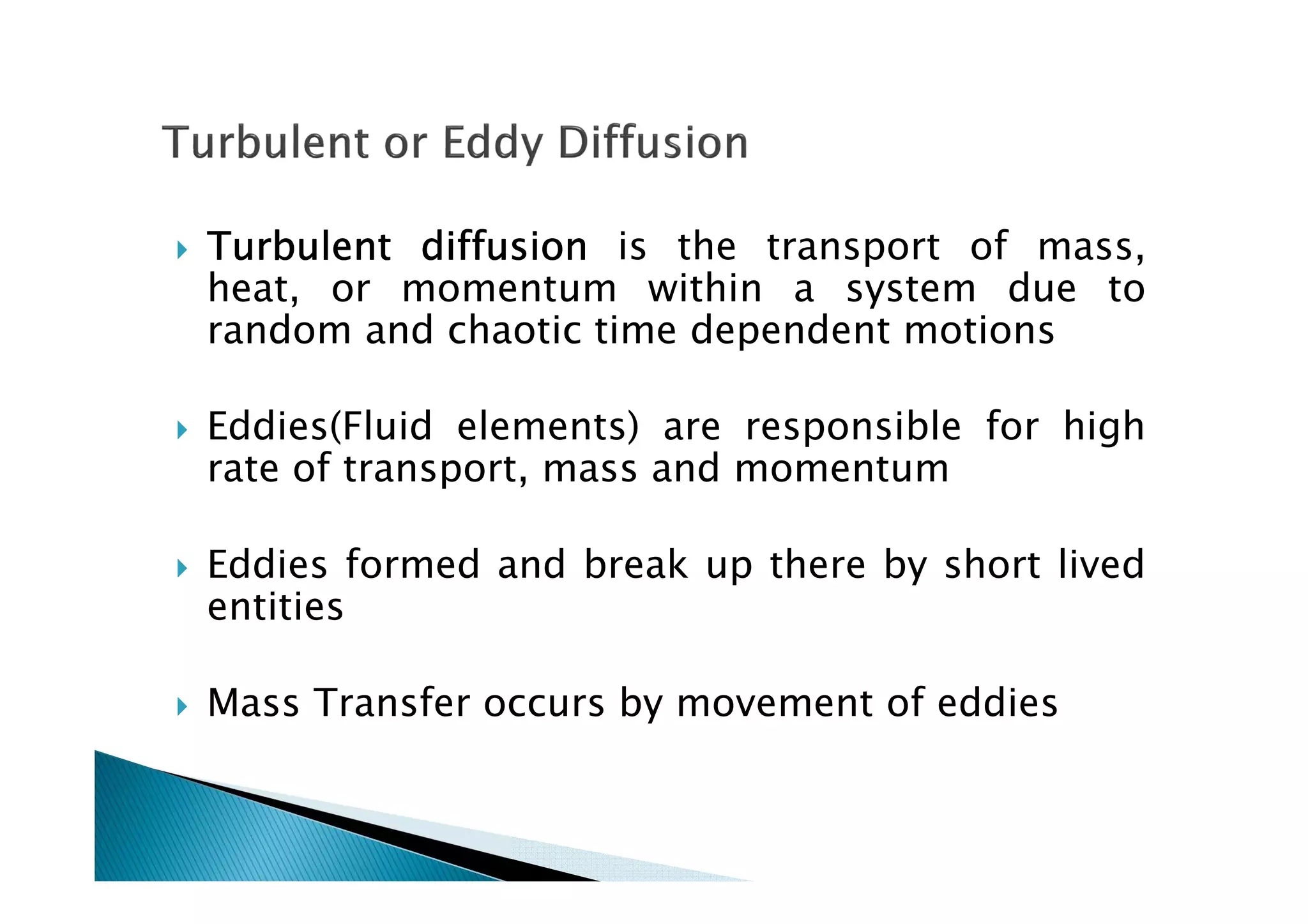
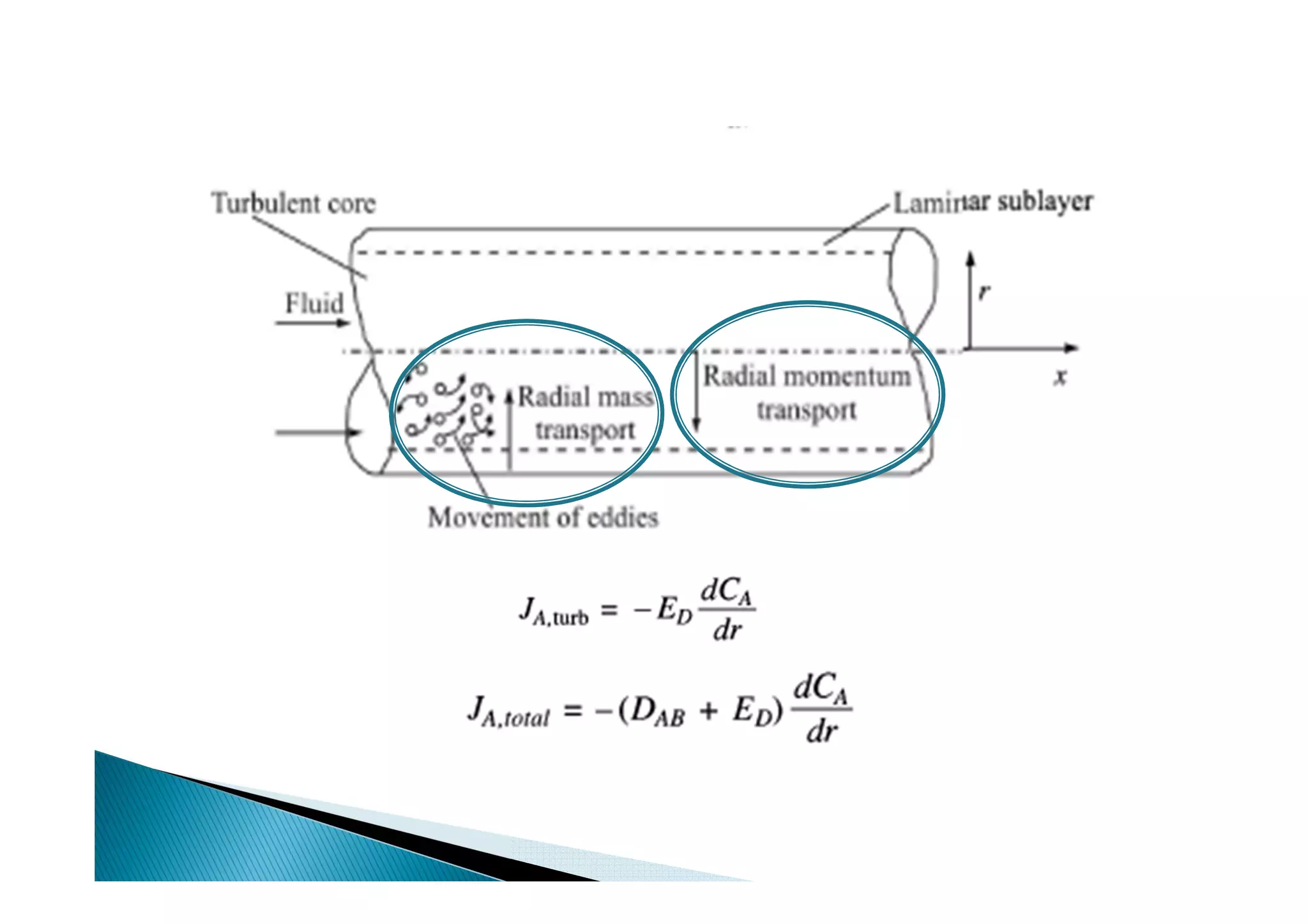
TurbulentTurbulentTurbulentTurbulent diffusiondiffusiondiffusiondiffusion is the transport of mass,
heat, or momentum within a system due to
random and chaotic time dependent motions
Eddies(Fluid elements) are responsible for high
rate of transport, mass and momentum
Eddies formed and break up there by short lived
entities
Mass Transfer occurs by movement of eddies
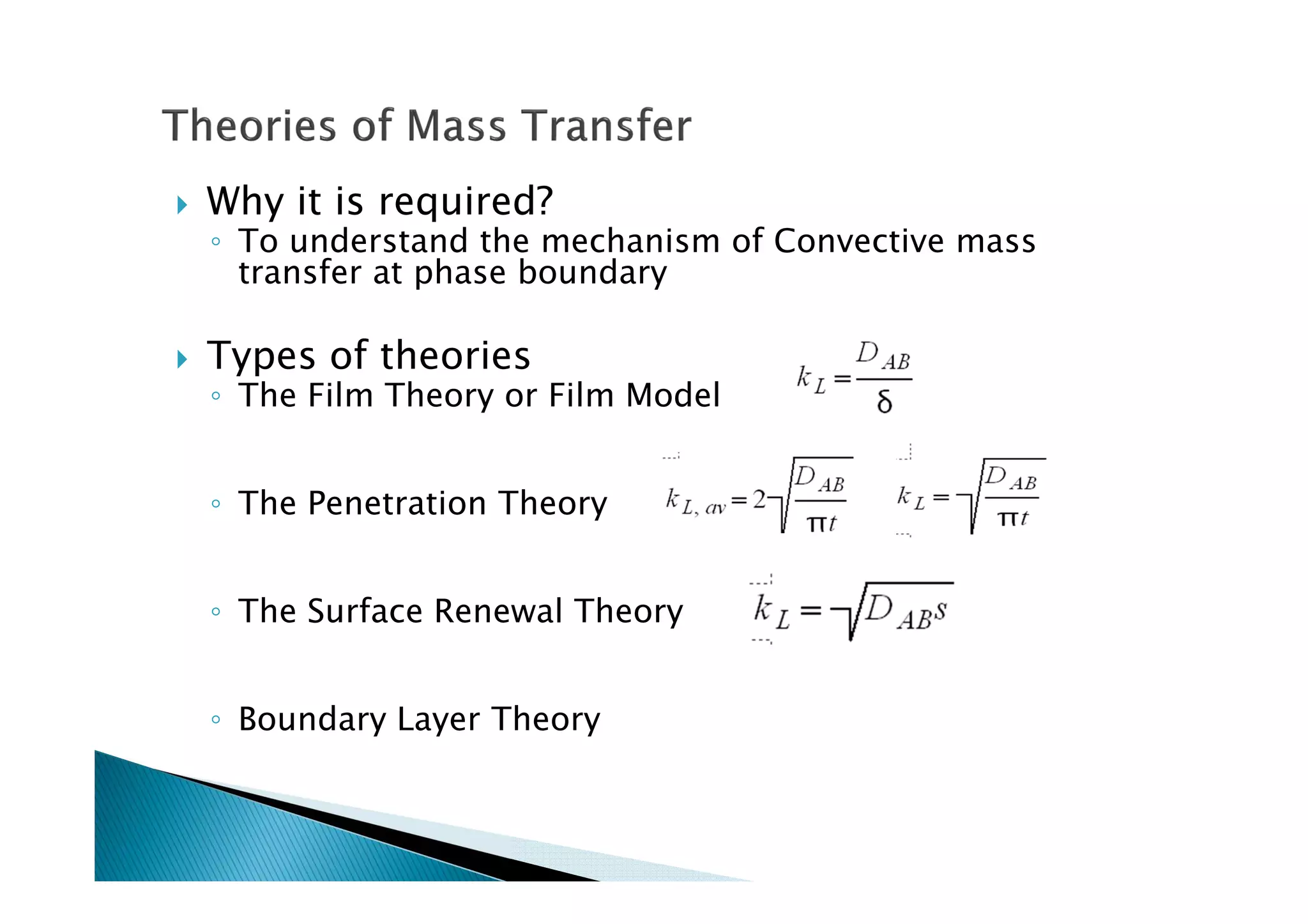
Why it is required?
◦ To understand the mechanism of Convective mass
transfer at phase boundary
Types of theories
◦ The Film Theory or Film Model
◦ The Penetration Theory
◦ The Surface Renewal Theory
◦ Boundary Layer Theory
What it is?
◦ Proposed by Whitman, 1923
What are the assumptions?
◦ Mass transfer by diffusion through stagnant layer at the boundary layer
◦ Steady state Mass Transfer
◦ Bulk flow term is negligible i.e flux is low and MT @ low conc
What does it say?
◦ Molecular diffusion dominates near the wall
◦ Convection dominates away from wall
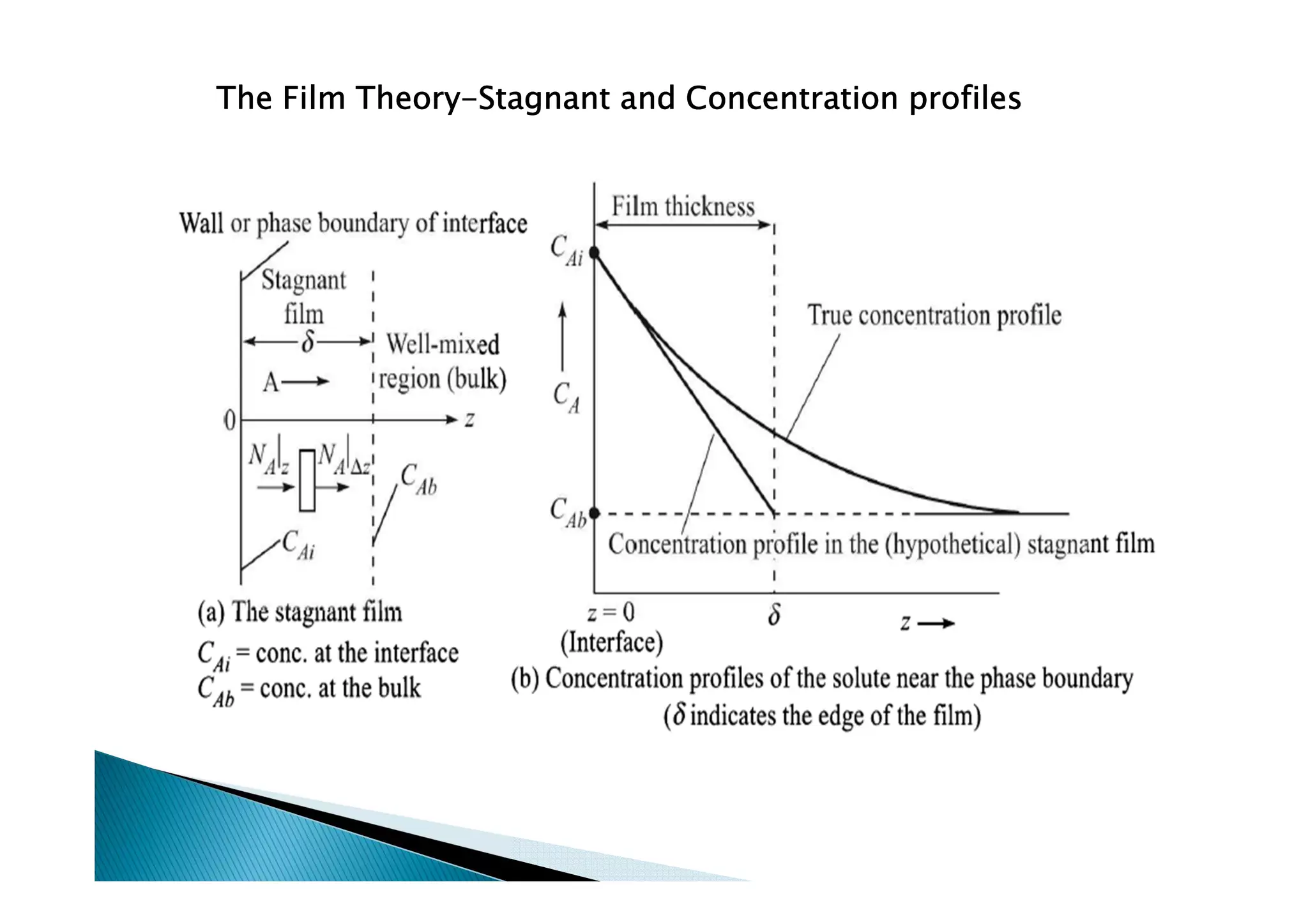
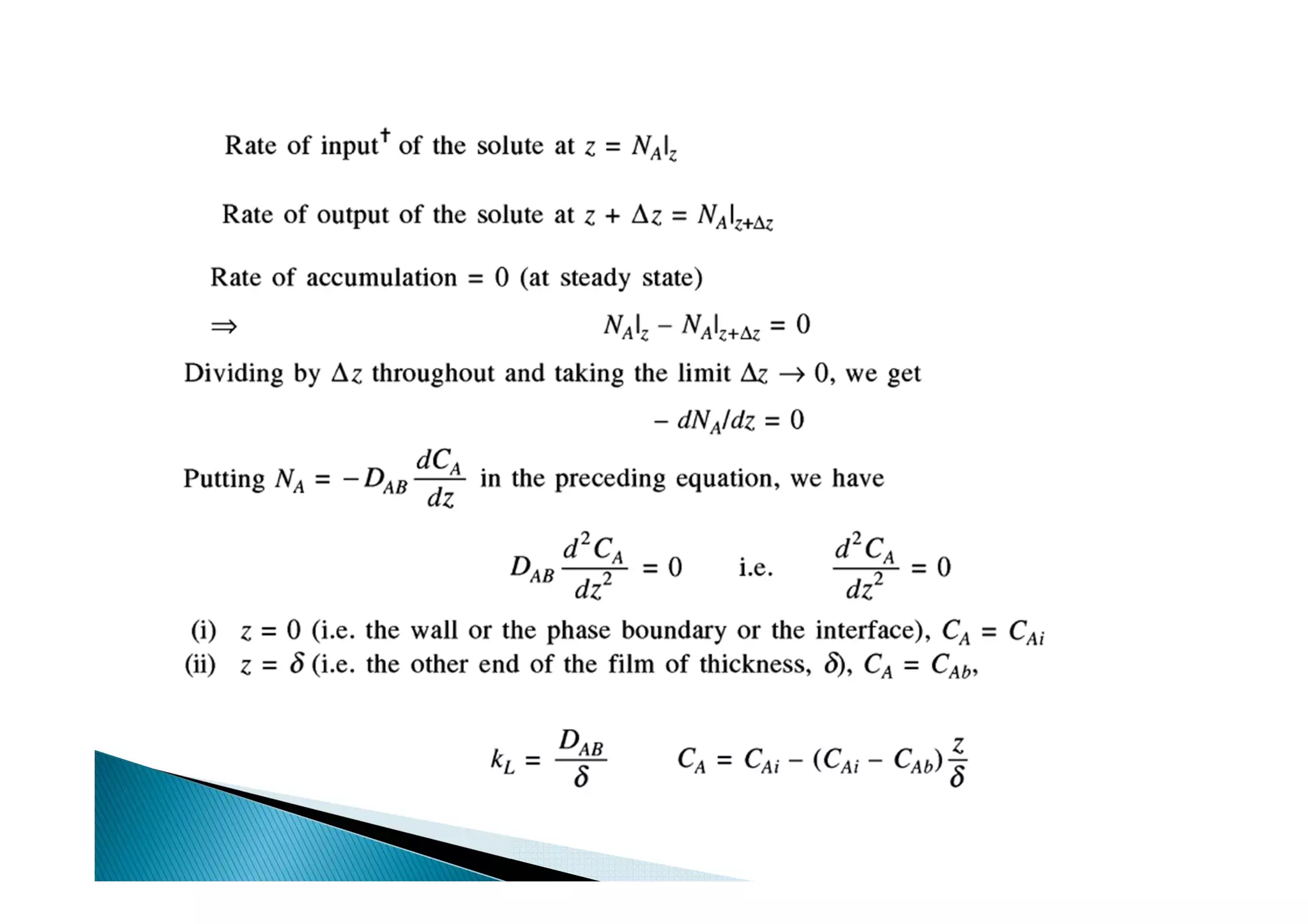
What are the concentration profiles?
What are the limitation?
The Film TheoryThe Film TheoryThe Film TheoryThe Film Theory----Stagnant and Concentration profilesStagnant and Concentration profilesStagnant and Concentration profilesStagnant and Concentration profiles
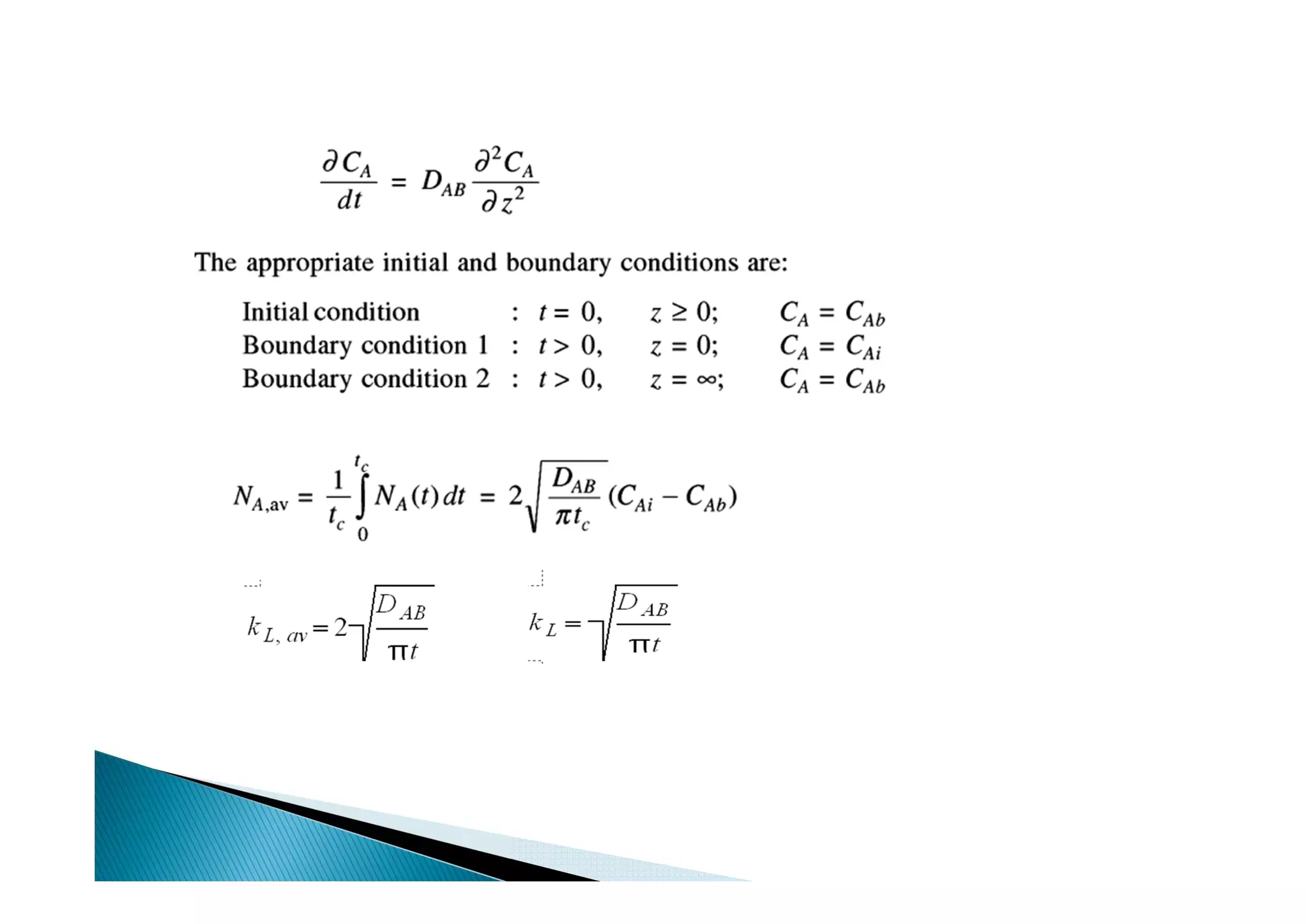
What it is?
◦ Proposed by Higbie, 1935
What are the assumptions?
◦ Unsteady state mass Transfer to liquid through out the contact with gas
phase
◦ Equilibrium exists between gas-liquid
◦ Each element stays for same time
What does it say?
◦ An element of liquid reaches interface and stays for short time and
receives some solute from other phase
◦ At the end of its stay, it moves back to bulk liquid and another element
comes in
What are the concentration profiles?
What are the limitation?
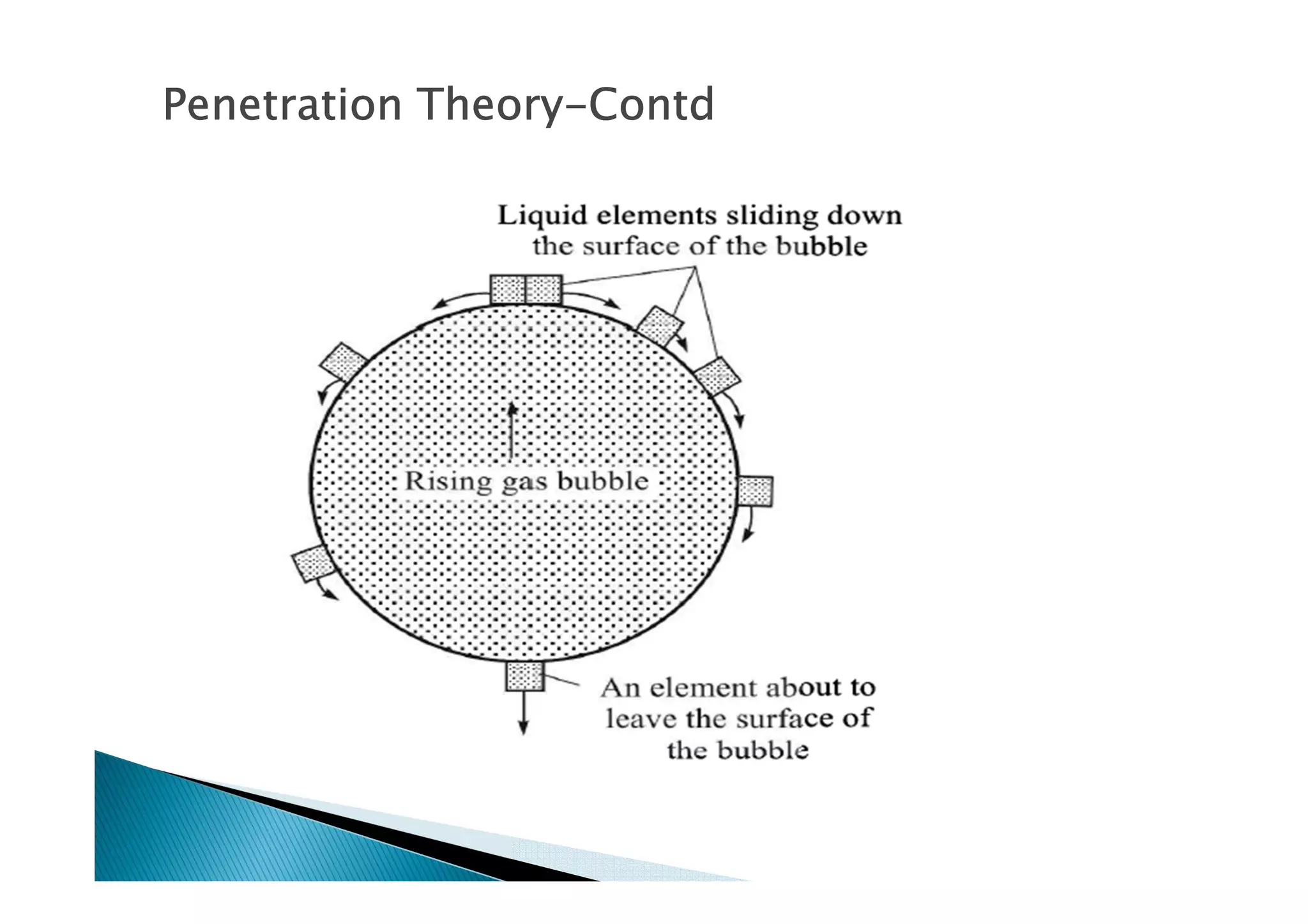
Penetration TheoryPenetration TheoryPenetration TheoryPenetration Theory----ContdContdContdContd
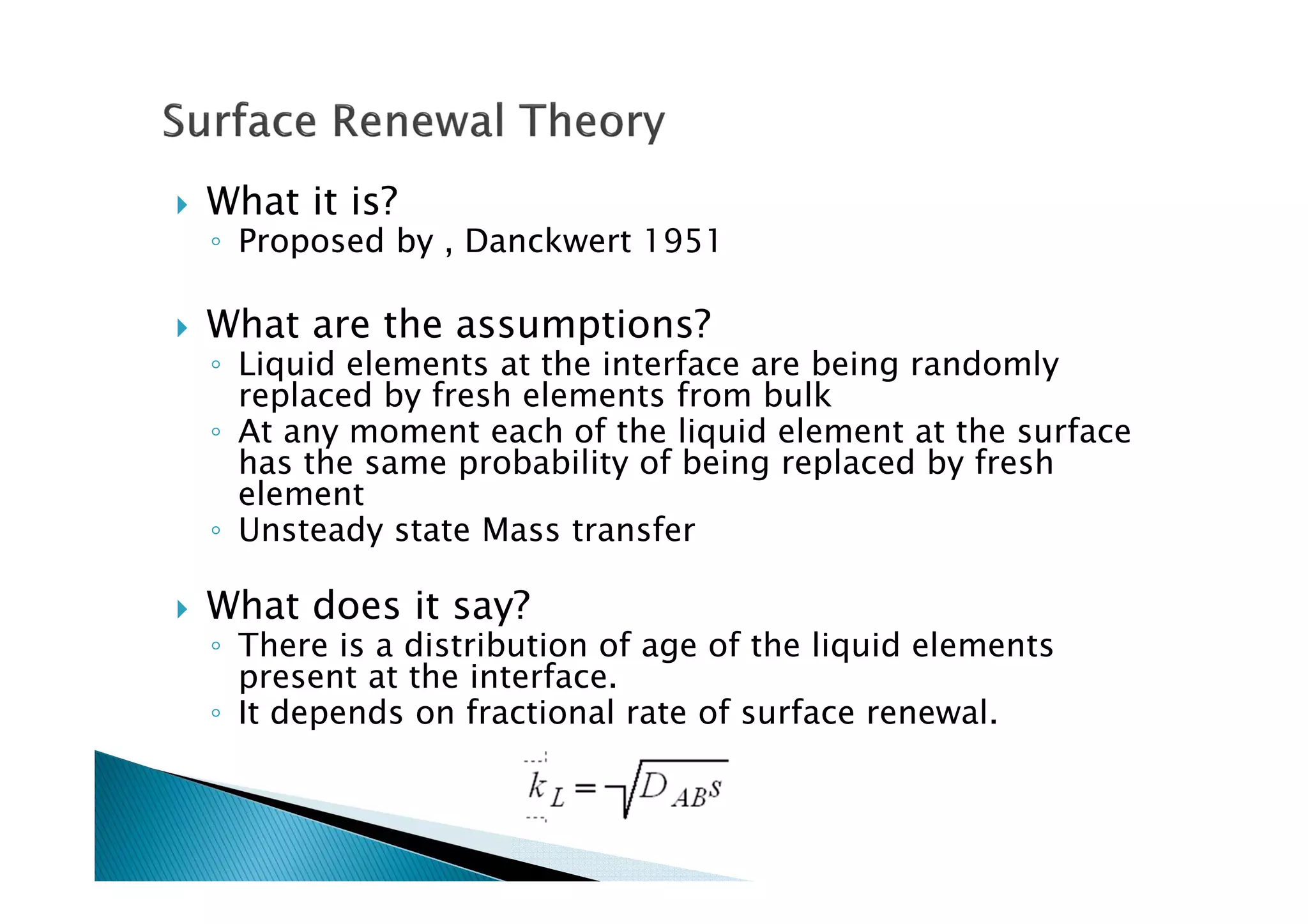
What it is?
◦ Proposed by , Danckwert 1951
What are the assumptions?
◦ Liquid elements at the interface are being randomly
replaced by fresh elements from bulk
◦ At any moment each of the liquid element at the surface
has the same probability of being replaced by fresh
element
◦ Unsteady state Mass transfer
What does it say?
◦ There is a distribution of age of the liquid elements
present at the interface.
◦ It depends on fractional rate of surface renewal.
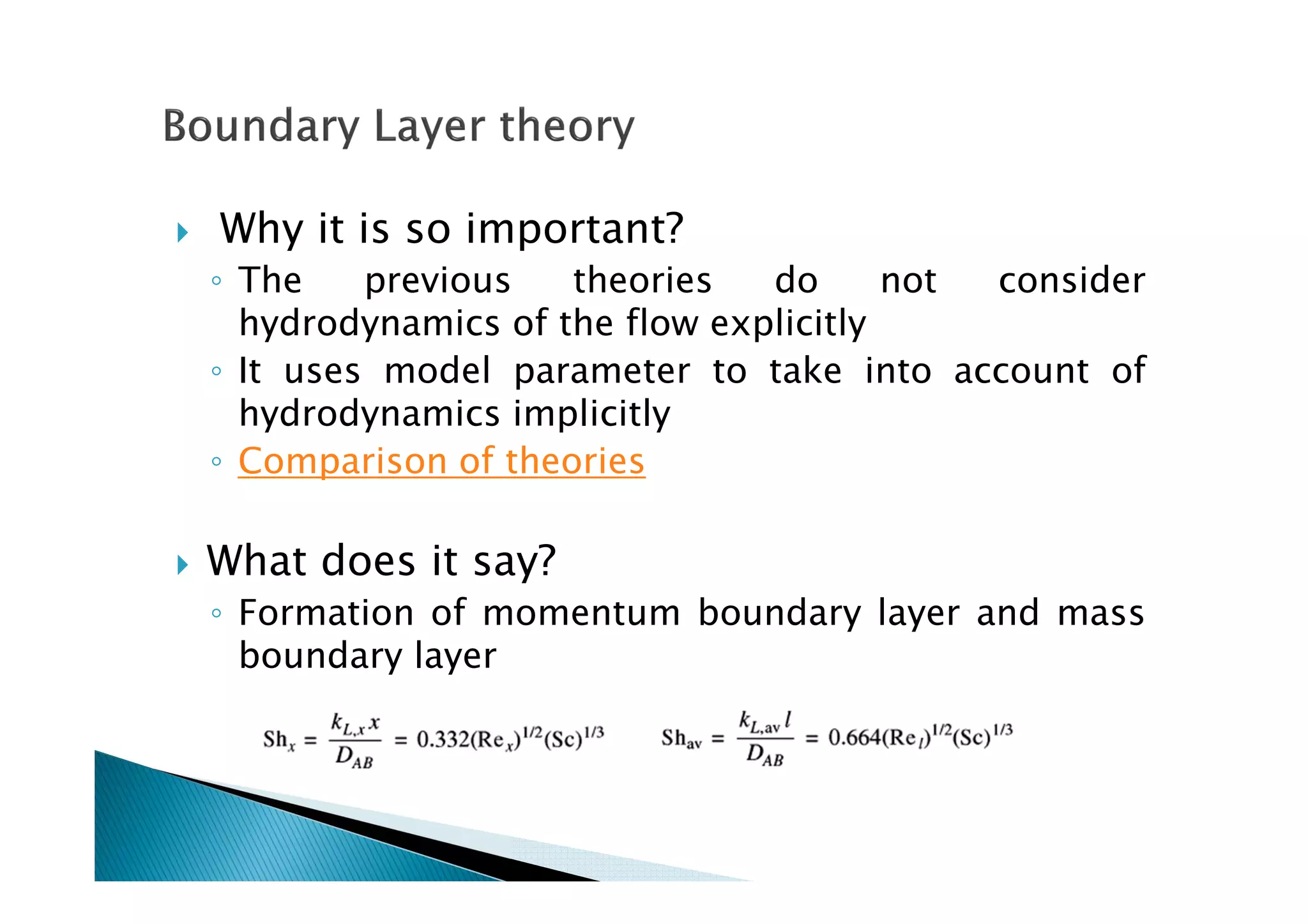
Why it is so important?
◦ The previous theories do not consider
hydrodynamics of the flow explicitly
◦ It uses model parameter to take into account of
hydrodynamics implicitly
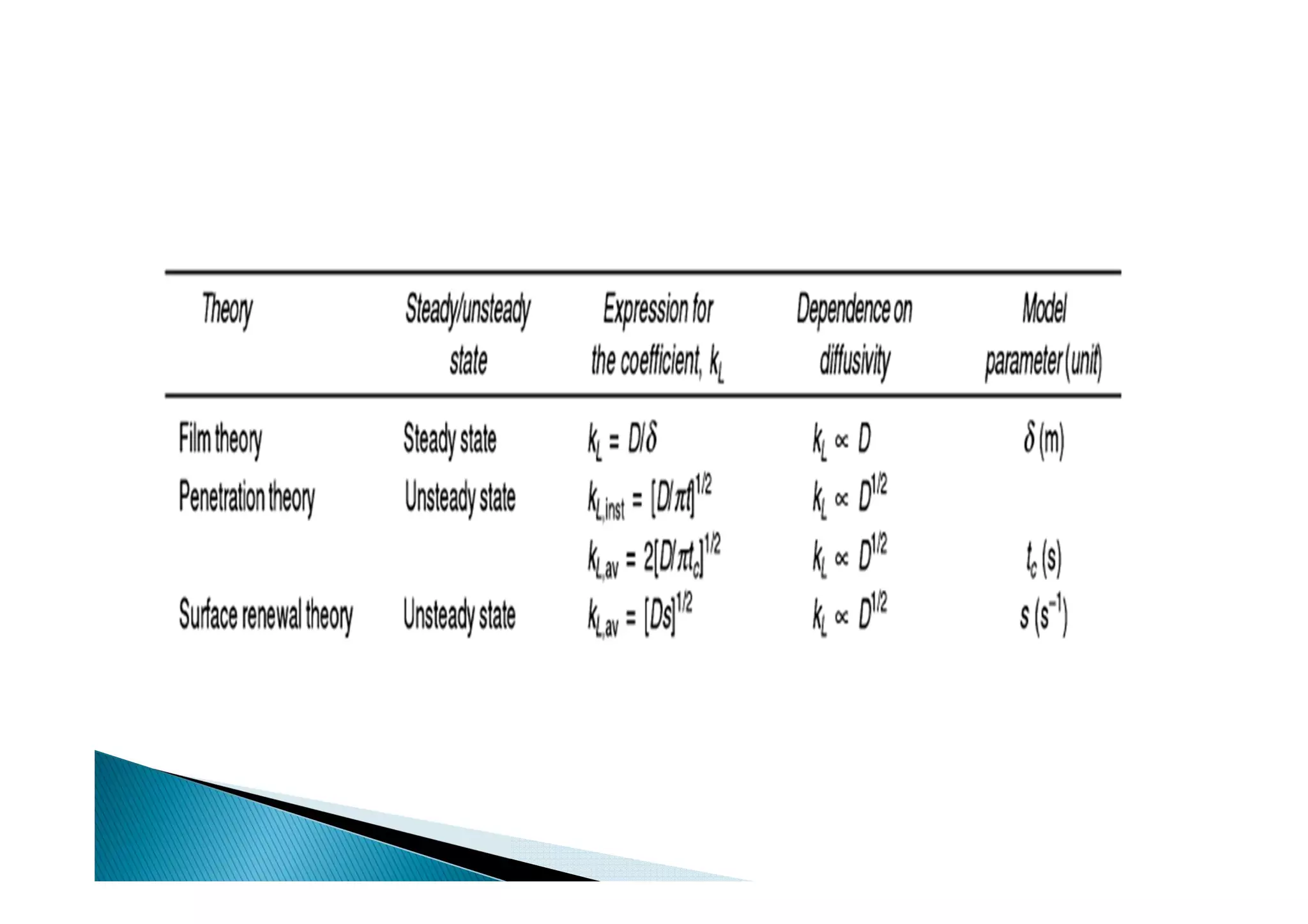
◦ Comparison of theories
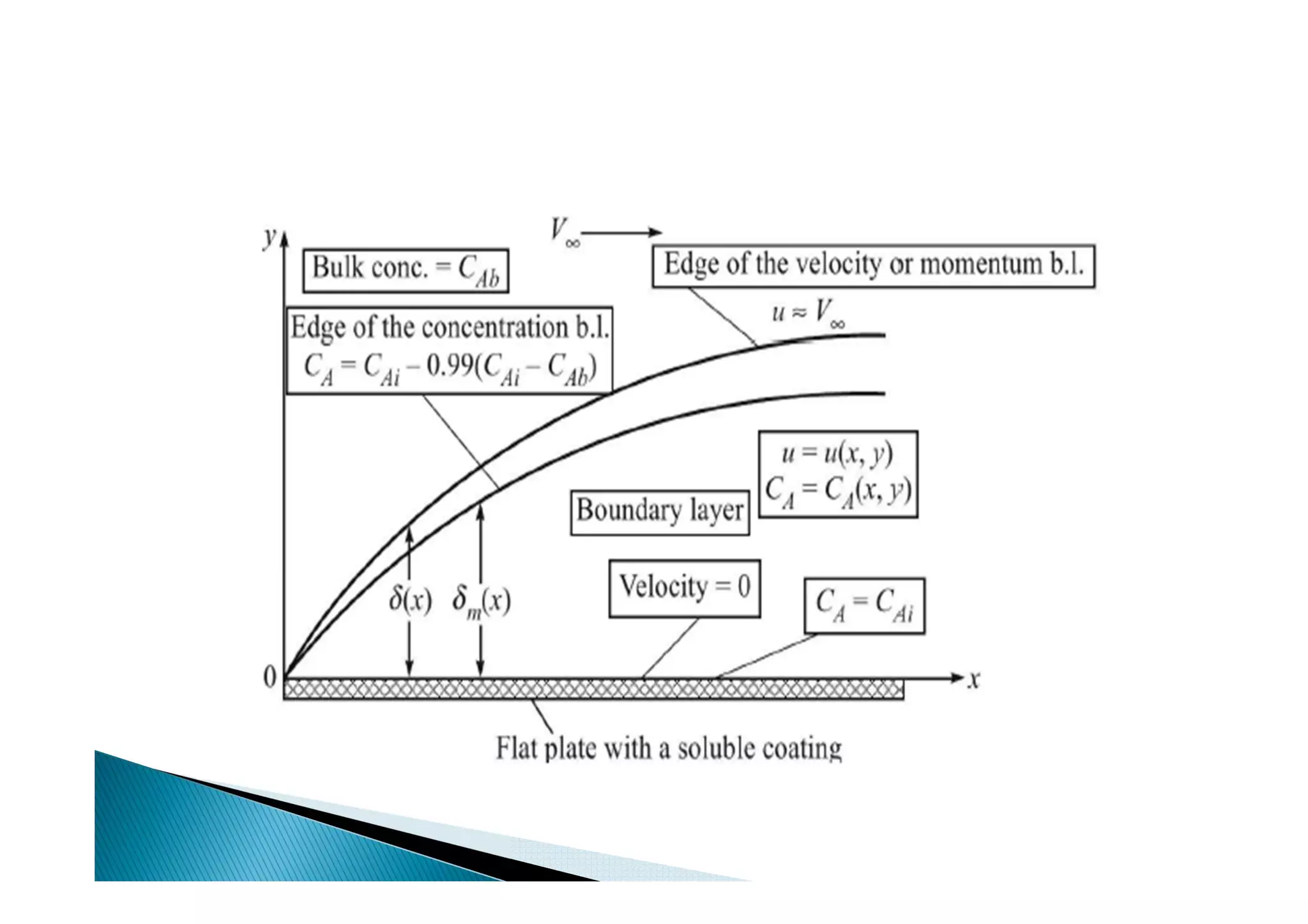
What does it say?
◦ Formation of momentum boundary layer and mass
boundary layer
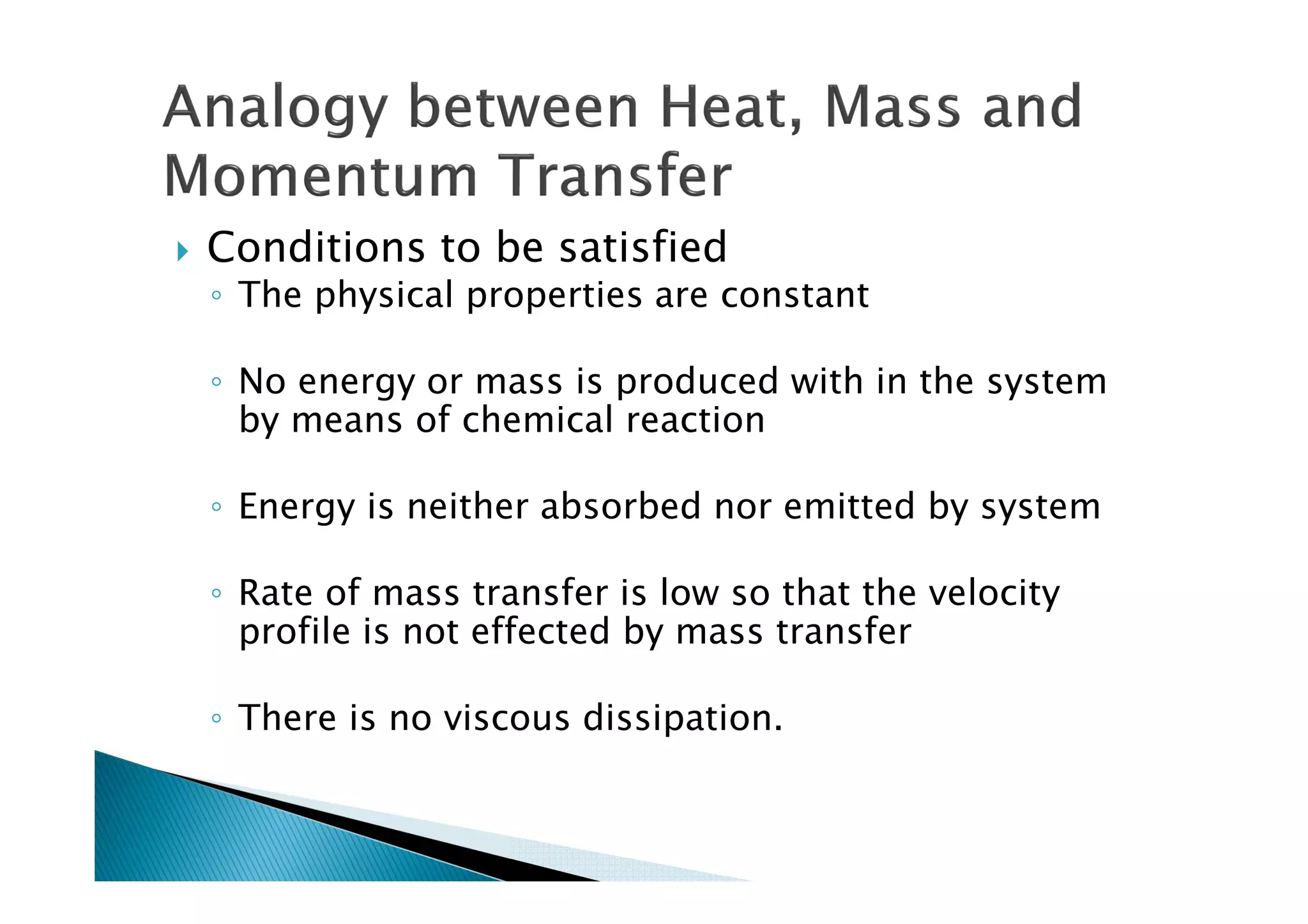
Conditions to be satisfied
◦ The physical properties are constant
◦ No energy or mass is produced with in the system
by means of chemical reaction
◦ Energy is neither absorbed nor emitted by system
◦ Rate of mass transfer is low so that the velocity
profile is not effected by mass transfer
◦ There is no viscous dissipation.
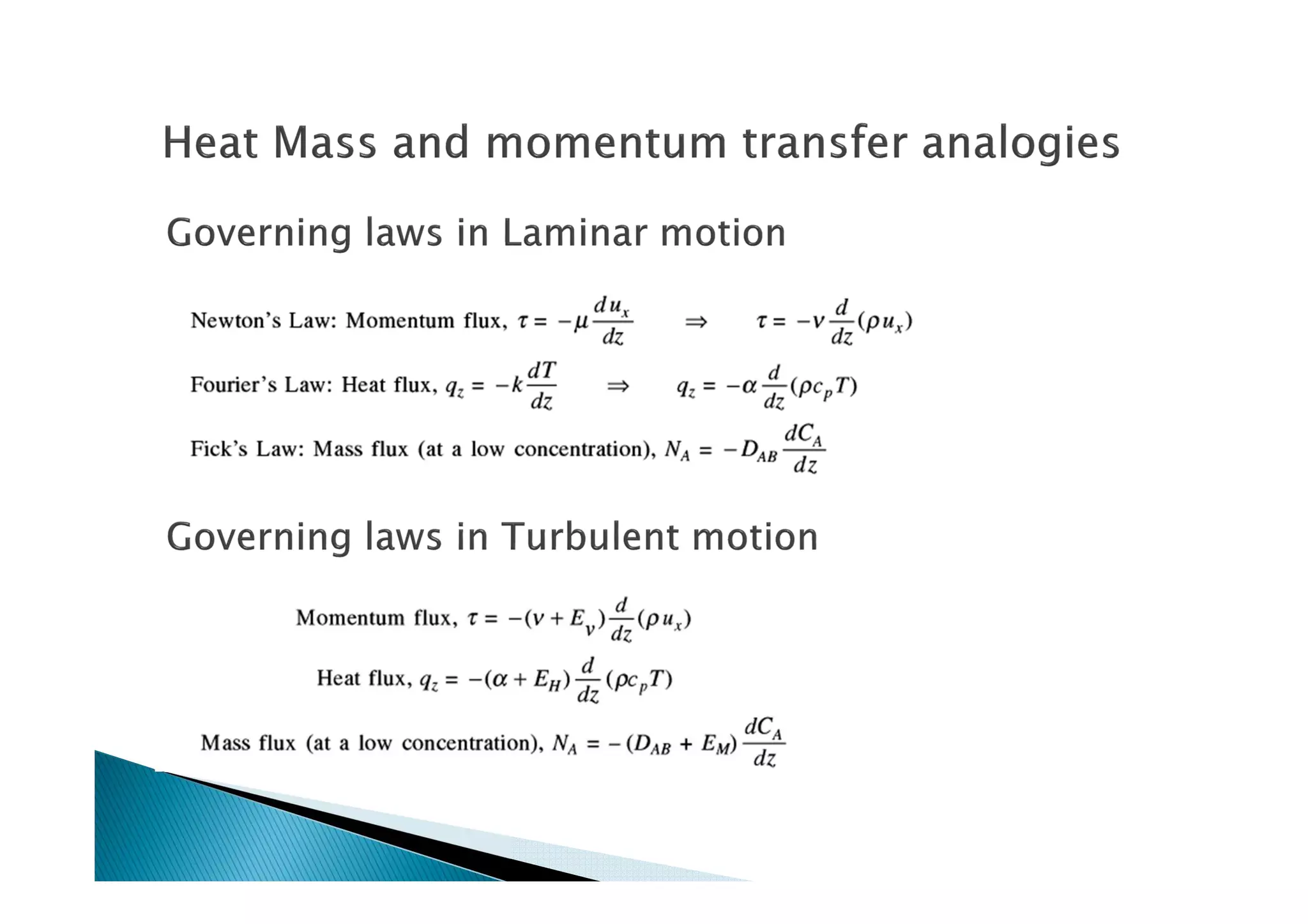
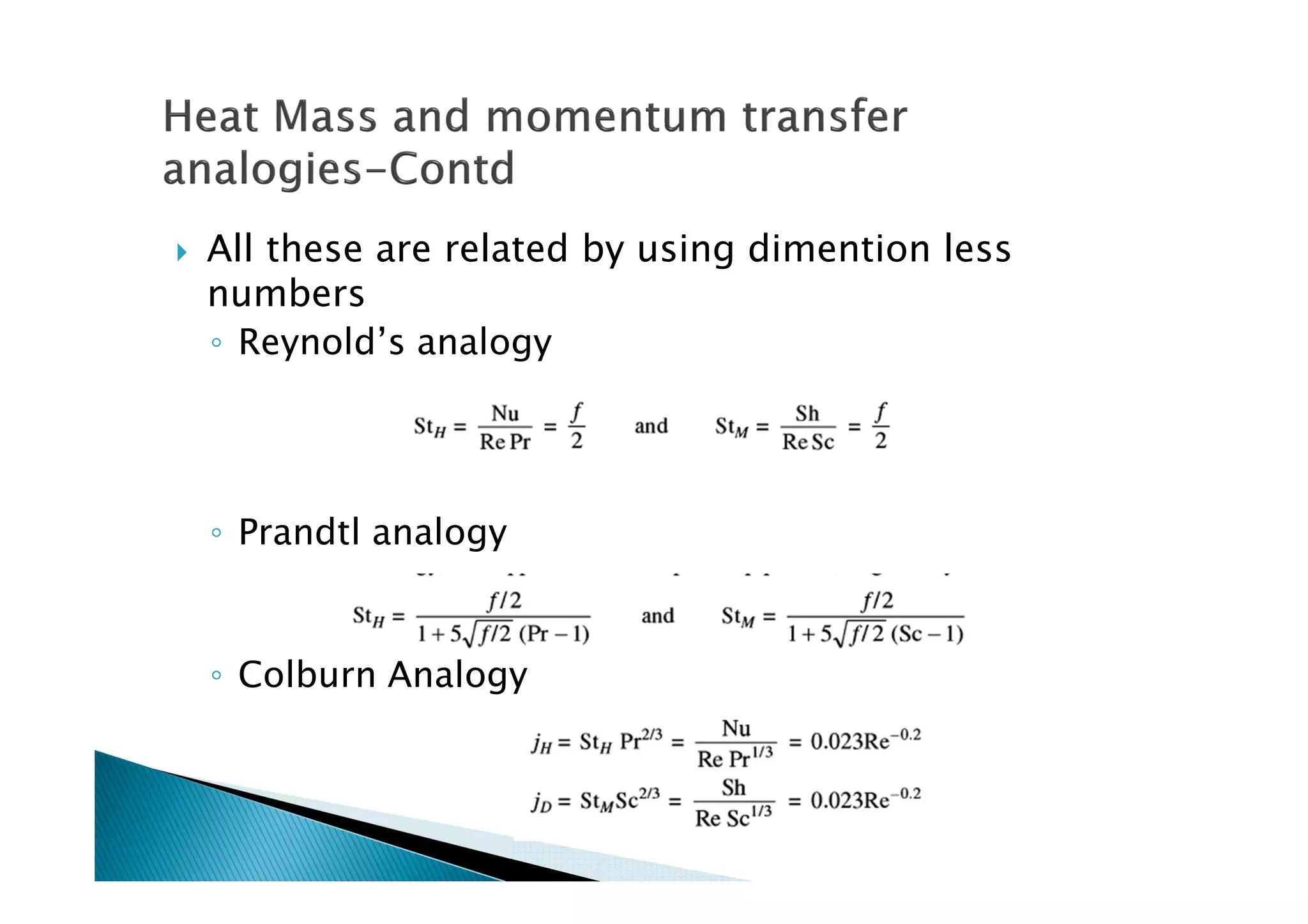
All these are related by using dimention less
numbers
◦ Reynold’s analogy
◦ Prandtl analogy
◦ Colburn Analogy

Convective mass transfer

  • 1.
    An Undergraduate Coursein Chemical Engineering By D S V J P Koteswari Assistant Professor RGUKT-RK Valley
  • 2.
    What is masstransfer? What is flux? What is Molar flux and Mass flux? What is Fick’s law What are the governing laws for molecular diffusion? Diffusivity-Measurement and Prediction
  • 3.
    Porous Solids ◦ Fick’sdiffusion ◦ Knudsen Diffusion ◦ Surface Diffusion Polymers Cellular Solids Crystalline Solids ◦ Interstitial Mechanism ◦ Vacancy Mechanism ◦ Interstitialcy Mechanism ◦ Diffusion through grain boundaries ◦ Crowd-ion Mechanism
  • 4.
    ◦ What isConvective Mass Transfer? Mass Transfer occurring under the influence of motion in fluid medium Eg:Sugar crystal dissolution in water ◦ Modes of convective mass transfer Forced Convection mass transfer – Fluid motion by external agency Free Convection Mass transfer – Fluid motion by difference in density
  • 6.
    Why it soimportant? ◦ If flow field not well defined like in mechanical stirring What it is? ◦ It is similar to convective heat transfer coefficient How it is defined? ◦ Based on phenomenological basis
  • 8.
    Depends on Medium ofoccurrence –Gas or Liquid Choice of Driving force Type of diffusion-Non-Diffusing B or Counter diffusion
  • 14.
    TurbulentTurbulentTurbulentTurbulent diffusiondiffusiondiffusiondiffusion isthe transport of mass, heat, or momentum within a system due to random and chaotic time dependent motions Eddies(Fluid elements) are responsible for high rate of transport, mass and momentum Eddies formed and break up there by short lived entities Mass Transfer occurs by movement of eddies
  • 16.
    Why it isrequired? ◦ To understand the mechanism of Convective mass transfer at phase boundary Types of theories ◦ The Film Theory or Film Model ◦ The Penetration Theory ◦ The Surface Renewal Theory ◦ Boundary Layer Theory
  • 17.
    What it is? ◦Proposed by Whitman, 1923 What are the assumptions? ◦ Mass transfer by diffusion through stagnant layer at the boundary layer ◦ Steady state Mass Transfer ◦ Bulk flow term is negligible i.e flux is low and MT @ low conc What does it say? ◦ Molecular diffusion dominates near the wall ◦ Convection dominates away from wall What are the concentration profiles? What are the limitation?
  • 18.
    The Film TheoryTheFilm TheoryThe Film TheoryThe Film Theory----Stagnant and Concentration profilesStagnant and Concentration profilesStagnant and Concentration profilesStagnant and Concentration profiles
  • 20.
    What it is? ◦Proposed by Higbie, 1935 What are the assumptions? ◦ Unsteady state mass Transfer to liquid through out the contact with gas phase ◦ Equilibrium exists between gas-liquid ◦ Each element stays for same time What does it say? ◦ An element of liquid reaches interface and stays for short time and receives some solute from other phase ◦ At the end of its stay, it moves back to bulk liquid and another element comes in What are the concentration profiles? What are the limitation?
  • 21.
    Penetration TheoryPenetration TheoryPenetrationTheoryPenetration Theory----ContdContdContdContd
  • 23.
    What it is? ◦Proposed by , Danckwert 1951 What are the assumptions? ◦ Liquid elements at the interface are being randomly replaced by fresh elements from bulk ◦ At any moment each of the liquid element at the surface has the same probability of being replaced by fresh element ◦ Unsteady state Mass transfer What does it say? ◦ There is a distribution of age of the liquid elements present at the interface. ◦ It depends on fractional rate of surface renewal.
  • 24.
    Why it isso important? ◦ The previous theories do not consider hydrodynamics of the flow explicitly ◦ It uses model parameter to take into account of hydrodynamics implicitly ◦ Comparison of theories What does it say? ◦ Formation of momentum boundary layer and mass boundary layer
  • 27.
    Conditions to besatisfied ◦ The physical properties are constant ◦ No energy or mass is produced with in the system by means of chemical reaction ◦ Energy is neither absorbed nor emitted by system ◦ Rate of mass transfer is low so that the velocity profile is not effected by mass transfer ◦ There is no viscous dissipation.
  • 29.
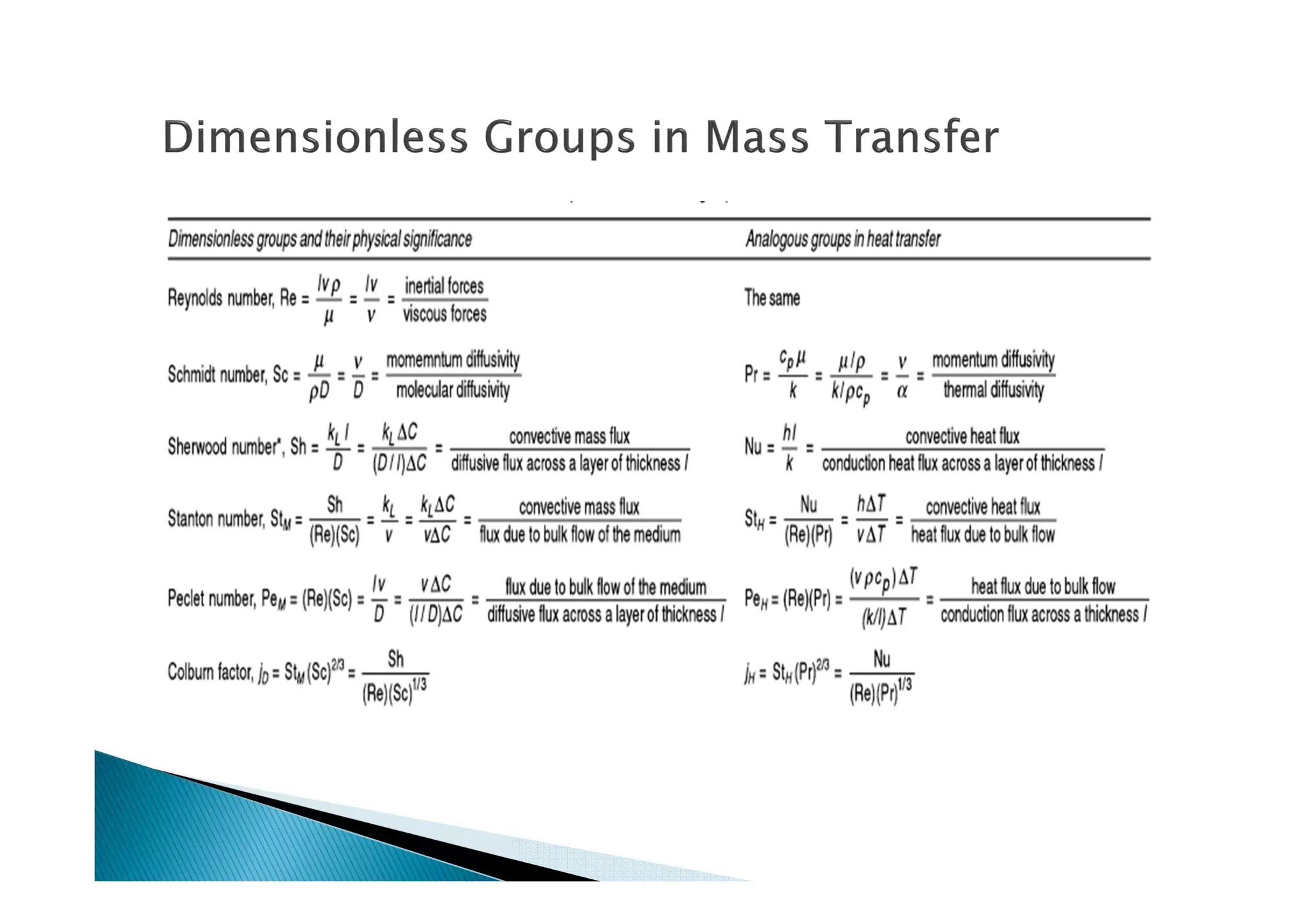
    All these arerelated by using dimention less numbers ◦ Reynold’s analogy ◦ Prandtl analogy ◦ Colburn Analogy