Supply and Demand
TOPIC: PRICE, SUPPLY AND DEMAND
RELATIONSHIP
CONTENTS:
 INTRODUCTION.
 THE LAW OF DEMAND.
 THE LAW OF SUPPLY.
 TIME AND SUPPLY.
 EQUILIBRIUM.
INTRODUCTION:
Supply and demand is perhaps one of the most
fundamental concepts of economics and it is the
backbone of a market economy. Demand refers to how
much (quantity) of a product or service is desired by
buyers. The quantity demanded is the amount of a
product people are willing to buy at a certain price; the
relationship between price and quantity demanded is
known as the demand relationship.
 Supply represents how much the market can offer. The
quantity supplied refers to the amount of a certain
good producers are willing to supply when receiving a
certain price. The correlation between price and how
much of a good or service is supplied to the market is
known as the supply relationship. Price, therefore, is a
reflection of supply and demand.
THE LAW OF DEMAND:
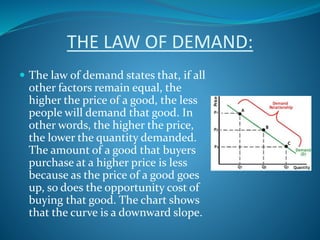
 The law of demand states that, if all
other factors remain equal, the
higher the price of a good, the less
people will demand that good. In
other words, the higher the price,
the lower the quantity demanded.
The amount of a good that buyers
purchase at a higher price is less
because as the price of a good goes
up, so does the opportunity cost of
buying that good. The chart shows
that the curve is a downward slope.
THE LAW OF SUPPLY:
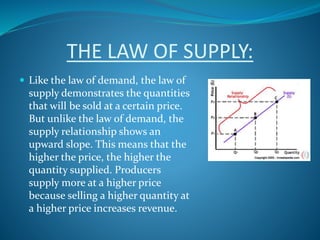
 Like the law of demand, the law of
supply demonstrates the quantities
that will be sold at a certain price.
But unlike the law of demand, the
supply relationship shows an
upward slope. This means that the
higher the price, the higher the
quantity supplied. Producers
supply more at a higher price
because selling a higher quantity at
a higher price increases revenue.
TIME AND SUPPLY
 Unlike the demand relationship, however, the supply
relationship is a factor of time. Time is important to
supply because suppliers must, but cannot always,
react quickly to a change in demand or price. So it is
important to try and determine whether a price change
that is caused by demand will be temporary or
permanent.
EQUILIBRIUM
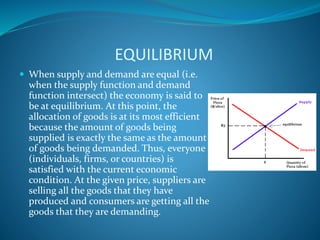
 When supply and demand are equal (i.e.
when the supply function and demand
function intersect) the economy is said to
be at equilibrium. At this point, the
allocation of goods is at its most efficient
because the amount of goods being
supplied is exactly the same as the amount
of goods being demanded. Thus, everyone
(individuals, firms, or countries) is
satisfied with the current economic
condition. At the given price, suppliers are
selling all the goods that they have
produced and consumers are getting all the
goods that they are demanding.
 In the real market place equilibrium can only ever be
reached in theory, so the prices of goods and services
are constantly changing in relation to fluctuations in
demand and supply.
Supply and demand

Supply and demand

  • 2.
  • 3.
    TOPIC: PRICE, SUPPLYAND DEMAND RELATIONSHIP CONTENTS:  INTRODUCTION.  THE LAW OF DEMAND.  THE LAW OF SUPPLY.  TIME AND SUPPLY.  EQUILIBRIUM.
  • 4.
    INTRODUCTION: Supply and demandis perhaps one of the most fundamental concepts of economics and it is the backbone of a market economy. Demand refers to how much (quantity) of a product or service is desired by buyers. The quantity demanded is the amount of a product people are willing to buy at a certain price; the relationship between price and quantity demanded is known as the demand relationship.
  • 5.
     Supply representshow much the market can offer. The quantity supplied refers to the amount of a certain good producers are willing to supply when receiving a certain price. The correlation between price and how much of a good or service is supplied to the market is known as the supply relationship. Price, therefore, is a reflection of supply and demand.
  • 6.
    THE LAW OFDEMAND:  The law of demand states that, if all other factors remain equal, the higher the price of a good, the less people will demand that good. In other words, the higher the price, the lower the quantity demanded. The amount of a good that buyers purchase at a higher price is less because as the price of a good goes up, so does the opportunity cost of buying that good. The chart shows that the curve is a downward slope.
  • 7.
    THE LAW OFSUPPLY:  Like the law of demand, the law of supply demonstrates the quantities that will be sold at a certain price. But unlike the law of demand, the supply relationship shows an upward slope. This means that the higher the price, the higher the quantity supplied. Producers supply more at a higher price because selling a higher quantity at a higher price increases revenue.
  • 8.
    TIME AND SUPPLY Unlike the demand relationship, however, the supply relationship is a factor of time. Time is important to supply because suppliers must, but cannot always, react quickly to a change in demand or price. So it is important to try and determine whether a price change that is caused by demand will be temporary or permanent.
  • 9.
    EQUILIBRIUM  When supplyand demand are equal (i.e. when the supply function and demand function intersect) the economy is said to be at equilibrium. At this point, the allocation of goods is at its most efficient because the amount of goods being supplied is exactly the same as the amount of goods being demanded. Thus, everyone (individuals, firms, or countries) is satisfied with the current economic condition. At the given price, suppliers are selling all the goods that they have produced and consumers are getting all the goods that they are demanding.
  • 10.
     In thereal market place equilibrium can only ever be reached in theory, so the prices of goods and services are constantly changing in relation to fluctuations in demand and supply.