
CROSS FLOW FILTRATION
A Seminar On
Presented By:
ROHINI KUMAR LAD
Roll No:20150465
Department of Chemical Engineering
Dr. Babasaheb Ambedkar Technological University, Lonere
Contents
• INTRODUCTION
• WHY CROSS FLOW FILTRATION ?
• CROSS FLOW FILTERS
• APPLICATIONS OVERVIEW
• REFERENCES
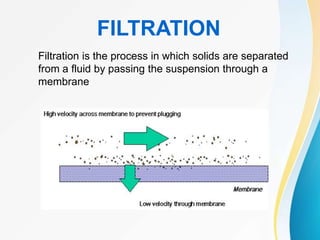
FILTRATION
Filtration is the process in which solids are separated
from a fluid by passing the suspension through a
membrane
Why Cross flow filtration?
•A higher overall liquid removal rate is achieved by
the prevention of filter cake formation
•Maintains constant filtration rates.
• Process feed remains in the form of a mobile slurry,
suitable for further processing
• Relatively high solids loads can be operated
continuously without blinding.
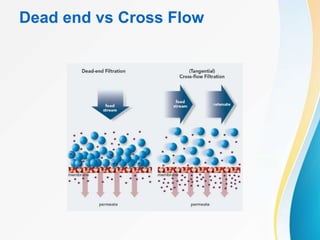
Dead end vs Cross Flow
flow filters
•Pore dimensions
•Pore size distributions
•Porosity
•Surface properties such as zeta potential
•Hydrophobic/ Hydrophilic character
•Membrane thickness
Features of cross flow filters:-
Techniques to improve
cross flow filtration
•Backwashing
•Clean-in-place (CIP)
•Concentration
•Diafiltration
•Process flow disruption
(PFD)
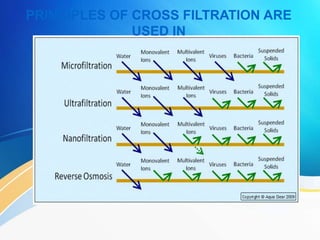
PRINCIPLES OF CROSS FILTRATION ARE
USED IN
1.Reverse Osmosis
This is a water purification technology that uses a semipermeable
membrane
Applications
•Separating low molecular weight substances in solutions
•Concentrating and Cleaning wastewater
•Demineralization
2.Nano filtration
Used for the particles up to 1nm
Applications
•Fine chemistry and Pharmaceuticals
•Oil and Petroleum chemistry
•Bulk Chemistry
•Natural Essential Oils and similar products
•Medicine
3.Ultra filtration
Used for the particles in the size range
from 103 to 106 Daltons
Applications
•Whey protein concentration
•Drinking water filtration
4.Micro Filtration
Used for the particles in the size range of 0.1-5μm
Applications
Water Treatment
Sterilisation
Petroleum Refining
Dairy Processing
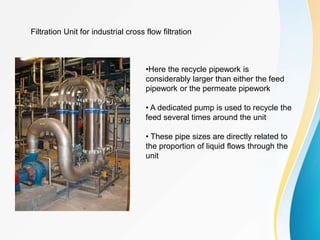
Filtration Unit for industrial cross flow filtration
•Here the recycle pipework is
considerably larger than either the feed
pipework or the permeate pipework
• A dedicated pump is used to recycle the
feed several times around the unit
• These pipe sizes are directly related to
the proportion of liquid flows through the
unit
CONCLUSIONS
• Cross flow filtrations has been proved useful while handling viscous
streams and fluids with large feeds containing a high proportion of small
particle size solids (where the permeate is of most value) because solid
material can quickly block (blind) the filter surface with dead-end filtration.
• Also the process feed remains in the form of a mobile slurry, suitable for
further processing
• Solids content of the product slurry may be varied over a wide range
References
1. Smith J.C. McCabe W.L. Harriott P. Unit Operations of
Chemical Engineering . McGraw Hill (Fifth Edition)
2. Ramesh Bhave , Fermentation and Biochemical
Engineering Handbook, Chapter 7
3. J F Richardson, JM Coulson, JH Harker , JR
Backhurst(2002) Coulson and Richardson chemical
engineering (Volume2) (fifth edition)
4.Millipore tangential flow filtration
5.Sahan Ranamukhaarachchi, Lena Meissner, Christine
Moresoli,Ultrafiltration and nanofiltration, October 2012.
6.Microfiltration in Dairy Processing ,U Merin,G Daufin, May
1990.
7.Nanofiltration technology in water treatment and reuse,
Article in Water Science & Technology,February 2015.
THANK YOU

cross flow filtration

  • 1.
    CROSS FLOW FILTRATION ASeminar On Presented By: ROHINI KUMAR LAD Roll No:20150465 Department of Chemical Engineering Dr. Babasaheb Ambedkar Technological University, Lonere
  • 2.
    Contents • INTRODUCTION • WHYCROSS FLOW FILTRATION ? • CROSS FLOW FILTERS • APPLICATIONS OVERVIEW • REFERENCES
  • 3.
    FILTRATION Filtration is theprocess in which solids are separated from a fluid by passing the suspension through a membrane
  • 4.
    Why Cross flowfiltration? •A higher overall liquid removal rate is achieved by the prevention of filter cake formation •Maintains constant filtration rates. • Process feed remains in the form of a mobile slurry, suitable for further processing • Relatively high solids loads can be operated continuously without blinding.
  • 5.
    Dead end vsCross Flow
  • 6.
    flow filters •Pore dimensions •Poresize distributions •Porosity •Surface properties such as zeta potential •Hydrophobic/ Hydrophilic character •Membrane thickness Features of cross flow filters:-
  • 7.
    Techniques to improve crossflow filtration •Backwashing •Clean-in-place (CIP) •Concentration •Diafiltration •Process flow disruption (PFD)
  • 8.
    PRINCIPLES OF CROSSFILTRATION ARE USED IN
  • 9.
    1.Reverse Osmosis This isa water purification technology that uses a semipermeable membrane Applications •Separating low molecular weight substances in solutions •Concentrating and Cleaning wastewater •Demineralization 2.Nano filtration Used for the particles up to 1nm Applications •Fine chemistry and Pharmaceuticals •Oil and Petroleum chemistry •Bulk Chemistry •Natural Essential Oils and similar products •Medicine
  • 10.
    3.Ultra filtration Used forthe particles in the size range from 103 to 106 Daltons Applications •Whey protein concentration •Drinking water filtration 4.Micro Filtration Used for the particles in the size range of 0.1-5μm Applications Water Treatment Sterilisation Petroleum Refining Dairy Processing
  • 11.
    Filtration Unit forindustrial cross flow filtration •Here the recycle pipework is considerably larger than either the feed pipework or the permeate pipework • A dedicated pump is used to recycle the feed several times around the unit • These pipe sizes are directly related to the proportion of liquid flows through the unit
  • 12.
    CONCLUSIONS • Cross flowfiltrations has been proved useful while handling viscous streams and fluids with large feeds containing a high proportion of small particle size solids (where the permeate is of most value) because solid material can quickly block (blind) the filter surface with dead-end filtration. • Also the process feed remains in the form of a mobile slurry, suitable for further processing • Solids content of the product slurry may be varied over a wide range
  • 13.
    References 1. Smith J.C.McCabe W.L. Harriott P. Unit Operations of Chemical Engineering . McGraw Hill (Fifth Edition) 2. Ramesh Bhave , Fermentation and Biochemical Engineering Handbook, Chapter 7 3. J F Richardson, JM Coulson, JH Harker , JR Backhurst(2002) Coulson and Richardson chemical engineering (Volume2) (fifth edition) 4.Millipore tangential flow filtration 5.Sahan Ranamukhaarachchi, Lena Meissner, Christine Moresoli,Ultrafiltration and nanofiltration, October 2012. 6.Microfiltration in Dairy Processing ,U Merin,G Daufin, May 1990. 7.Nanofiltration technology in water treatment and reuse, Article in Water Science & Technology,February 2015.
  • 14.