Prepared by: Prachand M.S. Rajbhandari Page 1
Note: Please, for more details refer books
Flow Cytometry: Definition
 Flow cytometry is a standard laser-based technology that is used in the detection and
measurement of physical and chemical characteristics of cells or particles in a
heterogeneous fluid mixture.
 The use of flow cytometry has increased over the years as it provides a rapid analysis of
multiple characteristics (both qualitative and quantitative) of the cells.
 The properties that can be measured by this process include a particle’s size, granularity or
internal complexity, and fluorescence intensity.
Flow Cytometry: Principle
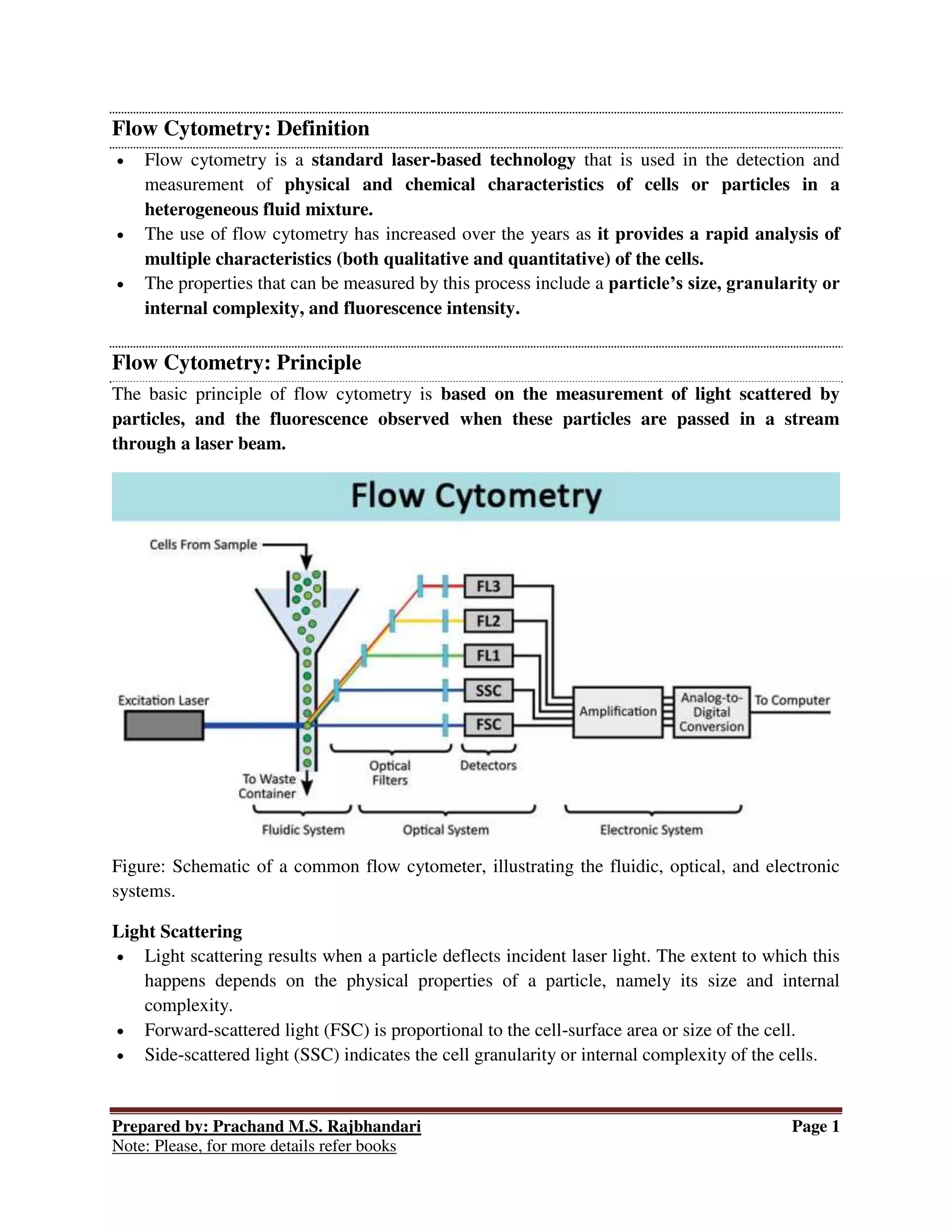
The basic principle of flow cytometry is based on the measurement of light scattered by
particles, and the fluorescence observed when these particles are passed in a stream
through a laser beam.
Figure: Schematic of a common flow cytometer, illustrating the fluidic, optical, and electronic
systems.
Light Scattering
 Light scattering results when a particle deflects incident laser light. The extent to which this
happens depends on the physical properties of a particle, namely its size and internal
complexity.
 Forward-scattered light (FSC) is proportional to the cell-surface area or size of the cell.
 Side-scattered light (SSC) indicates the cell granularity or internal complexity of the cells.
Prepared by: Prachand M.S. Rajbhandari Page 2
Note: Please, for more details refer books
 The measurements of FSC and SSC are used for the differentiation of cell types in a
heterogeneous cell population.
Fluorescence
 Fluorescent markers used to detect the expression of cellular molecules such as
proteins or nucleic acids in a system.
 The fluorescent compound absorbs light energy over a range of wavelengths that is
characteristic of that compound.
 This absorption of light causes an electron in the fluorescent compound to be raised to a
higher energy level.
 The excited electron quickly decays to its ground state, emitting the excess energy in the
form of fluorescence which is then collected by detectors.
 The electronics system then converts the detected light signals into electronic signals that
can be processed by the computer.
Instrumentation/Parts of Flow Cytometry
A flow cytometer is made up of three main systems: fluidics, optics system, and electronics
system.
Fluidics:
 The purpose of the fluidics system is to transport particles in a fluid stream to the laser
beam. To accomplish this, the sample is injected into a stream of sheath fluid (usually a
buffered saline solution) within the flow chamber.
Optics System:
 The optical system of the cytometer consists of excitation optics and collection optics.
 The excitation optics consists of the laser and lenses that are used to shape and focus the
laser beam to the flow of the sample.
 The collection optics consist of a collection lens to collect light emitted after the particle
interacts with the laser beam and a system of optical mirrors that divert the specified
wavelengths of the collected light to designated optical detectors.
Electronics system:
 The electronic system converts the signals from the detectors into digital signals that can be
read by a computer.
Applications/Uses
Flow Cytometry is used in several fields including molecular biology, pathology, immunology,
virology, plant biology, and marine biology. Some of the common application includes:
 It is used in clinical labs for the detection of malignancy in bodily fluids like leukemia.
 Cytometers like cell sorters can be used to separate the cells of interest in separate collection
tubes physically.
Prepared by: Prachand M.S. Rajbhandari Page 3
Note: Please, for more details refer books
 It can be used for the detection of the content of DNA by using fluorescent markers.
 Flow cytometers allow the analysis of replication cells by using fluorescent dye for four
different stages of the cell cycle.
 Acoustic flow cytometers are used in the study of multi-drug resistant bacteria in the blood
and other samples.
 The different stages of cell death, apoptosis, and necrosis can be detected by flow
cytometers based on the differences in the morphological and biochemical changes.

Flow cytometry

  • 1.
    Prepared by: PrachandM.S. Rajbhandari Page 1 Note: Please, for more details refer books Flow Cytometry: Definition  Flow cytometry is a standard laser-based technology that is used in the detection and measurement of physical and chemical characteristics of cells or particles in a heterogeneous fluid mixture.  The use of flow cytometry has increased over the years as it provides a rapid analysis of multiple characteristics (both qualitative and quantitative) of the cells.  The properties that can be measured by this process include a particle’s size, granularity or internal complexity, and fluorescence intensity. Flow Cytometry: Principle The basic principle of flow cytometry is based on the measurement of light scattered by particles, and the fluorescence observed when these particles are passed in a stream through a laser beam. Figure: Schematic of a common flow cytometer, illustrating the fluidic, optical, and electronic systems. Light Scattering  Light scattering results when a particle deflects incident laser light. The extent to which this happens depends on the physical properties of a particle, namely its size and internal complexity.  Forward-scattered light (FSC) is proportional to the cell-surface area or size of the cell.  Side-scattered light (SSC) indicates the cell granularity or internal complexity of the cells.
  • 2.
    Prepared by: PrachandM.S. Rajbhandari Page 2 Note: Please, for more details refer books  The measurements of FSC and SSC are used for the differentiation of cell types in a heterogeneous cell population. Fluorescence  Fluorescent markers used to detect the expression of cellular molecules such as proteins or nucleic acids in a system.  The fluorescent compound absorbs light energy over a range of wavelengths that is characteristic of that compound.  This absorption of light causes an electron in the fluorescent compound to be raised to a higher energy level.  The excited electron quickly decays to its ground state, emitting the excess energy in the form of fluorescence which is then collected by detectors.  The electronics system then converts the detected light signals into electronic signals that can be processed by the computer. Instrumentation/Parts of Flow Cytometry A flow cytometer is made up of three main systems: fluidics, optics system, and electronics system. Fluidics:  The purpose of the fluidics system is to transport particles in a fluid stream to the laser beam. To accomplish this, the sample is injected into a stream of sheath fluid (usually a buffered saline solution) within the flow chamber. Optics System:  The optical system of the cytometer consists of excitation optics and collection optics.  The excitation optics consists of the laser and lenses that are used to shape and focus the laser beam to the flow of the sample.  The collection optics consist of a collection lens to collect light emitted after the particle interacts with the laser beam and a system of optical mirrors that divert the specified wavelengths of the collected light to designated optical detectors. Electronics system:  The electronic system converts the signals from the detectors into digital signals that can be read by a computer. Applications/Uses Flow Cytometry is used in several fields including molecular biology, pathology, immunology, virology, plant biology, and marine biology. Some of the common application includes:  It is used in clinical labs for the detection of malignancy in bodily fluids like leukemia.  Cytometers like cell sorters can be used to separate the cells of interest in separate collection tubes physically.
  • 3.
    Prepared by: PrachandM.S. Rajbhandari Page 3 Note: Please, for more details refer books  It can be used for the detection of the content of DNA by using fluorescent markers.  Flow cytometers allow the analysis of replication cells by using fluorescent dye for four different stages of the cell cycle.  Acoustic flow cytometers are used in the study of multi-drug resistant bacteria in the blood and other samples.  The different stages of cell death, apoptosis, and necrosis can be detected by flow cytometers based on the differences in the morphological and biochemical changes.