
Google Hangouts
Photo credit: Enwikipedia.org
Photo credit: Flickr.com
Presenter Bios
Alyse McKeal is a reference and instruction librarian at
Palm Beach Beach State College. Shortly after earning her MLIS from
the University of South Florida, she pursued a Master’s degree in
Social Work. Prior to moving to PBSC last spring, Alyse was a Social
Sciences Librarian at FAU Libraries for just under 8 years. She has
been very involved in various committees, including SEFLIN
Committees and the PBCLA while in her tenure at FAU Libraries.
Alyse has been actively involved in the ALA NMRT for the last five
years. She has published and presented at local, state, and national
conferences on various subjects. Alyse has served in various
committee leadership roles while at FAU and PBSC.
When not working, I enjoy studying psychology, social work,
instructional design, and higher education, and also doing volunteer
work. In addition, I like traveling and spending time with her family.
Lawrence Mello is a reference and instruction librarian at
Florida Atlantic University. He earned his MLS at the University of
Maryland under John Bertot, where he specialized in E-Government
Information and Government Documents. He published the article
“Travel.State.Gov. Bureau of Consular Affairs, U.S. Department of
State. 2201 C Street, NW, Washington, DC 20520.” Government
Information Quarterly. He was part of a panel presentation with John
Bertot at the Florida Library Association (FLA) in 2012, Building the
Next Generation of E- government Librarians: Skills, Training and
Services.
Outside of the Library I like anything Disney, Star Wars, all things
Colonial and American Revolution, enjoy traveling to National Parks
with my family.
Why use Google Hangouts in your Library:
Google Hangouts is an instant messaging and video chat platform created by Google. It allows anyone with
Internet access and a Google email account to communicate with others. It will allow you to converse one-on-
one with a colleague or student, engage in a meeting with up to 10 people around the world via video chat, as
well as, the dissemination ideas and information through the use of built-in features like:
● Hold a consultation with a group of students without having to traipse across campus during a Florida
rainstorm.
● Bring in guest lecturers from around the world right in to your class to discuss the latest topic or event.
● Give an off-campus lecture without having to leave campus.
● Share your Computer Screen with ease when you need a visual aid to explain your point.
● Be able to share and collaborate purtant documents via Google Drive.
● Engage your students or colleagues when at a conference through your mobile device.
● You can broadcast and record your presentation on the web viaYouTube.
What do I need to get started...
• With Hangouts, you can send messages and make video calls on multiple devices to multiple people. You can
also share photos and your location with others. You can keep touch with family and friends at home or
when you're on-the-go through Hangouts in Gmail, Google+, the Chrome exension, or on your iOS or
Android Device.
• What you need to get started on Hangouts
• To use Hangouts, you’ll need a Google Account.
• On a computer:
• Gmail: You’ll need to turn on Hangouts in Gmail.
• Google+: Hangouts is automatically enabled in Google+.
• Chrome browser extension: Download the Hangouts Chrome extension. A Chrome browser or Chrome OS
device required. Windows 8 Metro Mode is not supported.
• On a mobile device:
• Android devices: Download the Hangouts app. If you want to make phone calls, you’ll need to download the
Hangouts Dialer to turn on calling in the Hangouts app.
• iOS devices: Download the Hangouts app.
Specifications
• Chat messages
• You can have a group Hangout with up to 150 people
• Video calls
• Video calls can have a maximum of 10 participants (requires Google Plus)
• Google Apps for Work: The maximum is 15 participants
• After 2.5 hours, Hangouts will prompt you to confirm you're still in the video call
• Google Apps for Work: Hangouts will prompt you after 12 hours
• To improve audio and video quality, Hangouts calls use a direct peer-to-peer
connection when possible, instead of routing through a server.
Requirements for Using Google Hangouts
• Supported operating systems
• Hangouts supports the current version and the 2 previous major releases of the operating systems listed below.
• Mac OS X
• Windows
• Chrome
• Ubuntu and other Debian-based Linux distributions
• Supported web browsers
• Hangouts supports the current version and 1 previous major release of the browsers listed below.
• Google Chrome: Download
• Microsoft Internet Explorer (IE): Download
• Mozilla Firefox: Download
• Safari: Download
• Camera & microphone access
• You'll need to let Hangouts use your camera and microphone when you start a video call for the first time. On Internet Explorer, Firefox, and Safari
browsers, this includes downloading and installing the latest version of the Hangouts plugin.
• Video call requirements
• Broadband connection to the Internet
• USB web camera or BlackMagic device
• Other devices, like virtual cameras, may not work with Hangouts
• Any 2 GHz dual-core processor or greater
• Bandwidth for video calls
• The bandwidth used by Hangouts is adaptive and will vary to provide the best experience on participants’ network.
Further requirements
• Minimum bandwidth required
• Outbound from the participant: 300 kbps
• Inbound to the participant: 300 kbps
• Ideal bandwidth
• Two-person video calls:
• Outbound from the participant: 2.6 mbps
• Inbound to the participant: 2.6 mbps
• Group video calls:
• Outbound from the participant in all situations: 2.6 mbps
• Inbound to the participant with 5 participants: 3.2 mbps
• Inbound to the participant with 10 participants: 4.0 mbps
Uses for Google Hangout
•Consultations/ Appointments
•Online Presentations
•Professional Development
•Works Meetings
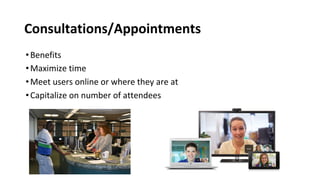
Consultations/Appointments
•Benefits
•Maximize time
•Meet users online or where they are at
•Capitalize on number of attendees
Online Presentations
• Via YouTube
• Taking Google Hangout to the next level:
• If you already have Google or a Gmail account, then adding a Google Plus
account is only a few clicks away. A Google Plus account will allow you to:
• Instead of being limited to only one other person, you can include up to 10
people in a hangout.
• Upgrading to Google Plus allows for YouTube functionality to be
incorporated into the hangout.
• What does this enhancement mean for you: not only will you be able to
watch YouTube content together, but it will allow you the ability to
"Broadcast" your hangout to YouTube, which will allows greater attendees
for your presentation.
Additional Broadcasting
(Online Presentations)
• HANGOUTS ON AIR
• Get started with Hangouts On Air
• NEXT: HANGOUTS ON AIR COMMON QUESTIONS
• With Hangouts On Air, you can broadcast live discussions and performances to the world through your
Google+ Home page and YouTube channel. You can also edit and share a copy of the broadcast.
• Getting started
• To start broadcasting Hangouts On Air, you need the following:
• YouTube channel - If you don’t already have one, create a YouTube channel. Make sure you verify
your YouTube channel through SMS.
• Google+ profile or page - Make sure your Google+ profile or page is connected to your YouTube channel.
Newly created YouTube channels are automatically connected to Google+. If you have an existing channel
that is not connected to Google+, you can connect it to a Google+ profile or a Google+ page. And if you
previously used your Google+ page to broadcast to a Google+ profile administrator’s channel, you need
to link the page to its own YouTube channel.
Professional Development
•Maximize time and training efforts
Hold Meetings
Getting Started with Google Hangouts
•Why use Google Hangouts
•How to get started
•Sharing your screen
•How to use with various devices (via apps), and much more.
How to Get Started(add an image)
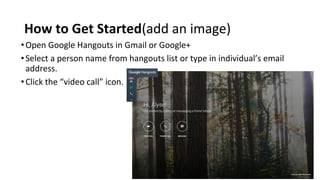
•Open Google Hangouts in Gmail or Google+
•Select a person name from hangouts list or type in individual’s email
address.
•Click the “video call” icon.
•Sign up for Google+ for more features in Hangouts
•To access more advanced features of Hangouts, like starting
Hangouts with Google+ circles or sharing your Google+ photos, you’ll
need a Google+ account.
Some features of Google Hangouts
Why: Share Your Screen?
• Show your presentations: Having a meeting with colleagues or holding a student
consultation via a video call, with screenshare you can instantly share your
computer screen and show the presentation you have for them.
• Helping others (guiding them): It will allow you to explain with relative ease how
to use or navigate a particular website or database. Merely share the screen you
want to explain and step them through the process one step at a time.
• Share your pictures: You are engaged in a video call, disscusing a recent
archeology dig, or your trip to the Smithsonian. Now your colleague is asking you
to send pictures (but those are too big in size so will take time to upload). Share
them through screen share in real time and no need to upload them to an e-mail.
• Show Movies: You are watching training movie or webinar, now you have an
option to let the other person watch the movie as well
Screenshare
● Show your presentations: Having a meeting with
colleagues or holding a student consultation via a
video call? Using screenshare you can instantly
share your computer screen and show the
presentation you have for them.
● Helping others (guiding them): It will allow you to
explain with relative ease how to use or navigate a
particular website or database. Merely share the
screen you want to explain and step them through
the process one step at a time.
● Share your pictures: You are engaged in a video
call, discussing a recent archeology dig, or your trip
to the Smithsonian. Now your colleague is asking
you to send pictures (but those are too big in size so
will take time to upload). Share them through screen
share in real time and no need to upload them to an
e-mail.
● Show Movies: You are watching training movie or
webinar, now you have an option to let the other
person watch the movie as well
Watching YouTube videos in a Google
Hangout
• YouTube App
• To watch YouTube videos with others in a video call simply open the YouTube app. Everyone in the video call
will also have to add the app.
• Finding videos to play
• Click on the blue Add videos to playlist button to find videos. To find videos you can either search for a
specific video or copy and paste the URL of a specific YouTube video.
• We recommend videos to you based on the playlist you currently have. They appear below the shared
playlist in a separate section. You can add them to your playlist by clicking the green “+” button.
• Once you have found a video, click the green “+” button(s) to add one or more search results to the shared
playlist. Once added to the playlist, the button(s) will turn red. Click the red button to remove the
corresponding video from the shared playlist.
Use it on your mobile Android or Apple
Devices and stay connected while on the go.
Best Practices (Continued)
• Google Hangouts screensharing technology only allows the participants to view each other’s screens; it does NOT give any
participant control of another participant's computer. You do not need a webcam or microphone for screensharing, although a
microphone and speakers or headphones can be useful.
• To meet remotely with a consultant, you will first set up Google Hangouts and then make an appointment:
• 1) Activate Google Plus on your Google (FAU) account. If you do not have a Google (FAU) account, you can use another Gmail
account. If you do not have any sort of Google (FAU) or Gmail account, see note below.
• Screensharing is not available in Hangouts on accounts that do not have Google Plus activated. To activate Google Plus, log
into your Google (FAU) email, and then click on the +[YourName] link all the way on the left, on the black bar at the top of the
screen. You will fill out some information if you have not done this before. This does not obligate you to use Google Plus in any
way. (Google Plus is a Facebook-like social media platform.)
• 2) Make an appointment with the consultant via email or phone. If you have a phone number at which you will be available,
please provide that in case technical problems make connecting difficult, or if we have audio problems.
Best Practices
• 3) Accept the invitation to chat from the consultant. In order to participate in a Google Hangout with someone, they must
already be in your "invited to chat" category of contacts. The consultant(Librarian) will initiate this, and you just need to look
for an email or notification about the invitation. This can be done at the time of the appointment, too.
• 4) (Optional) Test screensharing with a friend. Do this from whatever computer you plan to have the consultation from. E.g.,
that might be from a Sites computer that has GIS software as well, because you'll want to share your screen to get help
troubleshooting a problem in GIS. If from a non-centrally-managed computer, you may have to install browser plugins in order
to make this work. Google's Chrome browser will work best with Google Hangouts.
• 5) At the time of your appointment, be logged into your Google (FAU) or Gmail account, and wait for the Google Hangout
invitation from the consultant.
Bibliography (Continued)
Alexander, R. (2013, August). Collaborate in Google hangouts. Learning & Leading with Technology, 41(1), 34+. Retrieved from http://go.
galegroup.com/ps/i.do?id=GALE%7CA345774075&v=2.1&u=gale15691&it=r&p=AONE&sw=w&asid=1e562d4f060bfc58d6be822020646a92
Anderson, K. E., & Still, J. M. (2011). An introduction to google plus. Library Hi Tech News, 28(8), 7-10. doi:10.1108/07419051111187842
Berube, L. (2004). Collaborative digital reference: An ask a librarian (UK) overview. Program: Electronic Library and Information Systems, 38
(1), 29-41, doi:10.1108/00330330410519189
Booth, C. (2008). Developing skype-based reference services. Internet Reference Services Quarterly, 13(2-3), 147-165. doi:10.1080
/10875300802103684
Booth, C. (2010). Chapter 1: VoIP demystified. Library Technology Reports, 46(5), 5+. Retrieved from http://go.galegroup.com/ps/i.do?
id=GALE%7CA245661472&v=2.1&u=gale15691&it=r&p=AONE&sw=w&asid=0a9fa5e7ed07c8b987a58481ba587a51
Booth, C. (2010). Chapter 4: VoIP in reference, user services, and instruction. Library Technology Reports, 46(5), 25+. Retrieved from http:
//go.galegroup.com/ps/i.do?id=GALE%7CA245661475&v=2.
1&u=gale15691&it=r&p=AONE&sw=w&asid=125cf8b6e6c0e871ce1f493f52ab772a
Booth, C. (2010). Chapter 6: Lessons for library innovation. Library Technology Reports, 46(5), 38+. Retrieved from http://go.galegroup.
com/ps/i.do?id=GALE%7CA245661477&v=2.1&u=gale15691&it=r&p=AONE&sw=w&asid=2a27d2fbeb005b3c1ec66b0caaa924f2
Bibliography (Cont’d)
Booth, C. (2010). Chapter 7: Knowledge sharing and the next-generation network. Library Technology Reports, 46(5), 44+. Retrieved from
http://go.galegroup.com/ps/i.do?id=GALE%7CA245661478&v=2.
1&u=gale15691&it=r&p=AONE&sw=w&asid=eb083fb76d9087afec36880d737165f6
Byrne, R. (2012). Making the Most of Video in the Classroom. School Library Journal, 58(8), 15. Retrieved from
http://web.b.ebscohost.com/ehost/detail/detail?sid=fd548044 e905-45af-a561-03a0d224c264%40sessionmgr115&vid=6&hid=112&
data=JnNpdGU9ZWhvc3QtbGl2ZQ%3d%3d#db=llf&AN=78359992
Dankowski, Terra (May 2013). "How libraries are using social media: expanding online toolkits to promote advocacy." American Libraries
38+. Retrieved from http://go.galegroup.com/ps/i.do?id=GALE%7CA330500909&v=2.
1&u=gale15691&it=r&p=AONE&sw=w&asid=858fc3b545bbb7338464ac938e491ac9
FAU Libraries, Reference Department Google Hangouts’ Working Group. Google Hangouts LibGuide. http://libguides.fau.
edu/Googlehangouts
Fredrick, K. (2013). Google... plus. School Library Monthly, 29(6), 23-25. Retrieved from http://ezproxy.fau.edu/login?url=http://search.
proquest.com/docview/1492222296?accountid=10902
Graham, T. (2014). Create, record, and broadcast (live) your Google+ hangouts: Conference report. Journal of Electronic Resources
Librarianship, 26(1), 61-62. doi:10.1080/1941126X.2014.878631
Hawkins, D. T. (2011, November). NFAIS: a closer look at Google+. Information Today, 28(10), 16. Retrieved from http://go.galegroup.
com/ps/i.do?id=GALE%7CA272168729&v=2.1&u=gale15691&it=r&p=AONE&sw=w&asid=4840980c6f9bca742b0f0c1c4dac984d
Bibliography
Kiel, J. M., Montenery, S., Perry, N. N., Jones, A. D., & Ross, D. S. (2013). Google+ gets an A+ in distance education. Journal of Nursing
Education, 52(9), 543. doi:10.3928/01484834-20130822-11
Librarians on the Fly Blog (4/22/13). Broadcast your Google Hangout on Youtube. http://librariansonthefly.blogspot.
com/2013/04/broadcast-your-google-hangout-on-youtube.html
Miller, S. (2014). Innovators: Virtually Connected. Library Journal, 139(5), 50. Retrieved from http://web.b.ebscohost.
com/ehost/detail/detail?vid=3&sid=fd548044-e905-45af-a561-03a0d224c264%
40sessionmgr115&hid=112&bdata=JnNpdGU9ZWhvc3QtbGl2ZQ%3d%3d#db=llf&AN=94841558
Schaffhauser, D. (1/16/13). School of Ed Tests Out Google+ Hangouts. Campus Technology. Retrieved from http://campustechnology.
com/articles/2013/01/16/school-of-ed-tests-out-google-hangouts.aspx?=CT21
Schmidt, J. (2007). Promoting library services in a google world. Library Management, 28(6/7), 337-346. doi:10.1108/01435120710774477
Scholtz, N. (7/16/14). Remote reference services. University of Michigan Libraries. http://www.lib.umich.edu/clark-library/services/remote-
reference
Stern, D. (2013, January-February). Virtual reference and in-depth assistance using shared workspaces. Online Searcher, 37(1), 22+.
Retrieved from http://go.galegroup.com/ps/i.do?id=GALE%7CA320732754&v=2.
1&u=gale15691&it=r&p=HRCA&sw=w&asid=4c1847b6a1e8edec813c0c439ef6b780
Williams, K. C. (2014). Office hours: bringing them to where your students are. NACTA Journal, 58(1), 81. Retrieved from http://go.
galegroup.com/ps/i.do?id=GALE%7CA365458643&v=2.1&u=gale15691&it=r&p=AONE&sw=w&asid=6e66d9ee626af6c0055f0e6ea8825feb

Florida Library Webinars, Google Hangouts Presentation by Alyse McKeal and Lawrence Mello

  • 1.
    Google Hangouts Photo credit:Enwikipedia.org Photo credit: Flickr.com
  • 2.
    Presenter Bios Alyse McKealis a reference and instruction librarian at Palm Beach Beach State College. Shortly after earning her MLIS from the University of South Florida, she pursued a Master’s degree in Social Work. Prior to moving to PBSC last spring, Alyse was a Social Sciences Librarian at FAU Libraries for just under 8 years. She has been very involved in various committees, including SEFLIN Committees and the PBCLA while in her tenure at FAU Libraries. Alyse has been actively involved in the ALA NMRT for the last five years. She has published and presented at local, state, and national conferences on various subjects. Alyse has served in various committee leadership roles while at FAU and PBSC. When not working, I enjoy studying psychology, social work, instructional design, and higher education, and also doing volunteer work. In addition, I like traveling and spending time with her family. Lawrence Mello is a reference and instruction librarian at Florida Atlantic University. He earned his MLS at the University of Maryland under John Bertot, where he specialized in E-Government Information and Government Documents. He published the article “Travel.State.Gov. Bureau of Consular Affairs, U.S. Department of State. 2201 C Street, NW, Washington, DC 20520.” Government Information Quarterly. He was part of a panel presentation with John Bertot at the Florida Library Association (FLA) in 2012, Building the Next Generation of E- government Librarians: Skills, Training and Services. Outside of the Library I like anything Disney, Star Wars, all things Colonial and American Revolution, enjoy traveling to National Parks with my family.
  • 3.
    Why use GoogleHangouts in your Library: Google Hangouts is an instant messaging and video chat platform created by Google. It allows anyone with Internet access and a Google email account to communicate with others. It will allow you to converse one-on- one with a colleague or student, engage in a meeting with up to 10 people around the world via video chat, as well as, the dissemination ideas and information through the use of built-in features like: ● Hold a consultation with a group of students without having to traipse across campus during a Florida rainstorm. ● Bring in guest lecturers from around the world right in to your class to discuss the latest topic or event. ● Give an off-campus lecture without having to leave campus. ● Share your Computer Screen with ease when you need a visual aid to explain your point. ● Be able to share and collaborate purtant documents via Google Drive. ● Engage your students or colleagues when at a conference through your mobile device. ● You can broadcast and record your presentation on the web viaYouTube.
  • 4.
    What do Ineed to get started... • With Hangouts, you can send messages and make video calls on multiple devices to multiple people. You can also share photos and your location with others. You can keep touch with family and friends at home or when you're on-the-go through Hangouts in Gmail, Google+, the Chrome exension, or on your iOS or Android Device. • What you need to get started on Hangouts • To use Hangouts, you’ll need a Google Account. • On a computer: • Gmail: You’ll need to turn on Hangouts in Gmail. • Google+: Hangouts is automatically enabled in Google+. • Chrome browser extension: Download the Hangouts Chrome extension. A Chrome browser or Chrome OS device required. Windows 8 Metro Mode is not supported. • On a mobile device: • Android devices: Download the Hangouts app. If you want to make phone calls, you’ll need to download the Hangouts Dialer to turn on calling in the Hangouts app. • iOS devices: Download the Hangouts app.
  • 5.
    Specifications • Chat messages •You can have a group Hangout with up to 150 people • Video calls • Video calls can have a maximum of 10 participants (requires Google Plus) • Google Apps for Work: The maximum is 15 participants • After 2.5 hours, Hangouts will prompt you to confirm you're still in the video call • Google Apps for Work: Hangouts will prompt you after 12 hours • To improve audio and video quality, Hangouts calls use a direct peer-to-peer connection when possible, instead of routing through a server.
  • 6.
    Requirements for UsingGoogle Hangouts • Supported operating systems • Hangouts supports the current version and the 2 previous major releases of the operating systems listed below. • Mac OS X • Windows • Chrome • Ubuntu and other Debian-based Linux distributions • Supported web browsers • Hangouts supports the current version and 1 previous major release of the browsers listed below. • Google Chrome: Download • Microsoft Internet Explorer (IE): Download • Mozilla Firefox: Download • Safari: Download • Camera & microphone access • You'll need to let Hangouts use your camera and microphone when you start a video call for the first time. On Internet Explorer, Firefox, and Safari browsers, this includes downloading and installing the latest version of the Hangouts plugin. • Video call requirements • Broadband connection to the Internet • USB web camera or BlackMagic device • Other devices, like virtual cameras, may not work with Hangouts • Any 2 GHz dual-core processor or greater • Bandwidth for video calls • The bandwidth used by Hangouts is adaptive and will vary to provide the best experience on participants’ network.
  • 7.
    Further requirements • Minimumbandwidth required • Outbound from the participant: 300 kbps • Inbound to the participant: 300 kbps • Ideal bandwidth • Two-person video calls: • Outbound from the participant: 2.6 mbps • Inbound to the participant: 2.6 mbps • Group video calls: • Outbound from the participant in all situations: 2.6 mbps • Inbound to the participant with 5 participants: 3.2 mbps • Inbound to the participant with 10 participants: 4.0 mbps
  • 8.
    Uses for GoogleHangout •Consultations/ Appointments •Online Presentations •Professional Development •Works Meetings
  • 9.
    Consultations/Appointments •Benefits •Maximize time •Meet usersonline or where they are at •Capitalize on number of attendees
  • 10.
    Online Presentations • ViaYouTube • Taking Google Hangout to the next level: • If you already have Google or a Gmail account, then adding a Google Plus account is only a few clicks away. A Google Plus account will allow you to: • Instead of being limited to only one other person, you can include up to 10 people in a hangout. • Upgrading to Google Plus allows for YouTube functionality to be incorporated into the hangout. • What does this enhancement mean for you: not only will you be able to watch YouTube content together, but it will allow you the ability to "Broadcast" your hangout to YouTube, which will allows greater attendees for your presentation.
  • 11.
    Additional Broadcasting (Online Presentations) •HANGOUTS ON AIR • Get started with Hangouts On Air • NEXT: HANGOUTS ON AIR COMMON QUESTIONS • With Hangouts On Air, you can broadcast live discussions and performances to the world through your Google+ Home page and YouTube channel. You can also edit and share a copy of the broadcast. • Getting started • To start broadcasting Hangouts On Air, you need the following: • YouTube channel - If you don’t already have one, create a YouTube channel. Make sure you verify your YouTube channel through SMS. • Google+ profile or page - Make sure your Google+ profile or page is connected to your YouTube channel. Newly created YouTube channels are automatically connected to Google+. If you have an existing channel that is not connected to Google+, you can connect it to a Google+ profile or a Google+ page. And if you previously used your Google+ page to broadcast to a Google+ profile administrator’s channel, you need to link the page to its own YouTube channel.
  • 12.
  • 13.
  • 14.
    Getting Started withGoogle Hangouts •Why use Google Hangouts •How to get started •Sharing your screen •How to use with various devices (via apps), and much more.
  • 15.
    How to GetStarted(add an image) •Open Google Hangouts in Gmail or Google+ •Select a person name from hangouts list or type in individual’s email address. •Click the “video call” icon.
  • 16.
    •Sign up forGoogle+ for more features in Hangouts •To access more advanced features of Hangouts, like starting Hangouts with Google+ circles or sharing your Google+ photos, you’ll need a Google+ account.
  • 17.
    Some features ofGoogle Hangouts
  • 18.
    Why: Share YourScreen? • Show your presentations: Having a meeting with colleagues or holding a student consultation via a video call, with screenshare you can instantly share your computer screen and show the presentation you have for them. • Helping others (guiding them): It will allow you to explain with relative ease how to use or navigate a particular website or database. Merely share the screen you want to explain and step them through the process one step at a time. • Share your pictures: You are engaged in a video call, disscusing a recent archeology dig, or your trip to the Smithsonian. Now your colleague is asking you to send pictures (but those are too big in size so will take time to upload). Share them through screen share in real time and no need to upload them to an e-mail. • Show Movies: You are watching training movie or webinar, now you have an option to let the other person watch the movie as well
  • 19.
    Screenshare ● Show yourpresentations: Having a meeting with colleagues or holding a student consultation via a video call? Using screenshare you can instantly share your computer screen and show the presentation you have for them. ● Helping others (guiding them): It will allow you to explain with relative ease how to use or navigate a particular website or database. Merely share the screen you want to explain and step them through the process one step at a time. ● Share your pictures: You are engaged in a video call, discussing a recent archeology dig, or your trip to the Smithsonian. Now your colleague is asking you to send pictures (but those are too big in size so will take time to upload). Share them through screen share in real time and no need to upload them to an e-mail. ● Show Movies: You are watching training movie or webinar, now you have an option to let the other person watch the movie as well
  • 20.
    Watching YouTube videosin a Google Hangout • YouTube App • To watch YouTube videos with others in a video call simply open the YouTube app. Everyone in the video call will also have to add the app. • Finding videos to play • Click on the blue Add videos to playlist button to find videos. To find videos you can either search for a specific video or copy and paste the URL of a specific YouTube video. • We recommend videos to you based on the playlist you currently have. They appear below the shared playlist in a separate section. You can add them to your playlist by clicking the green “+” button. • Once you have found a video, click the green “+” button(s) to add one or more search results to the shared playlist. Once added to the playlist, the button(s) will turn red. Click the red button to remove the corresponding video from the shared playlist.
  • 21.
    Use it onyour mobile Android or Apple Devices and stay connected while on the go.
  • 22.
    Best Practices (Continued) •Google Hangouts screensharing technology only allows the participants to view each other’s screens; it does NOT give any participant control of another participant's computer. You do not need a webcam or microphone for screensharing, although a microphone and speakers or headphones can be useful. • To meet remotely with a consultant, you will first set up Google Hangouts and then make an appointment: • 1) Activate Google Plus on your Google (FAU) account. If you do not have a Google (FAU) account, you can use another Gmail account. If you do not have any sort of Google (FAU) or Gmail account, see note below. • Screensharing is not available in Hangouts on accounts that do not have Google Plus activated. To activate Google Plus, log into your Google (FAU) email, and then click on the +[YourName] link all the way on the left, on the black bar at the top of the screen. You will fill out some information if you have not done this before. This does not obligate you to use Google Plus in any way. (Google Plus is a Facebook-like social media platform.) • 2) Make an appointment with the consultant via email or phone. If you have a phone number at which you will be available, please provide that in case technical problems make connecting difficult, or if we have audio problems.
  • 23.
    Best Practices • 3)Accept the invitation to chat from the consultant. In order to participate in a Google Hangout with someone, they must already be in your "invited to chat" category of contacts. The consultant(Librarian) will initiate this, and you just need to look for an email or notification about the invitation. This can be done at the time of the appointment, too. • 4) (Optional) Test screensharing with a friend. Do this from whatever computer you plan to have the consultation from. E.g., that might be from a Sites computer that has GIS software as well, because you'll want to share your screen to get help troubleshooting a problem in GIS. If from a non-centrally-managed computer, you may have to install browser plugins in order to make this work. Google's Chrome browser will work best with Google Hangouts. • 5) At the time of your appointment, be logged into your Google (FAU) or Gmail account, and wait for the Google Hangout invitation from the consultant.
  • 24.
    Bibliography (Continued) Alexander, R.(2013, August). Collaborate in Google hangouts. Learning & Leading with Technology, 41(1), 34+. Retrieved from http://go. galegroup.com/ps/i.do?id=GALE%7CA345774075&v=2.1&u=gale15691&it=r&p=AONE&sw=w&asid=1e562d4f060bfc58d6be822020646a92 Anderson, K. E., & Still, J. M. (2011). An introduction to google plus. Library Hi Tech News, 28(8), 7-10. doi:10.1108/07419051111187842 Berube, L. (2004). Collaborative digital reference: An ask a librarian (UK) overview. Program: Electronic Library and Information Systems, 38 (1), 29-41, doi:10.1108/00330330410519189 Booth, C. (2008). Developing skype-based reference services. Internet Reference Services Quarterly, 13(2-3), 147-165. doi:10.1080 /10875300802103684 Booth, C. (2010). Chapter 1: VoIP demystified. Library Technology Reports, 46(5), 5+. Retrieved from http://go.galegroup.com/ps/i.do? id=GALE%7CA245661472&v=2.1&u=gale15691&it=r&p=AONE&sw=w&asid=0a9fa5e7ed07c8b987a58481ba587a51 Booth, C. (2010). Chapter 4: VoIP in reference, user services, and instruction. Library Technology Reports, 46(5), 25+. Retrieved from http: //go.galegroup.com/ps/i.do?id=GALE%7CA245661475&v=2. 1&u=gale15691&it=r&p=AONE&sw=w&asid=125cf8b6e6c0e871ce1f493f52ab772a Booth, C. (2010). Chapter 6: Lessons for library innovation. Library Technology Reports, 46(5), 38+. Retrieved from http://go.galegroup. com/ps/i.do?id=GALE%7CA245661477&v=2.1&u=gale15691&it=r&p=AONE&sw=w&asid=2a27d2fbeb005b3c1ec66b0caaa924f2
  • 25.
    Bibliography (Cont’d) Booth, C.(2010). Chapter 7: Knowledge sharing and the next-generation network. Library Technology Reports, 46(5), 44+. Retrieved from http://go.galegroup.com/ps/i.do?id=GALE%7CA245661478&v=2. 1&u=gale15691&it=r&p=AONE&sw=w&asid=eb083fb76d9087afec36880d737165f6 Byrne, R. (2012). Making the Most of Video in the Classroom. School Library Journal, 58(8), 15. Retrieved from http://web.b.ebscohost.com/ehost/detail/detail?sid=fd548044 e905-45af-a561-03a0d224c264%40sessionmgr115&vid=6&hid=112& data=JnNpdGU9ZWhvc3QtbGl2ZQ%3d%3d#db=llf&AN=78359992 Dankowski, Terra (May 2013). "How libraries are using social media: expanding online toolkits to promote advocacy." American Libraries 38+. Retrieved from http://go.galegroup.com/ps/i.do?id=GALE%7CA330500909&v=2. 1&u=gale15691&it=r&p=AONE&sw=w&asid=858fc3b545bbb7338464ac938e491ac9 FAU Libraries, Reference Department Google Hangouts’ Working Group. Google Hangouts LibGuide. http://libguides.fau. edu/Googlehangouts Fredrick, K. (2013). Google... plus. School Library Monthly, 29(6), 23-25. Retrieved from http://ezproxy.fau.edu/login?url=http://search. proquest.com/docview/1492222296?accountid=10902 Graham, T. (2014). Create, record, and broadcast (live) your Google+ hangouts: Conference report. Journal of Electronic Resources Librarianship, 26(1), 61-62. doi:10.1080/1941126X.2014.878631 Hawkins, D. T. (2011, November). NFAIS: a closer look at Google+. Information Today, 28(10), 16. Retrieved from http://go.galegroup. com/ps/i.do?id=GALE%7CA272168729&v=2.1&u=gale15691&it=r&p=AONE&sw=w&asid=4840980c6f9bca742b0f0c1c4dac984d
  • 26.
    Bibliography Kiel, J. M.,Montenery, S., Perry, N. N., Jones, A. D., & Ross, D. S. (2013). Google+ gets an A+ in distance education. Journal of Nursing Education, 52(9), 543. doi:10.3928/01484834-20130822-11 Librarians on the Fly Blog (4/22/13). Broadcast your Google Hangout on Youtube. http://librariansonthefly.blogspot. com/2013/04/broadcast-your-google-hangout-on-youtube.html Miller, S. (2014). Innovators: Virtually Connected. Library Journal, 139(5), 50. Retrieved from http://web.b.ebscohost. com/ehost/detail/detail?vid=3&sid=fd548044-e905-45af-a561-03a0d224c264% 40sessionmgr115&hid=112&bdata=JnNpdGU9ZWhvc3QtbGl2ZQ%3d%3d#db=llf&AN=94841558 Schaffhauser, D. (1/16/13). School of Ed Tests Out Google+ Hangouts. Campus Technology. Retrieved from http://campustechnology. com/articles/2013/01/16/school-of-ed-tests-out-google-hangouts.aspx?=CT21 Schmidt, J. (2007). Promoting library services in a google world. Library Management, 28(6/7), 337-346. doi:10.1108/01435120710774477 Scholtz, N. (7/16/14). Remote reference services. University of Michigan Libraries. http://www.lib.umich.edu/clark-library/services/remote- reference Stern, D. (2013, January-February). Virtual reference and in-depth assistance using shared workspaces. Online Searcher, 37(1), 22+. Retrieved from http://go.galegroup.com/ps/i.do?id=GALE%7CA320732754&v=2. 1&u=gale15691&it=r&p=HRCA&sw=w&asid=4c1847b6a1e8edec813c0c439ef6b780 Williams, K. C. (2014). Office hours: bringing them to where your students are. NACTA Journal, 58(1), 81. Retrieved from http://go. galegroup.com/ps/i.do?id=GALE%7CA365458643&v=2.1&u=gale15691&it=r&p=AONE&sw=w&asid=6e66d9ee626af6c0055f0e6ea8825feb