HOT TOPICS IN
INTELLECTUAL
FREEDOM:
A DISCUSSION
Florida Library Association Intellectual
Freedom Committee
ALA Freedom to Read
Statement
“There is no place in our society for efforts to
coerce the taste of others, to confine adults to
the reading matter deemed suitable for
adolescents, or to inhibit the efforts of writers to
achieve artistic expression.”
Debi Cheek: eBooks and Access
Zach English: Internet Censorship- An International
Perspective
Robin Shader: Challenges
Alyse Ergood: Librarians‟ Intellectual Freedom and
Rights
Sara Gonzalez, Moderator
Panelists and Moderator
Debi Cheek
Debi earned her MLIS from the University of
South Florida. She has worked as both a K-12
Media Specialist and an Academic Librarian.
Currently, she works as an adjunct professor for
Rasmussen College teaching Introduction to
Undergraduate Research. Additionally, she is
working on her doctorate in Educational
Technology at Florida Gulf Coast University.
Zach English
Zach English is the Director of Library Services for
Everglades University. He has worked and interned in
academic libraries for three years, including libraries at
Hillsborough Community College, Keiser University and
Everglades University. He earned his Master of Arts
degree in Library and Information Science from the
University of South Florida, and his Bachelor of Arts in
Philosophy from the University of Central Florida. He is a
member of the Palm Beach County Library
Association, the Florida Library Association, and the
Southeast Florida Library Information Network (SEFLIN).
He has served on FLA‟s Intellectual Freedom Committee
for two years, and has also written for FLA‟s Media
Clippings blog and Florida Libraries journal. His interest in
intellectual freedom issues comes from a belief that the
rights to pursue knowledge and to express oneself are
core human rights.
Robin Shader
Robin Shader is the Director of the Northwest
Regional Library System, serving Bay, Gulf, and
Liberty Counties, Florida. She is a New Jersey
native and received her MLS from Rutgers
University. Robin has worked in public libraries in
New Jersey, Georgia and Florida for the past 15
years. She has published articles in School Library
Journal, ALA's Applied Professional Association‟s
Library Worklife, and has two essays in the book
Library Management Tips that Work published in
2011 by ALA Editions. Robin is a member of the
American Library Association Intellectual Freedom
Committee and is the Chair of the FLA Intellectual
Freedom Committee.
Alyse Ergood
Alyse Ergood is an Associate University Librarian in the
Reference and Instruction Department at Florida Atlantic
University (FAU) in Boca Raton. She is the social sciences
librarian, and is a subject specialist in nursing, languages
and linguistics, and anthropology to name a few. After
receiving her MLIS from the University of South Florida in
2006, Alyse became very active on a variety of library and
university committees. She is currently the Vice-
Chair/President Elect of the PBCLA, and a member of
various committees in SEFLIN and the ALA‟s New Member
Roundtable (NMRT). Alyse has published and presented
on various topics including marketing, emerging
technologies, and creating online tutorials. Her research
interests include online education, intellectual freedom,
emerging technologies, and various topics within the social
sciences. Alyse is working on her Master‟s degree in
Social Work at FAU.
ALA Censorship and
Challenges
A challenge is an attempt to remove or restrict
materials, based upon the objections of a person
or group. A banning is the removal of those
materials. Challenges do not simply involve a
person expressing a point of view; rather, they
are an attempt to remove material from the
curriculum or library, thereby restricting the
access of others.
ALA Freedom to Read
Statement
It is in the public interest for publishers and
librarians to make available the widest diversity
of views and expressions, including those that
are unorthodox, unpopular, or considered
dangerous by the majority.
E-BOOKS & ACCESS
Debi Cheek, Rasmussen College
E-Books & Access
ACCESS
1.Device
2.Patron
3.Material
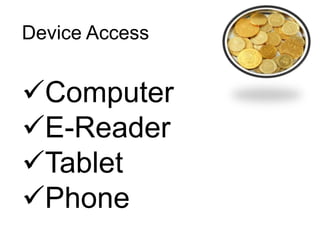
Device Access
Computer
E-Reader
Tablet
Phone
E-Readers & Your Library
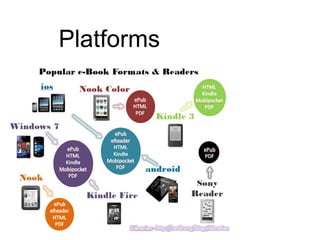
Platforms
E-Books & Print Disabled
Patrons
“(The) blind and other print-disabled
users, for the first time in history, gain
access to the same books and
publications at the same price and at
the same time as the rest of society”
(Mason, 2012, pp. 18-19).
.
Print Disabled Options
Magnification
Text-to-Speech
Braille
E-Book Options
• iOS – Available with Apple Products
• VoiceOver Option
• Connect Blue-tooth enabled Braille display
• Kindle
• Very limited accessibility (Kindle Fire)
• Many books don‟t offer text-to-talk feature
either
• NOOK & Sony Reader
• Not accessible
Access & the Law
 NFB v. Free Library of Philadelphia (Enis &
Schwartz, 2012)
 Pilot program Nook
 Patrons 50+ could check out reader
 Used Federal Funds to purchase
 No Text-to-Speech
 Violated Section 504 Rehabilitation Act & Title II
ADA
 NFB & Dept. of Justice v. Sacramento Public
Library
 Nook lending
 Violated ADA
Other Options to Assist
Print Disabled Patrons
• LEAP : Available at no cost
for libraries who have a
relationship with Overdrive.
Registered patrons will
have access to
BookShare, a separate
collection of books and
magazines in DAISY &
Where did my e-book go?
Clipart from: Operation Awesome
Digital Rights Management
(DRM) & Material Access
Type of device
Print, copy or download
restrictions
Publisher Restrictions
Vendor Restrictions
INTERNET CENSORSHIP: AN
INTERNATIONAL PERSPECTIVE
Zach English, Everglades University
Threats to Internet
Expression
 Cyber-crime
 Anti-Counterfeiting Trade Agreement
 Protecting against obscenity and harmful content
 Filters in school and library computers
 Intellectual property
 Stop Online Piracy Act (SOPA)
 Protect IP Act (PIPA)
 Intellectual Property Rights Enforcement Directive
(IPRED)
 National security
 WikiLeaks
ACLU‟s “Don‟t Filter Me”
Project
 Viewpoint-neutral content in
public schools
 2000: Children‟s Internet
Protection Act (CIPA)
 Web-filtering software
categorizes content
 Problems with allowing
removal of filters on a case-
by-case basis
 2012: PFLAG v. Camdenton
R-III School District
 URL Blacklist
Social Media and Social
Protests
 Social media sites like Twitter, Facebook
and YouTube have facilitated more
dissident social organizing internationally
 With progress has also come attempts to
censor:
 Being required to give up your email and
Facebook passwords
 Government ownership of Internet Service
Providers
 Governments hiring people to seed the
Internet with pro-regime content
 Filtering and spying
Reporters without Borders‟ 2012
“Enemies of the Internet” Report
 Egypt: Cut Internet access for five days during the height
of protests in January 2011.
 Iran and Syria: Slow Internet speeds to a crawl so that
photos and videos cannot be transmitted.
 Uzbekistan, Belarus, China: Block access to social
media sites during times of social protest.
 Thailand: A news editor faces a 20-year jail sentence for
failing to withdraw comments posted on a news website.
 Russia arrests bloggers and creates cyber-attacks to
shut down websites that are critical of the government.
Companies Providing
Filtering Technology
 Repressive regimes use
Western companies to
filter websites and spy
on Internet users
 Syria uses BlueCoat
(U.S.) and AreaSpa
(France)
 The European
Parliament‟s resolution
(2012)
 Congressional
A Threat of Internet
Fragmentation
 Internet sovereignty
 2010: Burma created a
national Web
 Iran is working to create an
Islamic “halal” version of the
Web
 Several countries restrict
access to local intranets
 Threat to the idea of the Web
as global village
International Anti-Censorship
Rulings and Response
 European Court of
Justice ruling: SABAM
v. Scarlet (2012)
 ISPs can‟t be asked to
filter
 UN Human Rights
Council statement
(2012)
 Hacktivists
CHALLENGES AND
CASES
Robin Shader, Northwest Regional Library
System
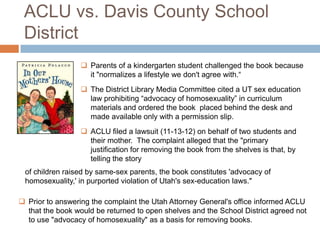
ACLU vs. Davis County School
District
 Parents of a kindergarten student challenged the book because
it "normalizes a lifestyle we don't agree with.“
 The District Library Media Committee cited a UT sex education
law prohibiting “advocacy of homosexuality” in curriculum
materials and ordered the book placed behind the desk and
made available only with a permission slip.
 ACLU filed a lawsuit (11-13-12) on behalf of two students and
their mother. The complaint alleged that the "primary
justification for removing the book from the shelves is that, by
telling the story
 Prior to answering the complaint the Utah Attorney General's office informed ACLU
that the book would be returned to open shelves and the School District agreed not
to use "advocacy of homosexuality" as a basis for removing books.
of children raised by same-sex parents, the book constitutes 'advocacy of
homosexuality,' in purported violation of Utah's sex-education laws."
Board of Education v. Pico
Board of Education, Island Trees Union Free School District No. 26 v.
Pico, 457 U.S. 853, 102 S.Ct. 2799, 73 L.Ed.2d 435 (1982)
 U.S. Supreme Court Justice Brennan declared in a plurality
opinion: "Local school boards may not remove books from school
library shelves simply because they dislike the ideas contained in
those books and seek their removal to „prescribe what shall be
orthodox in politics, nationalism, religion, or other matters of
opinion.‟ "
 "If petitioners intended by their removal decision to deny
respondents access to ideas with which petitioners disagreed, and
if this intent was the decisive factor in the petitioners‟ decision, then
petitioners have exercised their discretion in violation of the
Constitution."
Preparing for Challenges
 Discuss concerns with patrons; in many cases a
formal reconsideration can be avoided.
 Make sure you have a collection management plan
specifying criteria for adding and removing materials.
 Make sure you have a clear reconsideration process.
 Plans/policies should be adopted by your governing
board and periodically reviewed/reaffirmed.
 Regularly train staff and library board members on
library policies/processes and the principles behind
them.
 Educate the community as much as possible on
intellectual freedom issues.
PROTECTING
INTELLECTUAL FREEDOM
FOR LIBRARIANS AND OUR
PATRONS
Alyse Ergood, Florida Atlantic University
Why Protect?
 To maintain and uphold freedoms
 First Amendment: Freedom of Religion and
Press
 Fourth Amendment: Guards against
unreasonable searchers and seizures (U.S.
Constitution)
 To uphold the Library Bill of Rights and
advocate for our patrons and our services
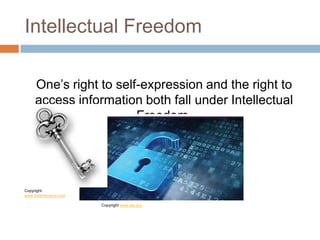
Intellectual Freedom
One‟s right to self-expression and the right to
access information both fall under Intellectual
Freedom.
Copyright www.ala.org
Copyright:
www.thewritingnut.com
How to Protect Intellectual
Freedom
 Become involved in creating the mission and
vision of larger entity that library is a part of.
 Ensure that library policy, mission, and vision align
with the Library Bill of Rights.
 It all comes back to justifying support of Library Bill of
Rights.
 Bridge the divide and engage with policy and
decision makers, including administrators
 Understand and communicate with the key
players (Board of
Trustees, Legislature, Administration and so forth)
Jones, B.M., 2009).
How?
 Engage in academic and intellectual groups
Copyright: www.jenniferdefrancisco.com
How to Protect Intellectual
Freedom
 Self-educate and know your rights (or not)
regarding your computer files, emails, reference
appointments, calls, and computer and other
equipment
 Educate others about the importance of
intellectual freedom, such as your IT Personnel
and garner support on campus for intellectual
freedom (Jones, B.M., 2009).
 Advocate, Advocate, Advocate
 For
self, patrons, colleagues, freedom, access, equality
Self-Censorship
Where can it be seen?
 Acquisitions (electronic and print)
 Weeding
 Selection of items displayed (or not) for book
and varied exhibits
 Classes/Workshops
 Work Presentations
 Expression overall
Why and how is this possible?
 Unconscious
 Perceived or real lack of support
 Fear of backlash or reprimand
 Financial/Budget
 Cyclical (or Top down)
 Culture of a particular library or type of
library, etc.
 Perpetuate status-quo
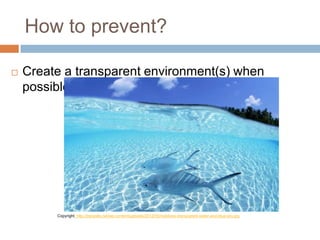
How to prevent?
 Create a transparent environment(s) when
possible
Copyright: http://topwalls.net/wp-content/uploads/2012/05/maldives-transparent-water-and-blue-sky.jpg
How to prevent?
 Be honest with your self and others
 Analyze your motives
 Reflect on your actions or lack of
 Remember your focus
Copyright: www.askville.amazon.com
Boundary Between Personal and
Professional Blurry
Copyright: www.flickr.com
Boundary Between Personal
and Professional Blurry
 Social Media (webpage, blog, twitter, non-
related personal Facebook pages and
postings)
 Research/Publications
 Presentations
 Grant and other applications
Who Protects Our Rights to
Intellectual Freedom
 ALA (American Library Association)
 ALA-APA (American Library Association Allied
Professional Association)
 American Association for University Professors (Private
academic libraries)
 ACRL (Association for College and Research
Librarians)
 FEA (Florida Education Association) or other agency
 UFF (United Faculty of Florida Union) or other union
 United States Constitution and Bill of Rights
 United States Courts
Conclusion
 “Scholarship cannot flourish in an atmosphere
of suspicion and distrust. Teachers and
student must always remain free to inquire, to
study and to evaluate, to gain new maturity
and understanding; otherwise our civilization
will stagnate and die”(Jones, B.M., 2009, p.
17).
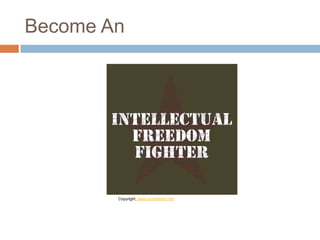
Become An
Copyright: www.unshelved.com
Enis, M. & Schwartz, M. (2012, October 25). Free library of
Philadelphia resolves NOOK accessibility lawsuit. The Digital
Shift. Retrieved from http://www.thedigitalshift.com/2012/
10/hardware-2/free-library-of-philadelphia-resolves-nook-
accessibility-lawsuit/
Mason, A. (2012). Mainstream access to e-books: What works,
what doesn't, and what is still unclear. Future Reflections, 31(2),
18-24.
References- eBooks
Challenge and IF Resources
FLA Intellectual Freedom Manual, http://www.flalib.org/int_Freedom_Manual.php
FLA Executive Director, Faye Roberts, faye.roberts@comcast.net, 386-438-5795
FLA Intellectual Freedom Committee Chair, Robin Shader, rshader@nwrls.com
FLA Readers‟ Rights and Privacy member group
ALA Intellectual Freedom Manual, www.ifmanual.org
ALA Office for Intellectual Freedom, oif@ala.org, 800-545-2433 x4223
Resources at www.ala.org/challengereporting
Librarians' References
 Jones, B.M. (2009). Protecting Intellectual Freedom in Your Academic Library:
Scenarios from the Front Lines. Chicago: American Library Association.
 Moody, K. (2010). Covert censorship in libraries. Australian Library Journal, 54.
Retrieved from http://www.alia.org.au/publishing/alj/54.2/full.text/moody.html.
 O‟neil, R. (2008). Academic Freedom in the Wired World. Cambridge, Mass.: Harvard
University Press.

Protecting Intellectual Freedom for Librarians and Our Patrons by Alyse Ergood (Final Section)

  • 1.
    HOT TOPICS IN INTELLECTUAL FREEDOM: ADISCUSSION Florida Library Association Intellectual Freedom Committee
  • 2.
    ALA Freedom toRead Statement “There is no place in our society for efforts to coerce the taste of others, to confine adults to the reading matter deemed suitable for adolescents, or to inhibit the efforts of writers to achieve artistic expression.”
  • 3.
    Debi Cheek: eBooksand Access Zach English: Internet Censorship- An International Perspective Robin Shader: Challenges Alyse Ergood: Librarians‟ Intellectual Freedom and Rights Sara Gonzalez, Moderator Panelists and Moderator
  • 4.
    Debi Cheek Debi earnedher MLIS from the University of South Florida. She has worked as both a K-12 Media Specialist and an Academic Librarian. Currently, she works as an adjunct professor for Rasmussen College teaching Introduction to Undergraduate Research. Additionally, she is working on her doctorate in Educational Technology at Florida Gulf Coast University.
  • 5.
    Zach English Zach Englishis the Director of Library Services for Everglades University. He has worked and interned in academic libraries for three years, including libraries at Hillsborough Community College, Keiser University and Everglades University. He earned his Master of Arts degree in Library and Information Science from the University of South Florida, and his Bachelor of Arts in Philosophy from the University of Central Florida. He is a member of the Palm Beach County Library Association, the Florida Library Association, and the Southeast Florida Library Information Network (SEFLIN). He has served on FLA‟s Intellectual Freedom Committee for two years, and has also written for FLA‟s Media Clippings blog and Florida Libraries journal. His interest in intellectual freedom issues comes from a belief that the rights to pursue knowledge and to express oneself are core human rights.
  • 6.
    Robin Shader Robin Shaderis the Director of the Northwest Regional Library System, serving Bay, Gulf, and Liberty Counties, Florida. She is a New Jersey native and received her MLS from Rutgers University. Robin has worked in public libraries in New Jersey, Georgia and Florida for the past 15 years. She has published articles in School Library Journal, ALA's Applied Professional Association‟s Library Worklife, and has two essays in the book Library Management Tips that Work published in 2011 by ALA Editions. Robin is a member of the American Library Association Intellectual Freedom Committee and is the Chair of the FLA Intellectual Freedom Committee.
  • 7.
    Alyse Ergood Alyse Ergoodis an Associate University Librarian in the Reference and Instruction Department at Florida Atlantic University (FAU) in Boca Raton. She is the social sciences librarian, and is a subject specialist in nursing, languages and linguistics, and anthropology to name a few. After receiving her MLIS from the University of South Florida in 2006, Alyse became very active on a variety of library and university committees. She is currently the Vice- Chair/President Elect of the PBCLA, and a member of various committees in SEFLIN and the ALA‟s New Member Roundtable (NMRT). Alyse has published and presented on various topics including marketing, emerging technologies, and creating online tutorials. Her research interests include online education, intellectual freedom, emerging technologies, and various topics within the social sciences. Alyse is working on her Master‟s degree in Social Work at FAU.
  • 8.
    ALA Censorship and Challenges Achallenge is an attempt to remove or restrict materials, based upon the objections of a person or group. A banning is the removal of those materials. Challenges do not simply involve a person expressing a point of view; rather, they are an attempt to remove material from the curriculum or library, thereby restricting the access of others.
  • 9.
    ALA Freedom toRead Statement It is in the public interest for publishers and librarians to make available the widest diversity of views and expressions, including those that are unorthodox, unpopular, or considered dangerous by the majority.
  • 10.
    E-BOOKS & ACCESS DebiCheek, Rasmussen College
  • 11.
  • 12.
  • 13.
  • 14.
  • 15.
  • 16.
    E-Books & PrintDisabled Patrons “(The) blind and other print-disabled users, for the first time in history, gain access to the same books and publications at the same price and at the same time as the rest of society” (Mason, 2012, pp. 18-19). .
  • 17.
  • 18.
    E-Book Options • iOS– Available with Apple Products • VoiceOver Option • Connect Blue-tooth enabled Braille display • Kindle • Very limited accessibility (Kindle Fire) • Many books don‟t offer text-to-talk feature either • NOOK & Sony Reader • Not accessible
  • 20.
    Access & theLaw  NFB v. Free Library of Philadelphia (Enis & Schwartz, 2012)  Pilot program Nook  Patrons 50+ could check out reader  Used Federal Funds to purchase  No Text-to-Speech  Violated Section 504 Rehabilitation Act & Title II ADA  NFB & Dept. of Justice v. Sacramento Public Library  Nook lending  Violated ADA
  • 21.
    Other Options toAssist Print Disabled Patrons • LEAP : Available at no cost for libraries who have a relationship with Overdrive. Registered patrons will have access to BookShare, a separate collection of books and magazines in DAISY &
  • 22.
    Where did mye-book go? Clipart from: Operation Awesome
  • 23.
    Digital Rights Management (DRM)& Material Access Type of device Print, copy or download restrictions Publisher Restrictions Vendor Restrictions
  • 24.
    INTERNET CENSORSHIP: AN INTERNATIONALPERSPECTIVE Zach English, Everglades University
  • 25.
    Threats to Internet Expression Cyber-crime  Anti-Counterfeiting Trade Agreement  Protecting against obscenity and harmful content  Filters in school and library computers  Intellectual property  Stop Online Piracy Act (SOPA)  Protect IP Act (PIPA)  Intellectual Property Rights Enforcement Directive (IPRED)  National security  WikiLeaks
  • 26.
    ACLU‟s “Don‟t FilterMe” Project  Viewpoint-neutral content in public schools  2000: Children‟s Internet Protection Act (CIPA)  Web-filtering software categorizes content  Problems with allowing removal of filters on a case- by-case basis  2012: PFLAG v. Camdenton R-III School District  URL Blacklist
  • 27.
    Social Media andSocial Protests  Social media sites like Twitter, Facebook and YouTube have facilitated more dissident social organizing internationally  With progress has also come attempts to censor:  Being required to give up your email and Facebook passwords  Government ownership of Internet Service Providers  Governments hiring people to seed the Internet with pro-regime content  Filtering and spying
  • 28.
    Reporters without Borders‟2012 “Enemies of the Internet” Report  Egypt: Cut Internet access for five days during the height of protests in January 2011.  Iran and Syria: Slow Internet speeds to a crawl so that photos and videos cannot be transmitted.  Uzbekistan, Belarus, China: Block access to social media sites during times of social protest.  Thailand: A news editor faces a 20-year jail sentence for failing to withdraw comments posted on a news website.  Russia arrests bloggers and creates cyber-attacks to shut down websites that are critical of the government.
  • 29.
    Companies Providing Filtering Technology Repressive regimes use Western companies to filter websites and spy on Internet users  Syria uses BlueCoat (U.S.) and AreaSpa (France)  The European Parliament‟s resolution (2012)  Congressional
  • 30.
    A Threat ofInternet Fragmentation  Internet sovereignty  2010: Burma created a national Web  Iran is working to create an Islamic “halal” version of the Web  Several countries restrict access to local intranets  Threat to the idea of the Web as global village
  • 31.
    International Anti-Censorship Rulings andResponse  European Court of Justice ruling: SABAM v. Scarlet (2012)  ISPs can‟t be asked to filter  UN Human Rights Council statement (2012)  Hacktivists
  • 32.
    CHALLENGES AND CASES Robin Shader,Northwest Regional Library System
  • 33.
    ACLU vs. DavisCounty School District  Parents of a kindergarten student challenged the book because it "normalizes a lifestyle we don't agree with.“  The District Library Media Committee cited a UT sex education law prohibiting “advocacy of homosexuality” in curriculum materials and ordered the book placed behind the desk and made available only with a permission slip.  ACLU filed a lawsuit (11-13-12) on behalf of two students and their mother. The complaint alleged that the "primary justification for removing the book from the shelves is that, by telling the story  Prior to answering the complaint the Utah Attorney General's office informed ACLU that the book would be returned to open shelves and the School District agreed not to use "advocacy of homosexuality" as a basis for removing books. of children raised by same-sex parents, the book constitutes 'advocacy of homosexuality,' in purported violation of Utah's sex-education laws."
  • 34.
    Board of Educationv. Pico Board of Education, Island Trees Union Free School District No. 26 v. Pico, 457 U.S. 853, 102 S.Ct. 2799, 73 L.Ed.2d 435 (1982)  U.S. Supreme Court Justice Brennan declared in a plurality opinion: "Local school boards may not remove books from school library shelves simply because they dislike the ideas contained in those books and seek their removal to „prescribe what shall be orthodox in politics, nationalism, religion, or other matters of opinion.‟ "  "If petitioners intended by their removal decision to deny respondents access to ideas with which petitioners disagreed, and if this intent was the decisive factor in the petitioners‟ decision, then petitioners have exercised their discretion in violation of the Constitution."
  • 35.
    Preparing for Challenges Discuss concerns with patrons; in many cases a formal reconsideration can be avoided.  Make sure you have a collection management plan specifying criteria for adding and removing materials.  Make sure you have a clear reconsideration process.  Plans/policies should be adopted by your governing board and periodically reviewed/reaffirmed.  Regularly train staff and library board members on library policies/processes and the principles behind them.  Educate the community as much as possible on intellectual freedom issues.
  • 36.
    PROTECTING INTELLECTUAL FREEDOM FOR LIBRARIANSAND OUR PATRONS Alyse Ergood, Florida Atlantic University
  • 37.
    Why Protect?  Tomaintain and uphold freedoms  First Amendment: Freedom of Religion and Press  Fourth Amendment: Guards against unreasonable searchers and seizures (U.S. Constitution)  To uphold the Library Bill of Rights and advocate for our patrons and our services
  • 38.
    Intellectual Freedom One‟s rightto self-expression and the right to access information both fall under Intellectual Freedom. Copyright www.ala.org Copyright: www.thewritingnut.com
  • 39.
    How to ProtectIntellectual Freedom  Become involved in creating the mission and vision of larger entity that library is a part of.  Ensure that library policy, mission, and vision align with the Library Bill of Rights.  It all comes back to justifying support of Library Bill of Rights.  Bridge the divide and engage with policy and decision makers, including administrators  Understand and communicate with the key players (Board of Trustees, Legislature, Administration and so forth) Jones, B.M., 2009).
  • 40.
    How?  Engage inacademic and intellectual groups Copyright: www.jenniferdefrancisco.com
  • 41.
    How to ProtectIntellectual Freedom  Self-educate and know your rights (or not) regarding your computer files, emails, reference appointments, calls, and computer and other equipment  Educate others about the importance of intellectual freedom, such as your IT Personnel and garner support on campus for intellectual freedom (Jones, B.M., 2009).  Advocate, Advocate, Advocate  For self, patrons, colleagues, freedom, access, equality
  • 42.
    Self-Censorship Where can itbe seen?  Acquisitions (electronic and print)  Weeding  Selection of items displayed (or not) for book and varied exhibits  Classes/Workshops  Work Presentations  Expression overall
  • 43.
    Why and howis this possible?  Unconscious  Perceived or real lack of support  Fear of backlash or reprimand  Financial/Budget  Cyclical (or Top down)  Culture of a particular library or type of library, etc.  Perpetuate status-quo
  • 44.
    How to prevent? Create a transparent environment(s) when possible Copyright: http://topwalls.net/wp-content/uploads/2012/05/maldives-transparent-water-and-blue-sky.jpg
  • 45.
    How to prevent? Be honest with your self and others  Analyze your motives  Reflect on your actions or lack of  Remember your focus Copyright: www.askville.amazon.com
  • 46.
    Boundary Between Personaland Professional Blurry Copyright: www.flickr.com
  • 47.
    Boundary Between Personal andProfessional Blurry  Social Media (webpage, blog, twitter, non- related personal Facebook pages and postings)  Research/Publications  Presentations  Grant and other applications
  • 48.
    Who Protects OurRights to Intellectual Freedom  ALA (American Library Association)  ALA-APA (American Library Association Allied Professional Association)  American Association for University Professors (Private academic libraries)  ACRL (Association for College and Research Librarians)  FEA (Florida Education Association) or other agency  UFF (United Faculty of Florida Union) or other union  United States Constitution and Bill of Rights  United States Courts
  • 49.
    Conclusion  “Scholarship cannotflourish in an atmosphere of suspicion and distrust. Teachers and student must always remain free to inquire, to study and to evaluate, to gain new maturity and understanding; otherwise our civilization will stagnate and die”(Jones, B.M., 2009, p. 17).
  • 50.
  • 51.
    Enis, M. &Schwartz, M. (2012, October 25). Free library of Philadelphia resolves NOOK accessibility lawsuit. The Digital Shift. Retrieved from http://www.thedigitalshift.com/2012/ 10/hardware-2/free-library-of-philadelphia-resolves-nook- accessibility-lawsuit/ Mason, A. (2012). Mainstream access to e-books: What works, what doesn't, and what is still unclear. Future Reflections, 31(2), 18-24. References- eBooks
  • 52.
    Challenge and IFResources FLA Intellectual Freedom Manual, http://www.flalib.org/int_Freedom_Manual.php FLA Executive Director, Faye Roberts, faye.roberts@comcast.net, 386-438-5795 FLA Intellectual Freedom Committee Chair, Robin Shader, rshader@nwrls.com FLA Readers‟ Rights and Privacy member group ALA Intellectual Freedom Manual, www.ifmanual.org ALA Office for Intellectual Freedom, oif@ala.org, 800-545-2433 x4223 Resources at www.ala.org/challengereporting
  • 53.
    Librarians' References  Jones,B.M. (2009). Protecting Intellectual Freedom in Your Academic Library: Scenarios from the Front Lines. Chicago: American Library Association.  Moody, K. (2010). Covert censorship in libraries. Australian Library Journal, 54. Retrieved from http://www.alia.org.au/publishing/alj/54.2/full.text/moody.html.  O‟neil, R. (2008). Academic Freedom in the Wired World. Cambridge, Mass.: Harvard University Press.

Editor's Notes

  • #39 www.ala.org
  • #41 Copyright: www.jenniferdefrancisco.com
  • #42 Your opinions are protected regardless of where you work…just not necessarily by where you work
  • #43 Where we get in our own way
  • #45  Even itif
  • #46 Do some soul searching