Council of State University Libraries (CSUL)
Public Services Planning Committee & Information
Literacy Subcommittee
June 2011
Jim Alderman (UNF), Alyse Ergood (FAU),Carol Maksian (FGCU)&
Kristy Padron, Information Literacy Subcommittee Chair (‘10 & ‘11)
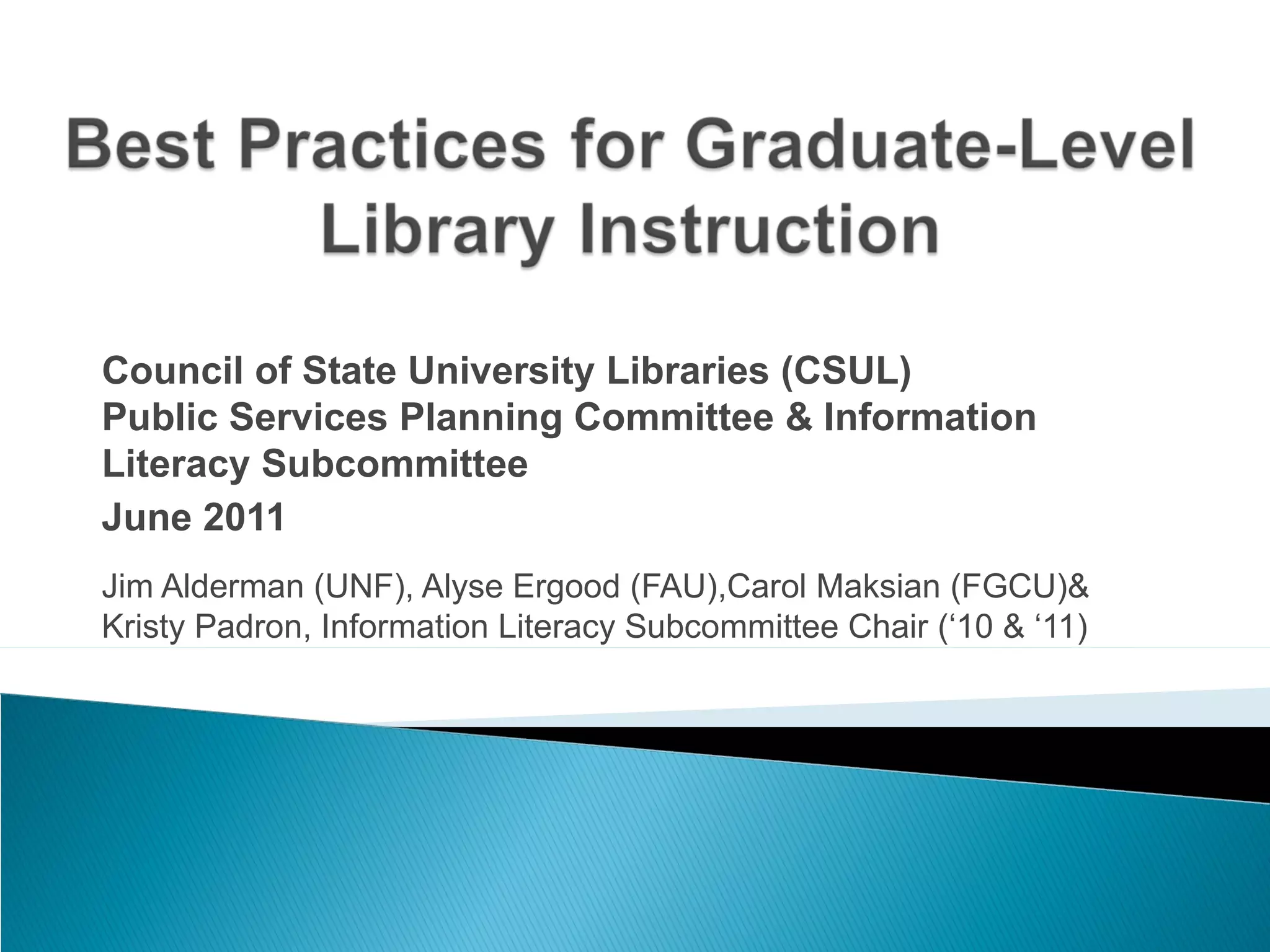
Source: Florida Board of Governors,
http://www.flbog.edu/resources/iud/enrollment_search
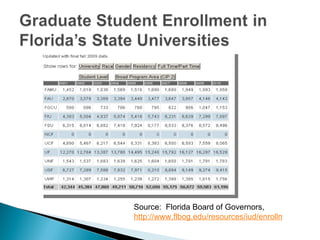
Top program areas:
Health Professions to
Clinical Sciences
Education
Business Management/
Marketing
Engineering
Biological/Medical
Sciences
Physical Sciences
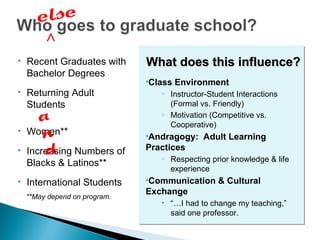
else
        ^
   Recent Graduates with      What does this influence?
    Bachelor Degrees
                               Class   Environment
   Returning Adult               o   Instructor-Student Interactions
    Students                          (Formal vs. Friendly)

     ^
       a                          o   Motivation (Competitive vs.
                                      Cooperative)

        n
    Women**                    Andragogy:     Adult Learning
       d
    Increasing Numbers of      Practices
                                  o   Respecting prior knowledge & life
    Blacks & Latinos**
                                      experience
                               Communication      & Cultural
   International Students
                               Exchange
    **May depend on program.
                                     “…I had to change my teaching,”
                                      said one professor.
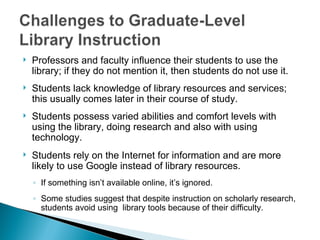
   Professors and faculty influence their students to use the
    library; if they do not mention it, then students do not use it.
   Students lack knowledge of library resources and services;
    this usually comes later in their course of study.
   Students possess varied abilities and comfort levels with
    using the library, doing research and also with using
    technology.
   Students rely on the Internet for information and are more
    likely to use Google instead of library resources.
    ◦ If something isn’t available online, it’s ignored.
    ◦ Some studies suggest that despite instruction on scholarly research,
      students avoid using library tools because of their difficulty.
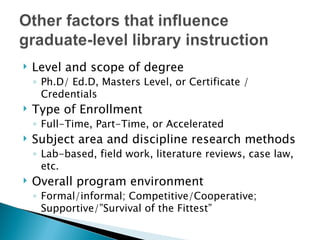
   Level and scope of degree
    ◦ Ph.D/ Ed.D, Masters Level, or Certificate /
      Credentials
   Type of Enrollment
    ◦ Full-Time, Part-Time, or Accelerated
   Subject area and discipline research methods
    ◦ Lab-based, field work, literature reviews, case law,
      etc.
   Overall program environment
    ◦ Formal/informal; Competitive/Cooperative;
      Supportive/”Survival of the Fittest”
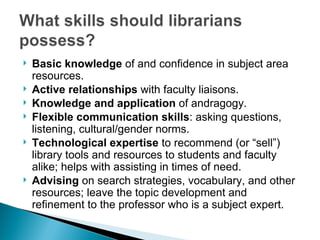
   Basic knowledge of and confidence in subject area
    resources.
   Active relationships with faculty liaisons.
   Knowledge and application of andragogy.
   Flexible communication skills: asking questions,
    listening, cultural/gender norms.
   Technological expertise to recommend (or “sell”)
    library tools and resources to students and faculty
    alike; helps with assisting in times of need.
   Advising on search strategies, vocabulary, and other
    resources; leave the topic development and
    refinement to the professor who is a subject expert.
   Library catalog and local services most used by graduate
    students (interlibrary loan, consultations, etc.)
   Multidisciplinary databases (ProQuest Central, Academic Search
    Premier) are not sufficient resources for a comprehensive
    graduate-level literature review.
   Introduce and demonstrate subject-area databases and Web of
    Science or other citation databases.
   Additional information sources: WorldCat, SUL Union Catalog,
    dissertation databases (ProQuest & WorldCat), controlled
    vocabulary sources (MeSH, CINAHL headings, thesauri)
   Bibliographic management software (RefWorks, EndNote)
   Advise students to identify and read literature
    reviews by others within their subject area;
    approach the literature toward finding something
    new.
   Ask questions that could help the student discover
    his or her own refinements.
   Subject and research areas are becoming
    increasingly multidisciplinary; suggest related areas
    and resources as needed.
   Suggest to researcher that consultation with the
    faculty adviser might be the next step in the
    process.
The Purpose of the Literature Review:
 Set the background on what has been researched
  on a topic.
 Show why a topic is significant to a subject area.
 Discover relationships between ideas.
 Identify major themes & concepts.
 Identify critical gaps & points of disagreement.
 Help the researcher turn a network of articles into a
  coherent view of the literature.
Web Pages & Tutorials                              Selected Articles

Florida Gulf Coast University Library.              Blummer, B. (2009). Providing library
Conducting & Writing Literature Reviews                instruction to graduate students: A review of
(LibGuide).                                            the literature. Public Services Quarterly,
http://fgcu.libguides.com/litreviews                   5(1): 15-39.
                                                    Harkins, M.J., Rodrigues, D.B., and Orlov, S.
North Carolina State Libraries. Literature             (2011). Where to start? Consideration for
Reviews: An Overview for Graduate                      faculty and librarians in delivering
Students.                                              information literacy instruction for graduate
http://www.lib.ncsu.edu/tutorials/lit-review/          students. Practical Academic Librarianship:
                                                       The International Journal of the SLA
The University of Arizona University                   Academic Division, 1(1), 28-50.
Libraries. Researching and Writing                  Williams, H.C. (2000). User Education for
Literature Reviews.                                    Graduate Students: Never a Given, and Not
http://www.library.arizona.edu/help/tutorials/litreviews/index.html
                                                       Always Received in Teaching the new
                                                       library to today's users: reaching
                                                       international, minority, senior citizens,
                                                       gay/lesbian, first-generation college, at-risk,
                                                       graduate and returning students, and
                                                       distance learners. Trudi E. Jacobson (ed.).
                                                       New York: Neal-Schuman, pp 145-172.

Florida SULS Information Literacy Subcommittee Presentation by group:2011 Grad Student Instruction

  • 1.
    Council of StateUniversity Libraries (CSUL) Public Services Planning Committee & Information Literacy Subcommittee June 2011 Jim Alderman (UNF), Alyse Ergood (FAU),Carol Maksian (FGCU)& Kristy Padron, Information Literacy Subcommittee Chair (‘10 & ‘11)
  • 2.
    Source: Florida Boardof Governors, http://www.flbog.edu/resources/iud/enrollment_search
  • 3.
    Top program areas: HealthProfessions to Clinical Sciences Education Business Management/ Marketing Engineering Biological/Medical Sciences Physical Sciences
  • 4.
    else ^  Recent Graduates with What does this influence? Bachelor Degrees Class Environment  Returning Adult o Instructor-Student Interactions Students (Formal vs. Friendly) ^ a o Motivation (Competitive vs. Cooperative)  n Women** Andragogy: Adult Learning  d Increasing Numbers of Practices o Respecting prior knowledge & life Blacks & Latinos** experience Communication & Cultural  International Students Exchange **May depend on program.  “…I had to change my teaching,” said one professor.
  • 5.
    Professors and faculty influence their students to use the library; if they do not mention it, then students do not use it.  Students lack knowledge of library resources and services; this usually comes later in their course of study.  Students possess varied abilities and comfort levels with using the library, doing research and also with using technology.  Students rely on the Internet for information and are more likely to use Google instead of library resources. ◦ If something isn’t available online, it’s ignored. ◦ Some studies suggest that despite instruction on scholarly research, students avoid using library tools because of their difficulty.
  • 6.
    Level and scope of degree ◦ Ph.D/ Ed.D, Masters Level, or Certificate / Credentials  Type of Enrollment ◦ Full-Time, Part-Time, or Accelerated  Subject area and discipline research methods ◦ Lab-based, field work, literature reviews, case law, etc.  Overall program environment ◦ Formal/informal; Competitive/Cooperative; Supportive/”Survival of the Fittest”
  • 7.
    Basic knowledge of and confidence in subject area resources.  Active relationships with faculty liaisons.  Knowledge and application of andragogy.  Flexible communication skills: asking questions, listening, cultural/gender norms.  Technological expertise to recommend (or “sell”) library tools and resources to students and faculty alike; helps with assisting in times of need.  Advising on search strategies, vocabulary, and other resources; leave the topic development and refinement to the professor who is a subject expert.
  • 8.
    Library catalog and local services most used by graduate students (interlibrary loan, consultations, etc.)  Multidisciplinary databases (ProQuest Central, Academic Search Premier) are not sufficient resources for a comprehensive graduate-level literature review.  Introduce and demonstrate subject-area databases and Web of Science or other citation databases.  Additional information sources: WorldCat, SUL Union Catalog, dissertation databases (ProQuest & WorldCat), controlled vocabulary sources (MeSH, CINAHL headings, thesauri)  Bibliographic management software (RefWorks, EndNote)
  • 9.
    Advise students to identify and read literature reviews by others within their subject area; approach the literature toward finding something new.  Ask questions that could help the student discover his or her own refinements.  Subject and research areas are becoming increasingly multidisciplinary; suggest related areas and resources as needed.  Suggest to researcher that consultation with the faculty adviser might be the next step in the process.
  • 10.
    The Purpose ofthe Literature Review:  Set the background on what has been researched on a topic.  Show why a topic is significant to a subject area.  Discover relationships between ideas.  Identify major themes & concepts.  Identify critical gaps & points of disagreement.  Help the researcher turn a network of articles into a coherent view of the literature.
  • 11.
    Web Pages &Tutorials Selected Articles Florida Gulf Coast University Library. Blummer, B. (2009). Providing library Conducting & Writing Literature Reviews instruction to graduate students: A review of (LibGuide). the literature. Public Services Quarterly, http://fgcu.libguides.com/litreviews 5(1): 15-39. Harkins, M.J., Rodrigues, D.B., and Orlov, S. North Carolina State Libraries. Literature (2011). Where to start? Consideration for Reviews: An Overview for Graduate faculty and librarians in delivering Students. information literacy instruction for graduate http://www.lib.ncsu.edu/tutorials/lit-review/ students. Practical Academic Librarianship: The International Journal of the SLA The University of Arizona University Academic Division, 1(1), 28-50. Libraries. Researching and Writing Williams, H.C. (2000). User Education for Literature Reviews. Graduate Students: Never a Given, and Not http://www.library.arizona.edu/help/tutorials/litreviews/index.html Always Received in Teaching the new library to today's users: reaching international, minority, senior citizens, gay/lesbian, first-generation college, at-risk, graduate and returning students, and distance learners. Trudi E. Jacobson (ed.). New York: Neal-Schuman, pp 145-172.

Editor's Notes

  • #3 Numbers largely depend on when programs (and universities) were incorporated, and also their teaching/research emphases. Source: Florida Board of Governors: http://www.flbog.edu/resources/iud/enrollment_search.php
  • #5 “… I had to change my teaching” – an FAU professor of education remarked that over the years, the students in his courses went from being mostly male to being increasingly female and diverse.
  • #6 Lends to library/ research anxiety.
  • #7 I was in a grad-level program in teaching where it was def. survival of the fittest. Yet now I work with a program where students and professors keep in touch with each other on many levels.
  • #8 Faculty liaisons: also a source of mentoring and subject-area support. Advise students to identify and read literature reviews by others within their subject area.
  • #10 For instance, a topic in education might also have sociological and psychological underpinnings.
  • #11 The lit review is not an annotated bibliography or a laundry list of articles. It integrates and synthesizes what is found into something new.