Depositional Fluvial Landforms
 A delta is a feature of deposition formed when a river
 flows into a standing body of water

 Deposition occurs as the velocity drops on entering the
 standing body of water, this reducing the capacity and
 competence of the river  bedload and suspended
 material are ‘dumped’
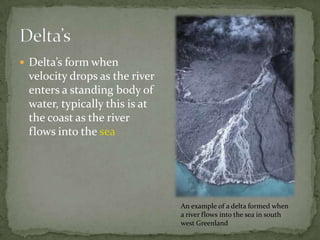
 Delta’s form when
 velocity drops as the river
 enters a standing body of
 water, typically this is at
 the coast as the river
 flows into the sea


                               An example of a delta formed when
                               a river flows into the sea in south
                               west Greenland
 Flocculation occurs as fresh water mixes with salt
 water - e.g where a river flows into the sea -(then
 called brackish water), and is the process by which tiny
 particles in suspension like clay and silt (which under
 normal fresh water conditions would likely never fall
 out of suspension) coagulate with the salt in the water
 by chemical reaction and become heavy enough to
 ‘sink’ and be deposited
 Deltas only form where rate of deposition exceeds rate
 of sediment removal – i.e. Where the critical threshold
 is no longer met and the system has fallen out of
 dynamic equilibrium. These conditions are likely
 where:
      The calibre of the load of the river is very large (therefore
       requiring a high amount of energy to keep in transport)

      The costal area into which the river dumps its load has a
       small tidal range and weak currents  meaning there is
       limited wave action and therefore little subsequent transport
       of sediment taking place after its initial deposition allowing
       large deltas to form
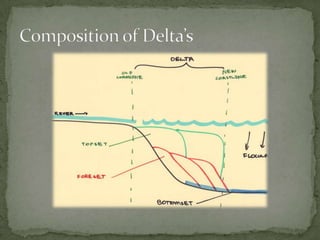
 Delta’s are usually composed of three types of deposit

   Topset beds: The larger and heavier particles are the first to
    be deposited as the river looses energy

   Foreset beds: Medium calibre particles travel a little further
    before they are deposited as more steep angled ‘wedges’ of
    sediment

   Bottomset Beds: The very finest particles travel the furthest
    before very low velocity/flocculation leads to their deposition
 Delta’s can be categorised into three main shapes

        Arcuate


        Birds Foot


        Cuspate
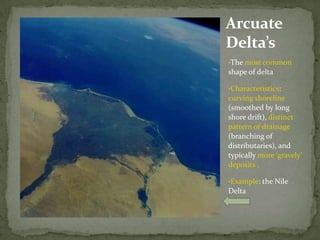
Arcuate
Delta’s
•The most common
shape of delta

•Characteristics:
curving shoreline
(smoothed by long
shore drift), distinct
pattern of drainage
(branching of
distributaries), and
typically more ‘gravely’
deposits .

•Example: the Nile
Delta
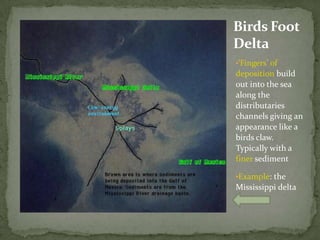
Birds Foot
Delta
•‘Fingers’ of
deposition build
out into the sea
along the
distributaries
channels giving an
appearance like a
birds claw.
Typically with a
finer sediment

•Example: the
Mississippi delta
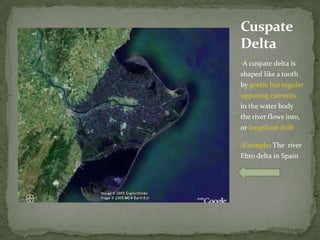
Cuspate
Delta
•A cuspate delta is
shaped like a tooth
by gentle but regular
opposing currents
in the water body
the river flows into,
or longshore drift

•Example: The river
Ebro delta in Spain
 Web:
     Image [slide 3]:
        http://upload.wikimedia.org/wikipedia/commons/thumb/e/e7/NarsarsuaqGreenland-
        ArcuateDelta.jpg/380px-NarsarsuaqGreenland-ArcuateDelta.jpg
       Image [slide 10] : http://strata.geol.sc.edu/MARINESEDIMENTS/delta/Nile.jpg
       Image [slide 11]:
        http://www.es.ucsc.edu/~es10/classnotes/images/MississippiDelta.drawn.jpg
       Image [slide 12]:
        http://www.iberianature.com/material/photos/google_earth_spain_2/images/delta_de_ebr
        o.jpg
       Info: http://wiki.answers.com/Q/Examples_of_cuspate_deltas


 Books: AQA text book, Oxford dictionary of
  Geography

Delta

  • 1.
  • 2.
     A deltais a feature of deposition formed when a river flows into a standing body of water  Deposition occurs as the velocity drops on entering the standing body of water, this reducing the capacity and competence of the river  bedload and suspended material are ‘dumped’
  • 3.
     Delta’s formwhen velocity drops as the river enters a standing body of water, typically this is at the coast as the river flows into the sea An example of a delta formed when a river flows into the sea in south west Greenland
  • 4.
     Flocculation occursas fresh water mixes with salt water - e.g where a river flows into the sea -(then called brackish water), and is the process by which tiny particles in suspension like clay and silt (which under normal fresh water conditions would likely never fall out of suspension) coagulate with the salt in the water by chemical reaction and become heavy enough to ‘sink’ and be deposited
  • 5.
     Deltas onlyform where rate of deposition exceeds rate of sediment removal – i.e. Where the critical threshold is no longer met and the system has fallen out of dynamic equilibrium. These conditions are likely where:  The calibre of the load of the river is very large (therefore requiring a high amount of energy to keep in transport)  The costal area into which the river dumps its load has a small tidal range and weak currents  meaning there is limited wave action and therefore little subsequent transport of sediment taking place after its initial deposition allowing large deltas to form
  • 6.
     Delta’s areusually composed of three types of deposit  Topset beds: The larger and heavier particles are the first to be deposited as the river looses energy  Foreset beds: Medium calibre particles travel a little further before they are deposited as more steep angled ‘wedges’ of sediment  Bottomset Beds: The very finest particles travel the furthest before very low velocity/flocculation leads to their deposition
  • 8.
     Delta’s canbe categorised into three main shapes  Arcuate  Birds Foot  Cuspate
  • 9.
    Arcuate Delta’s •The most common shapeof delta •Characteristics: curving shoreline (smoothed by long shore drift), distinct pattern of drainage (branching of distributaries), and typically more ‘gravely’ deposits . •Example: the Nile Delta
  • 10.
    Birds Foot Delta •‘Fingers’ of depositionbuild out into the sea along the distributaries channels giving an appearance like a birds claw. Typically with a finer sediment •Example: the Mississippi delta
  • 11.
    Cuspate Delta •A cuspate deltais shaped like a tooth by gentle but regular opposing currents in the water body the river flows into, or longshore drift •Example: The river Ebro delta in Spain
  • 12.
     Web:  Image [slide 3]: http://upload.wikimedia.org/wikipedia/commons/thumb/e/e7/NarsarsuaqGreenland- ArcuateDelta.jpg/380px-NarsarsuaqGreenland-ArcuateDelta.jpg  Image [slide 10] : http://strata.geol.sc.edu/MARINESEDIMENTS/delta/Nile.jpg  Image [slide 11]: http://www.es.ucsc.edu/~es10/classnotes/images/MississippiDelta.drawn.jpg  Image [slide 12]: http://www.iberianature.com/material/photos/google_earth_spain_2/images/delta_de_ebr o.jpg  Info: http://wiki.answers.com/Q/Examples_of_cuspate_deltas  Books: AQA text book, Oxford dictionary of Geography