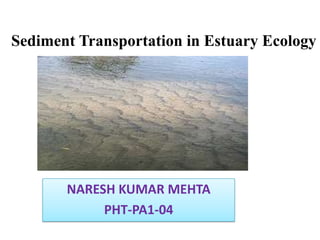
Sediment Transportation in Estuary Ecology

NARESH KUMAR MEHTA
PHT-PA1-04
What sediment is ?

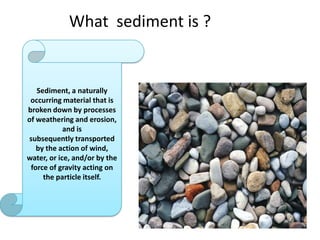
Sediment, a naturally
occurring material that is
broken down by processes
of weathering and erosion,
and is
subsequently transported
by the action of wind,
water, or ice, and/or by the
force of gravity acting on
the particle itself.
What are the sources of sediment ?
1. Land clearing
• There is a direct relationship between increased
soil erosion and sedimentation.
• In areas where catchments have been cleared and
river banks are consistently grazed, sediment loads
are often high.
• Grazing along river banks can strip vegetation,
disturb the soil and banks.
• Vegetation clearing increases = higher flows
increase erosion of the stream channel, leading to
the creation of deep gullies
2. Road building• Unsealed roads can contribute significant
sediment loads.
• The compacted road surfaces are subject to
erosion which generates sediment.
• Points where roads cross streams are
particularly damaging.
• Roads can become long term sources of
sediment if they are not properly maintained.
3. In-stream disturbance
• When dams and reservoirs are under
construction, disturbance to the stream bank
can generate large quantities of sediment.
• (Then PM Shri Atal Bihari Vajpayee declaration2003)
4. Other activities
• Sediment can also be increased by mining,
(including off-stream quarries and in-stream
sand extraction), dredging, some industrial
processes and cleaning weirs that have filled
with deposited sediment.
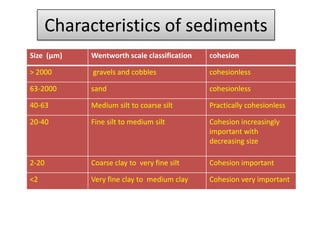
Characteristics of sediments
• Sediments carried by estuarine waters typically
encompass a range of sizes from less than 2
mm (0.002 mm) to more than 4 mm, but the
finer sizes dominate most estuaries
• The bed and banks of most estuaries are
dominated by clays and silts, with sand and
larger sizes depositing either at the head of the
estuary (from upstream sources) or at the sea
or ocean entrance (from downstream sources)
• Fine-grained sediments—clay sizes and some
silts—include both inorganic and organic
materials and are almost universally called
mud.
Characteristics of sediments
Size (μm)

Wentworth scale classification

cohesion

> 2000

gravels and cobbles

cohesionless

63-2000

sand

cohesionless

40-63

Medium silt to coarse silt

Practically cohesionless

20-40

Fine silt to medium silt

Cohesion increasingly
important with
decreasing size

2-20

Coarse clay to very fine silt

Cohesion important

<2

Very fine clay to medium clay

Cohesion very important
Conti..

• For transport purposes sediments are principally
characterized by their size, by constituent composition,
and by cohesion
• Estuarine sand is typically composed of quartz, although
other minerals such as feldspar or various heavy
minerals such as magnetite may be present or even
predominate, depending on the sediment source.
• Fine sediments in estuaries are mixtures of inorganic
minerals, organic materials, and biochemicals.
Cont…..
• Mineral grains consist of clays (e.g.
montmorillonite, illite, and kaolinite) and nonclay minerals (e.g. quartz and carbonate).
• Organic materials include biogenic detritus
and bacteria
• Organic fractions in suspended sediment
ranging from 18% to 85% have been reported
in various esturies
• Cohesion describes the tendency of fine
sediment grains to bind together (aggregate
or flocculate) under some circumstances,
which significantly affects sediment behaviour.
• In general, smaller grains are more cohesive,
with diameters greater than 40 mm essentially
cohesionless, and cohesion becoming
progressively more important as grain size
decreases.
Cohesionless Sediment Transport
• Transport Modes
• Cohesionless sediment (sand size and larger, plus
coarser silt are transported)
• At very low flow speeds, when the flow exerts
tractive forces on the bed that are lower than a
critical value, no motion occurs.
• If the flow-induced forces slightly exceed the
critical value for initiation of motion, individual
grains begin to tumble or hop along the bed
• At higher flow speeds the hops become longer
jumps and the bed surface sediment is
generally in motion, but with individual grains
remaining on the bed between jumps.

• Finally, jumps of some grains take them high
into the water column, where they can be
transported significant distances before
touching the bed again.
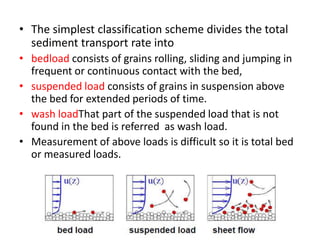
• The simplest classification scheme divides the total
sediment transport rate into
• bedload consists of grains rolling, sliding and jumping in
frequent or continuous contact with the bed,
• suspended load consists of grains in suspension above
the bed for extended periods of time.
• wash loadThat part of the suspended load that is not
found in the bed is referred as wash load.
• Measurement of above loads is difficult so it is total bed
or measured loads.
Bed-load transport
Once the forces acting
on particles are strong
enough to intiate motion…

Figure from Chanson, p. 200

… particles slide, roll, and
saltate down the river bed at a
steady rate.
Figure from Chanson, p. 180
Bed forms
• The shape of the cohesionless bed surface varies
with flow and the rate of transport
• An initially smooth, planar bed will remain smooth
for low transport rates,
• then become covered with moving ripples at a
slightly higher transport rate.
• At still higher rates the ripples coalesce into large
sand waves (or dunes)
Dunes and ripples
Conti…
• Sediment particles eroded from the upstream
dune face land on the steeper downstream face
and the waves march slowly downstream.

• Under the reversing flow of estuaries, sand waves
reverse their migration direction every few hours,
but often exhibit a locally dominant direction that
can be interpreted to establish dominant flow
and transport directions
• Effects of sedimentation
How does sedimentation affect
fluvial ecosystems ?
• Sediment suspended in water, can have significant
impacts on the flora and fauna living in the stream.
• Apart from the increased turbidity, water quality
can also be affected by increased loads of nutrients
and toxic substances attached to sediment particles.
• Deposited sediment form of sediment has marked
impacts on stream flora and fauna, coating instream habitat and filling in pools.
How does sedimentation
affect fish ?
• Increased
turbidity
has
significant
physical, physiological and behavioural
effects on fish.
• Sediment is harmful to the gills, clogging
gill mucus and causing asphyxiation.
• Fish can also swallow large quantities of
sediment, causing illness, reduced growth
and eventual death.
• Predatory fishes suffer from the food
• Clean, clear water is important for fish
breeding
What are the effects of sedimentation on invertebrates?

• Invertebrates (such as mayflies) use gills for
respiration. In silt-laden water their gills
become clogged and less effective.
• Some invertebrates filter food from the water
using nets spun from silk, (such as caddisfly
larvae) or other filtering devices,
• These devices become coated or clogged with
silt, limiting their effectiveness
• Leeches, snails and some fly larvae are
equipped with small suction devices
• Some species spend most of their life in these
spaces within the stream bed, others use it as
juveniles to escape predators, or during
floods to avoid being washed away
What are the effects of
sedimentation on aquatic plants ?
• Increased turbidity reduces the penetration of
light for aquatic plants to photosynthesise and
growth.
• Deposited sediment can smother plants living
on the bottom of the river or stream
• Increased amounts of nitrates and phosphates
in the water can create problems of excessive
plant growth and lead to blooms of algae and
weeds.
Actions to reduce sedimentation
• Prevent soil erosion through revegetation and
stabilisation of catchments and riparian zones.
• Protect riparian vegetation: maintain continuous riparian
vegetation along all waterways, ensuring dense groundcovers
such as grasses.
• Construct and maintain road crossings or stock access routes to
avoid erosion and runoff into waterways.
• Manage runoff from cleared or disturbed land so that it does
not enter waterways.
• Use sediment traps or other means.
• Don’t flush sediment accumulated in farm dams or weirs
downstream.
• Promote development and implementation of strategies or
codes of practice to minimise
reference
• Chapter 4, Sedimentation of rivers and streams. Department of Natural
Resources and Environment (NRE) at www.nre.vic.gov.au
• COASTAL ZONES AND ESTUARIES – Sediment Transport in Estuaries - W. H.
McNally, A. J. Mehta, USA.
• For further details
http://www.eolss.net/Eolss-sampleAllChapter.aspx
Jai Hind
Fish for food
Fish for health
Fish for environment

Sediments transportation

  • 1.
    Sediment Transportation inEstuary Ecology NARESH KUMAR MEHTA PHT-PA1-04
  • 2.
    What sediment is? Sediment, a naturally occurring material that is broken down by processes of weathering and erosion, and is subsequently transported by the action of wind, water, or ice, and/or by the force of gravity acting on the particle itself.
  • 3.
    What are thesources of sediment ? 1. Land clearing • There is a direct relationship between increased soil erosion and sedimentation. • In areas where catchments have been cleared and river banks are consistently grazed, sediment loads are often high. • Grazing along river banks can strip vegetation, disturb the soil and banks. • Vegetation clearing increases = higher flows increase erosion of the stream channel, leading to the creation of deep gullies
  • 4.
    2. Road building•Unsealed roads can contribute significant sediment loads. • The compacted road surfaces are subject to erosion which generates sediment. • Points where roads cross streams are particularly damaging. • Roads can become long term sources of sediment if they are not properly maintained.
  • 5.
    3. In-stream disturbance •When dams and reservoirs are under construction, disturbance to the stream bank can generate large quantities of sediment. • (Then PM Shri Atal Bihari Vajpayee declaration2003)
  • 6.
    4. Other activities •Sediment can also be increased by mining, (including off-stream quarries and in-stream sand extraction), dredging, some industrial processes and cleaning weirs that have filled with deposited sediment.
  • 7.
    Characteristics of sediments •Sediments carried by estuarine waters typically encompass a range of sizes from less than 2 mm (0.002 mm) to more than 4 mm, but the finer sizes dominate most estuaries • The bed and banks of most estuaries are dominated by clays and silts, with sand and larger sizes depositing either at the head of the estuary (from upstream sources) or at the sea or ocean entrance (from downstream sources) • Fine-grained sediments—clay sizes and some silts—include both inorganic and organic materials and are almost universally called mud.
  • 8.
    Characteristics of sediments Size(μm) Wentworth scale classification cohesion > 2000 gravels and cobbles cohesionless 63-2000 sand cohesionless 40-63 Medium silt to coarse silt Practically cohesionless 20-40 Fine silt to medium silt Cohesion increasingly important with decreasing size 2-20 Coarse clay to very fine silt Cohesion important <2 Very fine clay to medium clay Cohesion very important
  • 9.
    Conti.. • For transportpurposes sediments are principally characterized by their size, by constituent composition, and by cohesion • Estuarine sand is typically composed of quartz, although other minerals such as feldspar or various heavy minerals such as magnetite may be present or even predominate, depending on the sediment source. • Fine sediments in estuaries are mixtures of inorganic minerals, organic materials, and biochemicals.
  • 10.
    Cont….. • Mineral grainsconsist of clays (e.g. montmorillonite, illite, and kaolinite) and nonclay minerals (e.g. quartz and carbonate). • Organic materials include biogenic detritus and bacteria • Organic fractions in suspended sediment ranging from 18% to 85% have been reported in various esturies
  • 11.
    • Cohesion describesthe tendency of fine sediment grains to bind together (aggregate or flocculate) under some circumstances, which significantly affects sediment behaviour. • In general, smaller grains are more cohesive, with diameters greater than 40 mm essentially cohesionless, and cohesion becoming progressively more important as grain size decreases.
  • 12.
    Cohesionless Sediment Transport •Transport Modes • Cohesionless sediment (sand size and larger, plus coarser silt are transported) • At very low flow speeds, when the flow exerts tractive forces on the bed that are lower than a critical value, no motion occurs. • If the flow-induced forces slightly exceed the critical value for initiation of motion, individual grains begin to tumble or hop along the bed
  • 13.
    • At higherflow speeds the hops become longer jumps and the bed surface sediment is generally in motion, but with individual grains remaining on the bed between jumps. • Finally, jumps of some grains take them high into the water column, where they can be transported significant distances before touching the bed again.
  • 14.
    • The simplestclassification scheme divides the total sediment transport rate into • bedload consists of grains rolling, sliding and jumping in frequent or continuous contact with the bed, • suspended load consists of grains in suspension above the bed for extended periods of time. • wash loadThat part of the suspended load that is not found in the bed is referred as wash load. • Measurement of above loads is difficult so it is total bed or measured loads.
  • 15.
    Bed-load transport Once theforces acting on particles are strong enough to intiate motion… Figure from Chanson, p. 200 … particles slide, roll, and saltate down the river bed at a steady rate. Figure from Chanson, p. 180
  • 18.
    Bed forms • Theshape of the cohesionless bed surface varies with flow and the rate of transport • An initially smooth, planar bed will remain smooth for low transport rates, • then become covered with moving ripples at a slightly higher transport rate. • At still higher rates the ripples coalesce into large sand waves (or dunes)
  • 19.
  • 20.
    Conti… • Sediment particleseroded from the upstream dune face land on the steeper downstream face and the waves march slowly downstream. • Under the reversing flow of estuaries, sand waves reverse their migration direction every few hours, but often exhibit a locally dominant direction that can be interpreted to establish dominant flow and transport directions
  • 21.
    • Effects ofsedimentation
  • 22.
    How does sedimentationaffect fluvial ecosystems ? • Sediment suspended in water, can have significant impacts on the flora and fauna living in the stream. • Apart from the increased turbidity, water quality can also be affected by increased loads of nutrients and toxic substances attached to sediment particles. • Deposited sediment form of sediment has marked impacts on stream flora and fauna, coating instream habitat and filling in pools.
  • 23.
    How does sedimentation affectfish ? • Increased turbidity has significant physical, physiological and behavioural effects on fish. • Sediment is harmful to the gills, clogging gill mucus and causing asphyxiation. • Fish can also swallow large quantities of sediment, causing illness, reduced growth and eventual death. • Predatory fishes suffer from the food • Clean, clear water is important for fish breeding
  • 25.
    What are theeffects of sedimentation on invertebrates? • Invertebrates (such as mayflies) use gills for respiration. In silt-laden water their gills become clogged and less effective. • Some invertebrates filter food from the water using nets spun from silk, (such as caddisfly larvae) or other filtering devices, • These devices become coated or clogged with silt, limiting their effectiveness • Leeches, snails and some fly larvae are equipped with small suction devices • Some species spend most of their life in these spaces within the stream bed, others use it as juveniles to escape predators, or during floods to avoid being washed away
  • 26.
    What are theeffects of sedimentation on aquatic plants ? • Increased turbidity reduces the penetration of light for aquatic plants to photosynthesise and growth. • Deposited sediment can smother plants living on the bottom of the river or stream • Increased amounts of nitrates and phosphates in the water can create problems of excessive plant growth and lead to blooms of algae and weeds.
  • 27.
    Actions to reducesedimentation • Prevent soil erosion through revegetation and stabilisation of catchments and riparian zones. • Protect riparian vegetation: maintain continuous riparian vegetation along all waterways, ensuring dense groundcovers such as grasses. • Construct and maintain road crossings or stock access routes to avoid erosion and runoff into waterways. • Manage runoff from cleared or disturbed land so that it does not enter waterways. • Use sediment traps or other means. • Don’t flush sediment accumulated in farm dams or weirs downstream. • Promote development and implementation of strategies or codes of practice to minimise
  • 28.
    reference • Chapter 4,Sedimentation of rivers and streams. Department of Natural Resources and Environment (NRE) at www.nre.vic.gov.au • COASTAL ZONES AND ESTUARIES – Sediment Transport in Estuaries - W. H. McNally, A. J. Mehta, USA. • For further details http://www.eolss.net/Eolss-sampleAllChapter.aspx
  • 29.
    Jai Hind Fish forfood Fish for health Fish for environment

Editor's Notes

  • #15 Measurements of suspended load become increasingly difficult andinaccurate near the bed, and bedload can be satisfactorily measured only in specialcircumstances such as laboratory or small scale field experiments.