FLOATING POWER
STATIONS
By
S.SELVA PRIYADHARSHINI
III-EEE-B
CONTENTS
 INTRODUCTION
 HISTORY
 DESIGN CONSIDERATION
 WORKING
 RECENT DEVELOPMENTS
 ADVANTAGES
 DISADVANTAGES
 CONCLUSION
INTRODUCTION
 The floating power plant can supply electricity to a
district or to a specific facility that temporarily uses
electricity
 It can minimize limitations caused by environmental
regulations
 It can be used as emergency electric power source
HISTORY
 In 1940,by the US Army corporation of engineers, a
30 MW power generation facility put into service in
the Philippines is still in operation in Ecuador
 In 2000,which is the largest FPP in the world was
installed in Mangalore on the west coast of India
DESIGN CONSIDERATION
 It is designed in such a way that, it operates only
like a ship at ship only requiring fuel for its
generating machinery
 The FPP is designed to sit in waters and move like
a vessel at sea, but rather they are designed for
service in protected inland waters such as rivers,
lagoons or ports
 The completed vessel receives a classification as a
“power barrage”
 Single barrage designs ranged from 30MW up to
530MW
FUEL
 The options are often limited in several countries
and one has to use it with available fuels with
irrespective of the cost
 The fuels used in power station in land or sea is
mainly depends on the availability and cost
POWER BARGE DESIGN
BARGE OPERATION
 The operations are carried out as same as the land
based facilities.
 The fpp is fitted with on board control room with
data acquisition system with machinery and
equipment tools
 Step up transformers, motor controllers, switchgear
are also installed on barge
TRANSPORTATION
 One of the more significant differences of a
floating power plant to a land based plant is
it’s transportability.
 It is being capable of moving the unit from
one location to another.
 This is achieved with the use of submersible
heavy lift ships, designed to move very large
structures around the world weighing
upwards of 60,000 tons.
 A power barge can be moved from one
location to another in a matter of weeks and
connected to the grid to alleviate local
shortages.
WORKING OF FLOATING POWER STATION
 The structure of floating power plant can be divided
into
1.floating platform
2.rotor with blades-floating turbine
FLOATING PLATFORM
The floating platform gas various functions:
 It prevents undesirable materials from entering the
rotor of the machine
 It is equipped with submerged lateral guides to
guide the river water
 It permits the adjustment of the height of the
equipment above the surface of water
ROTOR WITH BLADES
(FLOATING TURBINE)
 Floating turbine on the surface of the river
with the blades being immersed in the water
 The first change is nothing but the
displacement of river water proportional to
the mass of the floating turbine in its
physical space
RECENT DEVELOPMENTS
 The recent research has come out with FPP with
more sophisticated, light weight, more efficiency
and more effective
 The latest developments in FPP
• Diesel energy
• Wind energy
• Tidal energy
FPP DIESEL(PHILIPPINES)
SOLAR FPP (JAPAN)
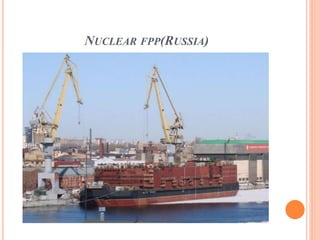
NUCLEAR FPP(RUSSIA)
ADVANTAGES
 Independent from soil quality
 Fast supply of electricity to areas with limited
infrastructure
 Provides addition safety in earth quake and flooding
areas
 Short delivery time
 Where land space is limited, large site area not
needed
DISADVANTAGES
 Infrastructure is costly when working off-shore
 The access to installations is critical when working
off-shore
CONCLUSION
 There are various positive environmental impacts
from the construction of fpp
 It absorbs and utilizes the energy from nature there
by reducing the use of elements which is harmful to
nature
REFERENCE
 http://www.floatingpowerplant.com/
 https://en.wikipedia.org/wiki/Powership
 http://www.powermag.com/of-floating-power-
barges-and-ships/
 https://en.wikipedia.org/wiki/Russian_floating_nucle
ar_power_station
 http://spectrum.ieee.org/energywise/energy/renewa
bles/japan-building-worlds-largest-floating-solar-
power-plant
Floating power stations

Floating power stations

  • 1.
  • 2.
    CONTENTS  INTRODUCTION  HISTORY DESIGN CONSIDERATION  WORKING  RECENT DEVELOPMENTS  ADVANTAGES  DISADVANTAGES  CONCLUSION
  • 3.
    INTRODUCTION  The floatingpower plant can supply electricity to a district or to a specific facility that temporarily uses electricity  It can minimize limitations caused by environmental regulations  It can be used as emergency electric power source
  • 4.
    HISTORY  In 1940,bythe US Army corporation of engineers, a 30 MW power generation facility put into service in the Philippines is still in operation in Ecuador  In 2000,which is the largest FPP in the world was installed in Mangalore on the west coast of India
  • 5.
    DESIGN CONSIDERATION  Itis designed in such a way that, it operates only like a ship at ship only requiring fuel for its generating machinery  The FPP is designed to sit in waters and move like a vessel at sea, but rather they are designed for service in protected inland waters such as rivers, lagoons or ports  The completed vessel receives a classification as a “power barrage”  Single barrage designs ranged from 30MW up to 530MW
  • 6.
    FUEL  The optionsare often limited in several countries and one has to use it with available fuels with irrespective of the cost  The fuels used in power station in land or sea is mainly depends on the availability and cost
  • 7.
  • 8.
    BARGE OPERATION  Theoperations are carried out as same as the land based facilities.  The fpp is fitted with on board control room with data acquisition system with machinery and equipment tools  Step up transformers, motor controllers, switchgear are also installed on barge
  • 9.
    TRANSPORTATION  One ofthe more significant differences of a floating power plant to a land based plant is it’s transportability.  It is being capable of moving the unit from one location to another.  This is achieved with the use of submersible heavy lift ships, designed to move very large structures around the world weighing upwards of 60,000 tons.
  • 10.
     A powerbarge can be moved from one location to another in a matter of weeks and connected to the grid to alleviate local shortages.
  • 11.
    WORKING OF FLOATINGPOWER STATION  The structure of floating power plant can be divided into 1.floating platform 2.rotor with blades-floating turbine
  • 12.
    FLOATING PLATFORM The floatingplatform gas various functions:  It prevents undesirable materials from entering the rotor of the machine  It is equipped with submerged lateral guides to guide the river water  It permits the adjustment of the height of the equipment above the surface of water
  • 13.
    ROTOR WITH BLADES (FLOATINGTURBINE)  Floating turbine on the surface of the river with the blades being immersed in the water  The first change is nothing but the displacement of river water proportional to the mass of the floating turbine in its physical space
  • 14.
    RECENT DEVELOPMENTS  Therecent research has come out with FPP with more sophisticated, light weight, more efficiency and more effective  The latest developments in FPP • Diesel energy • Wind energy • Tidal energy
  • 15.
  • 16.
  • 17.
  • 18.
    ADVANTAGES  Independent fromsoil quality  Fast supply of electricity to areas with limited infrastructure  Provides addition safety in earth quake and flooding areas  Short delivery time  Where land space is limited, large site area not needed
  • 19.
    DISADVANTAGES  Infrastructure iscostly when working off-shore  The access to installations is critical when working off-shore
  • 20.
    CONCLUSION  There arevarious positive environmental impacts from the construction of fpp  It absorbs and utilizes the energy from nature there by reducing the use of elements which is harmful to nature
  • 21.
    REFERENCE  http://www.floatingpowerplant.com/  https://en.wikipedia.org/wiki/Powership http://www.powermag.com/of-floating-power- barges-and-ships/  https://en.wikipedia.org/wiki/Russian_floating_nucle ar_power_station  http://spectrum.ieee.org/energywise/energy/renewa bles/japan-building-worlds-largest-floating-solar- power-plant