MINOR POJECT PRESENTATION
Shri shankarachary Institute of professional
management and technology raipur (C.g.)
492015
• OMESHWAR KUMAR
• NEERAJ KUMAR
• VIKAS GUPTA
• JYOTI JANGDE
MECHANICAL 7th SEM.
Submitted by Guide by
Mr. Hitesh sahu sir
Project Title
FLOATING SOLAR POWER PLANT
PROJECT AS A PROTOTYPE
INDEX
1. ABSTRACT
2. UNDERSTANDING FLOATING SOLAR PHOTOVOLTAICS
3. NEED FOR FLOATING PV OR WHY FLOATING SOLAR
4. MAJOR COMPONENTS OF PV SYSTEM
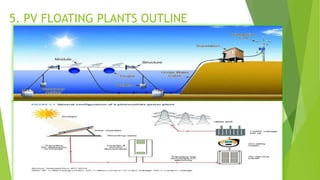
5. PV FLOATING PLANTS OUTLINE
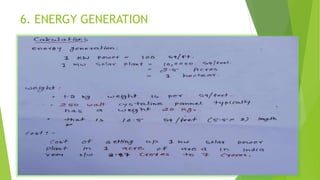
6. ENERGY GENERATION
7. ADVANTAGES
8. INDIA AND FLOATING PV
1. ABSTRACT
• The high energy demand and the constant depletion of the fossil fuels lead us to shift our
focus to renewable energy sources which are not only the future unlimited source of
energy, it is also Eco-friendly and viable for the environment.
2. UNDER STANDING SOLAR PV
What is floating solar PV?
• It is a technique of installing PV on water bodies instead of conventional place like land
or rooftops.the there are two main types of solar energy techonogies- PHOTOVOLTAICS(PV) AND
CONCENTRATING SOLAR THERMAL POWER.
• Solar photovoltaic energy or PV solar energy directly converts sunlight into electricity, using a
technology based on the photo-voltaic effect.
• When radiation from the sun hits one of the faces of a photoelectric cell (many of which make up a
solar panel), it produces an electric voltage differential between both faces that makes the electrons flow
between one to the other, generating an electric current.
3. NEED FOR FLOATING PV OR WHY FLOATING
SOLAR
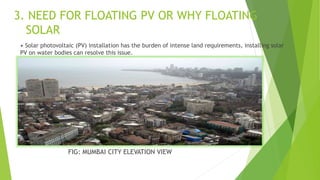
• Solar photovoltaic (PV) installation has the burden of intense land requirements, installing solar
PV on water bodies can resolve this issue.
FIG: MUMBAI CITY ELEVATION VIEW
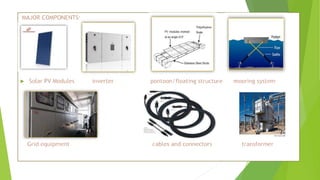
4. MAJOR COMPONENTS OF FLOATING SOLAR
PV PLANT
• SOLAR PV MODULE (SOLAR PANELS)
• INVERTER
• PONTOON & FLOATING SYSTEM
• MOORING SYSTEM
• GRID EQUIPMENT
• CABLES AND CONNECTORS
• TRANSFORMER
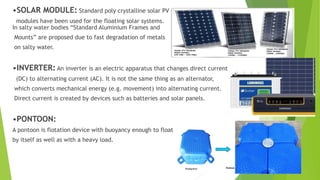
•SOLAR MODULE: Standard poly crystalline solar PV
modules have been used for the floating solar systems.
In salty water bodies “Standard Aluminium Frames and
Mounts” are proposed due to fast degradation of metals
on salty water.
•INVERTER: An inverter is an electric apparatus that changes direct current
(DC) to alternating current (AC). It is not the same thing as an alternator,
which converts mechanical energy (e.g. movement) into alternating current.
Direct current is created by devices such as batteries and solar panels.
•PONTOON:
A pontoon is flotation device with buoyancy enough to float
by itself as well as with a heavy load.
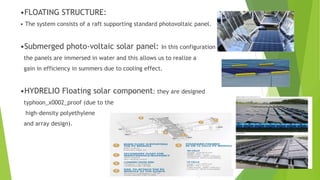
•FLOATING STRUCTURE:
• The system consists of a raft supporting standard photovoltaic panel.
•Submerged photo-voltaic solar panel: In this configuration
the panels are immersed in water and this allows us to realize a
gain in efficiency in summers due to cooling effect.
•HYDRELIO Floating solar component: they are designed
typhoon_x0002_proof (due to the
high-density polyethylene
and array design).
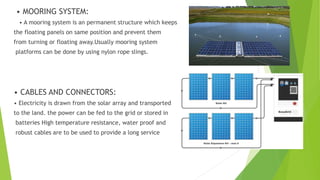
• MOORING SYSTEM:
• A mooring system is an permanent structure which keeps
the floating panels on same position and prevent them
from turning or floating away.Usually mooring system
platforms can be done by using nylon rope slings.
• CABLES AND CONNECTORS:
• Electricity is drawn from the solar array and transported
to the land. the power can be fed to the grid or stored in
batteries High temperature resistance, water proof and
robust cables are to be used to provide a long service
5. PV FLOATING PLANTS OUTLINE
6. ENERGY GENERATION
7. ADVANTAGES
1. They reduce reservoir water evaporation and algae growth by shading the water.
2. Floating platforms are 100% recyclable, utilizing high_x0002_density polyethylene, which can
withstand ultraviolet rays and resists corrosion.
3. Floating solar power generating systems typically generate more electricity than ground-mount
and rooftop systems due to the cooling effect of the water.
4. The floating platforms are designed and engineered to withstand extreme physical stress,
including typhoon and storm conditions.
5. More module install compare with the other system.
8. INDIA AND FLOATING PV
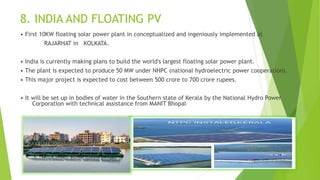
• First 10KW floating solar power plant in conceptualized and ingeniously implemented at
RAJARHAT in KOLKATA.
• India is currently making plans to build the world's largest floating solar power plant.
• The plant is expected to produce 50 MW under NHPC (national hydroelectric power cooperation).
• This major project is expected to cost between 500 crore to 700 crore rupees.
• It will be set up in bodies of water in the Southern state of Kerala by the National Hydro Power
Corporation with technical assistance from MANIT Bhopal
THANKYOU

Floating solar ppt

  • 1.
    MINOR POJECT PRESENTATION Shrishankarachary Institute of professional management and technology raipur (C.g.) 492015 • OMESHWAR KUMAR • NEERAJ KUMAR • VIKAS GUPTA • JYOTI JANGDE MECHANICAL 7th SEM. Submitted by Guide by Mr. Hitesh sahu sir
  • 2.
    Project Title FLOATING SOLARPOWER PLANT PROJECT AS A PROTOTYPE
  • 3.
    INDEX 1. ABSTRACT 2. UNDERSTANDINGFLOATING SOLAR PHOTOVOLTAICS 3. NEED FOR FLOATING PV OR WHY FLOATING SOLAR 4. MAJOR COMPONENTS OF PV SYSTEM 5. PV FLOATING PLANTS OUTLINE 6. ENERGY GENERATION 7. ADVANTAGES 8. INDIA AND FLOATING PV
  • 4.
    1. ABSTRACT • Thehigh energy demand and the constant depletion of the fossil fuels lead us to shift our focus to renewable energy sources which are not only the future unlimited source of energy, it is also Eco-friendly and viable for the environment.
  • 5.
    2. UNDER STANDINGSOLAR PV What is floating solar PV? • It is a technique of installing PV on water bodies instead of conventional place like land or rooftops.the there are two main types of solar energy techonogies- PHOTOVOLTAICS(PV) AND CONCENTRATING SOLAR THERMAL POWER. • Solar photovoltaic energy or PV solar energy directly converts sunlight into electricity, using a technology based on the photo-voltaic effect. • When radiation from the sun hits one of the faces of a photoelectric cell (many of which make up a solar panel), it produces an electric voltage differential between both faces that makes the electrons flow between one to the other, generating an electric current.
  • 6.
    3. NEED FORFLOATING PV OR WHY FLOATING SOLAR • Solar photovoltaic (PV) installation has the burden of intense land requirements, installing solar PV on water bodies can resolve this issue. FIG: MUMBAI CITY ELEVATION VIEW
  • 7.
    4. MAJOR COMPONENTSOF FLOATING SOLAR PV PLANT • SOLAR PV MODULE (SOLAR PANELS) • INVERTER • PONTOON & FLOATING SYSTEM • MOORING SYSTEM • GRID EQUIPMENT • CABLES AND CONNECTORS • TRANSFORMER
  • 9.
    •SOLAR MODULE: Standardpoly crystalline solar PV modules have been used for the floating solar systems. In salty water bodies “Standard Aluminium Frames and Mounts” are proposed due to fast degradation of metals on salty water. •INVERTER: An inverter is an electric apparatus that changes direct current (DC) to alternating current (AC). It is not the same thing as an alternator, which converts mechanical energy (e.g. movement) into alternating current. Direct current is created by devices such as batteries and solar panels. •PONTOON: A pontoon is flotation device with buoyancy enough to float by itself as well as with a heavy load.
  • 10.
    •FLOATING STRUCTURE: • Thesystem consists of a raft supporting standard photovoltaic panel. •Submerged photo-voltaic solar panel: In this configuration the panels are immersed in water and this allows us to realize a gain in efficiency in summers due to cooling effect. •HYDRELIO Floating solar component: they are designed typhoon_x0002_proof (due to the high-density polyethylene and array design).
  • 11.
    • MOORING SYSTEM: •A mooring system is an permanent structure which keeps the floating panels on same position and prevent them from turning or floating away.Usually mooring system platforms can be done by using nylon rope slings. • CABLES AND CONNECTORS: • Electricity is drawn from the solar array and transported to the land. the power can be fed to the grid or stored in batteries High temperature resistance, water proof and robust cables are to be used to provide a long service
  • 12.
    5. PV FLOATINGPLANTS OUTLINE
  • 13.
  • 14.
    7. ADVANTAGES 1. Theyreduce reservoir water evaporation and algae growth by shading the water. 2. Floating platforms are 100% recyclable, utilizing high_x0002_density polyethylene, which can withstand ultraviolet rays and resists corrosion. 3. Floating solar power generating systems typically generate more electricity than ground-mount and rooftop systems due to the cooling effect of the water. 4. The floating platforms are designed and engineered to withstand extreme physical stress, including typhoon and storm conditions. 5. More module install compare with the other system.
  • 15.
    8. INDIA ANDFLOATING PV • First 10KW floating solar power plant in conceptualized and ingeniously implemented at RAJARHAT in KOLKATA. • India is currently making plans to build the world's largest floating solar power plant. • The plant is expected to produce 50 MW under NHPC (national hydroelectric power cooperation). • This major project is expected to cost between 500 crore to 700 crore rupees. • It will be set up in bodies of water in the Southern state of Kerala by the National Hydro Power Corporation with technical assistance from MANIT Bhopal
  • 16.