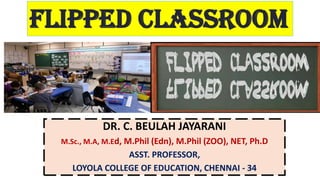
Flipped Classroom
DR. C. BEULAH JAYARANI
M.Sc., M.A, M.Ed, M.Phil (Edn), M.Phil (ZOO), NET, Ph.D
ASST. PROFESSOR,
LOYOLA COLLEGE OF EDUCATION, CHENNAI - 34
INTRODUCTION
A flipped classroom is a type of blended
learning where students are introduced to
content at home and practice working
through it at school. This is the reverse of the
more common practice of introducing new
content at school, then assigning homework and
projects to completed by the students
independently at home.
4/17/2022 Dr. C. Beulah Jayarani 2
Flipped classroom
Pedagogical model in which the
typical lecture and homework
elements of a course are
reversed.
Short video lectures are viewed
by students at home before the
class session, while in-class
time is devoted to exercises,
projects, or discussions.
4/17/2022 Dr. C. Beulah Jayarani 3
AIM OF FLIPPED CLASSROOM
• The main goal of a flipped classroom
is to enhance student learning and
achievement by reversing the
traditional model of a classroom,
focusing class time on student
understanding rather than on lecture.
4/17/2022 Dr. C. Beulah Jayarani 4
4 Pillars of Flipped Classroom
i) Flexible
Environment
ii) Learning
Culture
iii) Intentional
Content
iv)
Professional
Educator
4/17/2022 Dr. C. Beulah Jayarani 5
• i) Flexible Environment: In flipped classroom,
teachers need to create flexible learning
environment by providing opportunities for
students to choose when and where they want to
learn.
• Ii) Learning Culture: In flipped model, class time
is shifting to discuss more in-depth about each
topic. More over, flipped classroom changes the
traditional learning culture into learner
centered class. As a result, students are actively
involved in knowledge construction.
4 Pillars of Flipped Classroom
4/17/2022 Dr. C. Beulah Jayarani 6
• iii. Intentional Content: Flipped learning requires
intentional content. Means, in flipped model, the
teachers determine what they need to teach and
what materials students should handle on their own.
Here, teachers use intentional content to maximize
class time in order to adopt learner- centered,
activity-oriented class.
• iv. Professional Educator: The role of a professional
educator is even more important in a flipped
classroom than in traditional one. The flipped model
needs instructors who can observe, provide timely
feedback, continuously assess work, and help
students master content. This is something only
professional educators can do.
4 Pillars of Flipped Classroom
4/17/2022 Dr. C. Beulah Jayarani 7
Advantages of Flipped Classroom
Students take ownership for learning.
It promotes student-centered learning
and collaboration.
Lessons and content are more accessible.
It emphasis on co-operative learning.
It gives more time to explore the content.
It can be more efficient.
4/17/2022 Dr. C. Beulah Jayarani 8
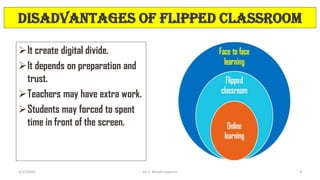
Disadvantages of Flipped Classroom
It create digital divide.
It depends on preparation and
trust.
Teachers may have extra work.
Students may forced to spent
time in front of the screen.
4/17/2022 Dr. C. Beulah Jayarani 9
references
• David Black-Schaffer; “Flipping the Classroom” in an
Introductory IT Course
• Bruce M. Saulnier; From “Sage on the Stage” to “Guide
on the Side” Revisited: (Un)Covering the Content in the
Learner Centered Information Systems Course
• Tamar Lewin; After Setbacks, Online Courses Are
Rethought
4/17/2022 Dr. C. Beulah Jayarani 10

Flipped Classroom.pdf

  • 1.
    Flipped Classroom DR. C.BEULAH JAYARANI M.Sc., M.A, M.Ed, M.Phil (Edn), M.Phil (ZOO), NET, Ph.D ASST. PROFESSOR, LOYOLA COLLEGE OF EDUCATION, CHENNAI - 34
  • 2.
    INTRODUCTION A flipped classroomis a type of blended learning where students are introduced to content at home and practice working through it at school. This is the reverse of the more common practice of introducing new content at school, then assigning homework and projects to completed by the students independently at home. 4/17/2022 Dr. C. Beulah Jayarani 2
  • 3.
    Flipped classroom Pedagogical modelin which the typical lecture and homework elements of a course are reversed. Short video lectures are viewed by students at home before the class session, while in-class time is devoted to exercises, projects, or discussions. 4/17/2022 Dr. C. Beulah Jayarani 3
  • 4.
    AIM OF FLIPPEDCLASSROOM • The main goal of a flipped classroom is to enhance student learning and achievement by reversing the traditional model of a classroom, focusing class time on student understanding rather than on lecture. 4/17/2022 Dr. C. Beulah Jayarani 4
  • 5.
    4 Pillars ofFlipped Classroom i) Flexible Environment ii) Learning Culture iii) Intentional Content iv) Professional Educator 4/17/2022 Dr. C. Beulah Jayarani 5
  • 6.
    • i) FlexibleEnvironment: In flipped classroom, teachers need to create flexible learning environment by providing opportunities for students to choose when and where they want to learn. • Ii) Learning Culture: In flipped model, class time is shifting to discuss more in-depth about each topic. More over, flipped classroom changes the traditional learning culture into learner centered class. As a result, students are actively involved in knowledge construction. 4 Pillars of Flipped Classroom 4/17/2022 Dr. C. Beulah Jayarani 6
  • 7.
    • iii. IntentionalContent: Flipped learning requires intentional content. Means, in flipped model, the teachers determine what they need to teach and what materials students should handle on their own. Here, teachers use intentional content to maximize class time in order to adopt learner- centered, activity-oriented class. • iv. Professional Educator: The role of a professional educator is even more important in a flipped classroom than in traditional one. The flipped model needs instructors who can observe, provide timely feedback, continuously assess work, and help students master content. This is something only professional educators can do. 4 Pillars of Flipped Classroom 4/17/2022 Dr. C. Beulah Jayarani 7
  • 8.
    Advantages of FlippedClassroom Students take ownership for learning. It promotes student-centered learning and collaboration. Lessons and content are more accessible. It emphasis on co-operative learning. It gives more time to explore the content. It can be more efficient. 4/17/2022 Dr. C. Beulah Jayarani 8
  • 9.
    Disadvantages of FlippedClassroom It create digital divide. It depends on preparation and trust. Teachers may have extra work. Students may forced to spent time in front of the screen. 4/17/2022 Dr. C. Beulah Jayarani 9
  • 10.
    references • David Black-Schaffer;“Flipping the Classroom” in an Introductory IT Course • Bruce M. Saulnier; From “Sage on the Stage” to “Guide on the Side” Revisited: (Un)Covering the Content in the Learner Centered Information Systems Course • Tamar Lewin; After Setbacks, Online Courses Are Rethought 4/17/2022 Dr. C. Beulah Jayarani 10