EDU03 EDUCATIONAL TECHNOLOGY AND
COMMUNICATION IN EDUCATION
TOPIC-FLIPPED CLASSROOM
FLIPPED CLASSROOM
It is a form of blended learning
Student learn new content in online by watching video lectures at home, and what
used to be homework is done in class with teachers offering more personalized
guidance and interaction with students, instead of lecturing
It is a teaching strategy that reverses the traditional learning environment by
delivering instructional content , outside of the classroom.
Other names –backwards classroom, inverted classroom, reverse teaching
The classroom becomes a space for dynamic, interactive learning where the teacher
guides students to apply concept they have learned online and engage creatively
with the subject matter through group work, discussion, and peer feedback
• Many reasons –schools shift from traditional methods into flipped
classroom model
• In a traditional classroom, a teacher lectures –students practice -finally
assessed
• Now, the students have been raised in the age of the internet
• Most are adept at using multimedia
• That makes the need of teachers sit up in front of them and simply present
information almost obsolete.
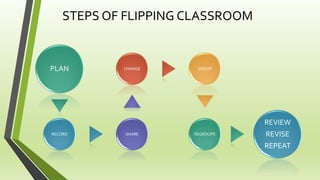
STEPS OF FLIPPING CLASSROOM
PLAN
RECORD SHARE
CHANGE GROUP
REGROUPE
REVIEW
REVISE
REPEAT
1. PLAN: Figure out the lesson in particular want to flip
2. RECORD: Instead of teaching the lesson in person, make a video
3. SHARE: Send the video to students
4. CHANGE: Students have viewed the lesson, they are prepared to actually
go more in depth than ever
5. GROUP: An effective to discuss the topic is to separate into groups where
students are given a task to perform
6. REGROUP: Get the class back together to share the individual group’s
work with everyone
7. REVIEW, REVISE, REPEAT: Go over what worked with this flipped lesson.
Change what didn't work so well. Do it again.
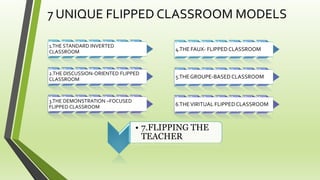
7 UNIQUE FLIPPED CLASSROOM MODELS
1.THE STANDARD INVERTED
CLASSROOM
2.THE DISCUSSION-ORIENTED FLIPPED
CLASSROOM
3.THE DEMONSTRATION –FOCUSED
FLIPPED CLASSROOM
4.THE FAUX- FLIPPED CLASSROOM
5.THEGROUPE-BASED CLASSROOM
6.THEVIRITUAL FLIPPEDCLASSROOM
• 7.FLIPPING THE
TEACHER
• THE STANDARD INVERTEDCLASSROOM: Students are assigned the home work of
watching video lectures and reading any materials relevant to the next day’s class. During
class time, students practice what they have learned through traditional school work, with
their teachers feed up for additional one-on-one time
• THE DISCUSSION-ORIENTED FLIPPED CLASSROOM: Teachers assign lecture videos, as
well as any other video or reading related to the day’s subject — thinkTEDTalks,YouTube
videos, and other resources. Class time is then devoted to discussion and exploration of the
subject.This can be an especially useful approach in subjects where context is everything
such as history, art, or English.
• THE DEMONSTRATION-FOCUSED FLIPPEDCLASSROOM: Especially for those subjects
that require students to remember and repeat activities exactly — think chemistry, physics,
and just about every math class — it is most helpful to have a video demonstration to be
able to rewind and re-watch. In this model, the teacher uses screen recording software to
demonstrate the activity in a way that allows students to follow along at their own pace.
• THE FAUX-FLIPPED CLASSROOM: One great idea Education Drive uncovered is perfect
for younger students for whom actual homework might not yet be appropriate.This flipped
classroom model instead has those students watch lecture video in class — giving them the
opportunity to review materials at their own pace, with the teacher able to move from
student to student to offer whatever individual support each young learner needs.
• THE GROUP-BASED FLIPPED CLASSROOM: This model adds a new element to help
students learn — each other.The class starts the same way others do, with lecture videos
and other resources shared before class.The shift happens when students come to class,
teaming up to work together on that day’s assignment.This format encourages students to
learn from one another and helps students to not only learn what the right answers are but
also how to actually explain to a peer why those answers are right.
• THEVIRTUAL FLIPPED CLASSROOM: For older students and in some courses, the flipped
classroom can eliminate the need for classroom time at all. Some college and university
professors now share lecture videos for student viewing, assign and collect work via online
learning management systems, and simply require students to attend office hours or other
regularly scheduled time for brief one-on-one instruction based on that individual student’s
needs.
• FLIPPINGTHETEACHER: All the video created for a flipped classroom doesn’t have to
begin and end with the teacher. Students too can make use of video to better demonstrate
proficiency.Assign students to their record practice role-play activities to show
competency, or ask each to film themselves presenting a new subject or skill as a means to
“teach the teacher”.
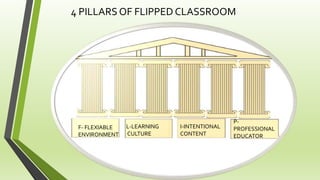
4 PILLARS OF FLIPPED CLASSROOM
F- FLEXIABLE
ENVIRONMENT
L-LEARNING
CULTURE
I-INTENTIONAL
CONTENT
P-
PROFESSIONAL
EDUCATOR
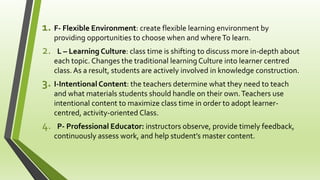
1. F- Flexible Environment: create flexible learning environment by
providing opportunities to choose when and whereTo learn.
2. L – Learning Culture: class time is shifting to discuss more in-depth about
each topic. Changes the traditional learning Culture into learner centred
class. As a result, students are actively involved in knowledge construction.
3. I-Intentional Content: the teachers determine what they need to teach
and what materials students should handle on their own.Teachers use
intentional content to maximize class time in order to adopt learner-
centred, activity-oriented Class.
4. P- Professional Educator: instructors observe, provide timely feedback,
continuously assess work, and help student’s master content.
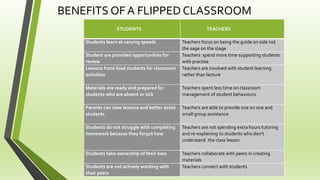
BENEFITS OF A FLIPPED CLASSROOM
STUDENTS TEACHERS
Students learn at varying speeds Teachers focus on being the guide on side not
the sage on the stage
Student are provided opportunities for
review
Teachers spend more time supporting students
with practise
Lessons front-load students for classroom
activities
Teachers are involved with student learning
rather than lecture
Materials are ready and prepared for
students who are absent or sick
Teachers spent less time on classroom
management of student behaviours
Parents can view lessons and better assist
students
Teachers are able to provide one on one and
small group assistance
Students do not struggle with completing
homework because they forgot how
Teachers are not spending extra hours tutoring
and re-explaining to students who don’t
understand the class lesson
Students take ownership of their own Teachers collaborate with peers in creating
materials
Students are not actively working with
their peers
Teachers connect with students
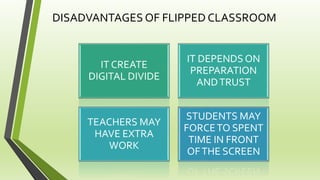
DISADVANTAGES OF FLIPPED CLASSROOM
IT CREATE
DIGITAL DIVIDE
IT DEPENDS ON
PREPARATION
ANDTRUST
TEACHERS MAY
HAVE EXTRA
WORK
STUDENTS MAY
FORCETO SPENT
TIME IN FRONT
OFTHE SCREEN
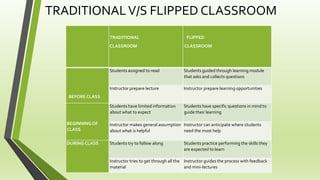
TRADITIONALV/S FLIPPED CLASSROOM
TRADITIONAL
CLASSROOM
FLIPPED
CLASSROOM
BEFORE CLASS
Students assigned to read Students guided through learning module
that asks and collects questions
Instructor prepare lecture Instructor prepare learning opportunities
BEGINNINGOF
CLASS
Students have limited information
about what to expect
Students have specific questions in mind to
guide their learning
Instructor makes general assumption
about what is helpful
Instructor can anticipate where students
need the most help
DURINGCLASS Students try to follow along Students practice performing the skills they
are expected to learn
Instructor tries to get through all the
material
Instructor guides the process with feedback
and mini-lectures
educational technology and communication in education

educational technology and communication in education

  • 1.
    EDU03 EDUCATIONAL TECHNOLOGYAND COMMUNICATION IN EDUCATION TOPIC-FLIPPED CLASSROOM
  • 2.
    FLIPPED CLASSROOM It isa form of blended learning Student learn new content in online by watching video lectures at home, and what used to be homework is done in class with teachers offering more personalized guidance and interaction with students, instead of lecturing It is a teaching strategy that reverses the traditional learning environment by delivering instructional content , outside of the classroom. Other names –backwards classroom, inverted classroom, reverse teaching The classroom becomes a space for dynamic, interactive learning where the teacher guides students to apply concept they have learned online and engage creatively with the subject matter through group work, discussion, and peer feedback
  • 3.
    • Many reasons–schools shift from traditional methods into flipped classroom model • In a traditional classroom, a teacher lectures –students practice -finally assessed • Now, the students have been raised in the age of the internet • Most are adept at using multimedia • That makes the need of teachers sit up in front of them and simply present information almost obsolete.
  • 4.
    STEPS OF FLIPPINGCLASSROOM PLAN RECORD SHARE CHANGE GROUP REGROUPE REVIEW REVISE REPEAT
  • 5.
    1. PLAN: Figureout the lesson in particular want to flip 2. RECORD: Instead of teaching the lesson in person, make a video 3. SHARE: Send the video to students 4. CHANGE: Students have viewed the lesson, they are prepared to actually go more in depth than ever 5. GROUP: An effective to discuss the topic is to separate into groups where students are given a task to perform 6. REGROUP: Get the class back together to share the individual group’s work with everyone 7. REVIEW, REVISE, REPEAT: Go over what worked with this flipped lesson. Change what didn't work so well. Do it again.
  • 6.
    7 UNIQUE FLIPPEDCLASSROOM MODELS 1.THE STANDARD INVERTED CLASSROOM 2.THE DISCUSSION-ORIENTED FLIPPED CLASSROOM 3.THE DEMONSTRATION –FOCUSED FLIPPED CLASSROOM 4.THE FAUX- FLIPPED CLASSROOM 5.THEGROUPE-BASED CLASSROOM 6.THEVIRITUAL FLIPPEDCLASSROOM • 7.FLIPPING THE TEACHER
  • 7.
    • THE STANDARDINVERTEDCLASSROOM: Students are assigned the home work of watching video lectures and reading any materials relevant to the next day’s class. During class time, students practice what they have learned through traditional school work, with their teachers feed up for additional one-on-one time • THE DISCUSSION-ORIENTED FLIPPED CLASSROOM: Teachers assign lecture videos, as well as any other video or reading related to the day’s subject — thinkTEDTalks,YouTube videos, and other resources. Class time is then devoted to discussion and exploration of the subject.This can be an especially useful approach in subjects where context is everything such as history, art, or English. • THE DEMONSTRATION-FOCUSED FLIPPEDCLASSROOM: Especially for those subjects that require students to remember and repeat activities exactly — think chemistry, physics, and just about every math class — it is most helpful to have a video demonstration to be able to rewind and re-watch. In this model, the teacher uses screen recording software to demonstrate the activity in a way that allows students to follow along at their own pace. • THE FAUX-FLIPPED CLASSROOM: One great idea Education Drive uncovered is perfect for younger students for whom actual homework might not yet be appropriate.This flipped classroom model instead has those students watch lecture video in class — giving them the opportunity to review materials at their own pace, with the teacher able to move from student to student to offer whatever individual support each young learner needs.
  • 8.
    • THE GROUP-BASEDFLIPPED CLASSROOM: This model adds a new element to help students learn — each other.The class starts the same way others do, with lecture videos and other resources shared before class.The shift happens when students come to class, teaming up to work together on that day’s assignment.This format encourages students to learn from one another and helps students to not only learn what the right answers are but also how to actually explain to a peer why those answers are right. • THEVIRTUAL FLIPPED CLASSROOM: For older students and in some courses, the flipped classroom can eliminate the need for classroom time at all. Some college and university professors now share lecture videos for student viewing, assign and collect work via online learning management systems, and simply require students to attend office hours or other regularly scheduled time for brief one-on-one instruction based on that individual student’s needs. • FLIPPINGTHETEACHER: All the video created for a flipped classroom doesn’t have to begin and end with the teacher. Students too can make use of video to better demonstrate proficiency.Assign students to their record practice role-play activities to show competency, or ask each to film themselves presenting a new subject or skill as a means to “teach the teacher”.
  • 9.
    4 PILLARS OFFLIPPED CLASSROOM F- FLEXIABLE ENVIRONMENT L-LEARNING CULTURE I-INTENTIONAL CONTENT P- PROFESSIONAL EDUCATOR
  • 10.
    1. F- FlexibleEnvironment: create flexible learning environment by providing opportunities to choose when and whereTo learn. 2. L – Learning Culture: class time is shifting to discuss more in-depth about each topic. Changes the traditional learning Culture into learner centred class. As a result, students are actively involved in knowledge construction. 3. I-Intentional Content: the teachers determine what they need to teach and what materials students should handle on their own.Teachers use intentional content to maximize class time in order to adopt learner- centred, activity-oriented Class. 4. P- Professional Educator: instructors observe, provide timely feedback, continuously assess work, and help student’s master content.
  • 11.
    BENEFITS OF AFLIPPED CLASSROOM STUDENTS TEACHERS Students learn at varying speeds Teachers focus on being the guide on side not the sage on the stage Student are provided opportunities for review Teachers spend more time supporting students with practise Lessons front-load students for classroom activities Teachers are involved with student learning rather than lecture Materials are ready and prepared for students who are absent or sick Teachers spent less time on classroom management of student behaviours Parents can view lessons and better assist students Teachers are able to provide one on one and small group assistance Students do not struggle with completing homework because they forgot how Teachers are not spending extra hours tutoring and re-explaining to students who don’t understand the class lesson Students take ownership of their own Teachers collaborate with peers in creating materials Students are not actively working with their peers Teachers connect with students
  • 12.
    DISADVANTAGES OF FLIPPEDCLASSROOM IT CREATE DIGITAL DIVIDE IT DEPENDS ON PREPARATION ANDTRUST TEACHERS MAY HAVE EXTRA WORK STUDENTS MAY FORCETO SPENT TIME IN FRONT OFTHE SCREEN
  • 13.
    TRADITIONALV/S FLIPPED CLASSROOM TRADITIONAL CLASSROOM FLIPPED CLASSROOM BEFORECLASS Students assigned to read Students guided through learning module that asks and collects questions Instructor prepare lecture Instructor prepare learning opportunities BEGINNINGOF CLASS Students have limited information about what to expect Students have specific questions in mind to guide their learning Instructor makes general assumption about what is helpful Instructor can anticipate where students need the most help DURINGCLASS Students try to follow along Students practice performing the skills they are expected to learn Instructor tries to get through all the material Instructor guides the process with feedback and mini-lectures