• The flipped classroom, a teaching
method that delivers lecture
content to students at home
through electronic means.
• Uses class time for practical
application activities, may be
useful for class room instruction.
• Today the technological movement has
changed the face of education.
• This technological movement has enabled
the amplification and duplication of
information at an extremely low-cost.
• Digital learning, online learning, and the
development of software tools to facilitate
student learning has given entirely new
directions for education research.
• Flipped classroom is an exciting new topic in
educational research.
• The flipped classroom is known by various names
including the inverted classroom, and more simply,
the flip.
• The flipped classroom is known by various names
including the inverted classroom, and more simply,
the flip.
• The flip evolved out of a history of
experimentation with the concept of hybrid or
blended learning and problem based learning,
using active learning techniques and new
technologies to engage students.
• Origination stories differ, but most credit goes to
Jonathan Bergmann and Aaron Sams, high school
chemistry teachers from Colorado, who began
using recorded lectures in 2006. (Arnold 2014)
 Defined simplistically as "school
work at home and home work at
school,
 flipped learning is a pedagogical
approach that allows teachers to
implement a methodology, or various
methodologies in their classrooms.
It is an instructional strategy and a
type of blended learning that
reverses the traditional educational
arrangement by delivering
instructional content, often online,
outside of the classroom and moves
activities, including those they may
have traditionally been considered
homework into the classroom.
• Intentionally shifts instruction to a leaner-
centred model
• Class time is dedicated to exploring topics
in greater depth and creating meaningful
learning opportunities.
• Educational technology such as online
videos are employed to deliver content
outside of the classroom.
Content delivery may take a variety of
forms - often, video lessons prepared
by the teacher or third parties are
used as delivery mechanism, through
online collaborative discussions,
digital research, or text readings may
be utilized as well.
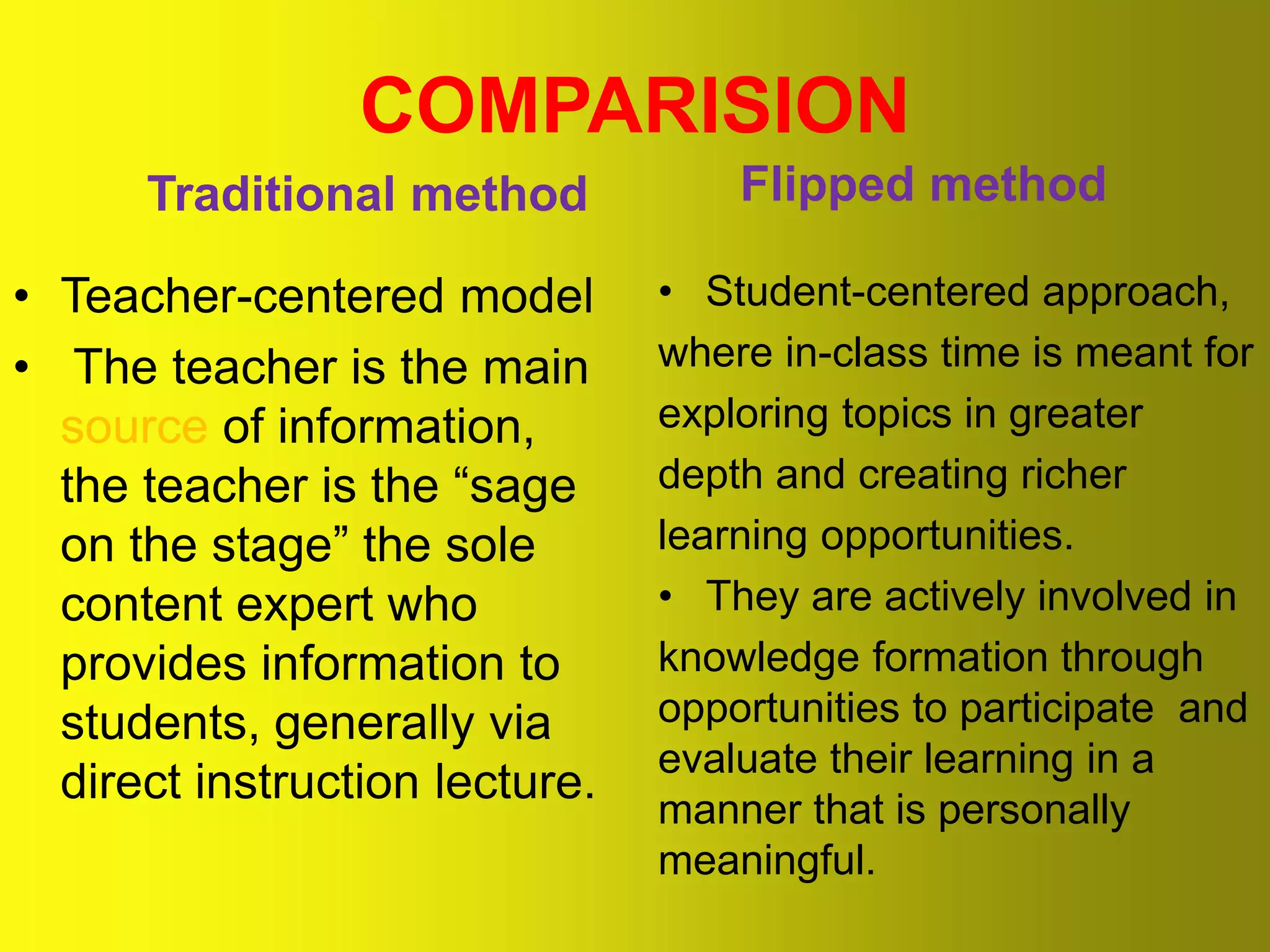
COMPARISION
Traditional method
• Teacher-centered model
• The teacher is the main
source of information,
the teacher is the “sage
on the stage” the sole
content expert who
provides information to
students, generally via
direct instruction lecture.
Flipped method
• Student-centered approach,
where in-class time is meant for
exploring topics in greater
depth and creating richer
learning opportunities.
• They are actively involved in
knowledge formation through
opportunities to participate and
evaluate their learning in a
manner that is personally
meaningful.
• As curricular requirements grow,
instructors are pressured to make
more efficient use of class time.
• In the flipped classroom students can
get the most out of class time by
spending it on practical application,
not on inactive lecture.
• This transfer of what has traditionally been
passive learning out of the classroom
leaves class time to focus on the more
engaging elements of teaching and
learning.
• The class time can be utilized to interact
and clarify material, more time to explore
concepts deeply.
• The flip provides more time for active
learning to happen in the classroom
setting.
• The flipped classroom provides an opportunity to
students to learn the contents before attending the
class.
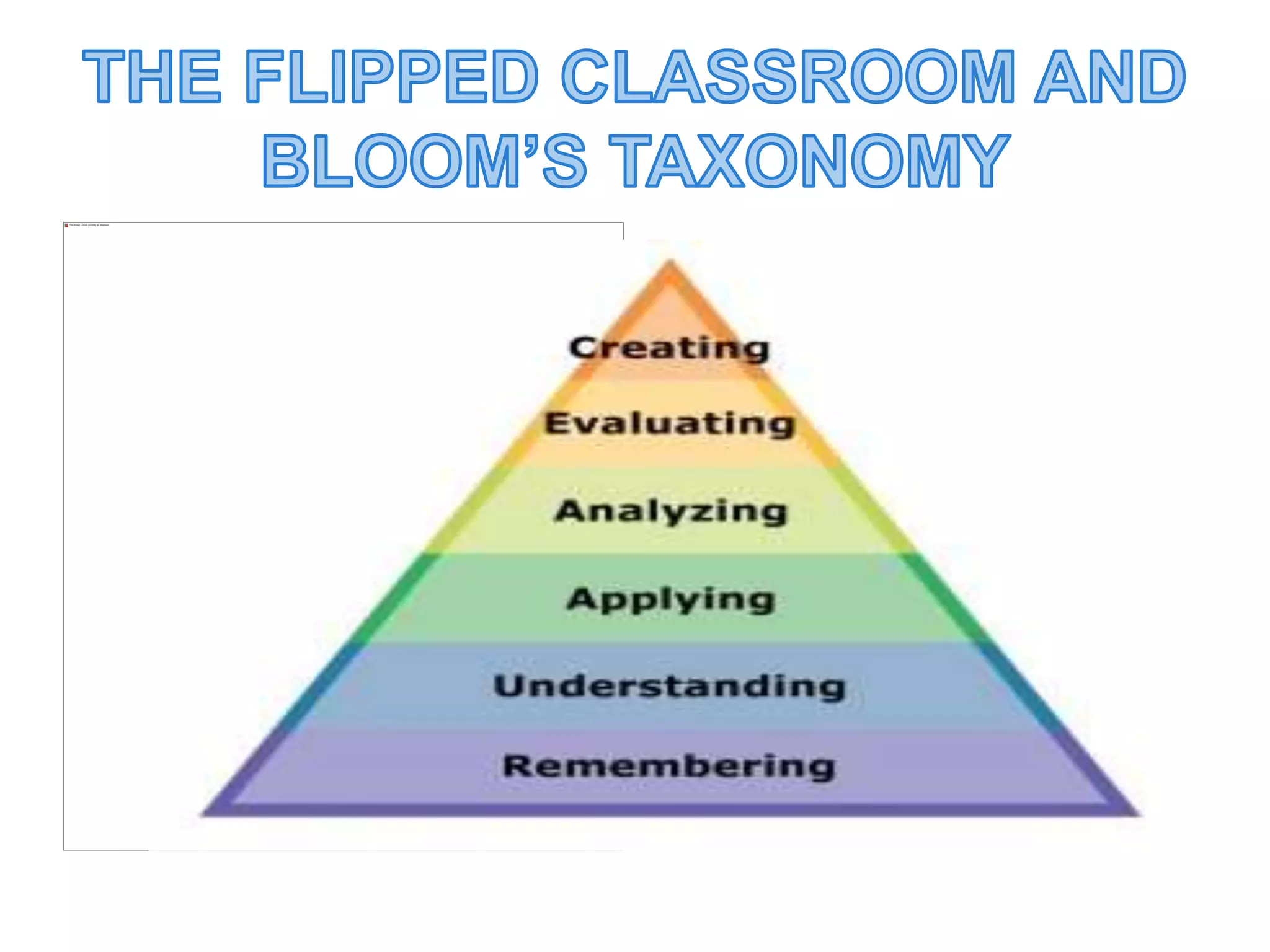
• The idea is to address students learning at the lower
level of Bloom’s taxonomy so that students can
remember and understand the contents by reading
lecture notes or view the videos.
• As the student come to the class they involve
in activity based learning individually or in
groups.
• Thus giving them an opportunity to master their
knowledge and skills by working on the higher
levels of Bloom’s taxonomy by applying,
analysing, evaluating and creating new
knowledge and understanding as shown in
figure in the next slide:
• A cadre of experienced educators from the
Flipped Learning Network, along with
Pearson (2013), identified those four
Pillars of F-L-I-P™,
• An acronym of Flexible Environment,
Learning Culture, Intentional Content, and
Professional Educator. (Hamdam et al,).
Educators create flexible spaces to
accommodate in which students
choose when and where they learn.
Educators who flip their classes are
flexible in their expectations of
student timelines for learning and in
their assessments of student learning.
• Educators determine what they need to
teach and what materials students should
explore on their own.
• Educators use intentional contents to
maximise classroom time in order to adopt
methods of student- centered, active
learning strategies, depending on grade
level and subject matter.
• In flipped learning the instruction
shifts from teacher-centred to
learner-centred approach.
• Students are actively involved in the
knowledge construction as they
participate and evaluate their
learning in a manner that is
personally meaningful.
During class time educators
continually observe their
students, providing them with
feedback relevant in the
moment, and assessing their
work.
• In this world of digital and online learning, flipped
model can prove to be effective in implementing in
the classroom by the educators.
• The flipped classroom constitutes a role change
for instructors, who give up their front-of-the-class
position in favour of a more collaborative and
cooperative contribution to the teaching process.
• There is a change in the role of students.
• Many of whom are used to being cast as passive
participants in the education process, where
instruction is served to them.
• The flipped model puts more of the responsibility
for learning on the shoulders of students.
• Activities can be student-led, and communication
among students can become the determining
dynamic of a session devoted to learning through
hands-on work.
• What the flip does particularly well is to bring
about a distinctive shift in priorities— from merely
covering material to working toward mastery of it.
• However more qualitative and quantitative
research needs to be done to identify how the
potential of the model can be maximized.
The flipped classroom

The flipped classroom

  • 2.
    • The flippedclassroom, a teaching method that delivers lecture content to students at home through electronic means. • Uses class time for practical application activities, may be useful for class room instruction.
  • 3.
    • Today thetechnological movement has changed the face of education. • This technological movement has enabled the amplification and duplication of information at an extremely low-cost. • Digital learning, online learning, and the development of software tools to facilitate student learning has given entirely new directions for education research.
  • 4.
    • Flipped classroomis an exciting new topic in educational research. • The flipped classroom is known by various names including the inverted classroom, and more simply, the flip. • The flipped classroom is known by various names including the inverted classroom, and more simply, the flip.
  • 5.
    • The flipevolved out of a history of experimentation with the concept of hybrid or blended learning and problem based learning, using active learning techniques and new technologies to engage students. • Origination stories differ, but most credit goes to Jonathan Bergmann and Aaron Sams, high school chemistry teachers from Colorado, who began using recorded lectures in 2006. (Arnold 2014)
  • 6.
     Defined simplisticallyas "school work at home and home work at school,  flipped learning is a pedagogical approach that allows teachers to implement a methodology, or various methodologies in their classrooms.
  • 7.
    It is aninstructional strategy and a type of blended learning that reverses the traditional educational arrangement by delivering instructional content, often online, outside of the classroom and moves activities, including those they may have traditionally been considered homework into the classroom.
  • 8.
    • Intentionally shiftsinstruction to a leaner- centred model • Class time is dedicated to exploring topics in greater depth and creating meaningful learning opportunities. • Educational technology such as online videos are employed to deliver content outside of the classroom.
  • 9.
    Content delivery maytake a variety of forms - often, video lessons prepared by the teacher or third parties are used as delivery mechanism, through online collaborative discussions, digital research, or text readings may be utilized as well.
  • 10.
    COMPARISION Traditional method • Teacher-centeredmodel • The teacher is the main source of information, the teacher is the “sage on the stage” the sole content expert who provides information to students, generally via direct instruction lecture. Flipped method • Student-centered approach, where in-class time is meant for exploring topics in greater depth and creating richer learning opportunities. • They are actively involved in knowledge formation through opportunities to participate and evaluate their learning in a manner that is personally meaningful.
  • 11.
    • As curricularrequirements grow, instructors are pressured to make more efficient use of class time. • In the flipped classroom students can get the most out of class time by spending it on practical application, not on inactive lecture.
  • 12.
    • This transferof what has traditionally been passive learning out of the classroom leaves class time to focus on the more engaging elements of teaching and learning. • The class time can be utilized to interact and clarify material, more time to explore concepts deeply. • The flip provides more time for active learning to happen in the classroom setting.
  • 13.
    • The flippedclassroom provides an opportunity to students to learn the contents before attending the class. • The idea is to address students learning at the lower level of Bloom’s taxonomy so that students can remember and understand the contents by reading lecture notes or view the videos.
  • 14.
    • As thestudent come to the class they involve in activity based learning individually or in groups. • Thus giving them an opportunity to master their knowledge and skills by working on the higher levels of Bloom’s taxonomy by applying, analysing, evaluating and creating new knowledge and understanding as shown in figure in the next slide:
  • 16.
    • A cadreof experienced educators from the Flipped Learning Network, along with Pearson (2013), identified those four Pillars of F-L-I-P™, • An acronym of Flexible Environment, Learning Culture, Intentional Content, and Professional Educator. (Hamdam et al,).
  • 17.
    Educators create flexiblespaces to accommodate in which students choose when and where they learn. Educators who flip their classes are flexible in their expectations of student timelines for learning and in their assessments of student learning.
  • 18.
    • Educators determinewhat they need to teach and what materials students should explore on their own. • Educators use intentional contents to maximise classroom time in order to adopt methods of student- centered, active learning strategies, depending on grade level and subject matter.
  • 19.
    • In flippedlearning the instruction shifts from teacher-centred to learner-centred approach. • Students are actively involved in the knowledge construction as they participate and evaluate their learning in a manner that is personally meaningful.
  • 20.
    During class timeeducators continually observe their students, providing them with feedback relevant in the moment, and assessing their work.
  • 21.
    • In thisworld of digital and online learning, flipped model can prove to be effective in implementing in the classroom by the educators. • The flipped classroom constitutes a role change for instructors, who give up their front-of-the-class position in favour of a more collaborative and cooperative contribution to the teaching process. • There is a change in the role of students. • Many of whom are used to being cast as passive participants in the education process, where instruction is served to them.
  • 22.
    • The flippedmodel puts more of the responsibility for learning on the shoulders of students. • Activities can be student-led, and communication among students can become the determining dynamic of a session devoted to learning through hands-on work. • What the flip does particularly well is to bring about a distinctive shift in priorities— from merely covering material to working toward mastery of it. • However more qualitative and quantitative research needs to be done to identify how the potential of the model can be maximized.