
By Rohit Agarwal (127)
Sourabh Saran (148)
Index
1. Introduction
2. Competitors
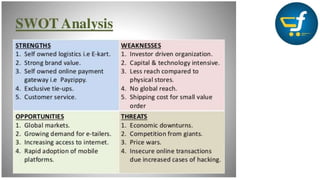
3. SWOT Analysis
4. S.T.P.
5. Marketing Strategies
6. Order Lifecycle
7. Logistics
8. Marketing Mix (4P’s)
9. Conclusion
Introduction
Parent Company Flipkart Private Limited (FPL)
Category E-commerce – online retail apparel, electronics
Sector IT & Technology
Slogan The Onl;ine Megastore
USP Wide variety of products across many segments
Introduction
• Founded in 2007 by Binny and Sachin Bansal.
• Started with selling of books.
• HQ at Bangalore, Karnataka
• First book sold: “Leaving Microsoft to change the World” by John Wood
• Later expanded its product line to
a. Electronics
b. Home and Kitchen Appliances
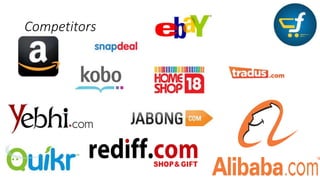
Competitors
Competitive Advantage
1. Hands on Understanding of Customer: Flipkart has better understanding of
Indian customer than Amazon in terms of actual experience- not analytics. Also,
they have been pioneers of concepts like Cash On Delivery.
2. Established Brand
3. Logistics: Flipkart has built it’s own delivery arm.
4. Supply Chain
5. Strategic warehousing & distribution capability
6. Well aligned fulfillment process
7. Inventory Model
8. Innovative advertisements
9. Payment Options
Market Segmentation
1. Geographic : caters to Tier1, Tier2, Tier3 cities
2. Demographic : 75% of online users between age group of 15-34 years.
3. Behavioural: Web Friendly people
4. Psychographic: (a)It helps in deciding where to display ads online.
(b)They target online shoppers and people who don’t online shop.
Market Positioning
1. Points Of Parity:
• Easy locating of products
• Competitive Prices
• Discount on Purchases
• Home Delivery
• Gifting services
• Cash on Delivery
• No hassles of going to shops personally & shop for products.
• Availability of various products on 1 platform
2. Points of Difference:
• Flipkart membership cards for premium customers
• Better user interface – one drag approach
• Vernacular language
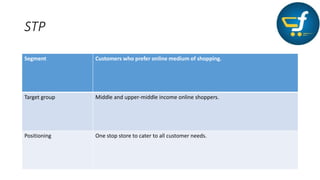
STP
Segment Customers who prefer online medium of shopping.
Target group Middle and upper-middle income online shoppers.
Positioning One stop store to cater to all customer needs.
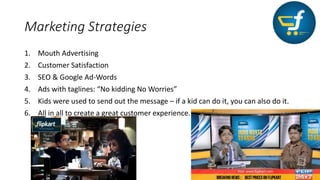
Marketing Strategies
1. Mouth Advertising
2. Customer Satisfaction
3. SEO & Google Ad-Words
4. Ads with taglines: “No kidding No Worries”
5. Kids were used to send out the message – if a kid can do it, you can also do it.
6. All in all to create a great customer experience.
Order Lifecycle
1. Attract users to the site
2. Provide selection
3. Evaluation of product
4. Price well
5. Provide convenient payment options
6. Confirm payment
7. Get the product
8. Clean & check for sanity
9. Pack the item
10. Select courier & hand over
11. Get tracking ID & communicate to customer
Marketing Mix : 4 P’s
1. Product:
• Electronic good apparels
• Home & kitchen appliances
• Men’s & women’s appliances
• Computer software & hardware
• Book
• Sport store
• Baby & kids section
2.)Place:
• All major inventory are located near to the airports.
• Major warehouses are located in Bengaluru, Chennai, Delhi, Hyderabad, Mumbai,
Noida, Pune, Kolkata.
• Biggest advantage: Nationwide reach to all sellers of different sizes
• Covers all Tier1, Tier2, Tier3 cities.
3) Price :
• Much less price than other e-commerce websites
• Availability of E-wallets & E-gifts
• EMI option for specific products
• Discounted coupons
• Free shipping facility
• Special discount & promotional codes for loyal customers
4) Promotion:
a. Above the line promotion:
• TV advertisement
• Radio Jingles
• Print Ads
b. Below the line promotion:
• Word of mouth
• Bulk mailing
• In app push notification
c. Through the line promotion:
• Social Media Marketing / campaign
Conclusion
• Flipkart is the 1st billion dollar Internet company from India.
• Amazon in early 2012 tried to acquire Flipkart through high buyout
price but failed.
• With online retail industry in India pegged to reach $1.5 billion
(2015), sources suggest that e-commerce is just hotting up in India &
we may soon see many more Internet companies achieving similar
success.
THANK YOU

Flipkart (Consumer Behavior Buying Decision Process)

  • 1.
    By Rohit Agarwal(127) Sourabh Saran (148)
  • 2.
    Index 1. Introduction 2. Competitors 3.SWOT Analysis 4. S.T.P. 5. Marketing Strategies 6. Order Lifecycle 7. Logistics 8. Marketing Mix (4P’s) 9. Conclusion
  • 3.
    Introduction Parent Company FlipkartPrivate Limited (FPL) Category E-commerce – online retail apparel, electronics Sector IT & Technology Slogan The Onl;ine Megastore USP Wide variety of products across many segments
  • 4.
    Introduction • Founded in2007 by Binny and Sachin Bansal. • Started with selling of books. • HQ at Bangalore, Karnataka • First book sold: “Leaving Microsoft to change the World” by John Wood • Later expanded its product line to a. Electronics b. Home and Kitchen Appliances
  • 5.
  • 6.
    Competitive Advantage 1. Handson Understanding of Customer: Flipkart has better understanding of Indian customer than Amazon in terms of actual experience- not analytics. Also, they have been pioneers of concepts like Cash On Delivery. 2. Established Brand 3. Logistics: Flipkart has built it’s own delivery arm. 4. Supply Chain 5. Strategic warehousing & distribution capability 6. Well aligned fulfillment process 7. Inventory Model 8. Innovative advertisements 9. Payment Options
  • 8.
    Market Segmentation 1. Geographic: caters to Tier1, Tier2, Tier3 cities 2. Demographic : 75% of online users between age group of 15-34 years. 3. Behavioural: Web Friendly people 4. Psychographic: (a)It helps in deciding where to display ads online. (b)They target online shoppers and people who don’t online shop.
  • 9.
    Market Positioning 1. PointsOf Parity: • Easy locating of products • Competitive Prices • Discount on Purchases • Home Delivery • Gifting services • Cash on Delivery • No hassles of going to shops personally & shop for products. • Availability of various products on 1 platform
  • 10.
    2. Points ofDifference: • Flipkart membership cards for premium customers • Better user interface – one drag approach • Vernacular language
  • 11.
    STP Segment Customers whoprefer online medium of shopping. Target group Middle and upper-middle income online shoppers. Positioning One stop store to cater to all customer needs.
  • 12.
    Marketing Strategies 1. MouthAdvertising 2. Customer Satisfaction 3. SEO & Google Ad-Words 4. Ads with taglines: “No kidding No Worries” 5. Kids were used to send out the message – if a kid can do it, you can also do it. 6. All in all to create a great customer experience.
  • 13.
    Order Lifecycle 1. Attractusers to the site 2. Provide selection 3. Evaluation of product 4. Price well 5. Provide convenient payment options 6. Confirm payment 7. Get the product 8. Clean & check for sanity 9. Pack the item 10. Select courier & hand over 11. Get tracking ID & communicate to customer
  • 15.
    Marketing Mix :4 P’s 1. Product: • Electronic good apparels • Home & kitchen appliances • Men’s & women’s appliances • Computer software & hardware • Book • Sport store • Baby & kids section
  • 16.
    2.)Place: • All majorinventory are located near to the airports. • Major warehouses are located in Bengaluru, Chennai, Delhi, Hyderabad, Mumbai, Noida, Pune, Kolkata. • Biggest advantage: Nationwide reach to all sellers of different sizes • Covers all Tier1, Tier2, Tier3 cities.
  • 17.
    3) Price : •Much less price than other e-commerce websites • Availability of E-wallets & E-gifts • EMI option for specific products • Discounted coupons • Free shipping facility • Special discount & promotional codes for loyal customers
  • 18.
    4) Promotion: a. Abovethe line promotion: • TV advertisement • Radio Jingles • Print Ads b. Below the line promotion: • Word of mouth • Bulk mailing • In app push notification c. Through the line promotion: • Social Media Marketing / campaign
  • 19.
    Conclusion • Flipkart isthe 1st billion dollar Internet company from India. • Amazon in early 2012 tried to acquire Flipkart through high buyout price but failed. • With online retail industry in India pegged to reach $1.5 billion (2015), sources suggest that e-commerce is just hotting up in India & we may soon see many more Internet companies achieving similar success.
  • 20.