
•The concept of e-commerce is emerging.
•Shortage of time is a big driver for online shopping.
•Accessibility to a variety of products.
•Has a strong Customer Support Team
•Flipkart uses its in-house logistics (FKL) as well as third party logistics (3PL).
•30 day return policy and it bearing courier charges for returned products.
•Flipkart when it started employed the consignment model of procurement but
then they changed to Inventory model to ensure superior delivery times.
•With foreign direct investment (FDI) favoring the marketplace model in
April2013, Flipkart changed its business model to marketplace model.
•WS Retail now handles the inventory and warehouse management.
•Excellent delivery time because of their developed supply chain management.
EXECUTIVE SUMMARY
MARKET OVERVIEW
•India has an internet user base of about 252.2 million as of June 2016.
•Penetration of e-commerce is low compared to markets like the U.S.A & U.K.
•Growth rate is high with a large number of new entrants.
•Unique to India, cash on delivery is a preferred payment method.
•India has a vibrant cash economy as a result of which 80% of Indian e- commerce tends to be
Cash on Delivery.
•However, COD may harm e-commerce business in India in the long run and there is a need to make
a shift towards online payment mechanisms.
•India's e-commerce market was worth about $2.5 billion in 2009, $6.3 billion in 2011& $14 billion 2012.
•About 75% of this is travel related.
•Online Retailing comprises about 12.5% ($300 Million as of 2009)
•India has close to 10 million online shoppers and is growing at an estimated 30% CAGR
•Electronics and Apparel are the biggest categories in terms of sales.
•Key drivers in Indian e-commerce are: Increasing broadband Internet and 3G penetration,
•Rising standards of living,
•Availability of much wider product range compared to what is available at brick and mortar retailers,
•Busy lifestyles, lack of time for offline shopping, Lower prices compared to brick and mortar,
•Online travel constitutes a sizable portion (87%) of this market today.
•Overall e-commerce market was expected to reach Rs 1, 07,800 crores (US$24 billion) by the year 2015
with both online travel and e-tailing contributing equally.
•Investment will be made in large warehouses and increased automation of their process, so that the
•product is not delayed.
Opportunities
•Global Markets
•Growing demand of e- tailers
•Rapid adoption of mobile platforms
Threats:
•Competition from giants
•Price wars
•Insecure online transactions due to hacking
CORE COMPETENCY
•Excellent Product Delivery.
• Self owned delivery network.
•Supplier network.
•First mover advantage.
•Payment Mode.
•Excellent customer service.
•Large loyal customer base.
Flipkart customers consist of middle class social groups who are comfortable with online
shopping and find it convenient. Majority of the customers are the professional who are
busy with their business/Job & find it convenient to purchase anything online rather than
visiting the physical outlet in order to save time & money.
Because of its diverse product range it targets all age groups whether be it
Students, office going people, house wives, old age people.
MARKET SEGMENTATION The four basic market segmentation-strategies are
based on
•Geographic Segmentation- CATERS TO TIER 1, TIER 2 AND TIER 3 CITIES
•Demographic Segmentation - 75% of online users between the age group of 15-34 years.
Flipkart targets mainly the youth of the country.
•Behavioural Segmentation–Web friendly people.
•Psychographic Segmentation– Flipkart concentrates on more Psychographic, which helps in
deciding where to display ads online. They target online shoppers and people who don‘t
online shop (thus TVC to encourage them)
TARGET CUSTOMERS & SEGMENTATION
They will look at bigger investments in their supply chain and technology.
Investment will be made in large warehouses and increased automation of their process, so that the
product is not delayed.
They intend to enter in to various new categories and expand their current categories as well. Everything
except for groceries and automobiles will be available on Flipkart in future.
To go further in the value chain, Flipkart is looking at associations with a larger number of suppliers and
partners, both nationally and internationally.
FLIPKART” Aims to become the largest retailer in India”.
Entering global market.
GOALS
•2010: WeRead, a social book discovery tool.
•2011: Mime360, a digital content platform company.
•2011: Chakpak.com, a Bollywood news site that offers updates, news, photos and
videos. Flipkart acquired the rights to Chakpak's digital catalogue which includes
40,000 filmographies, 10,000 movies and close to 50,000 ratings. Flipkart has
categorically said that it will not be involved with the original site and will not use
the brand name.
•2012: Letsbuy.com, an Indian e-retailer in electronics. Flipkart has bought the
company for an estimated US$25 million. Letsbuy.com was closed down and all
traffic to Letsbuy has been diverted to Flipkart.
•2014: Acquired Myntra.com in an estimated ₹20 billion (US$300 million) deal.
•2015: Flipkart acquired a mobile marketing start-up Appiterate as to strengthen
its mobile platform.
•2016: Flipkart’s Myntra acquires rival fashion shopping site Jabong for $70
million.
•2016: In April, Flipkart acquired payment start-up PhonePe.
Investments.
Major Acquisitions
COLLABORATORS
•Dell
•Xiaomi
•Oppo
•NIFT
•Euronet
•InMobi
•CyberSource
•Black & Decker
•Yonyx
•HBase
These are some to name a few.
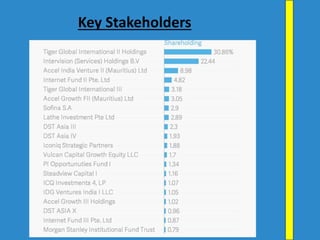
Key Stakeholders
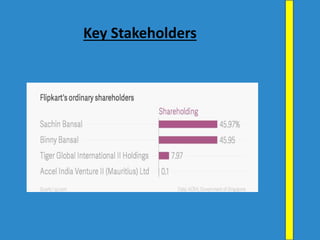
Key Stakeholders
MAJOR COMPETITIORS
•Amazon.com
•Snapdeal.com
•eBay Inc.
•HomeShop18
•Yebhi.com
Positive and Negative Economic, Socio-cultural and
Technological aspects
Economical
•Increase in income level
and standard of living
•Busy life schedule results in
increase in online purchases
•Less taxes in online
purchases
•Better deals available on
other sites
Socio-Cultural
•Word of mouth promotion
•Better use of social media platform for promotion of
other product
•Increase in customer literacy
•Better customer feedback
•Increase in the security levels for making online
purchases.
•Negative feedback by customers on social media
•Various type of same products effecting selection of
products by customers
•More promotion done by the competitors at the social
and digital front
Technological
Best search engine optimization
Proper placement of advertisement of products
Increase in the use of internet
Integration of various payment gateways
Less internet knowledge in rural areas
Security issue with online methods
Long payment methods for making online payments
Value Propositions
Customers:
•Complete hassle free shopping experience with the best services to everyone,
everywhere and everyone in India.
Employees:
•Handsome salaries.
•Free meals.
•Special leaves for special days.
•Reimbursement of broadband bill.
•Work from home.
Collaborators:
•Trade allowances.
•Brand promotions.
MARKET-MIX
1. Product
2. Service
3. Brand
4. Price
5. Incentives
6. Communication
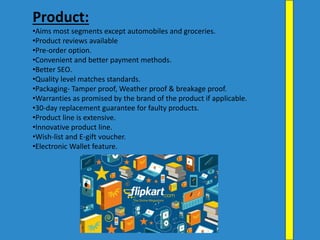
Product:
•Aims most segments except automobiles and groceries.
•Product reviews available
•Pre-order option.
•Convenient and better payment methods.
•Better SEO.
•Quality level matches standards.
•Packaging- Tamper proof, Weather proof & breakage proof.
•Warranties as promised by the brand of the product if applicable.
•30-day replacement guarantee for faulty products.
•Product line is extensive.
•Innovative product line.
•Wish-list and E-gift voucher.
•Electronic Wallet feature.
Price:
•Price of the product taking account of various expenses such as
Supplier expenses, Transportation expenses,etc.
•Discounts up to 35% across all categories. Upper edge in competitive
pricing.
•Special discount for loyal customers and regular buyers.
•As shipping is within India the shipping cost reduces, which indirectly
reduces the overall cost for the company and thus company offers less
price as compared to other players.
•Free shipping overall Indian boundaries after certain amount of
purchase done from the site and even without minimum purchase for
the regular and loyal customers.
•For expensive products transit cost is borne by company.
•Maximum discounts in the occasional time like Diwali, Eid etc.
•Pricing would always differ if you are buying from e-commerce sites
and Shopping Malls, reason for that is the middleman charges and the
cost of store which increases the price of the particular product.
Services:
•Diverse product line.
•Convenient payment methods.
•Home Delivery.
•Innovative offers.
(* Many listed under Products.)
Brand:
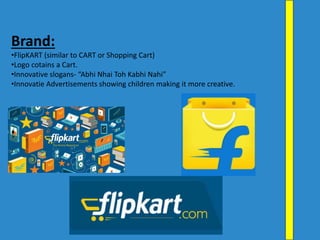
•FlipKART (similar to CART or Shopping Cart)
•Logo cotains a Cart.
•Innovative slogans- “Abhi Nhai Toh Kabhi Nahi”
•Innovatie Advertisements showing children making it more creative.
Incentives:
•To customers is that it offers low prices than ordinary local stores.
•To the employees it offers handsome salaries along with many perks like
reimbursement, special holidays, meals, etc
•To the collaborators it offers trade allowances and brand promotion
opportunities.
Communications
Various means of communications are:
•Newspaper
•Emails
•Facebok
•Twitter
•SMS
•Magazines
THANK YOU….

Flipkart

  • 2.
    •The concept ofe-commerce is emerging. •Shortage of time is a big driver for online shopping. •Accessibility to a variety of products. •Has a strong Customer Support Team •Flipkart uses its in-house logistics (FKL) as well as third party logistics (3PL). •30 day return policy and it bearing courier charges for returned products. •Flipkart when it started employed the consignment model of procurement but then they changed to Inventory model to ensure superior delivery times. •With foreign direct investment (FDI) favoring the marketplace model in April2013, Flipkart changed its business model to marketplace model. •WS Retail now handles the inventory and warehouse management. •Excellent delivery time because of their developed supply chain management. EXECUTIVE SUMMARY
  • 3.
    MARKET OVERVIEW •India hasan internet user base of about 252.2 million as of June 2016. •Penetration of e-commerce is low compared to markets like the U.S.A & U.K. •Growth rate is high with a large number of new entrants. •Unique to India, cash on delivery is a preferred payment method. •India has a vibrant cash economy as a result of which 80% of Indian e- commerce tends to be Cash on Delivery. •However, COD may harm e-commerce business in India in the long run and there is a need to make a shift towards online payment mechanisms. •India's e-commerce market was worth about $2.5 billion in 2009, $6.3 billion in 2011& $14 billion 2012. •About 75% of this is travel related. •Online Retailing comprises about 12.5% ($300 Million as of 2009) •India has close to 10 million online shoppers and is growing at an estimated 30% CAGR •Electronics and Apparel are the biggest categories in terms of sales. •Key drivers in Indian e-commerce are: Increasing broadband Internet and 3G penetration, •Rising standards of living, •Availability of much wider product range compared to what is available at brick and mortar retailers, •Busy lifestyles, lack of time for offline shopping, Lower prices compared to brick and mortar, •Online travel constitutes a sizable portion (87%) of this market today. •Overall e-commerce market was expected to reach Rs 1, 07,800 crores (US$24 billion) by the year 2015 with both online travel and e-tailing contributing equally. •Investment will be made in large warehouses and increased automation of their process, so that the •product is not delayed.
  • 4.
    Opportunities •Global Markets •Growing demandof e- tailers •Rapid adoption of mobile platforms Threats: •Competition from giants •Price wars •Insecure online transactions due to hacking
  • 5.
    CORE COMPETENCY •Excellent ProductDelivery. • Self owned delivery network. •Supplier network. •First mover advantage. •Payment Mode. •Excellent customer service. •Large loyal customer base.
  • 6.
    Flipkart customers consistof middle class social groups who are comfortable with online shopping and find it convenient. Majority of the customers are the professional who are busy with their business/Job & find it convenient to purchase anything online rather than visiting the physical outlet in order to save time & money. Because of its diverse product range it targets all age groups whether be it Students, office going people, house wives, old age people. MARKET SEGMENTATION The four basic market segmentation-strategies are based on •Geographic Segmentation- CATERS TO TIER 1, TIER 2 AND TIER 3 CITIES •Demographic Segmentation - 75% of online users between the age group of 15-34 years. Flipkart targets mainly the youth of the country. •Behavioural Segmentation–Web friendly people. •Psychographic Segmentation– Flipkart concentrates on more Psychographic, which helps in deciding where to display ads online. They target online shoppers and people who don‘t online shop (thus TVC to encourage them) TARGET CUSTOMERS & SEGMENTATION
  • 7.
    They will lookat bigger investments in their supply chain and technology. Investment will be made in large warehouses and increased automation of their process, so that the product is not delayed. They intend to enter in to various new categories and expand their current categories as well. Everything except for groceries and automobiles will be available on Flipkart in future. To go further in the value chain, Flipkart is looking at associations with a larger number of suppliers and partners, both nationally and internationally. FLIPKART” Aims to become the largest retailer in India”. Entering global market. GOALS
  • 8.
    •2010: WeRead, asocial book discovery tool. •2011: Mime360, a digital content platform company. •2011: Chakpak.com, a Bollywood news site that offers updates, news, photos and videos. Flipkart acquired the rights to Chakpak's digital catalogue which includes 40,000 filmographies, 10,000 movies and close to 50,000 ratings. Flipkart has categorically said that it will not be involved with the original site and will not use the brand name. •2012: Letsbuy.com, an Indian e-retailer in electronics. Flipkart has bought the company for an estimated US$25 million. Letsbuy.com was closed down and all traffic to Letsbuy has been diverted to Flipkart. •2014: Acquired Myntra.com in an estimated ₹20 billion (US$300 million) deal. •2015: Flipkart acquired a mobile marketing start-up Appiterate as to strengthen its mobile platform. •2016: Flipkart’s Myntra acquires rival fashion shopping site Jabong for $70 million. •2016: In April, Flipkart acquired payment start-up PhonePe. Investments. Major Acquisitions
  • 9.
  • 10.
  • 11.
  • 12.
  • 13.
    Positive and NegativeEconomic, Socio-cultural and Technological aspects Economical •Increase in income level and standard of living •Busy life schedule results in increase in online purchases •Less taxes in online purchases •Better deals available on other sites Socio-Cultural •Word of mouth promotion •Better use of social media platform for promotion of other product •Increase in customer literacy •Better customer feedback •Increase in the security levels for making online purchases. •Negative feedback by customers on social media •Various type of same products effecting selection of products by customers •More promotion done by the competitors at the social and digital front Technological Best search engine optimization Proper placement of advertisement of products Increase in the use of internet Integration of various payment gateways Less internet knowledge in rural areas Security issue with online methods Long payment methods for making online payments
  • 14.
    Value Propositions Customers: •Complete hasslefree shopping experience with the best services to everyone, everywhere and everyone in India. Employees: •Handsome salaries. •Free meals. •Special leaves for special days. •Reimbursement of broadband bill. •Work from home. Collaborators: •Trade allowances. •Brand promotions.
  • 15.
    MARKET-MIX 1. Product 2. Service 3.Brand 4. Price 5. Incentives 6. Communication
  • 16.
    Product: •Aims most segmentsexcept automobiles and groceries. •Product reviews available •Pre-order option. •Convenient and better payment methods. •Better SEO. •Quality level matches standards. •Packaging- Tamper proof, Weather proof & breakage proof. •Warranties as promised by the brand of the product if applicable. •30-day replacement guarantee for faulty products. •Product line is extensive. •Innovative product line. •Wish-list and E-gift voucher. •Electronic Wallet feature.
  • 17.
    Price: •Price of theproduct taking account of various expenses such as Supplier expenses, Transportation expenses,etc. •Discounts up to 35% across all categories. Upper edge in competitive pricing. •Special discount for loyal customers and regular buyers. •As shipping is within India the shipping cost reduces, which indirectly reduces the overall cost for the company and thus company offers less price as compared to other players. •Free shipping overall Indian boundaries after certain amount of purchase done from the site and even without minimum purchase for the regular and loyal customers. •For expensive products transit cost is borne by company. •Maximum discounts in the occasional time like Diwali, Eid etc. •Pricing would always differ if you are buying from e-commerce sites and Shopping Malls, reason for that is the middleman charges and the cost of store which increases the price of the particular product.
  • 18.
    Services: •Diverse product line. •Convenientpayment methods. •Home Delivery. •Innovative offers. (* Many listed under Products.)
  • 19.
    Brand: •FlipKART (similar toCART or Shopping Cart) •Logo cotains a Cart. •Innovative slogans- “Abhi Nhai Toh Kabhi Nahi” •Innovatie Advertisements showing children making it more creative.
  • 20.
    Incentives: •To customers isthat it offers low prices than ordinary local stores. •To the employees it offers handsome salaries along with many perks like reimbursement, special holidays, meals, etc •To the collaborators it offers trade allowances and brand promotion opportunities.
  • 21.
    Communications Various means ofcommunications are: •Newspaper •Emails •Facebok •Twitter •SMS •Magazines
  • 22.