Flipkart case study
Flipkart (A):Summary
Inventory Model and Market place model
◦ Pros and cons
◦ Transitioning to a market place model
India’s fragmented retail market and Growth of E-tailing
◦ Digital India movement and Retail sector
◦ Online retail
◦ E-tailing: Horizontal and vertical player
Flipkart : Online book selling to
India’s biggest multiproduct store
• 2007: Online book seller from two story apartment
• 2010: COD, foray into music movies and games & Introduction of FCs
• 2011:An advertisement campaign with 3 key proposition.
• 2012-13: intensified competition with Product offering expansion.
• 2014: Continuing with bolt on acquisitions like MYNTRA
• 2015:4billion GMV with Two strategic changes : 100K seller base from 30K & E
kart as separate division
Commerce
Platform
Supply Chain
division
New Initiatives Fashion
Organizatio
n structure
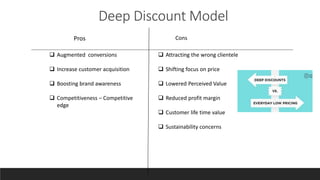
Deep Discount Model
Pros Cons
 Augmented conversions
 Increase customer acquisition
 Boosting brand awareness
 Competitiveness – Competitive
edge
 Attracting the wrong clientele
 Shifting focus on price
 Lowered Perceived Value
 Reduced profit margin
 Customer life time value
 Sustainability concerns
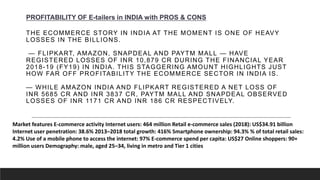
THE ECOMMERCE STORY IN INDIA AT THE MOMENT IS ONE OF HEAVY
LOSSES IN THE BILLIONS.
— FLIPKART, AMAZON, SNAPDEAL AND PAYTM MALL — HAVE
REGISTERED LOSSES OF INR 10,879 CR DURING THE FINANCIAL YEAR
2018-19 (FY19) IN INDIA. THIS STAGGERING AMOUNT HIGHLIGHTS JUST
HOW FAR OFF PROFITABILITY THE ECOMMERCE SECTOR IN INDIA IS.
— WHILE AMAZON INDIA AND FLIPKART REGISTERED A NET LOSS OF
INR 5685 CR AND INR 3837 CR, PAYTM MALL AND SNAPDEAL OBSERVED
LOSSES OF INR 1171 CR AND INR 186 CR RESPECTIVELY.
PROFITABILITY OF E-tailers in INDIA with PROS & CONS
Market features E-commerce activity Internet users: 464 million Retail e-commerce sales (2018): US$34.91 billion
Internet user penetration: 38.6% 2013–2018 total growth: 416% Smartphone ownership: 94.3% % of total retail sales:
4.2% Use of a mobile phone to access the internet: 97% E-commerce spend per capita: US$27 Online shoppers: 90+
million users Demography: male, aged 25–34, living in metro and Tier 1 cities
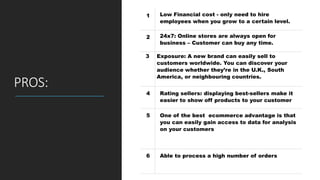
PROS:
1 Low Financial cost - only need to hire
employees when you grow to a certain level.
2 24x7: Online stores are always open for
business – Customer can buy any time.
3 Exposure: A new brand can easily sell to
customers worldwide. You can discover your
audience whether they’re in the U.K., South
America, or neighbouring countries.
4 Rating sellers: displaying best-sellers make it
easier to show off products to your customer
5 One of the best ecommerce advantage is that
you can easily gain access to data for analysis
on your customers
6 Able to process a high number of orders
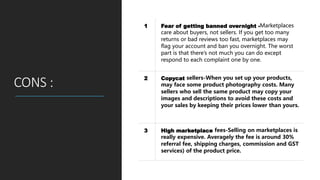
CONS :
1 Fear of getting banned overnight -Marketplaces
care about buyers, not sellers. If you get too many
returns or bad reviews too fast, marketplaces may
flag your account and ban you overnight. The worst
part is that there’s not much you can do except
respond to each complaint one by one.
2 Copycat sellers-When you set up your products,
may face some product photography costs. Many
sellers who sell the same product may copy your
images and descriptions to avoid these costs and
your sales by keeping their prices lower than yours.
3 High marketplace fees-Selling on marketplaces is
really expensive. Averagely the fee is around 30%
referral fee, shipping charges, commission and GST
services) of the product price.
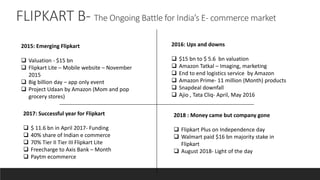
2015: Emerging Flipkart
 Valuation - $15 bn
 Flipkart Lite – Mobile website – November
2015
 Big billion day – app only event
 Project Udaan by Amazon (Mom and pop
grocery stores)
2016: Ups and downs
 $15 bn to $ 5.6 bn valuation
 Amazon Tatkal – Imaging, marketing
 End to end logistics service by Amazon
 Amazon Prime- 11 million (Month) products
 Snapdeal downfall
 Ajio , Tata Cliq- April, May 2016
2017: Successful year for Flipkart
 $ 11.6 bn in April 2017- Funding
 40% share of Indian e commerce
 70% Tier II Tier III Flipkart Lite
 Freecharge to Axis Bank – Month
 Paytm ecommerce
2018 : Money came but company gone
 Flipkart Plus on Independence day
 Walmart paid $16 bn majority stake in
Flipkart
 August 2018- Light of the day
FLIPKART B- The Ongoing Battle for India’s E- commerce market
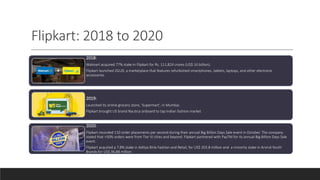
Flipkart: 2018 to 2020
2018:
Walmart acquired 77% stake in Flipkart for Rs. 111,824 crores (US$ 16 billion).
Flipkart launched 2GUD, a marketplace that features refurbished smartphones, tablets, laptops, and other electronic
accessories
2019:
Launched its online grocery store, ‘Supermart’, in Mumbai.
Flipkart brought US brand Nautica onboard to tap Indian fashion market
2020:
Flipkart recorded 110 order placements per second during their annual Big Billion Days Sale event in October. The company
stated that >50% orders were from Tier III cities and beyond. Flipkart partnered with PayTM for its annual Big Billion Days Sale
event.
Flipkart acquired a 7.8% stake in Aditya Birla Fashion and Retail, for US$ 203.8 million and a minority stake in Arvind Youth
Brands for US$ 36.88 million
Flipkart: 2018 to 2020
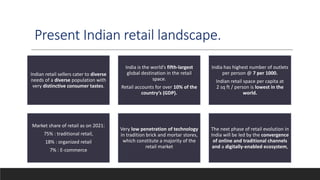
Present Indian retail landscape.
Indian retail sellers cater to diverse
needs of a diverse population with
very distinctive consumer tastes.
India is the world’s fifth-largest
global destination in the retail
space.
Retail accounts for over 10% of the
country’s (GDP).
India has highest number of outlets
per person @ 7 per 1000.
Indian retail space per capita at
2 sq ft / person is lowest in the
world.
Market share of retail as on 2021:
75% : traditional retail,
18% : organized retail
7% : E-commerce
Very low penetration of technology
in tradition brick and mortar stores,
which constitute a majority of the
retail market
The next phase of retail evolution in
India will be led by the convergence
of online and traditional channels
and a digitally-enabled ecosystem,
Kirana stores are here to stay.
As a major fallout of the nationwide lockdown imposed in view of the coronavirus pandemic, the humble kirana store —
the face of the $750 billion-plus Indian retail industry — has suddenly come into the spotlight. Global corporate giants like
Reliance, Amazon, and Walmart-owned-Flipkart have started to woo the kirana stores that provide the much-needed
household essentials.
On the one hand, ecommerce companies want to expand their presence by reaching out to more number of consumers
while the kirana stores want to increase their proximity with this base while expanding the range of products along with
convenience. the ecommerce companies have access to technology while the kirana stores know their customers well.
The supply chain network of the Indian retail industry especially in the food and grocery segment is very complicated. It is
a mix of both organised and unorganised segments which has an interplay of many elements like logistics, distributors,
warehouses and financing. This has hindered the giants from scaling up as easily as they did with electronic products
Ref: https://yourstory.com/2020/05/jiomart-amazon-flipkart-wooing-kirana-stores-startups?utm_pageloadtype=scroll
Thank you

Flipkart case study (003).pptx

  • 1.
  • 2.
    Flipkart (A):Summary Inventory Modeland Market place model ◦ Pros and cons ◦ Transitioning to a market place model India’s fragmented retail market and Growth of E-tailing ◦ Digital India movement and Retail sector ◦ Online retail ◦ E-tailing: Horizontal and vertical player
  • 3.
    Flipkart : Onlinebook selling to India’s biggest multiproduct store • 2007: Online book seller from two story apartment • 2010: COD, foray into music movies and games & Introduction of FCs • 2011:An advertisement campaign with 3 key proposition. • 2012-13: intensified competition with Product offering expansion. • 2014: Continuing with bolt on acquisitions like MYNTRA • 2015:4billion GMV with Two strategic changes : 100K seller base from 30K & E kart as separate division
  • 4.
  • 5.
    Deep Discount Model ProsCons  Augmented conversions  Increase customer acquisition  Boosting brand awareness  Competitiveness – Competitive edge  Attracting the wrong clientele  Shifting focus on price  Lowered Perceived Value  Reduced profit margin  Customer life time value  Sustainability concerns
  • 6.
    THE ECOMMERCE STORYIN INDIA AT THE MOMENT IS ONE OF HEAVY LOSSES IN THE BILLIONS. — FLIPKART, AMAZON, SNAPDEAL AND PAYTM MALL — HAVE REGISTERED LOSSES OF INR 10,879 CR DURING THE FINANCIAL YEAR 2018-19 (FY19) IN INDIA. THIS STAGGERING AMOUNT HIGHLIGHTS JUST HOW FAR OFF PROFITABILITY THE ECOMMERCE SECTOR IN INDIA IS. — WHILE AMAZON INDIA AND FLIPKART REGISTERED A NET LOSS OF INR 5685 CR AND INR 3837 CR, PAYTM MALL AND SNAPDEAL OBSERVED LOSSES OF INR 1171 CR AND INR 186 CR RESPECTIVELY. PROFITABILITY OF E-tailers in INDIA with PROS & CONS Market features E-commerce activity Internet users: 464 million Retail e-commerce sales (2018): US$34.91 billion Internet user penetration: 38.6% 2013–2018 total growth: 416% Smartphone ownership: 94.3% % of total retail sales: 4.2% Use of a mobile phone to access the internet: 97% E-commerce spend per capita: US$27 Online shoppers: 90+ million users Demography: male, aged 25–34, living in metro and Tier 1 cities
  • 7.
    PROS: 1 Low Financialcost - only need to hire employees when you grow to a certain level. 2 24x7: Online stores are always open for business – Customer can buy any time. 3 Exposure: A new brand can easily sell to customers worldwide. You can discover your audience whether they’re in the U.K., South America, or neighbouring countries. 4 Rating sellers: displaying best-sellers make it easier to show off products to your customer 5 One of the best ecommerce advantage is that you can easily gain access to data for analysis on your customers 6 Able to process a high number of orders
  • 8.
    CONS : 1 Fearof getting banned overnight -Marketplaces care about buyers, not sellers. If you get too many returns or bad reviews too fast, marketplaces may flag your account and ban you overnight. The worst part is that there’s not much you can do except respond to each complaint one by one. 2 Copycat sellers-When you set up your products, may face some product photography costs. Many sellers who sell the same product may copy your images and descriptions to avoid these costs and your sales by keeping their prices lower than yours. 3 High marketplace fees-Selling on marketplaces is really expensive. Averagely the fee is around 30% referral fee, shipping charges, commission and GST services) of the product price.
  • 9.
    2015: Emerging Flipkart Valuation - $15 bn  Flipkart Lite – Mobile website – November 2015  Big billion day – app only event  Project Udaan by Amazon (Mom and pop grocery stores) 2016: Ups and downs  $15 bn to $ 5.6 bn valuation  Amazon Tatkal – Imaging, marketing  End to end logistics service by Amazon  Amazon Prime- 11 million (Month) products  Snapdeal downfall  Ajio , Tata Cliq- April, May 2016 2017: Successful year for Flipkart  $ 11.6 bn in April 2017- Funding  40% share of Indian e commerce  70% Tier II Tier III Flipkart Lite  Freecharge to Axis Bank – Month  Paytm ecommerce 2018 : Money came but company gone  Flipkart Plus on Independence day  Walmart paid $16 bn majority stake in Flipkart  August 2018- Light of the day FLIPKART B- The Ongoing Battle for India’s E- commerce market
  • 10.
    Flipkart: 2018 to2020 2018: Walmart acquired 77% stake in Flipkart for Rs. 111,824 crores (US$ 16 billion). Flipkart launched 2GUD, a marketplace that features refurbished smartphones, tablets, laptops, and other electronic accessories 2019: Launched its online grocery store, ‘Supermart’, in Mumbai. Flipkart brought US brand Nautica onboard to tap Indian fashion market 2020: Flipkart recorded 110 order placements per second during their annual Big Billion Days Sale event in October. The company stated that >50% orders were from Tier III cities and beyond. Flipkart partnered with PayTM for its annual Big Billion Days Sale event. Flipkart acquired a 7.8% stake in Aditya Birla Fashion and Retail, for US$ 203.8 million and a minority stake in Arvind Youth Brands for US$ 36.88 million
  • 11.
  • 12.
    Present Indian retaillandscape. Indian retail sellers cater to diverse needs of a diverse population with very distinctive consumer tastes. India is the world’s fifth-largest global destination in the retail space. Retail accounts for over 10% of the country’s (GDP). India has highest number of outlets per person @ 7 per 1000. Indian retail space per capita at 2 sq ft / person is lowest in the world. Market share of retail as on 2021: 75% : traditional retail, 18% : organized retail 7% : E-commerce Very low penetration of technology in tradition brick and mortar stores, which constitute a majority of the retail market The next phase of retail evolution in India will be led by the convergence of online and traditional channels and a digitally-enabled ecosystem,
  • 13.
    Kirana stores arehere to stay. As a major fallout of the nationwide lockdown imposed in view of the coronavirus pandemic, the humble kirana store — the face of the $750 billion-plus Indian retail industry — has suddenly come into the spotlight. Global corporate giants like Reliance, Amazon, and Walmart-owned-Flipkart have started to woo the kirana stores that provide the much-needed household essentials. On the one hand, ecommerce companies want to expand their presence by reaching out to more number of consumers while the kirana stores want to increase their proximity with this base while expanding the range of products along with convenience. the ecommerce companies have access to technology while the kirana stores know their customers well. The supply chain network of the Indian retail industry especially in the food and grocery segment is very complicated. It is a mix of both organised and unorganised segments which has an interplay of many elements like logistics, distributors, warehouses and financing. This has hindered the giants from scaling up as easily as they did with electronic products Ref: https://yourstory.com/2020/05/jiomart-amazon-flipkart-wooing-kirana-stores-startups?utm_pageloadtype=scroll
  • 14.