IKEA’s plans
                    to enter India
                    International Distribution


Nikhil Garg
Lov Loothra
Emilie Perrussel
Anne-Laure Laclau
SUMMARY


Summary
I.     Presentation of the company
II.    IKEA’s General distribution strategy
III.   IKEA in India: 3 possible strategies
        Plan A: Leverage the Global Production &
         Distribution Network
        Plan B: Setup a Production & Distribution centre
        Plan C: Identify established player for a Joint
         Venture
IV.    Suggestion
V.     Conclusion
I. Presentation of IKEA


IKEA
   Founded in Sweden (1943); HQ in Netherlands
   Privately held, international home products
    company
   Specialized in affordable self-assembly
    furniture
   338 stores in 40 countries in 2012
   € 27,5 billion turnover of which
          80% made in Europe
          15% made in the US
          Only 5 % in Asia!
I. Presentation of IKEA


The IKEA Vision
 Offer well designed, functional home
  furnishing products
 Low prices in order to ensure affordability
  by most people

The IKEA VISION guides the way IKEA
products are designed, manufactured,
transported, sold and assembled
II. Distribution strategy


Hallmarks of IKEA’s Distribution
  Global Network


  Large Volumes


  Flat Packages


  Low Costs
II. Distribution strategy


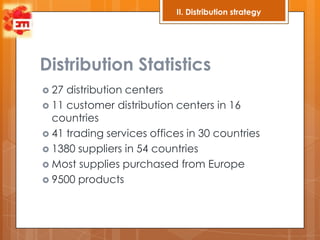
Distribution Statistics
 27 distribution centers
 11 customer distribution centers in 16
  countries
 41 trading services offices in 30 countries
 1380 suppliers in 54 countries
 Most supplies purchased from Europe
 9500 products
II. Distribution strategy


Success Factors
   Sourcing materials close to the supply chain
    to reduce transport costs
   Building DCs closer to seaports so that it can
    use more of ocean transport and less of road
    transport
   Delivering products directly from the supplier
    to IKEA stores to cut handling cost, reduce
    road miles and lower the carbon footprint
   Warehouse attached to retail stores
II. Distribution strategy


Success Factors
   Using flat packs: reduce costs through
    reduced transportation expenses, lowered
    storage space requirements, decreased
    transportation damage and reductions in
    labor costs
   Transporting goods where possible by rail and
    sea
   Utilizing fuel-saving techniques that allows to
    be cost-effective and environmentally friendly
II. Distribution strategy


Success Factors
   Implementing JDA supply chain management tools
       JDA Demand
       JDA fulfillment
   Advantages:
       Consolidated suppliers base, helps focus on low cost
        suppliers
       Improved forecast accuracy to drive profits
       Cost saving due to long term commitments achieved
        from near accurate forecasts
       Increased overall supply chain visibility
       Better coordination in sales, capacity and distribution
III. IKEA in India: 3 possible
                                     strategies


Foray into India
 On 21st January 2013, India’s Foreign
 Investment Promotion Board (FIPB)
 provided its clearance to IKEA to invest in
 India

 Ikea
     plans to open 25 stores, investing
 about €1.5 billion over the next 15 to 20
 years
III. IKEA in India: 3 possible
                                                       strategies


Distribution Challenges in India
Infrastructure


Low % of car ownership & No “DIY” culture


Low Home and Design expenditure


Competitors with very low prices


No brand awareness


Sourcing strategy


Legislative and social aspects


Scandinavian design too plain
III. IKEA in India: 3 possible
                               strategies


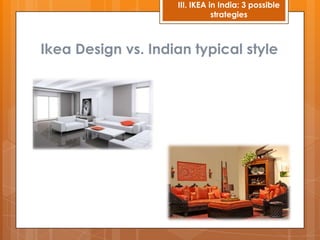
Ikea Design vs. Indian typical style
III. IKEA in India: 3 possible
                                               strategies


Plan A
Leverage the Global Production & Distribution
Network
 Pros
       Already established: no initial setup costs
       Reliable
       Consistency of Quality
   Cons
       Costly
       Decreased viability in the long run
       Legislative constraints
III. IKEA in India: 3 possible
                                                         strategies

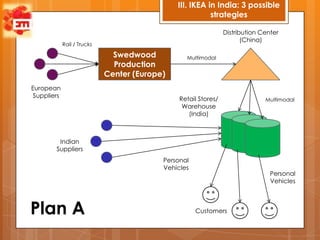
                                                                Distribution Center
                                                                       (China)
            Rail / Trucks

                              Swedwood           Multimodal
                              Production
                            Center (Europe)
European
Suppliers
                                               Retail Stores/                 Multimodal
                                                Warehouse
                                                  (India)


        Indian
       Suppliers
                                          Personal
                                          Vehicles
                                                                                Personal
                                                                                Vehicles


Plan A                                               Customers
III. IKEA in India: 3 possible
                                        strategies


Plan B
Setup a Production & Distribution center in
India
 Pros
     Easy to meet local demand
     Better coverage possible
     Will create jobs for locals
 Cons
     Huge initial time and cost
     Infrastructure can be a hindrance
III. IKEA in India: 3 possible
                                                   strategies

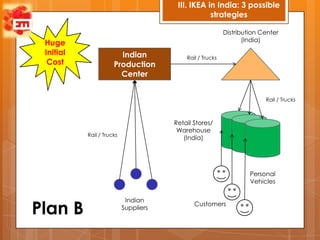
                                                           Distribution Center
                                                                  (India)
 Huge
 Initial                Indian             Rail / Trucks
  Cost                Production
                        Center


                                                                         Rail / Trucks


                                       Retail Stores/
                                        Warehouse
           Rail / Trucks
                                          (India)


                                                                    Personal
                                                                    Vehicles


                            Indian
Plan B                     Suppliers
                                              Customers
III. IKEA in India: 3 possible
                                             strategies


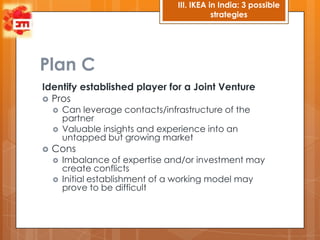
Plan C
Identify established player for a Joint Venture
 Pros
       Can leverage contacts/infrastructure of the
        partner
       Valuable insights and experience into an
        untapped but growing market
   Cons
       Imbalance of expertise and/or investment may
        create conflicts
       Initial establishment of a working model may
        prove to be difficult
III. IKEA in India: 3 possible
                                                               strategies

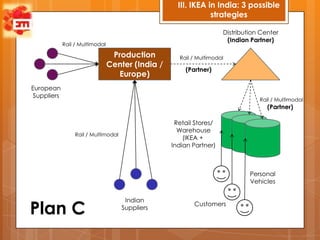
                                                                    Distribution Center
                                                                     (Indian Partner)
            Rail / Multimodal

                                 Production         Rail / Multimodal
                                Center (India /
                                                      (Partner)
                                   Europe)
European
Suppliers
                                                                                Rail / Multimodal
                                                                                   (Partner)

                                                   Retail Stores/
                                                    Warehouse
                Rail / Multimodal
                                                      (IKEA +
                                                  Indian Partner)


                                                                             Personal
                                                                             Vehicles


                                     Indian
Plan C                              Suppliers
                                                         Customers
IV. Conclusion


Conclusion
 Our   distribution plan suggestion

 Exercising   patience

 Therefore, a well-developed strategic
 plan with both short-term and long-term
 goals is extremely important to finally be
 successful in a huge, diverse, and fast-
 growing country as India
REFERENCES


References
1.   TREBILCOCK Bob, "IKEA: Think global, act local for warehouse
     distribution", Modern Materials Handling, 25 August 2011
2.   SHARMA Amol, HANSEGARD Jens, “IKEA Says It Is Ready To
     Give India a Try”, The Wall Street Journal, 24 June 2012
3.   SHARMA Malavika, “IKEA India Plans Give Scant Reassurance
     to Foreigners”, Bloomberg, 10 January 2013
4.   ROY Rajesh, AHMED Rumman, “Indian Agency Clears IKEA's
     Proposal to Open Stores”, The Wall Street Journal, 21 January
     2013
5.   DAS Sohini, "Local players give thumbs up to IKEA's entry in
     India", Business Standard, 28 January 2013
6.   http://www.youtube.com/watch?v=11AehTPD-Vg
7.   http://franchisor.ikea.com/about.html
8.   http://www.swedwood.com/about-swedwood/
Thank you for your attention!

IKEA's Distribution Strategy in India

  • 1.
    IKEA’s plans to enter India International Distribution Nikhil Garg Lov Loothra Emilie Perrussel Anne-Laure Laclau
  • 2.
    SUMMARY Summary I. Presentation of the company II. IKEA’s General distribution strategy III. IKEA in India: 3 possible strategies  Plan A: Leverage the Global Production & Distribution Network  Plan B: Setup a Production & Distribution centre  Plan C: Identify established player for a Joint Venture IV. Suggestion V. Conclusion
  • 3.
    I. Presentation ofIKEA IKEA  Founded in Sweden (1943); HQ in Netherlands  Privately held, international home products company  Specialized in affordable self-assembly furniture  338 stores in 40 countries in 2012  € 27,5 billion turnover of which  80% made in Europe  15% made in the US  Only 5 % in Asia!
  • 4.
    I. Presentation ofIKEA The IKEA Vision  Offer well designed, functional home furnishing products  Low prices in order to ensure affordability by most people The IKEA VISION guides the way IKEA products are designed, manufactured, transported, sold and assembled
  • 5.
    II. Distribution strategy Hallmarksof IKEA’s Distribution Global Network Large Volumes Flat Packages Low Costs
  • 6.
    II. Distribution strategy DistributionStatistics  27 distribution centers  11 customer distribution centers in 16 countries  41 trading services offices in 30 countries  1380 suppliers in 54 countries  Most supplies purchased from Europe  9500 products
  • 7.
    II. Distribution strategy SuccessFactors  Sourcing materials close to the supply chain to reduce transport costs  Building DCs closer to seaports so that it can use more of ocean transport and less of road transport  Delivering products directly from the supplier to IKEA stores to cut handling cost, reduce road miles and lower the carbon footprint  Warehouse attached to retail stores
  • 8.
    II. Distribution strategy SuccessFactors  Using flat packs: reduce costs through reduced transportation expenses, lowered storage space requirements, decreased transportation damage and reductions in labor costs  Transporting goods where possible by rail and sea  Utilizing fuel-saving techniques that allows to be cost-effective and environmentally friendly
  • 9.
    II. Distribution strategy SuccessFactors  Implementing JDA supply chain management tools  JDA Demand  JDA fulfillment  Advantages:  Consolidated suppliers base, helps focus on low cost suppliers  Improved forecast accuracy to drive profits  Cost saving due to long term commitments achieved from near accurate forecasts  Increased overall supply chain visibility  Better coordination in sales, capacity and distribution
  • 10.
    III. IKEA inIndia: 3 possible strategies Foray into India  On 21st January 2013, India’s Foreign Investment Promotion Board (FIPB) provided its clearance to IKEA to invest in India  Ikea plans to open 25 stores, investing about €1.5 billion over the next 15 to 20 years
  • 11.
    III. IKEA inIndia: 3 possible strategies Distribution Challenges in India Infrastructure Low % of car ownership & No “DIY” culture Low Home and Design expenditure Competitors with very low prices No brand awareness Sourcing strategy Legislative and social aspects Scandinavian design too plain
  • 12.
    III. IKEA inIndia: 3 possible strategies Ikea Design vs. Indian typical style
  • 13.
    III. IKEA inIndia: 3 possible strategies Plan A Leverage the Global Production & Distribution Network  Pros  Already established: no initial setup costs  Reliable  Consistency of Quality  Cons  Costly  Decreased viability in the long run  Legislative constraints
  • 14.
    III. IKEA inIndia: 3 possible strategies Distribution Center (China) Rail / Trucks Swedwood Multimodal Production Center (Europe) European Suppliers Retail Stores/ Multimodal Warehouse (India) Indian Suppliers Personal Vehicles Personal Vehicles Plan A Customers
  • 15.
    III. IKEA inIndia: 3 possible strategies Plan B Setup a Production & Distribution center in India  Pros  Easy to meet local demand  Better coverage possible  Will create jobs for locals  Cons  Huge initial time and cost  Infrastructure can be a hindrance
  • 16.
    III. IKEA inIndia: 3 possible strategies Distribution Center (India) Huge Initial Indian Rail / Trucks Cost Production Center Rail / Trucks Retail Stores/ Warehouse Rail / Trucks (India) Personal Vehicles Indian Plan B Suppliers Customers
  • 17.
    III. IKEA inIndia: 3 possible strategies Plan C Identify established player for a Joint Venture  Pros  Can leverage contacts/infrastructure of the partner  Valuable insights and experience into an untapped but growing market  Cons  Imbalance of expertise and/or investment may create conflicts  Initial establishment of a working model may prove to be difficult
  • 18.
    III. IKEA inIndia: 3 possible strategies Distribution Center (Indian Partner) Rail / Multimodal Production Rail / Multimodal Center (India / (Partner) Europe) European Suppliers Rail / Multimodal (Partner) Retail Stores/ Warehouse Rail / Multimodal (IKEA + Indian Partner) Personal Vehicles Indian Plan C Suppliers Customers
  • 19.
    IV. Conclusion Conclusion  Our distribution plan suggestion  Exercising patience  Therefore, a well-developed strategic plan with both short-term and long-term goals is extremely important to finally be successful in a huge, diverse, and fast- growing country as India
  • 20.
    REFERENCES References 1. TREBILCOCK Bob, "IKEA: Think global, act local for warehouse distribution", Modern Materials Handling, 25 August 2011 2. SHARMA Amol, HANSEGARD Jens, “IKEA Says It Is Ready To Give India a Try”, The Wall Street Journal, 24 June 2012 3. SHARMA Malavika, “IKEA India Plans Give Scant Reassurance to Foreigners”, Bloomberg, 10 January 2013 4. ROY Rajesh, AHMED Rumman, “Indian Agency Clears IKEA's Proposal to Open Stores”, The Wall Street Journal, 21 January 2013 5. DAS Sohini, "Local players give thumbs up to IKEA's entry in India", Business Standard, 28 January 2013 6. http://www.youtube.com/watch?v=11AehTPD-Vg 7. http://franchisor.ikea.com/about.html 8. http://www.swedwood.com/about-swedwood/
  • 21.
    Thank you foryour attention!

Editor's Notes

  • #14 Challenges:Indian FDI law mandates to source 30 per cent material locally.High cost in transportation in India:Increasing Fuel prices shoots the road transport cost very highTraditional rail road transport not reliableFew sea ports restricted to few states only
  • #16 Challenges in India:Stores Likely to be 350,000 square feet (costly with the increasing real estate cost in Metros)No single mall in India with this spaceLarge bays required for unloading and loading of furniture, Not present in any existing facility in IndiaIKEA energy regulations:Goal to achieve 100 per cent renewable energy run storesWind turbineSolar powerIKEA Goes RenewablePermission to open stores with IKEA restaurants and café inside not granted in IndiaChallenge to change the format as rest all 300 stores have a café or a restaurant
  • #18 Existing Furniture Retail Chains in India ( that can serve both as a competition or a partner)1- Pantaloons Retail (Brands:Hometown, Furniture Bazar, Collection-i)                       -small area                       -NO internet presence as such, not much retail through websites                       -Located in Malls and no dedicated stores                       -Do not deal in ready to assemble furniture2- Godrej Intero (India's largest furniture retail chain)                       -100 times smaller than IKEA                       -Wide Distribution network through local retail stores3-TATA Group (Brands:Lifestyle, Westside, Landmark, Croma, Titian)                       -Strong public image                       -No presence in furniture retail4- Reliance Group (Brands:Reliance Fresh) -Recently venture in the retail with plans to invest $6.67 Billion -