Sr.No Content
1 Introduction
2 Vision, Mission and Objective
3 User Interface
4 Products
5 Security
6 Payment Method
7 Delivery Method
8 Supply Chain
9 Marketing Strategy
10 Promotional Strategy
11 Acquisition
12 SWOT
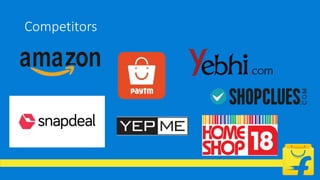
13 Competitor
14 Success of Flipkart
15 Future Aspect
16 Conclusion
Introduction
• Flipkart is an Indian e-commerce company headquartered in
Bangalore, Karnataka.
• It was founded by two IIT graduates (Sachin Bansal and Binny Bansal)
in 2007.
• In the initial years, Flipkart focuses on online sale of books.
• Added other products like electronic goods and a variety of other
products.
• Flipkart is the first company to introduce cash on delivery payment
system.
Vision, Mission and Objectives
• Vision
• “To become Amazon of India”
• Mission
• “Providing a delightful and memorable customer experience”
• Objectives
• “Completely hassle free shopping experience with best prices in
India”.
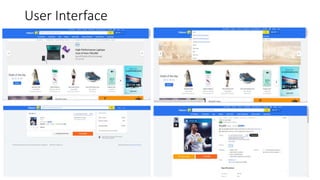
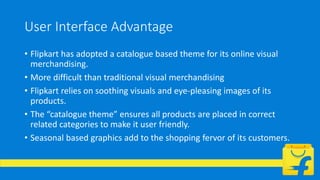
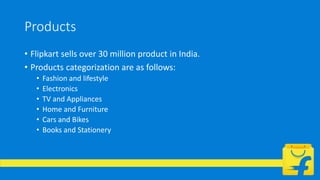
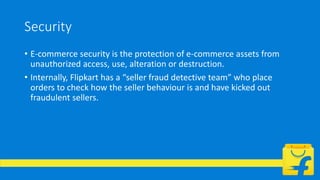
User Interface
User Interface Advantage
• Flipkart has adopted a catalogue based theme for its online visual
merchandising.
• More difficult than traditional visual merchandising
• Flipkart relies on soothing visuals and eye-pleasing images of its
products.
• The “catalogue theme” ensures all products are placed in correct
related categories to make it user friendly.
• Seasonal based graphics add to the shopping fervor of its customers.
Products
• Flipkart sells over 30 million product in India.
• Products categorization are as follows:
• Fashion and lifestyle
• Electronics
• TV and Appliances
• Home and Furniture
• Cars and Bikes
• Books and Stationery
Security
• E-commerce security is the protection of e-commerce assets from
unauthorized access, use, alteration or destruction.
• Internally, Flipkart has a “seller fraud detective team” who place
orders to check how the seller behaviour is and have kicked out
fraudulent sellers.
Payment Method
• Online Banking (Debit/Credit Cards)
• E Gift Voucher
• COD - Maximum order value is Rs. 50000/-
• EMI Option for American Express, Citi Bank, HDFC, ICICI.
Delivery Method
• Flipkart is one company which has launched its own courier service
“eKart”
• Currently eKart offers 3 tiers of service to its customers.
• Express Delivery: Also called as NDD, Next Day Delivery.
• Economy Tier : Where shipments are transported through surface
transport.
• Regular Tier: Which ever is the best mode of transport considering
cost & supply chain capacity utilization.
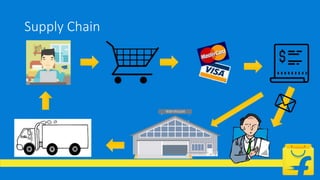
Supply Chain
Marketing Strategy
• Mostly marketed by word of mouth advertising.
• Advertisements are comparatively rarer.
• “Customer experience delight” has been their best marketing
strength.
• Very wisely used SEO (search engine optimization) and google ad-
words as the marketing tools to have a far reach in the online world.
• Flipkart.com official face book page has 7 million plus ‘likes’. Its
twitter page has 2 million plus followers
Promotional Strategies
• “Big Billion Day” Offer
• Exclusive Product Launch
• “Flipkart First”
• Social Media Marketing
• Advertisements
• E-Vouchers and Gift Coupons
• “Festive Season Sale” Offer
ADD VIDEO
Acquisition
• 2012: Letsbuy.com, an Indian e-retailer in electronics. Flipkart has
bought the company for an estimated US$25 million.Letsbuy.com was
closed down and all traffic to Letsbuy has been diverted to Flipkart.
• 2014: Acquired Myntra.com in an estimated US $310 million deal.
• 2016: Flipkart’s Myntra acquires rival fashion shopping site Jabong for
$70 million.
• 2016: In April, Flipkart acquired payment start-up PhonePe.
• 2017 : In July, Flipkart offered Snapdeal a amount of $700-$800 million
dollar, but Snapdeal rejected its deal as they wanted a sum of
minimum $1billion cash
SWOT
Competitors
Success of Flipkart
• Great customer service
• Easy to use website
• Hassle free payment system
• Convenient modes of payment
• Keen focus on user experience
Future Aspect
• Project ‘MIRA’
• Providing sponsorship (IPL 9, Pro-Kabaddi League)
• Investment of $2 billion in logistics and another $500 million in a
nationwide warehouse network.
• Cost cutting on packaging.
• The automated state-of-the-art fulfilment center.
• Investment in startup (Ather Electric Scooter Maker, Touch Talent,
News in Short)
• Looking at opening 80 to 100 warehouses across the country.
Conclusion
• Every time they require to update internal structure and innovative
management system with sound data base to provide end to end
connectivity with all suppliers, customers and partners effectively.
• Online retail industry are booming up in India. We may see many
more ecommerce companies achieving similar success.
Thank You!!

Flipkart

  • 2.
    Sr.No Content 1 Introduction 2Vision, Mission and Objective 3 User Interface 4 Products 5 Security 6 Payment Method 7 Delivery Method 8 Supply Chain 9 Marketing Strategy 10 Promotional Strategy 11 Acquisition 12 SWOT 13 Competitor 14 Success of Flipkart 15 Future Aspect 16 Conclusion
  • 3.
    Introduction • Flipkart isan Indian e-commerce company headquartered in Bangalore, Karnataka. • It was founded by two IIT graduates (Sachin Bansal and Binny Bansal) in 2007. • In the initial years, Flipkart focuses on online sale of books. • Added other products like electronic goods and a variety of other products. • Flipkart is the first company to introduce cash on delivery payment system.
  • 4.
    Vision, Mission andObjectives • Vision • “To become Amazon of India” • Mission • “Providing a delightful and memorable customer experience” • Objectives • “Completely hassle free shopping experience with best prices in India”.
  • 5.
  • 6.
    User Interface Advantage •Flipkart has adopted a catalogue based theme for its online visual merchandising. • More difficult than traditional visual merchandising • Flipkart relies on soothing visuals and eye-pleasing images of its products. • The “catalogue theme” ensures all products are placed in correct related categories to make it user friendly. • Seasonal based graphics add to the shopping fervor of its customers.
  • 7.
    Products • Flipkart sellsover 30 million product in India. • Products categorization are as follows: • Fashion and lifestyle • Electronics • TV and Appliances • Home and Furniture • Cars and Bikes • Books and Stationery
  • 8.
    Security • E-commerce securityis the protection of e-commerce assets from unauthorized access, use, alteration or destruction. • Internally, Flipkart has a “seller fraud detective team” who place orders to check how the seller behaviour is and have kicked out fraudulent sellers.
  • 9.
    Payment Method • OnlineBanking (Debit/Credit Cards) • E Gift Voucher • COD - Maximum order value is Rs. 50000/- • EMI Option for American Express, Citi Bank, HDFC, ICICI.
  • 10.
    Delivery Method • Flipkartis one company which has launched its own courier service “eKart” • Currently eKart offers 3 tiers of service to its customers. • Express Delivery: Also called as NDD, Next Day Delivery. • Economy Tier : Where shipments are transported through surface transport. • Regular Tier: Which ever is the best mode of transport considering cost & supply chain capacity utilization.
  • 11.
  • 12.
    Marketing Strategy • Mostlymarketed by word of mouth advertising. • Advertisements are comparatively rarer. • “Customer experience delight” has been their best marketing strength. • Very wisely used SEO (search engine optimization) and google ad- words as the marketing tools to have a far reach in the online world. • Flipkart.com official face book page has 7 million plus ‘likes’. Its twitter page has 2 million plus followers
  • 13.
    Promotional Strategies • “BigBillion Day” Offer • Exclusive Product Launch • “Flipkart First” • Social Media Marketing • Advertisements • E-Vouchers and Gift Coupons • “Festive Season Sale” Offer
  • 14.
  • 15.
    Acquisition • 2012: Letsbuy.com,an Indian e-retailer in electronics. Flipkart has bought the company for an estimated US$25 million.Letsbuy.com was closed down and all traffic to Letsbuy has been diverted to Flipkart. • 2014: Acquired Myntra.com in an estimated US $310 million deal. • 2016: Flipkart’s Myntra acquires rival fashion shopping site Jabong for $70 million. • 2016: In April, Flipkart acquired payment start-up PhonePe. • 2017 : In July, Flipkart offered Snapdeal a amount of $700-$800 million dollar, but Snapdeal rejected its deal as they wanted a sum of minimum $1billion cash
  • 16.
  • 17.
  • 18.
    Success of Flipkart •Great customer service • Easy to use website • Hassle free payment system • Convenient modes of payment • Keen focus on user experience
  • 19.
    Future Aspect • Project‘MIRA’ • Providing sponsorship (IPL 9, Pro-Kabaddi League) • Investment of $2 billion in logistics and another $500 million in a nationwide warehouse network. • Cost cutting on packaging. • The automated state-of-the-art fulfilment center. • Investment in startup (Ather Electric Scooter Maker, Touch Talent, News in Short) • Looking at opening 80 to 100 warehouses across the country.
  • 20.
    Conclusion • Every timethey require to update internal structure and innovative management system with sound data base to provide end to end connectivity with all suppliers, customers and partners effectively. • Online retail industry are booming up in India. We may see many more ecommerce companies achieving similar success.
  • 21.