Tips on using my ppt.
1. You can freely download, edit, modify and put your
name etc.
2. Don’t be concerned about number of slides. Half the
slides are blanks except for the title.
3. First show the blank slides (eg. Aetiology ) > Ask
students what they already know about ethology of
today's topic. > Then show next slide which enumerates
aetiologies.
4. At the end rerun the show – show blank> ask questions >
show next slide.
5. This will be an ACTIVE LEARNING SESSION x
three revisions.
6. Good for self study also.
7. See notes for bibliography.
Format
Format
1. Introduction & History
2. Relevant Anatomy, Physiology
3. Aetiology
4. Pathophysiology
5. Pathology
6. Classification
7. Clinical Features
8. Investigations
9. Management
10.Prevention
Fistula in Ano
Fistula in Ano
• Fistula is an abnormal communication
between two epithelized surfaces.
• A fistula-in-ano is an abnormal tract or
cavity with an external opening in the
perianal area that is communicating with the
rectum or anal canal by an identifiable
internal opening.
Anatomy
Anatomy
• Hollow tract or cavity.
• Primary opening inside the anal canal.
• Secondary opening in the perianal skin.
• secondary tracts may be multiple and can
extend from the same primary opening.
• Tract lined with granulation tissue.
Etiology and Pathophysiology
• Most fistulas are thought to arise as a result
of cryptoglandular infection with resultant
perirectal abscess.
• there are eight to 10 anal crypt glands at the
level of the dentate line in the anal canal,
arranged circumferentially.
• These glands penetrate the internal
sphincter and end in the intersphincteric
plane.
Etiology and Pathophysiology
• The cryptoglandular hypothesis states that
an infection begins in the anal canal glands
and progresses into the muscular wall of the
anal sphincters to cause an anorectal
abscess.
• The abscess represents the acute
inflammatory event, whereas the fistula is
representative of the chronic process.
Etiology and Pathophysiology
• After surgical or spontaneous drainage in
the perianal skin, a granulation tissue–lined
tract is occasionally left behind, causing
recurrent symptoms.
Etiology
Other fistulas develop secondary to-
• trauma (eg, rectal foreign bodies),
• Crohn disease,
• anal fissures,
• Carcinoma
• radiation therapy
• Actinomycoses
• Tuberculosis
• lymphogranuloma venereum
Clinical Features
Clinical Features
• Demography
• Symptoms
• Signs
• Prognosis
• Complications
Demography
Demography
• The incidence of a fistula-in-ano
developing from an anal abscess ranges
from 26% to 38%
• prevalence of fistula-in-ano is 8.6 cases per
100,000 population.
• The mean patient age is 38.3 years.
• The male-to-female ratio is 1.8:1.
History
Important points-
• Inflammatory bowel disease
• Diverticulitis
• Previous radiation therapy for prostate or
rectal cancer
• Tuberculosis
• Steroid therapy
• HIV infection
History
• A review of other systems
• Abdominal pain
• Weight loss
• Change in bowel habits
Symptoms
Symptoms
• Symptoms generally affect quality of life
significantly,
• Range from minor discomfort and drainage
with resultant hygienic problems to sepsis.
• history of previous pain, swelling, and
spontaneous or planned surgical drainage of
an anorectal abscess.
Symptoms
• Perianal discharge
• Pain
• Swelling
• Bleeding
• Diarrhea
• Skin excoriation
• External opening
Signs
Signs
• Physical findings are the mainstay of
diagnosis.
• external opening
– open sinus
– elevation of granulation tissue.
– Spontaneous discharge of pus or blood via the
external opening may be apparent or
expressible on digital rectal examination.
Digital rectal examination (DRE)
• fibrous tract or cord beneath the skin.
• It also helps to delineate any further acute
inflammation that is not yet drained.
• Lateral or posterior induration suggests
deep postanal or ischiorectal extension.
Goodsall Rule
Goodsall Rule
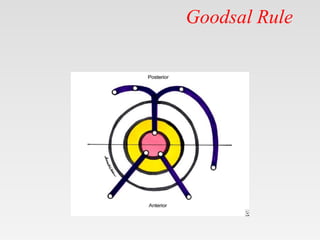
• In simple cases, the Goodsall rule can help
to anticipate the anatomy of a fistula-in-ano.
The rule states that fistulas with an external
opening anterior to a plane passing
transversely through the center of the anus
will follow a straight radial course to the
dentate line
Goodsall Rule
• . Fistulas with their openings posterior to
this line will follow a curved course to the
posterior midline (see image below).
Exceptions to this rule are external openings
more than 3cm from the anal verge. These
almost always originate as a primary or
secondary tract from the posterior midline,
consistent with a previous horseshoe
abscess
Goodsal Rule
Classification
Classification
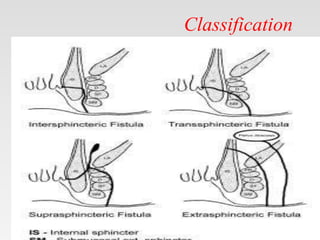
Parks Classification –
• intersphincteric,
• transsphincteric,
• suprasphincteric,
• extrasphincteric.
Classification
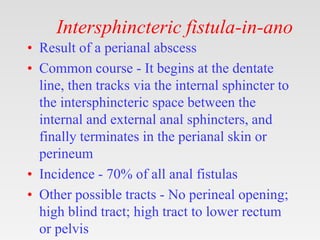
Intersphincteric fistula-in-ano
• Result of a perianal abscess
• Common course - It begins at the dentate
line, then tracks via the internal sphincter to
the intersphincteric space between the
internal and external anal sphincters, and
finally terminates in the perianal skin or
perineum
• Incidence - 70% of all anal fistulas
• Other possible tracts - No perineal opening;
high blind tract; high tract to lower rectum
or pelvis
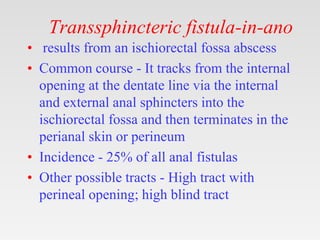
Transsphincteric fistula-in-ano
• results from an ischiorectal fossa abscess
• Common course - It tracks from the internal
opening at the dentate line via the internal
and external anal sphincters into the
ischiorectal fossa and then terminates in the
perianal skin or perineum
• Incidence - 25% of all anal fistulas
• Other possible tracts - High tract with
perineal opening; high blind tract
Suprasphincteric fistula-in-ano
• Arises from a supralevator abscess
• Course - internal opening at the dentate line
to the intersphincteric space, tracks
superiorly to above the puborectalis, and
then curves downward lateral to the external
anal sphincter into the ischiorectal fossa and
finally to the perianal skin or perineum
• Incidence - 5% percent of all anal fistulas
• Other possible tracts - High blind tract (ie,
palpable through rectal wall above dentate
line)
Extrasphincteric fistula-in-ano
• May arise from foreign body penetration of
the rectum with drainage through the
levators,
• Penetrating injury to the perineum
• Crohn disease
• Carcinoma or its treatment
• Pelvic inflammatory disease
Extrasphincteric fistula-in-ano
• Common course - It runs from the perianal
skin via the ischiorectal fossa, tracking
upward and through the levator ani muscles
to the rectal wall, completely outside the
sphincter mechanism, with or without a
connection to the dentate line
• Incidence - 1% of all anal fistulas
Current procedural terminology
coding
• Subcutaneous
• Submuscular (intersphincteric, low
transsphincteric)
• Complex, recurrent (high transsphincteric,
suprasphincteric and extrasphincteric,
multiple tracts, recurrent)
• Second stage
Dfferential
Dfferential
• Hidradenitis suppurativa
• Infected inclusion cysts
• Pilonidal disease
• Bartholin gland abscess in females
Investigations
• Laboratory Studies
– Routine
– Special
• Imaging Studies
• Tissue diagnosis
– Cytology
• FNAC
– Histology
Diagnostic Studies
Diagnostic Studies
Imaging Studies
• X-Ray
• USG
• CT
• Angiography
• MRI
• Endoscopy
• Nuclear scan
Diagnostic Studies
• Fistulography
• Endoanal Sonography
• MRI
• CT
• Barium meal /Enema
• Anal Manometry
Anal Manometry
•
Anal Manometry
• Patients in whom decreased tone is
observed during preoperative evaluation
• Patients with a history of previous
fistulotomy
• Patients with a history of obstetrical trauma
• Patients with a high transsphincteric or
suprasphincteric fistula (if known)
• Very elderly patients
•
Diagnostic Studies
Diagnostic Studies
• Examination under anesthesia
– Examination of the perineum,
– digital rectal examination (DRE),
– Anoscopy
• Proctosigmoidoscopy/colonoscopy
Treatment
• No definitive medical therapy
• long-term antibiotic prophylaxis and
infliximab may have a role in recurrent
fistulas in patients with Crohn disease.
Treatment
• .
Treatment
• Surgery is the treatment of choice
• Goals-
– draining infection
– eradicating the fistulous tract
– avoiding persistent or recurrent disease
– preserving anal sphincter function
Operative Therapy
• Fistulotomy
• Seton Placement
• Mucosal Advancement Flap
• Plugs and Adhesives
• Ligation of the intersphincteric fistula tract
(LIFT)
• VAAFT Video-assisted anal fistula
treatment
• SLOFT –Submmucosal Ligation Of Fistula
Trract.
Get this ppt in mobile
1. Download Microsoft
PowerPoint from play
store.
2. Open Google assistant
3. Open Google lens.
4. Scan qr code from
next slide.
Get my ppt collection
• https://www.slideshare.net/drpradeeppande/
edit_my_uploads
• https://www.dropbox.com/sh/x600md3cvj8
5woy/AACVMHuQtvHvl_K8ehc3ltkEa?dl
=0
• https://www.facebook.com/doctorpradeeppa
nde/?ref=pages_you_manage

Fistual in Ano.pptx

  • 1.
    Tips on usingmy ppt. 1. You can freely download, edit, modify and put your name etc. 2. Don’t be concerned about number of slides. Half the slides are blanks except for the title. 3. First show the blank slides (eg. Aetiology ) > Ask students what they already know about ethology of today's topic. > Then show next slide which enumerates aetiologies. 4. At the end rerun the show – show blank> ask questions > show next slide. 5. This will be an ACTIVE LEARNING SESSION x three revisions. 6. Good for self study also. 7. See notes for bibliography.
  • 2.
  • 3.
    Format 1. Introduction &History 2. Relevant Anatomy, Physiology 3. Aetiology 4. Pathophysiology 5. Pathology 6. Classification 7. Clinical Features 8. Investigations 9. Management 10.Prevention
  • 4.
  • 5.
    Fistula in Ano •Fistula is an abnormal communication between two epithelized surfaces. • A fistula-in-ano is an abnormal tract or cavity with an external opening in the perianal area that is communicating with the rectum or anal canal by an identifiable internal opening.
  • 6.
  • 7.
    Anatomy • Hollow tractor cavity. • Primary opening inside the anal canal. • Secondary opening in the perianal skin. • secondary tracts may be multiple and can extend from the same primary opening. • Tract lined with granulation tissue.
  • 8.
  • 9.
    Etiology and Pathophysiology •Most fistulas are thought to arise as a result of cryptoglandular infection with resultant perirectal abscess. • there are eight to 10 anal crypt glands at the level of the dentate line in the anal canal, arranged circumferentially. • These glands penetrate the internal sphincter and end in the intersphincteric plane.
  • 10.
    Etiology and Pathophysiology •The cryptoglandular hypothesis states that an infection begins in the anal canal glands and progresses into the muscular wall of the anal sphincters to cause an anorectal abscess. • The abscess represents the acute inflammatory event, whereas the fistula is representative of the chronic process.
  • 11.
    Etiology and Pathophysiology •After surgical or spontaneous drainage in the perianal skin, a granulation tissue–lined tract is occasionally left behind, causing recurrent symptoms.
  • 12.
    Etiology Other fistulas developsecondary to- • trauma (eg, rectal foreign bodies), • Crohn disease, • anal fissures, • Carcinoma • radiation therapy • Actinomycoses • Tuberculosis • lymphogranuloma venereum
  • 13.
  • 14.
    Clinical Features • Demography •Symptoms • Signs • Prognosis • Complications
  • 15.
  • 16.
    Demography • The incidenceof a fistula-in-ano developing from an anal abscess ranges from 26% to 38% • prevalence of fistula-in-ano is 8.6 cases per 100,000 population. • The mean patient age is 38.3 years. • The male-to-female ratio is 1.8:1.
  • 17.
    History Important points- • Inflammatorybowel disease • Diverticulitis • Previous radiation therapy for prostate or rectal cancer • Tuberculosis • Steroid therapy • HIV infection
  • 18.
    History • A reviewof other systems • Abdominal pain • Weight loss • Change in bowel habits
  • 19.
  • 20.
    Symptoms • Symptoms generallyaffect quality of life significantly, • Range from minor discomfort and drainage with resultant hygienic problems to sepsis. • history of previous pain, swelling, and spontaneous or planned surgical drainage of an anorectal abscess.
  • 21.
    Symptoms • Perianal discharge •Pain • Swelling • Bleeding • Diarrhea • Skin excoriation • External opening
  • 22.
  • 23.
    Signs • Physical findingsare the mainstay of diagnosis. • external opening – open sinus – elevation of granulation tissue. – Spontaneous discharge of pus or blood via the external opening may be apparent or expressible on digital rectal examination.
  • 24.
  • 25.
    Digital rectal examination(DRE) • fibrous tract or cord beneath the skin. • It also helps to delineate any further acute inflammation that is not yet drained. • Lateral or posterior induration suggests deep postanal or ischiorectal extension.
  • 26.
  • 27.
    Goodsall Rule • Insimple cases, the Goodsall rule can help to anticipate the anatomy of a fistula-in-ano. The rule states that fistulas with an external opening anterior to a plane passing transversely through the center of the anus will follow a straight radial course to the dentate line
  • 28.
    Goodsall Rule • .Fistulas with their openings posterior to this line will follow a curved course to the posterior midline (see image below). Exceptions to this rule are external openings more than 3cm from the anal verge. These almost always originate as a primary or secondary tract from the posterior midline, consistent with a previous horseshoe abscess
  • 29.
  • 30.
  • 31.
    Classification Parks Classification – •intersphincteric, • transsphincteric, • suprasphincteric, • extrasphincteric.
  • 32.
  • 33.
    Intersphincteric fistula-in-ano • Resultof a perianal abscess • Common course - It begins at the dentate line, then tracks via the internal sphincter to the intersphincteric space between the internal and external anal sphincters, and finally terminates in the perianal skin or perineum • Incidence - 70% of all anal fistulas • Other possible tracts - No perineal opening; high blind tract; high tract to lower rectum or pelvis
  • 34.
    Transsphincteric fistula-in-ano • resultsfrom an ischiorectal fossa abscess • Common course - It tracks from the internal opening at the dentate line via the internal and external anal sphincters into the ischiorectal fossa and then terminates in the perianal skin or perineum • Incidence - 25% of all anal fistulas • Other possible tracts - High tract with perineal opening; high blind tract
  • 35.
    Suprasphincteric fistula-in-ano • Arisesfrom a supralevator abscess • Course - internal opening at the dentate line to the intersphincteric space, tracks superiorly to above the puborectalis, and then curves downward lateral to the external anal sphincter into the ischiorectal fossa and finally to the perianal skin or perineum • Incidence - 5% percent of all anal fistulas • Other possible tracts - High blind tract (ie, palpable through rectal wall above dentate line)
  • 36.
    Extrasphincteric fistula-in-ano • Mayarise from foreign body penetration of the rectum with drainage through the levators, • Penetrating injury to the perineum • Crohn disease • Carcinoma or its treatment • Pelvic inflammatory disease
  • 37.
    Extrasphincteric fistula-in-ano • Commoncourse - It runs from the perianal skin via the ischiorectal fossa, tracking upward and through the levator ani muscles to the rectal wall, completely outside the sphincter mechanism, with or without a connection to the dentate line • Incidence - 1% of all anal fistulas
  • 38.
    Current procedural terminology coding •Subcutaneous • Submuscular (intersphincteric, low transsphincteric) • Complex, recurrent (high transsphincteric, suprasphincteric and extrasphincteric, multiple tracts, recurrent) • Second stage
  • 39.
  • 40.
    Dfferential • Hidradenitis suppurativa •Infected inclusion cysts • Pilonidal disease • Bartholin gland abscess in females
  • 41.
    Investigations • Laboratory Studies –Routine – Special • Imaging Studies • Tissue diagnosis – Cytology • FNAC – Histology
  • 42.
  • 43.
    Diagnostic Studies Imaging Studies •X-Ray • USG • CT • Angiography • MRI • Endoscopy • Nuclear scan
  • 44.
    Diagnostic Studies • Fistulography •Endoanal Sonography • MRI • CT • Barium meal /Enema • Anal Manometry
  • 45.
  • 46.
    Anal Manometry • Patientsin whom decreased tone is observed during preoperative evaluation • Patients with a history of previous fistulotomy • Patients with a history of obstetrical trauma • Patients with a high transsphincteric or suprasphincteric fistula (if known) • Very elderly patients •
  • 47.
  • 48.
    Diagnostic Studies • Examinationunder anesthesia – Examination of the perineum, – digital rectal examination (DRE), – Anoscopy • Proctosigmoidoscopy/colonoscopy
  • 49.
    Treatment • No definitivemedical therapy • long-term antibiotic prophylaxis and infliximab may have a role in recurrent fistulas in patients with Crohn disease.
  • 50.
  • 51.
    Treatment • Surgery isthe treatment of choice • Goals- – draining infection – eradicating the fistulous tract – avoiding persistent or recurrent disease – preserving anal sphincter function
  • 52.
    Operative Therapy • Fistulotomy •Seton Placement • Mucosal Advancement Flap • Plugs and Adhesives • Ligation of the intersphincteric fistula tract (LIFT) • VAAFT Video-assisted anal fistula treatment • SLOFT –Submmucosal Ligation Of Fistula Trract.
  • 53.
    Get this pptin mobile 1. Download Microsoft PowerPoint from play store. 2. Open Google assistant 3. Open Google lens. 4. Scan qr code from next slide.
  • 56.
    Get my pptcollection • https://www.slideshare.net/drpradeeppande/ edit_my_uploads • https://www.dropbox.com/sh/x600md3cvj8 5woy/AACVMHuQtvHvl_K8ehc3ltkEa?dl =0 • https://www.facebook.com/doctorpradeeppa nde/?ref=pages_you_manage

Editor's Notes

  • #5 https://emedicine.medscape.com/article/190234-overview
  • #6 https://emedicine.medscape.com/article/190234-overview
  • #7 https://emedicine.medscape.com/article/190234-overview
  • #8 https://emedicine.medscape.com/article/190234-overview
  • #56 drpradeeppande@gmail.com 7697305442