SURGERY
FISTULA IN ANAL (ANAL FISTLUE)
DR. CHONGO SHAPI (BSc. HB, MBChB)
FISTULA IN-ANO
Definition
-An anorectal fistula (Fistula-in-Ano) is an abnormal
communication between the anus and the perianal skin.
-It occurs as hollow tract lined with granulation tissue
connecting a primary opening inside the anal canal to a
secondary opening in the perianal skin.
-Secondary tracts may be multiple and from the same primary
opening.
Sex and Age
The male-to-female ratio approx. 2:1
The mean age of patients is 38 years.
Etiology:
-Fistula-in-ano is nearly always caused by a previous
anorectal abscess.
-Anal canal glands situated at the dentate line afford a path for
infecting organisms to reach the intramuscular spaces.
Other predisposing factors
1) Trauma
2) Crohn disease
3) Anal fissures
4) Anorectal Carcinoma
5) Radiation therapy
6) Infection -actinomycoses, tuberculosis, and
chlamydial infections.
7) Prolapsed internal hemorrhoid
8) Acute appendicitis, salpingitis, diverticulitis
9) Immunosuppression
10)
Pathophysiology:
The cryptoglandular hypothesis
The infection begins in cryptoglandular situated at the dentate
line in the anal canal and progresses into the muscular wall of
the anal sphincters to cause an anorectal abscess.
Following surgical or spontaneous drainage in the perianal
skin, occasionally a granulation tissue–lined tract is left
behind, forming the fistula in-ano which causes recurrent
symptoms.
Clinical presentation
History (in order of prevalence)
1) Perianal discharge-intermittent or constant
2) Perianal pain-worse during defecation, may be
constant
3) Swelling /lump in the perianal area
4) Bleeding in the perianal area
5) Diarrhea
6) Discoloration of skin surrounding the fistula
7) External opening in the perianal discharging
8) Fever
Past medical history
Important points in the history that may suggest a complex
fistula include the following:
-Inflammatory bowel disease
-Diverticulitis
-History of trauma
-Previous radiation therapy for prostate or rectal cancer
-Tuberculosis
-Immune suppression-Steroid therapy , HIV infection
Review of symptoms
-Abdominal pain
-Weight loss
-Change in bowel habits
Physical examination
Physical examination findings remain the mainstay of
diagnosis.
➢ The examiner should observe the entire
perineum
➢ external opening that appears as an open
sinus or elevation of granulation tissue
➢ Spontaneous discharge via the external
opening may be apparent or expressible
upon digital rectal examination.
DRE
➢ External Anal sphincter tone
➢ Tenderness on examaination
➢ Fibrous tract or cord beneath the skin.
➢ Bogginess-any abceses.
➢ Lateral or posterior induration suggests
deep postanal or ischiorectal extension.
Differential diagnoses
The following do not communicate with the anal
canal:
➢ Perianal abscess
➢ Urethroperineal fistulas
➢ Abceses-Ischiorectal abscess,Submucous
or high muscular abscess, Pelvirectal
abscess (rare)
➢ Crohn's disease
➢ Carcinoma
➢ Retrorectal tumors
➢ Hidradenitis suppurativa
➢ Infected inclusion cysts
➢ Pilonidal disease
➢ Bartholin gland abscess in females
The Goodsall Rule
Help to anticipate the anatomy of fistula-in-ano.
The rule states that fistulae with an external opening
anterior to a plane passing transversely through the
center of the anus will follow a straight radial course
to the dentate line. Fistulae with their openings
posterior to this line will follow a curved course to the
posterior midline.
Investigations
Lab Studies:
No specific laboratory studies are required; the
normal preoperative studies are performed based on
age and comorbidities.
Imaging Studies:
These are not performed for routine fistula evaluation.
They can be helpful when the primary opening is
difficult to identify or in the case of recurrent or
multiple fistulae to identify secondary tracts or missed
primary openings.
1.Fistulography
This involves injection of contrast via the internal
opening, which is followed by anteroposterior, lateral,
and oblique x-ray images to outline the course of the
fistula tract.
Classification of fistula in-ano
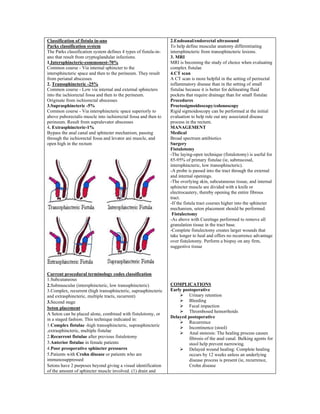
Parks classification system
The Parks classification system defines 4 types of fistula-in-
ano that result from cryptoglandular infections.
1.Intersphincteric-commonest-70%
Common course - Via internal sphincter to the
intersphincteric space and then to the perineum. They result
from perianal abscesses
2. Transsphincteric -25%
Common course - Low via internal and external sphincters
into the ischiorectal fossa and then to the perineum.
Originate from ischiorectal abscesses
3.Suprasphincteric -5%
Common course - Via intersphincteric space superiorly to
above puborectalis muscle into ischiorectal fossa and then to
perineum. Result from supralevator abscesses
4. Extrasphincteric-1%
Bypass the anal canal and sphincter mechanism, passing
through the ischiorectal fossa and levator ani muscle, and
open high in the rectum
1.
2.
3. Current procedural terminology codes classification
1.Subcutaneous
4. 2.Submuscular (intersphincteric, low transsphincteric)
3.Complex, recurrent (high transsphincteric, suprasphincteric
and extrasphincteric, multiple tracts, recurrent)
5. 3.Second stage
6. Seton placement
7. A Seton can be placed alone, combined with fistulotomy, or
in a staged fashion. This technique indicated in:
8. 1.Complex fistulae -high transsphincteric, suprasphincteric
,extrasphincteric, multiple fistulae
9. 2.Recurrent fistulae after previous fistulotomy
10. 3.Anterior fistulae in female patients
11. 4.Poor preoperative sphincter pressures
12. 5.Patients with Crohn disease or patients who are
immunosuppressed
13. Setons have 2 purposes beyond giving a visual identification
of the amount of sphincter muscle involved. (1) drain and
2.Endoanal/endorectal ultrasound
To help define muscular anatomy differentiating
intersphincteric from transsphincteric lesions.
3. MRI
MRI is becoming the study of choice when evaluating
complex fistulae
4.CT scan
A CT scan is more helpful in the setting of perirectal
inflammatory disease than in the setting of small
fistulae because it is better for delineating fluid
pockets that require drainage than for small fistulae
Procedures
Proctosigmoidoscopy/colonoscopy
Rigid sigmoidoscopy can be performed at the initial
evaluation to help rule out any associated disease
process in the rectum.
MANAGEMENT
Medical
Broad spectrum antibiotics
Surgery
Fistulotomy
-The laying-open technique (fistulotomy) is useful for
85-95% of primary fistulae (ie, submucosal,
intersphincteric, low transsphincteric).
-A probe is passed into the tract through the external
and internal openings.
-The overlying skin, subcutaneous tissue, and internal
sphincter muscle are divided with a knife or
electrocautery, thereby opening the entire fibrous
tract.
-If the fistula tract courses higher into the sphincter
mechanism, seton placement should be performed.
Fistulectomy
-As above with Curettage performed to remove all
granulation tissue in the tract base.
-Complete fistulectomy creates larger wounds that
take longer to heal and offers no recurrence advantage
over fistulotomy. Perform a biopsy on any firm,
suggestive tissue
COMPLICATIONS
Early postoperative
➢ Urinary retention
➢ Bleeding
➢ Fecal impaction
➢ Thrombosed hemorrhoids
Delayed postoperative
➢ Recurrence
➢ Incontinence (stool)
➢ Anal stenosis: The healing process causes
fibrosis of the anal canal. Bulking agents for
stool help prevent narrowing.
➢ Delayed wound healing: Complete healing
occurs by 12 weeks unless an underlying
disease process is present (ie, recurrence,
Crohn disease
promote fibrosis
14. (2) Cut through the fistula.
15. Setons can be made from large silk suture, silastic vessel
markers, or rubber bands that are threaded through the fistula
tract.
16. Procedure
17. -Pass the seton through the fistula tract around the deep
external sphincter after opening the skin, subcutaneous tissue,
internal sphincter muscle, and subcutaneous external
sphincter muscle.
18. -The seton is tightened down and secured with a separate silk
tie.
19. -With time, fibrosis occurs above the seton as it gradually cuts
through the sphincter muscles and essentially exteriorizes the
tract.
20. -The seton is tightened on subsequent office visits until it is
pulled through over 6-8 weeks.
21. In complex multiple fistula
22. -Colostomy may be fashioned
23. -Posterior Sagittal anorectoplasty done for multiple
fistulectomies
24. Preoperative details:
25. -Rectal irrigation with enemas should be performed on the
morning of the operation.
26. -Administer preoperative antibiotics.
27. -Prone jackknife position with buttocks apart is the most
advantageous position
28. Post-operative management
29. 1. Sitz baths, analgesics, and stool bulking agents (eg, bran,
psyllium products).
30. 2. Internal wound should not close prematurely, causing a
recurrent fistula.
31. Digital examination findings can help distinguish early
fibrosis.
32. 3.Wound healing usually occurs within 6 weeks
33.
FISTULA IN-ANO.pdf

FISTULA IN-ANO.pdf

  • 1.
    SURGERY FISTULA IN ANAL(ANAL FISTLUE) DR. CHONGO SHAPI (BSc. HB, MBChB)
  • 2.
    FISTULA IN-ANO Definition -An anorectalfistula (Fistula-in-Ano) is an abnormal communication between the anus and the perianal skin. -It occurs as hollow tract lined with granulation tissue connecting a primary opening inside the anal canal to a secondary opening in the perianal skin. -Secondary tracts may be multiple and from the same primary opening. Sex and Age The male-to-female ratio approx. 2:1 The mean age of patients is 38 years. Etiology: -Fistula-in-ano is nearly always caused by a previous anorectal abscess. -Anal canal glands situated at the dentate line afford a path for infecting organisms to reach the intramuscular spaces. Other predisposing factors 1) Trauma 2) Crohn disease 3) Anal fissures 4) Anorectal Carcinoma 5) Radiation therapy 6) Infection -actinomycoses, tuberculosis, and chlamydial infections. 7) Prolapsed internal hemorrhoid 8) Acute appendicitis, salpingitis, diverticulitis 9) Immunosuppression 10) Pathophysiology: The cryptoglandular hypothesis The infection begins in cryptoglandular situated at the dentate line in the anal canal and progresses into the muscular wall of the anal sphincters to cause an anorectal abscess. Following surgical or spontaneous drainage in the perianal skin, occasionally a granulation tissue–lined tract is left behind, forming the fistula in-ano which causes recurrent symptoms. Clinical presentation History (in order of prevalence) 1) Perianal discharge-intermittent or constant 2) Perianal pain-worse during defecation, may be constant 3) Swelling /lump in the perianal area 4) Bleeding in the perianal area 5) Diarrhea 6) Discoloration of skin surrounding the fistula 7) External opening in the perianal discharging 8) Fever Past medical history Important points in the history that may suggest a complex fistula include the following: -Inflammatory bowel disease -Diverticulitis -History of trauma -Previous radiation therapy for prostate or rectal cancer -Tuberculosis -Immune suppression-Steroid therapy , HIV infection Review of symptoms -Abdominal pain -Weight loss -Change in bowel habits Physical examination Physical examination findings remain the mainstay of diagnosis. ➢ The examiner should observe the entire perineum ➢ external opening that appears as an open sinus or elevation of granulation tissue ➢ Spontaneous discharge via the external opening may be apparent or expressible upon digital rectal examination. DRE ➢ External Anal sphincter tone ➢ Tenderness on examaination ➢ Fibrous tract or cord beneath the skin. ➢ Bogginess-any abceses. ➢ Lateral or posterior induration suggests deep postanal or ischiorectal extension. Differential diagnoses The following do not communicate with the anal canal: ➢ Perianal abscess ➢ Urethroperineal fistulas ➢ Abceses-Ischiorectal abscess,Submucous or high muscular abscess, Pelvirectal abscess (rare) ➢ Crohn's disease ➢ Carcinoma ➢ Retrorectal tumors ➢ Hidradenitis suppurativa ➢ Infected inclusion cysts ➢ Pilonidal disease ➢ Bartholin gland abscess in females The Goodsall Rule Help to anticipate the anatomy of fistula-in-ano. The rule states that fistulae with an external opening anterior to a plane passing transversely through the center of the anus will follow a straight radial course to the dentate line. Fistulae with their openings posterior to this line will follow a curved course to the posterior midline. Investigations Lab Studies: No specific laboratory studies are required; the normal preoperative studies are performed based on age and comorbidities. Imaging Studies: These are not performed for routine fistula evaluation. They can be helpful when the primary opening is difficult to identify or in the case of recurrent or multiple fistulae to identify secondary tracts or missed primary openings. 1.Fistulography This involves injection of contrast via the internal opening, which is followed by anteroposterior, lateral, and oblique x-ray images to outline the course of the fistula tract.
  • 3.
    Classification of fistulain-ano Parks classification system The Parks classification system defines 4 types of fistula-in- ano that result from cryptoglandular infections. 1.Intersphincteric-commonest-70% Common course - Via internal sphincter to the intersphincteric space and then to the perineum. They result from perianal abscesses 2. Transsphincteric -25% Common course - Low via internal and external sphincters into the ischiorectal fossa and then to the perineum. Originate from ischiorectal abscesses 3.Suprasphincteric -5% Common course - Via intersphincteric space superiorly to above puborectalis muscle into ischiorectal fossa and then to perineum. Result from supralevator abscesses 4. Extrasphincteric-1% Bypass the anal canal and sphincter mechanism, passing through the ischiorectal fossa and levator ani muscle, and open high in the rectum 1. 2. 3. Current procedural terminology codes classification 1.Subcutaneous 4. 2.Submuscular (intersphincteric, low transsphincteric) 3.Complex, recurrent (high transsphincteric, suprasphincteric and extrasphincteric, multiple tracts, recurrent) 5. 3.Second stage 6. Seton placement 7. A Seton can be placed alone, combined with fistulotomy, or in a staged fashion. This technique indicated in: 8. 1.Complex fistulae -high transsphincteric, suprasphincteric ,extrasphincteric, multiple fistulae 9. 2.Recurrent fistulae after previous fistulotomy 10. 3.Anterior fistulae in female patients 11. 4.Poor preoperative sphincter pressures 12. 5.Patients with Crohn disease or patients who are immunosuppressed 13. Setons have 2 purposes beyond giving a visual identification of the amount of sphincter muscle involved. (1) drain and 2.Endoanal/endorectal ultrasound To help define muscular anatomy differentiating intersphincteric from transsphincteric lesions. 3. MRI MRI is becoming the study of choice when evaluating complex fistulae 4.CT scan A CT scan is more helpful in the setting of perirectal inflammatory disease than in the setting of small fistulae because it is better for delineating fluid pockets that require drainage than for small fistulae Procedures Proctosigmoidoscopy/colonoscopy Rigid sigmoidoscopy can be performed at the initial evaluation to help rule out any associated disease process in the rectum. MANAGEMENT Medical Broad spectrum antibiotics Surgery Fistulotomy -The laying-open technique (fistulotomy) is useful for 85-95% of primary fistulae (ie, submucosal, intersphincteric, low transsphincteric). -A probe is passed into the tract through the external and internal openings. -The overlying skin, subcutaneous tissue, and internal sphincter muscle are divided with a knife or electrocautery, thereby opening the entire fibrous tract. -If the fistula tract courses higher into the sphincter mechanism, seton placement should be performed. Fistulectomy -As above with Curettage performed to remove all granulation tissue in the tract base. -Complete fistulectomy creates larger wounds that take longer to heal and offers no recurrence advantage over fistulotomy. Perform a biopsy on any firm, suggestive tissue COMPLICATIONS Early postoperative ➢ Urinary retention ➢ Bleeding ➢ Fecal impaction ➢ Thrombosed hemorrhoids Delayed postoperative ➢ Recurrence ➢ Incontinence (stool) ➢ Anal stenosis: The healing process causes fibrosis of the anal canal. Bulking agents for stool help prevent narrowing. ➢ Delayed wound healing: Complete healing occurs by 12 weeks unless an underlying disease process is present (ie, recurrence, Crohn disease
  • 4.
    promote fibrosis 14. (2)Cut through the fistula. 15. Setons can be made from large silk suture, silastic vessel markers, or rubber bands that are threaded through the fistula tract. 16. Procedure 17. -Pass the seton through the fistula tract around the deep external sphincter after opening the skin, subcutaneous tissue, internal sphincter muscle, and subcutaneous external sphincter muscle. 18. -The seton is tightened down and secured with a separate silk tie. 19. -With time, fibrosis occurs above the seton as it gradually cuts through the sphincter muscles and essentially exteriorizes the tract. 20. -The seton is tightened on subsequent office visits until it is pulled through over 6-8 weeks. 21. In complex multiple fistula 22. -Colostomy may be fashioned 23. -Posterior Sagittal anorectoplasty done for multiple fistulectomies 24. Preoperative details: 25. -Rectal irrigation with enemas should be performed on the morning of the operation. 26. -Administer preoperative antibiotics. 27. -Prone jackknife position with buttocks apart is the most advantageous position 28. Post-operative management 29. 1. Sitz baths, analgesics, and stool bulking agents (eg, bran, psyllium products). 30. 2. Internal wound should not close prematurely, causing a recurrent fistula. 31. Digital examination findings can help distinguish early fibrosis. 32. 3.Wound healing usually occurs within 6 weeks 33.