First Mile – Last Mile Connectivity
OCTOBER 21, 2015
MIAMI -DADE MPO - FISCAL PRIORITIES COMMITTEE
BACKGROUND
“Last and first mile” are terms used to describe the
difficulty in getting people to and from a transportation
hub
BACKGROUND
3
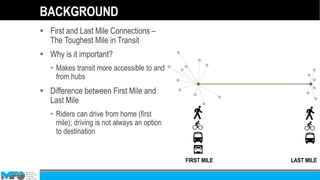
 First and Last Mile Connections –
The Toughest Mile in Transit
 Why is it important?
• Makes transit more accessible to and
from hubs
 Difference between First Mile and
Last Mile
• Riders can drive from home (first
mile); driving is not always an option
to destination
FIRST MILE LAST MILE
BACKGROUND
4
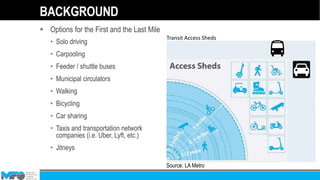
 Options for the First and the Last Mile
• Solo driving
• Carpooling
• Feeder / shuttle buses
• Municipal circulators
• Walking
• Bicycling
• Car sharing
• Taxis and transportation network
companies (i.e. Uber, Lyft, etc.)
• Jitneys
Source: LA Metro
Transit Access Sheds
EXISTING CONDITIONS – MODAL CATEGORIES
5
 Car access and egress
• Park-and-ride
• Carpooling and Vanpooling
• Kiss-and-ride
Factoids
• Nearly a third of Metrorail riders
access stations by car; only 6
percent use to destinations
• Taxis / shared cars reduce parking
demand and provide last-mile
connectivity
EXISTING CONDITIONS – MODAL CATEGORIES
6
 Transit access and egress
• Feeder services supply and
distribute passengers from trunk
routes
• Municipal circulators should extend
the reach of regional transit
network
• Employer provided van and shuttle
services bridge the gap (i.e. UM,
Baptist shuttles)
• Jitneys supplement bus
operations covering areas of low
demand
EXISTING CONDITIONS – MODAL CATEGORIES
7
 Non-motorized access and egress
• Pedestrian Facilities (walkways, canopy,
weather-protection)
• Bicycle Facilities – (i.e. racks, lockers,
sharing stations, etc.)
Factoids
• Nearly 95% of all Metrobus riders walk to
bus stops
• Nearly 1 in 3 riders walk to Metrorail
station; 2 in 3 walk from station to
destination
• Bicycle trips suitable for distances up to
three miles
• Walk trips suitable for distances up to half-
mile for premium transit
CHALLENGES – CAR ACCESS
8
 Capacity at park-and-rides
• ROW constraints
• Neighborhood impacts
• Construction costs
• Accessibility
◦ Pedestrian
◦ Bicycle
◦ ADA
CHALLENGES – TRANSIT ACCESS
9
 Somewhat disconnected municipal
circulator network
 Duplication of services
 Limited jitney network
 MDT service levels varies by facilities
 Transit systems integration
CHALLENGES – WALK ACCESS
10
 Incomplete bicycle and pedestrian network
Okeechobee Metrorail Station
Walking route using the existing pedestrian bridge
OPPORTUNITIES – WALK ACCESS
11
 Non-motorized Connectivity Plan – Okeechobee Station
OPPORTUNITIES – BIKE & WALK ACCESS
12
 Non-motorized Connectivity Plan – Golden Glades Terminal
OPPORTUNITIES – BIKE PARKING
13
• Provide safe, secure, and attractive bicycle parking at
stations and at park-and-ride lots
• Provide convenient on-vehicle capacity on buses and
within rail cars
• Integrate bike share station at transit facilities
New Tri-rail cars for bicycles Bike station, Union Station, Washington DC
OPPORTUNITIES – CAR ACCESS
14
 Creating new park-and-ride and multi-model terminals – Palmetto Intermodal
Terminal
OPPORTUNITIES – CAR ACCESS
15
 Busway park-and-ride improvements
• SW 152nd Street
• SW 168th Street
• SW 112th Avenue
OPPORTUNITY – LAND USE
16
 Implement Joint Development
Program
 Encourage Density and Access
through Zoning
 Encourage compatible land uses at or
near stations
WHERE DO WE GO FROM HERE?
17
 Future project to emphasize first and last mile –
NW 27th Bus Rapid Transit
NW 215th Street P&R
MIC
SR-112
HEFT
Miami Gardens Dr.
NW 79th Street
Unity Station Improvement Options
• Circulator, local, express and BRT services
• Park and ride
• Carpooling
• Bicycle and pedestrian facilities
Miami Airport Station
• Rail connections
• Feeder bus services
• Car sharing
• Taxi and TNCs (Uber)
Brownsville Station
• Transit oriented development (TOD)
• Bicycle and pedestrian facilities
• Feeder and jitney Bus services
18
 Coordinate transit access in corridor planning
 Strategically implement park-and-ride expansion
• Provide access for all modes
• Integrate with land use
 Coordinate municipal transit services
 Prioritize bicycle and pedestrian access in and around transit facilities
 Encourage bike share and car share in proximity to transit facilities
WHERE DO WE GO FROM HERE?

First-Last Mile Presentation

  • 1.
    First Mile –Last Mile Connectivity OCTOBER 21, 2015 MIAMI -DADE MPO - FISCAL PRIORITIES COMMITTEE
  • 2.
    BACKGROUND “Last and firstmile” are terms used to describe the difficulty in getting people to and from a transportation hub
  • 3.
    BACKGROUND 3  First andLast Mile Connections – The Toughest Mile in Transit  Why is it important? • Makes transit more accessible to and from hubs  Difference between First Mile and Last Mile • Riders can drive from home (first mile); driving is not always an option to destination FIRST MILE LAST MILE
  • 4.
    BACKGROUND 4  Options forthe First and the Last Mile • Solo driving • Carpooling • Feeder / shuttle buses • Municipal circulators • Walking • Bicycling • Car sharing • Taxis and transportation network companies (i.e. Uber, Lyft, etc.) • Jitneys Source: LA Metro Transit Access Sheds
  • 5.
    EXISTING CONDITIONS –MODAL CATEGORIES 5  Car access and egress • Park-and-ride • Carpooling and Vanpooling • Kiss-and-ride Factoids • Nearly a third of Metrorail riders access stations by car; only 6 percent use to destinations • Taxis / shared cars reduce parking demand and provide last-mile connectivity
  • 6.
    EXISTING CONDITIONS –MODAL CATEGORIES 6  Transit access and egress • Feeder services supply and distribute passengers from trunk routes • Municipal circulators should extend the reach of regional transit network • Employer provided van and shuttle services bridge the gap (i.e. UM, Baptist shuttles) • Jitneys supplement bus operations covering areas of low demand
  • 7.
    EXISTING CONDITIONS –MODAL CATEGORIES 7  Non-motorized access and egress • Pedestrian Facilities (walkways, canopy, weather-protection) • Bicycle Facilities – (i.e. racks, lockers, sharing stations, etc.) Factoids • Nearly 95% of all Metrobus riders walk to bus stops • Nearly 1 in 3 riders walk to Metrorail station; 2 in 3 walk from station to destination • Bicycle trips suitable for distances up to three miles • Walk trips suitable for distances up to half- mile for premium transit
  • 8.
    CHALLENGES – CARACCESS 8  Capacity at park-and-rides • ROW constraints • Neighborhood impacts • Construction costs • Accessibility ◦ Pedestrian ◦ Bicycle ◦ ADA
  • 9.
    CHALLENGES – TRANSITACCESS 9  Somewhat disconnected municipal circulator network  Duplication of services  Limited jitney network  MDT service levels varies by facilities  Transit systems integration
  • 10.
    CHALLENGES – WALKACCESS 10  Incomplete bicycle and pedestrian network Okeechobee Metrorail Station Walking route using the existing pedestrian bridge
  • 11.
    OPPORTUNITIES – WALKACCESS 11  Non-motorized Connectivity Plan – Okeechobee Station
  • 12.
    OPPORTUNITIES – BIKE& WALK ACCESS 12  Non-motorized Connectivity Plan – Golden Glades Terminal
  • 13.
    OPPORTUNITIES – BIKEPARKING 13 • Provide safe, secure, and attractive bicycle parking at stations and at park-and-ride lots • Provide convenient on-vehicle capacity on buses and within rail cars • Integrate bike share station at transit facilities New Tri-rail cars for bicycles Bike station, Union Station, Washington DC
  • 14.
    OPPORTUNITIES – CARACCESS 14  Creating new park-and-ride and multi-model terminals – Palmetto Intermodal Terminal
  • 15.
    OPPORTUNITIES – CARACCESS 15  Busway park-and-ride improvements • SW 152nd Street • SW 168th Street • SW 112th Avenue
  • 16.
    OPPORTUNITY – LANDUSE 16  Implement Joint Development Program  Encourage Density and Access through Zoning  Encourage compatible land uses at or near stations
  • 17.
    WHERE DO WEGO FROM HERE? 17  Future project to emphasize first and last mile – NW 27th Bus Rapid Transit NW 215th Street P&R MIC SR-112 HEFT Miami Gardens Dr. NW 79th Street Unity Station Improvement Options • Circulator, local, express and BRT services • Park and ride • Carpooling • Bicycle and pedestrian facilities Miami Airport Station • Rail connections • Feeder bus services • Car sharing • Taxi and TNCs (Uber) Brownsville Station • Transit oriented development (TOD) • Bicycle and pedestrian facilities • Feeder and jitney Bus services
  • 18.
    18  Coordinate transitaccess in corridor planning  Strategically implement park-and-ride expansion • Provide access for all modes • Integrate with land use  Coordinate municipal transit services  Prioritize bicycle and pedestrian access in and around transit facilities  Encourage bike share and car share in proximity to transit facilities WHERE DO WE GO FROM HERE?