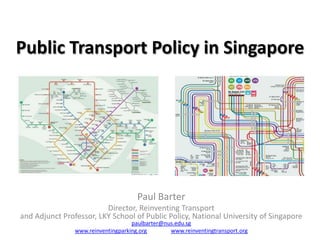
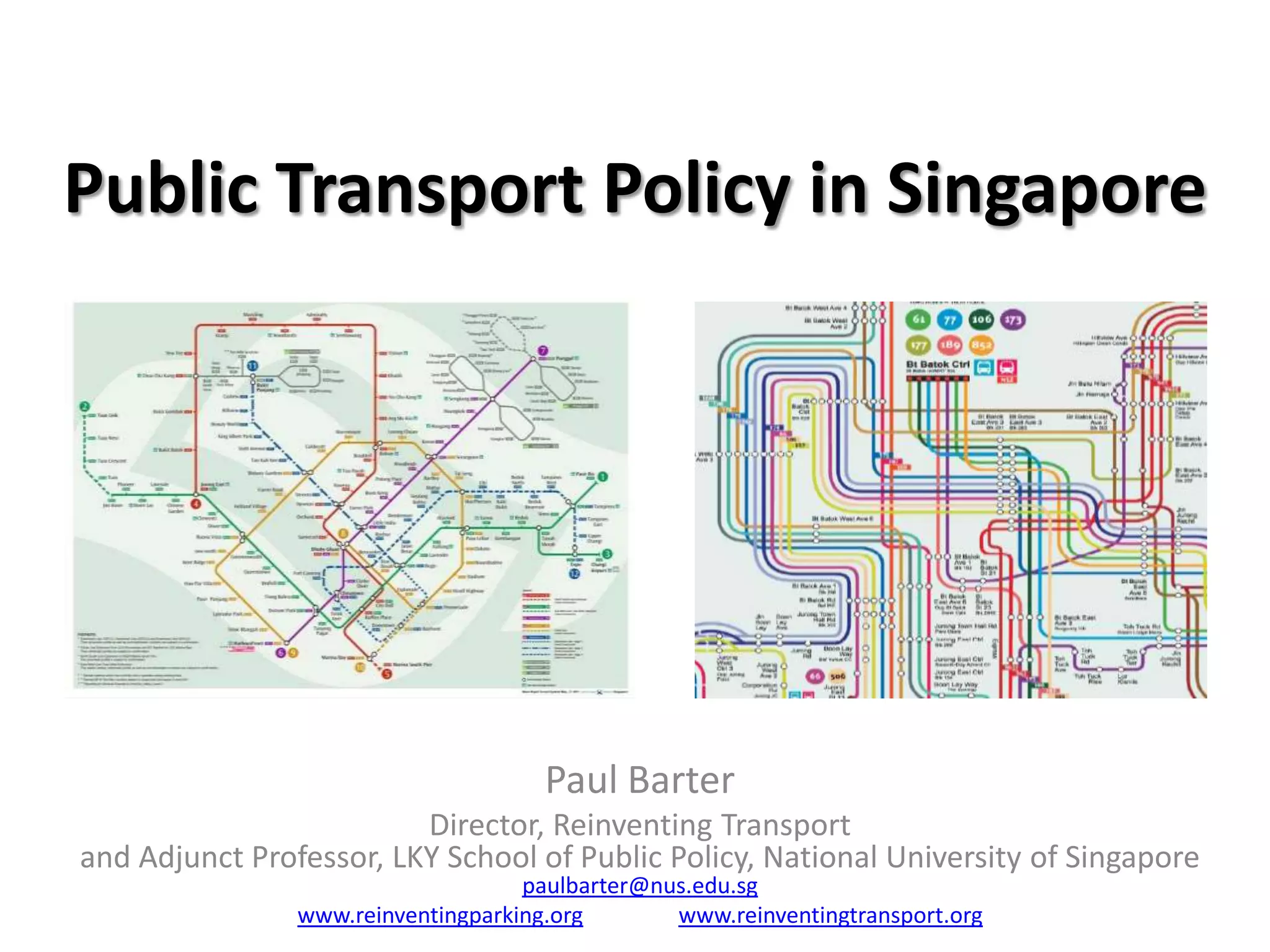
Public Transport Policy in Singapore

Paul Barter
Director, Reinventing Transport
and Adjunct Professor, LKY School of Public Policy, National University of Singapore
paulbarter@nus.edu.sg
www.reinventingparking.org
www.reinventingtransport.org
Summary
Transit-oriented planning
Constraint of cars
Bus improvements history
Urban rail

Public transport integration efforts

Paul Barter, Reinventing Transport
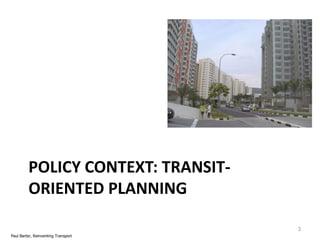
POLICY CONTEXT: TRANSITORIENTED PLANNING
3
Paul Barter, Reinventing Transport
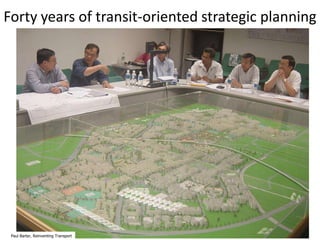
Forty years of transit-oriented strategic planning

Paul Barter, Reinventing Transport
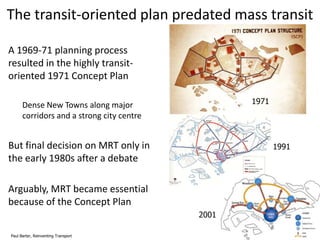
The transit-oriented plan predated mass transit
A 1969-71 planning process
resulted in the highly transitoriented 1971 Concept Plan
1971

Dense New Towns along major
corridors and a strong city centre

But final decision on MRT only in
the early 1980s after a debate

1991

Arguably, MRT became essential
because of the Concept Plan
2001
Paul Barter, Reinventing Transport
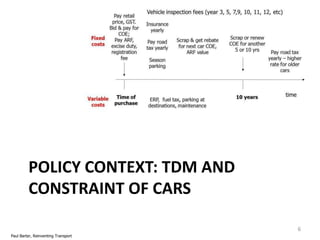
POLICY CONTEXT: TDM AND
CONSTRAINT OF CARS
6
Paul Barter, Reinventing Transport
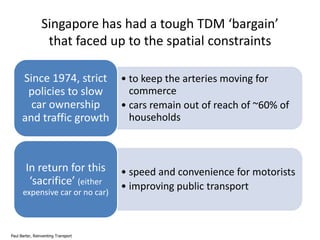
Singapore has had a tough TDM ‘bargain’
that faced up to the spatial constraints
Since 1974, strict • to keep the arteries moving for
commerce
policies to slow
car ownership
• cars remain out of reach of ~60% of
households
and traffic growth

In return for this
‘sacrifice’ (either
expensive car or no car)

Paul Barter, Reinventing Transport

• speed and convenience for motorists
• improving public transport
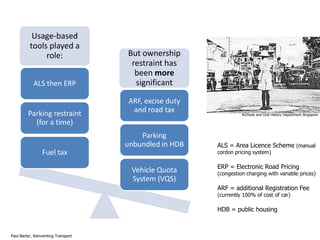
Usage-based
tools played a
role:
ALS then ERP

Parking restraint
(for a time)

But ownership
restraint has
been more
significant
ARF, excise duty
and road tax
Parking
unbundled in HDB

Archives and Oral History Department Singapore

ALS = Area Licence Scheme (manual
cordon pricing system)

Fuel tax
Vehicle Quota
System (VQS)

ERP = Electronic Road Pricing

(congestion charging with variable prices)

ARF = additional Registration Fee
(currently 100% of cost of car)

HDB = public housing

Paul Barter, Reinventing Transport
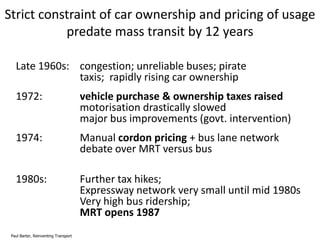
Strict constraint of car ownership and pricing of usage
predate mass transit by 12 years
Late 1960s: congestion; unreliable buses; pirate
taxis; rapidly rising car ownership
1972:

vehicle purchase & ownership taxes raised
motorisation drastically slowed
major bus improvements (govt. intervention)

1974:

Manual cordon pricing + bus lane network
debate over MRT versus bus

1980s:

Further tax hikes;
Expressway network very small until mid 1980s
Very high bus ridership;
MRT opens 1987

Paul Barter, Reinventing Transport
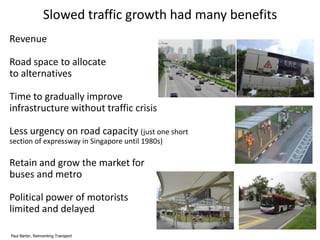
Slowed traffic growth had many benefits
Revenue
Road space to allocate
to alternatives
Time to gradually improve
infrastructure without traffic crisis
Less urgency on road capacity (just one short
section of expressway in Singapore until 1980s)

Retain and grow the market for
buses and metro
Political power of motorists
limited and delayed
Paul Barter, Reinventing Transport
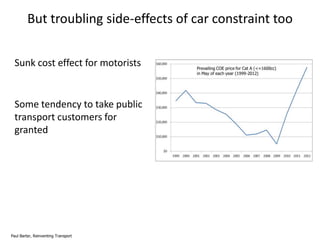
But troubling side-effects of car constraint too
Sunk cost effect for motorists

Some tendency to take public
transport customers for
granted

Paul Barter, Reinventing Transport
BUS IMPROVEMENTS 1970S - 1990S

12
Paul Barter, Reinventing Transport
Bus Regulation in Singapore
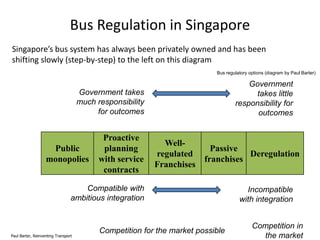
Singapore’s bus system has always been privately owned and has been
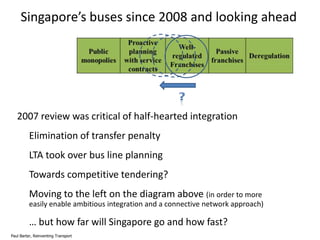
shifting slowly (step-by-step) to the left on this diagram
Bus regulatory options (diagram by Paul Barter)

Government
takes little
responsibility for
outcomes

Government takes
much responsibility
for outcomes

Public
monopolies

Proactive
planning
with service
contracts

Wellregulated
Franchises

Passive
Deregulation
franchises

Compatible with
ambitious integration

Paul Barter, Reinventing Transport

Competition for the market possible

Incompatible
with integration
Competition in
the market
Singapore’s buses pre 1935
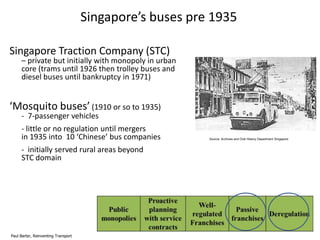
Singapore Traction Company (STC)

– private but initially with monopoly in urban
core (trams until 1926 then trolley buses and
diesel buses until bankruptcy in 1971)

‘Mosquito buses’ (1910 or so to 1935)
- 7-passenger vehicles

- little or no regulation until mergers
in 1935 into 10 ‘Chinese’ bus companies
- initially served rural areas beyond
STC domain

Paul Barter, Reinventing Transport

Source: Archives and Oral History Department Singapore
Singapore’s buses 1935 - 1973
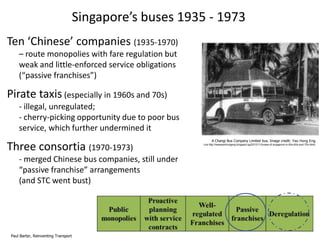
Ten ‘Chinese’ companies (1935-1970)
– route monopolies with fare regulation but
weak and little-enforced service obligations
(“passive franchises”)

Pirate taxis (especially in 1960s and 70s)
- illegal, unregulated;
- cherry-picking opportunity due to poor bus
service, which further undermined it

Three consortia (1970-1973)
- merged Chinese bus companies, still under
“passive franchise” arrangements
(and STC went bust)

Paul Barter, Reinventing Transport

A Changi Bus Company Limited bus. Image credit: Yeo Hong Eng
(via http://wwwyeohongeng.blogspot.sg/2012/11/buses-of-singapore-in-50s-60s-and-70s.html)
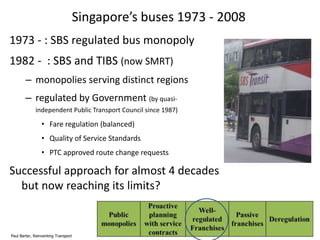
Singapore’s buses 1973 - 2008
1973 - : SBS regulated bus monopoly
1982 - : SBS and TIBS (now SMRT)
– monopolies serving distinct regions

– regulated by Government (by quasiindependent Public Transport Council since 1987)

• Fare regulation (balanced)
• Quality of Service Standards

• PTC approved route change requests

Successful approach for almost 4 decades
but now reaching its limits?

Paul Barter, Reinventing Transport

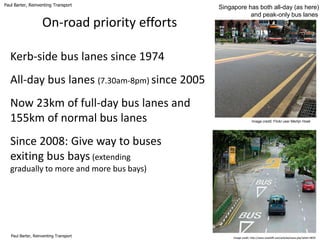
On-road priority efforts

Singapore has both all-day (as here)
and peak-only bus lanes

Kerb-side bus lanes since 1974
All-day bus lanes (7.30am-8pm) since 2005
Now 23km of full-day bus lanes and
155km of normal bus lanes

Image credit: Flickr user Merlijn Hoek

Since 2008: Give way to buses
exiting bus bays (extending
gradually to more and more bus bays)

Paul Barter, Reinventing Transport

Image credit: http://www.oneshift.com/articles/news.php?artid=4839
Image source: Wikimedia Commons user Vsion

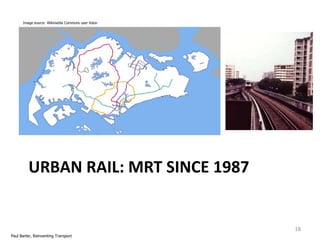
URBAN RAIL: MRT SINCE 1987

18
Paul Barter, Reinventing Transport
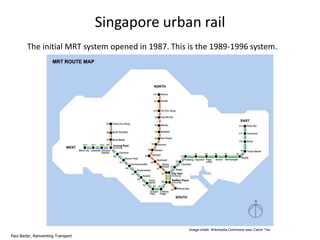
Singapore urban rail
The initial MRT system opened in 1987. This is the 1989-1996 system.

Image credit: Wikimedia Commons user Calvin Teo

Paul Barter, Reinventing Transport
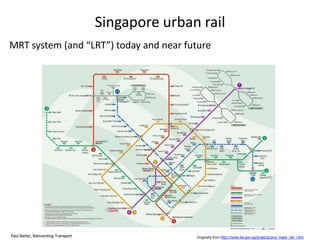
Singapore urban rail
MRT system (and “LRT”) today and near future

Paul Barter, Reinventing Transport

Originally from http://www.lta.gov.sg/projects/proj_maps_rail_l.htm
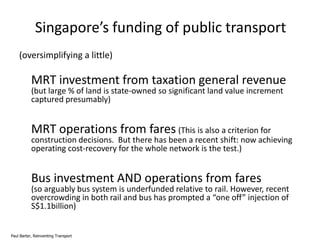
Singapore’s funding of public transport
(oversimplifying a little)

MRT investment from taxation general revenue
(but large % of land is state-owned so significant land value increment
captured presumably)

MRT operations from fares (This is also a criterion for

construction decisions. But there has been a recent shift: now achieving
operating cost-recovery for the whole network is the test.)

Bus investment AND operations from fares

(so arguably bus system is underfunded relative to rail. However, recent
overcrowding in both rail and bus has prompted a “one off” injection of
S$1.1billion)

Paul Barter, Reinventing Transport
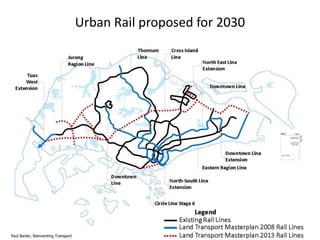
Urban Rail proposed for 2030

Paul Barter, Reinventing Transport
PUBLIC TRANSPORT INTEGRATION
EFFORTS AND REGULATORY DILEMMAS
23
Paul Barter, Reinventing Transport
‘Connective’ versus ‘Direct’
Public Transport Networks
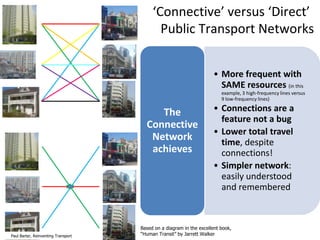
• More frequent with
SAME resources (in this
example, 3 high-frequency lines versus
9 low-frequency lines)

The
Connective
Network
achieves

Paul Barter, Reinventing Transport

• Connections are a
feature not a bug
• Lower total travel
time, despite
connections!
• Simpler network:
easily understood
and remembered

Based on a diagram in the excellent book,
“Human Transit” by Jarrett Walker
Strong Integration Efforts
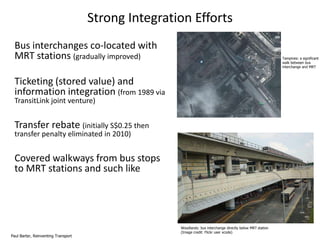
Bus interchanges co-located with
MRT stations (gradually improved)

Tampines: a significant
walk between bus
interchange and MRT

Ticketing (stored value) and
information integration (from 1989 via
TransitLink joint venture)

Transfer rebate (initially S$0.25 then
transfer penalty eliminated in 2010)

Covered walkways from bus stops
to MRT stations and such like

Paul Barter, Reinventing Transport

Woodlands: bus interchange directly below MRT station
(Image credit: Flickr user xcode)
Remaining integration shortcomings
Operators’ reluctant to offer
information on rival’s services (now
partially rectified by LTA)

TransitLink progress stalled
No system-wide season passes
until recently (and still limited)

Long bus headways and poor busstop locations make bus-bus
transfers unattractive
Lack of readable bus maps

Paul Barter, Reinventing Transport

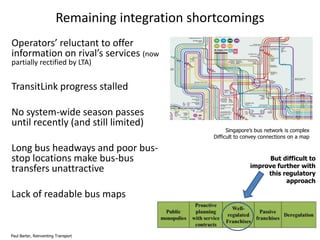
Singapore’s bus network is complex
Difficult to convey connections on a map

But difficult to
improve further with
this regulatory
approach
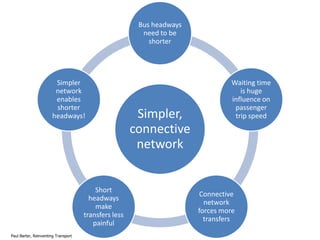
Bus headways
need to be
shorter

Simpler
network
enables
shorter
headways!

Short
headways
make
transfers less
painful
Paul Barter, Reinventing Transport

Simpler,
connective
network

Waiting time
is huge
influence on
passenger
trip speed

Connective
network
forces more
transfers
Singapore’s buses since 2008 and looking ahead

2007 review was critical of half-hearted integration
Elimination of transfer penalty
LTA took over bus line planning

Towards competitive tendering?
Moving to the left on the diagram above (in order to more
easily enable ambitious integration and a connective network approach)

… but how far will Singapore go and how fast?
Paul Barter, Reinventing Transport
Connective networks for buses too?
“Competently designed transit networks often
consist of trunk lines with frequent service and
separate feeders, even when both sections are
served by buses…”
Vukan Vuchic, Transportation for Livable Cities, 1999, p. 210

Paul Barter, Reinventing Transport
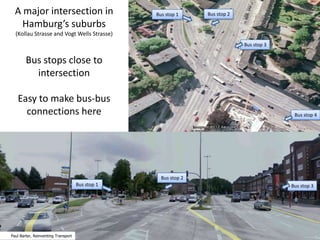
A major intersection in
Hamburg’s suburbs

Bus stop 1

Bus stop 2

(Kollau Strasse and Vogt Wells Strasse)
Bus stop 3

Bus stops close to
intersection
Easy to make bus-bus
connections here

Bus stop 4

Bus stop 2
Bus stop 1

Bus stop 3

30
Paul Barter, Reinventing Transport
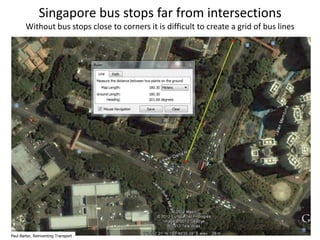
Singapore bus stops far from intersections
Without bus stops close to corners it is difficult to create a grid of bus lines

31
Paul Barter, Reinventing Transport
Towards a London/Scandinavian/Seoul
model for Singapore?
This is my preferred
option but time will tell
Government agency plans
bus lines and schedules
High level of ‘system unity’
(connective network aim)
Government takes revenue
risk (gross-cost contracts with
performance incentives)

Paul Barter, Reinventing Transport

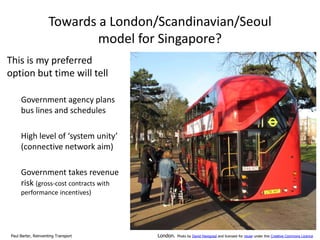
London.

Photo by David Hawgood and licensed for reuse under this Creative Commons Licence
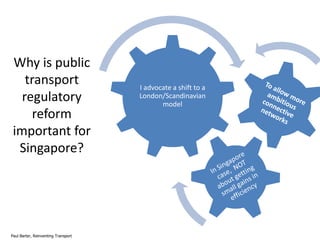
Why is public
transport
regulatory
reform
important for
Singapore?

Paul Barter, Reinventing Transport

I advocate a shift to a
London/Scandinavian
model
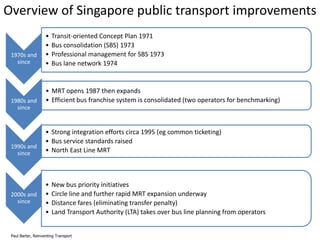
Overview of Singapore public transport improvements
1970s and
since

1980s and
since

1990s and
since

2000s and
since

•
•
•
•

Transit-oriented Concept Plan 1971
Bus consolidation (SBS) 1973
Professional management for SBS 1973
Bus lane network 1974

• MRT opens 1987 then expands
• Efficient bus franchise system is consolidated (two operators for benchmarking)

• Strong integration efforts circa 1995 (eg common ticketing)
• Bus service standards raised
• North East Line MRT

•
•
•
•

New bus priority initiatives
Circle line and further rapid MRT expansion underway
Distance fares (eliminating transfer penalty)
Land Transport Authority (LTA) takes over bus line planning from operators

Paul Barter, Reinventing Transport

Public Transport Policy in Singapore (a long view)

  • 1.
    Public Transport Policyin Singapore Paul Barter Director, Reinventing Transport and Adjunct Professor, LKY School of Public Policy, National University of Singapore paulbarter@nus.edu.sg www.reinventingparking.org www.reinventingtransport.org
  • 2.
    Summary Transit-oriented planning Constraint ofcars Bus improvements history Urban rail Public transport integration efforts Paul Barter, Reinventing Transport
  • 3.
    POLICY CONTEXT: TRANSITORIENTEDPLANNING 3 Paul Barter, Reinventing Transport
  • 4.
    Forty years oftransit-oriented strategic planning Paul Barter, Reinventing Transport
  • 5.
    The transit-oriented planpredated mass transit A 1969-71 planning process resulted in the highly transitoriented 1971 Concept Plan 1971 Dense New Towns along major corridors and a strong city centre But final decision on MRT only in the early 1980s after a debate 1991 Arguably, MRT became essential because of the Concept Plan 2001 Paul Barter, Reinventing Transport
  • 6.
    POLICY CONTEXT: TDMAND CONSTRAINT OF CARS 6 Paul Barter, Reinventing Transport
  • 7.
    Singapore has hada tough TDM ‘bargain’ that faced up to the spatial constraints Since 1974, strict • to keep the arteries moving for commerce policies to slow car ownership • cars remain out of reach of ~60% of households and traffic growth In return for this ‘sacrifice’ (either expensive car or no car) Paul Barter, Reinventing Transport • speed and convenience for motorists • improving public transport
  • 8.
    Usage-based tools played a role: ALSthen ERP Parking restraint (for a time) But ownership restraint has been more significant ARF, excise duty and road tax Parking unbundled in HDB Archives and Oral History Department Singapore ALS = Area Licence Scheme (manual cordon pricing system) Fuel tax Vehicle Quota System (VQS) ERP = Electronic Road Pricing (congestion charging with variable prices) ARF = additional Registration Fee (currently 100% of cost of car) HDB = public housing Paul Barter, Reinventing Transport
  • 9.
    Strict constraint ofcar ownership and pricing of usage predate mass transit by 12 years Late 1960s: congestion; unreliable buses; pirate taxis; rapidly rising car ownership 1972: vehicle purchase & ownership taxes raised motorisation drastically slowed major bus improvements (govt. intervention) 1974: Manual cordon pricing + bus lane network debate over MRT versus bus 1980s: Further tax hikes; Expressway network very small until mid 1980s Very high bus ridership; MRT opens 1987 Paul Barter, Reinventing Transport
  • 10.
    Slowed traffic growthhad many benefits Revenue Road space to allocate to alternatives Time to gradually improve infrastructure without traffic crisis Less urgency on road capacity (just one short section of expressway in Singapore until 1980s) Retain and grow the market for buses and metro Political power of motorists limited and delayed Paul Barter, Reinventing Transport
  • 11.
    But troubling side-effectsof car constraint too Sunk cost effect for motorists Some tendency to take public transport customers for granted Paul Barter, Reinventing Transport
  • 12.
    BUS IMPROVEMENTS 1970S- 1990S 12 Paul Barter, Reinventing Transport
  • 13.
    Bus Regulation inSingapore Singapore’s bus system has always been privately owned and has been shifting slowly (step-by-step) to the left on this diagram Bus regulatory options (diagram by Paul Barter) Government takes little responsibility for outcomes Government takes much responsibility for outcomes Public monopolies Proactive planning with service contracts Wellregulated Franchises Passive Deregulation franchises Compatible with ambitious integration Paul Barter, Reinventing Transport Competition for the market possible Incompatible with integration Competition in the market
  • 14.
    Singapore’s buses pre1935 Singapore Traction Company (STC) – private but initially with monopoly in urban core (trams until 1926 then trolley buses and diesel buses until bankruptcy in 1971) ‘Mosquito buses’ (1910 or so to 1935) - 7-passenger vehicles - little or no regulation until mergers in 1935 into 10 ‘Chinese’ bus companies - initially served rural areas beyond STC domain Paul Barter, Reinventing Transport Source: Archives and Oral History Department Singapore
  • 15.
    Singapore’s buses 1935- 1973 Ten ‘Chinese’ companies (1935-1970) – route monopolies with fare regulation but weak and little-enforced service obligations (“passive franchises”) Pirate taxis (especially in 1960s and 70s) - illegal, unregulated; - cherry-picking opportunity due to poor bus service, which further undermined it Three consortia (1970-1973) - merged Chinese bus companies, still under “passive franchise” arrangements (and STC went bust) Paul Barter, Reinventing Transport A Changi Bus Company Limited bus. Image credit: Yeo Hong Eng (via http://wwwyeohongeng.blogspot.sg/2012/11/buses-of-singapore-in-50s-60s-and-70s.html)
  • 16.
    Singapore’s buses 1973- 2008 1973 - : SBS regulated bus monopoly 1982 - : SBS and TIBS (now SMRT) – monopolies serving distinct regions – regulated by Government (by quasiindependent Public Transport Council since 1987) • Fare regulation (balanced) • Quality of Service Standards • PTC approved route change requests Successful approach for almost 4 decades but now reaching its limits? Paul Barter, Reinventing Transport
  • 17.
    Paul Barter, ReinventingTransport On-road priority efforts Singapore has both all-day (as here) and peak-only bus lanes Kerb-side bus lanes since 1974 All-day bus lanes (7.30am-8pm) since 2005 Now 23km of full-day bus lanes and 155km of normal bus lanes Image credit: Flickr user Merlijn Hoek Since 2008: Give way to buses exiting bus bays (extending gradually to more and more bus bays) Paul Barter, Reinventing Transport Image credit: http://www.oneshift.com/articles/news.php?artid=4839
  • 18.
    Image source: WikimediaCommons user Vsion URBAN RAIL: MRT SINCE 1987 18 Paul Barter, Reinventing Transport
  • 19.
    Singapore urban rail Theinitial MRT system opened in 1987. This is the 1989-1996 system. Image credit: Wikimedia Commons user Calvin Teo Paul Barter, Reinventing Transport
  • 20.
    Singapore urban rail MRTsystem (and “LRT”) today and near future Paul Barter, Reinventing Transport Originally from http://www.lta.gov.sg/projects/proj_maps_rail_l.htm
  • 21.
    Singapore’s funding ofpublic transport (oversimplifying a little) MRT investment from taxation general revenue (but large % of land is state-owned so significant land value increment captured presumably) MRT operations from fares (This is also a criterion for construction decisions. But there has been a recent shift: now achieving operating cost-recovery for the whole network is the test.) Bus investment AND operations from fares (so arguably bus system is underfunded relative to rail. However, recent overcrowding in both rail and bus has prompted a “one off” injection of S$1.1billion) Paul Barter, Reinventing Transport
  • 22.
    Urban Rail proposedfor 2030 Paul Barter, Reinventing Transport
  • 23.
    PUBLIC TRANSPORT INTEGRATION EFFORTSAND REGULATORY DILEMMAS 23 Paul Barter, Reinventing Transport
  • 24.
    ‘Connective’ versus ‘Direct’ PublicTransport Networks • More frequent with SAME resources (in this example, 3 high-frequency lines versus 9 low-frequency lines) The Connective Network achieves Paul Barter, Reinventing Transport • Connections are a feature not a bug • Lower total travel time, despite connections! • Simpler network: easily understood and remembered Based on a diagram in the excellent book, “Human Transit” by Jarrett Walker
  • 25.
    Strong Integration Efforts Businterchanges co-located with MRT stations (gradually improved) Tampines: a significant walk between bus interchange and MRT Ticketing (stored value) and information integration (from 1989 via TransitLink joint venture) Transfer rebate (initially S$0.25 then transfer penalty eliminated in 2010) Covered walkways from bus stops to MRT stations and such like Paul Barter, Reinventing Transport Woodlands: bus interchange directly below MRT station (Image credit: Flickr user xcode)
  • 26.
    Remaining integration shortcomings Operators’reluctant to offer information on rival’s services (now partially rectified by LTA) TransitLink progress stalled No system-wide season passes until recently (and still limited) Long bus headways and poor busstop locations make bus-bus transfers unattractive Lack of readable bus maps Paul Barter, Reinventing Transport Singapore’s bus network is complex Difficult to convey connections on a map But difficult to improve further with this regulatory approach
  • 27.
    Bus headways need tobe shorter Simpler network enables shorter headways! Short headways make transfers less painful Paul Barter, Reinventing Transport Simpler, connective network Waiting time is huge influence on passenger trip speed Connective network forces more transfers
  • 28.
    Singapore’s buses since2008 and looking ahead 2007 review was critical of half-hearted integration Elimination of transfer penalty LTA took over bus line planning Towards competitive tendering? Moving to the left on the diagram above (in order to more easily enable ambitious integration and a connective network approach) … but how far will Singapore go and how fast? Paul Barter, Reinventing Transport
  • 29.
    Connective networks forbuses too? “Competently designed transit networks often consist of trunk lines with frequent service and separate feeders, even when both sections are served by buses…” Vukan Vuchic, Transportation for Livable Cities, 1999, p. 210 Paul Barter, Reinventing Transport
  • 30.
    A major intersectionin Hamburg’s suburbs Bus stop 1 Bus stop 2 (Kollau Strasse and Vogt Wells Strasse) Bus stop 3 Bus stops close to intersection Easy to make bus-bus connections here Bus stop 4 Bus stop 2 Bus stop 1 Bus stop 3 30 Paul Barter, Reinventing Transport
  • 31.
    Singapore bus stopsfar from intersections Without bus stops close to corners it is difficult to create a grid of bus lines 31 Paul Barter, Reinventing Transport
  • 32.
    Towards a London/Scandinavian/Seoul modelfor Singapore? This is my preferred option but time will tell Government agency plans bus lines and schedules High level of ‘system unity’ (connective network aim) Government takes revenue risk (gross-cost contracts with performance incentives) Paul Barter, Reinventing Transport London. Photo by David Hawgood and licensed for reuse under this Creative Commons Licence
  • 33.
    Why is public transport regulatory reform importantfor Singapore? Paul Barter, Reinventing Transport I advocate a shift to a London/Scandinavian model
  • 34.
    Overview of Singaporepublic transport improvements 1970s and since 1980s and since 1990s and since 2000s and since • • • • Transit-oriented Concept Plan 1971 Bus consolidation (SBS) 1973 Professional management for SBS 1973 Bus lane network 1974 • MRT opens 1987 then expands • Efficient bus franchise system is consolidated (two operators for benchmarking) • Strong integration efforts circa 1995 (eg common ticketing) • Bus service standards raised • North East Line MRT • • • • New bus priority initiatives Circle line and further rapid MRT expansion underway Distance fares (eliminating transfer penalty) Land Transport Authority (LTA) takes over bus line planning from operators Paul Barter, Reinventing Transport

Editor's Notes

  • #8 Still broadlyreflected in the first two of the three key strategies for “a people centred land transport system” which are: Make public transport a choice mode Manage road use Meet diverse needs
  • #9 Result: low car ownership, high traffic speeds and high car-km per car
  • #15 Singapore Traction Company (STC) – trams until 1926 then trolley buses and diesel buses (monopoly in core urban area)In Singapore, “mosquito buses”, which were small 7-seater buses operated by individual or very small enterprises became very important by 1921. They became the dominant public transport mode by the 1930s (having amalgamated into eleven “Chinese bus companies” in 1935), along with buses run by the former tram company (Singapore’s tram services ceased in 1926) (Rimmer, 1986c). Rimmer (1986c) describes an almost identical scenario in Singapore in the 1960s with regard to the bus services of the Chinese bus companies and by the larger former tram company. With controlled fares and high taxation, bus services there deteriorated to such an extent that in the 1960s there were an increasing number of “pirate taxis” (private cars illegally offering shared-taxi or hybrid-type services mostly along the bus routes).
  • #28 We have neglected bus frequencyWaiting time is often more important than vehicle speed A simpler, ‘connective’ bus network could improve frequencies
  • #33 Interesting point from http://stevemunro.ca/?p=7223A London-style regulatory approach demands that the planner has excellent service and performance measurement. “… requires detailed metrics people can understand and agree to.”
  • #34 = proactive planning by government with gross-cost contracts (with some performance incentives) so government takes most of the revenue risk