Integrated Multi-Modal Transportation
System (IMMTS)
Submitted By:
Aditya Gupta
B-Tech Final Year
Department of Civil Engineering
Submitted To:
Dr. Trilok Gupta
Assistant professor
Department of Civil Engineering
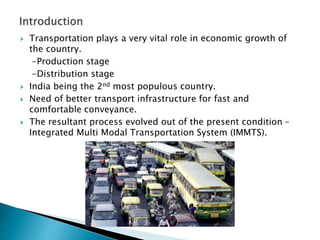
 Transportation plays a very vital role in economic growth of
the country.
-Production stage
-Distribution stage
 India being the 2nd most populous country.
 Need of better transport infrastructure for fast and
comfortable conveyance.
 The resultant process evolved out of the present condition –
Integrated Multi Modal Transportation System (IMMTS).
When two or more modes of transport are integrated for a single trip and
used for convenient and efficient
movement of passengers, it is defined as the Multi Modal Transport
System (MMTS)
Egress service
Walking Destination
Cycle rickshaw
Car/auto
Bus/DTC
2-wheeler
Access service
Origin Walking
Cycle Rickshaw
Car/AUTO
Bus
2-wheeler
Transfer Points
Primary Public
Transport
(MRTS,BRTS)
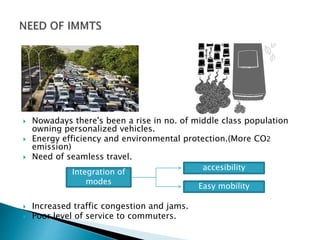
 Nowadays there's been a rise in no. of middle class population
owning personalized vehicles.
 Energy efficiency and environmental protection.(More CO2
emission)
 Need of seamless travel.
 Increased traffic congestion and jams.
 Poor level of service to commuters.
Integration of
modes
Easy mobility
accesibility
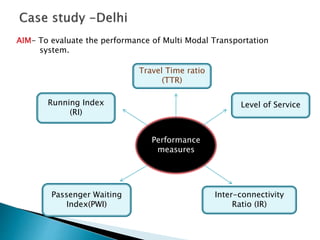
AIM- To evaluate the performance of Multi Modal Transportation
system.
Performance
measures
Travel Time ratio
(TTR)
Running Index
(RI)
Inter-connectivity
Ratio (IR)
Passenger Waiting
Index(PWI)
Level of Service
 To study the performance of mmts like delhi metro, extensive
commuter data is required.
 Out of total 460 people,176 were female and 284 male.
SURVEY PERFORMA
PASSENGER
DETAILS
• Gender, Age
• Income and purpose of trip
TRAVEL INFO
• Origin and Destination
• Access Mode And Time, Egress Mode and Time
PASSENGER
SATISFACTION
MEASURES
• Speed, cost and comfort
• Reliability and Transfer
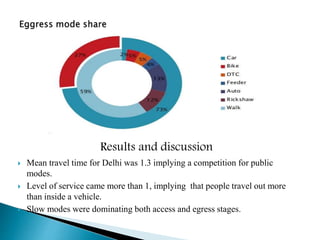
Access mode share
Results and discussion
 Mean travel time for Delhi was 1.3 implying a competition for public
modes.
 Level of service came more than 1, implying that people travel out more
than inside a vehicle.
 Slow modes were dominating both access and egress stages.
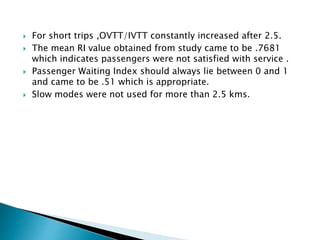
 For short trips ,OVTT/IVTT constantly increased after 2.5.
 The mean RI value obtained from study came to be .7681
which indicates passengers were not satisfied with service .
 Passenger Waiting Index should always lie between 0 and 1
and came to be .51 which is appropriate.
 Slow modes were not used for more than 2.5 kms.
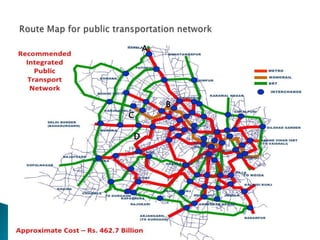
A
D
B
C
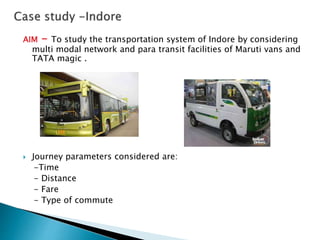
AIM - To study the transportation system of Indore by considering
multi modal network and para transit facilities of Maruti vans and
TATA magic .
 Journey parameters considered are:
-Time
- Distance
- Fare
- Type of commute
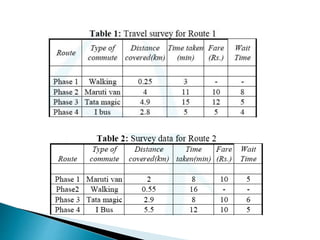
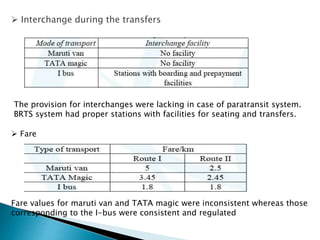
Routes selected for the survey are:
ROUTE 1: Gangwal Bus stand to Niranjanpur
ROUTE 2: Marimata Square to Rajiv Gandhi square
 The survey was done on two selected busy routes at noon
which comprised of the two extremities of the BRTS corridor
from the centre location to study the diverse characteristics
of the system .
 The journey comprised of four phases, each with a different
mode of transport.
Study analysis
 Distance composition:
Percentage of distance covered by par transit system was more than
60% of the total distance.
 Waiting time comparison:
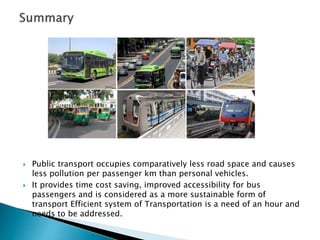
 Interchange during the transfers
The provision for interchanges were lacking in case of paratransit system.
BRTS system had proper stations with facilities for seating and transfers.
 Fare
Fare values for maruti van and TATA magic were inconsistent whereas those
corresponding to the I-bus were consistent and regulated
Results
• Use of paratransit facilities are more than BRTS, i.e. more than 60 %
was taking place in that.
• Waiting time for both the routes was more than BRTS due to
irregularity in boarding.
• Fare per km for paratransit facilities were greater than existing BRTS.
• No interchange facility was available for paratransit facilities as
compared with BRTS.
Discussions
• A well devised system of feedback can be effective to assess the
changes necessary for further improvement.
• The fares of the system can be integrated as a whole, thus serving a
easy and convenient way to solve the problem of high demands
• Proper interchange facility was missing in case of paratransit facilities.
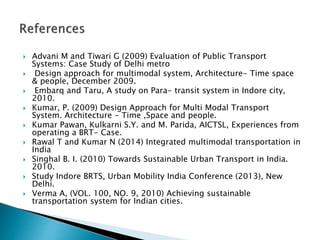
 Public transport occupies comparatively less road space and causes
less pollution per passenger km than personal vehicles.
 It provides time cost saving, improved accessibility for bus
passengers and is considered as a more sustainable form of
transport Efficient system of Transportation is a need of an hour and
needs to be addressed.
 Advani M and Tiwari G (2009) Evaluation of Public Transport
Systems: Case Study of Delhi metro
 Design approach for multimodal system, Architecture- Time space
& people, December 2009.
 Embarq and Taru, A study on Para- transit system in Indore city,
2010.
 Kumar, P. (2009) Design Approach for Multi Modal Transport
System. Architecture - Time ,Space and people.
 Kumar Pawan, Kulkarni S.Y. and M. Parida, AICTSL, Experiences from
operating a BRT- Case.
 Rawal T and Kumar N (2014) Integrated multimodal transportation in
India
 Singhal B. I. (2010) Towards Sustainable Urban Transport in India.
2010.
 Study Indore BRTS, Urban Mobility India Conference (2013), New
Delhi.
 Verma A, (VOL. 100, NO. 9, 2010) Achieving sustainable
transportation system for Indian cities.

Integrated multi modal transportation system

  • 1.
    Integrated Multi-Modal Transportation System(IMMTS) Submitted By: Aditya Gupta B-Tech Final Year Department of Civil Engineering Submitted To: Dr. Trilok Gupta Assistant professor Department of Civil Engineering
  • 2.
     Transportation playsa very vital role in economic growth of the country. -Production stage -Distribution stage  India being the 2nd most populous country.  Need of better transport infrastructure for fast and comfortable conveyance.  The resultant process evolved out of the present condition – Integrated Multi Modal Transportation System (IMMTS).
  • 3.
    When two ormore modes of transport are integrated for a single trip and used for convenient and efficient movement of passengers, it is defined as the Multi Modal Transport System (MMTS)
  • 4.
    Egress service Walking Destination Cyclerickshaw Car/auto Bus/DTC 2-wheeler Access service Origin Walking Cycle Rickshaw Car/AUTO Bus 2-wheeler Transfer Points Primary Public Transport (MRTS,BRTS)
  • 5.
     Nowadays there'sbeen a rise in no. of middle class population owning personalized vehicles.  Energy efficiency and environmental protection.(More CO2 emission)  Need of seamless travel.  Increased traffic congestion and jams.  Poor level of service to commuters. Integration of modes Easy mobility accesibility
  • 6.
    AIM- To evaluatethe performance of Multi Modal Transportation system. Performance measures Travel Time ratio (TTR) Running Index (RI) Inter-connectivity Ratio (IR) Passenger Waiting Index(PWI) Level of Service
  • 7.
     To studythe performance of mmts like delhi metro, extensive commuter data is required.  Out of total 460 people,176 were female and 284 male. SURVEY PERFORMA PASSENGER DETAILS • Gender, Age • Income and purpose of trip TRAVEL INFO • Origin and Destination • Access Mode And Time, Egress Mode and Time PASSENGER SATISFACTION MEASURES • Speed, cost and comfort • Reliability and Transfer
  • 8.
  • 9.
    Results and discussion Mean travel time for Delhi was 1.3 implying a competition for public modes.  Level of service came more than 1, implying that people travel out more than inside a vehicle.  Slow modes were dominating both access and egress stages.
  • 10.
     For shorttrips ,OVTT/IVTT constantly increased after 2.5.  The mean RI value obtained from study came to be .7681 which indicates passengers were not satisfied with service .  Passenger Waiting Index should always lie between 0 and 1 and came to be .51 which is appropriate.  Slow modes were not used for more than 2.5 kms.
  • 11.
  • 12.
    AIM - Tostudy the transportation system of Indore by considering multi modal network and para transit facilities of Maruti vans and TATA magic .  Journey parameters considered are: -Time - Distance - Fare - Type of commute
  • 13.
    Routes selected forthe survey are: ROUTE 1: Gangwal Bus stand to Niranjanpur ROUTE 2: Marimata Square to Rajiv Gandhi square  The survey was done on two selected busy routes at noon which comprised of the two extremities of the BRTS corridor from the centre location to study the diverse characteristics of the system .  The journey comprised of four phases, each with a different mode of transport.
  • 15.
    Study analysis  Distancecomposition: Percentage of distance covered by par transit system was more than 60% of the total distance.  Waiting time comparison:
  • 16.
     Interchange duringthe transfers The provision for interchanges were lacking in case of paratransit system. BRTS system had proper stations with facilities for seating and transfers.  Fare Fare values for maruti van and TATA magic were inconsistent whereas those corresponding to the I-bus were consistent and regulated
  • 17.
    Results • Use ofparatransit facilities are more than BRTS, i.e. more than 60 % was taking place in that. • Waiting time for both the routes was more than BRTS due to irregularity in boarding. • Fare per km for paratransit facilities were greater than existing BRTS. • No interchange facility was available for paratransit facilities as compared with BRTS. Discussions • A well devised system of feedback can be effective to assess the changes necessary for further improvement. • The fares of the system can be integrated as a whole, thus serving a easy and convenient way to solve the problem of high demands • Proper interchange facility was missing in case of paratransit facilities.
  • 18.
     Public transportoccupies comparatively less road space and causes less pollution per passenger km than personal vehicles.  It provides time cost saving, improved accessibility for bus passengers and is considered as a more sustainable form of transport Efficient system of Transportation is a need of an hour and needs to be addressed.
  • 19.
     Advani Mand Tiwari G (2009) Evaluation of Public Transport Systems: Case Study of Delhi metro  Design approach for multimodal system, Architecture- Time space & people, December 2009.  Embarq and Taru, A study on Para- transit system in Indore city, 2010.  Kumar, P. (2009) Design Approach for Multi Modal Transport System. Architecture - Time ,Space and people.  Kumar Pawan, Kulkarni S.Y. and M. Parida, AICTSL, Experiences from operating a BRT- Case.  Rawal T and Kumar N (2014) Integrated multimodal transportation in India  Singhal B. I. (2010) Towards Sustainable Urban Transport in India. 2010.  Study Indore BRTS, Urban Mobility India Conference (2013), New Delhi.  Verma A, (VOL. 100, NO. 9, 2010) Achieving sustainable transportation system for Indian cities.