Submitted by
Arun S R
Libin Paul
Prabu
Santana Pravin
Ram Kumar
Thayumanavan S K
Introduction of Indian
Metro Railway.
How it began
 India's 1st and Asia's 5th metro rail was introduced in
Kolkata.
 Over a length of 16.45 km and the work on this project
was sanctioned on 1.6.1972
 The construction work started in 1973-74.After crossing
so many hurdles Calcutta Metro started its journey on
October 24, 1984
Why is it needed ?
 Unprecedented growth of personal vehicles.
 Growing traffic congestion.
 Air pollution and traffic accidents has become a major
concern.
 To avoid congestion at peak hours.
 Time saving. Reduced fuel consumption.
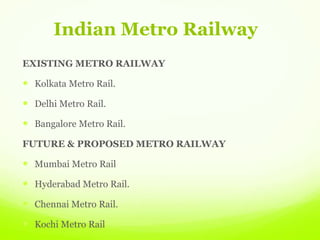
Indian Metro Railway
EXISTING METRO RAILWAY
 Kolkata Metro Rail.
 Delhi Metro Rail.
 Bangalore Metro Rail.
FUTURE & PROPOSED METRO RAILWAY
 Mumbai Metro Rail
 Hyderabad Metro Rail.
 Chennai Metro Rail.
 Kochi Metro Rail
Introduction On CMRL
Chennai Metropolis has been growing rapidly and the traffic volumes on the
roads have also been increasing enormously.
Chennai, the fourth-largest city in India, is the capital of the
State of Tamil Nadu. The city and its surrounding metropolitan area
have a population of nearly 8 million. This generates about 11 million
passenger trips a day, with about 6 million vehicular trips. There is a
strong need for an efficient transportation system in the city, and the
people of Chennai have long felt the need for an efficient, economic,
and reliable rail-based mass transit system that would augment and
complement the existing modes of public transport.
Hence the need for a new rail based rapid transport system has been felt and
towards this objective the Government of Tamil Nadu have decided to implement the
Chennai Metro Rail Project
Introduction On CMRL
This project aims at providing the people of Chennai with a fast,
reliable, convenient, efficient, modern and economical mode of public
transport, which is properly integrated with other forms of public and private
transport including buses, sub-urban trains and MRTS.
The Government of Tamil Nadu created a Special Purpose Vehicle
(SPV) for implementing the Chennai Metro Rail Project. This SPV named as
"Chennai Metro Rail Limited" was incorporated on 03.12.2007 under the
Companies Act. It has now been converted into a Joint Venture of
Government of India and Government of Tamil Nadu with equal equity
holding.
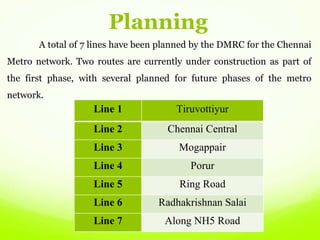
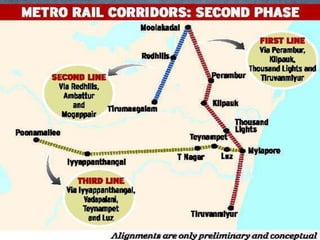
A total of 7 lines have been planned by the DMRC for the Chennai
Metro network. Two routes are currently under construction as part of
the first phase, with several planned for future phases of the metro
network.
Line 1 Tiruvottiyur
Line 2 Chennai Central
Line 3 Mogappair
Line 4 Porur
Line 5 Ring Road
Line 6 Radhakrishnan Salai
Line 7 Along NH5 Road
Planning
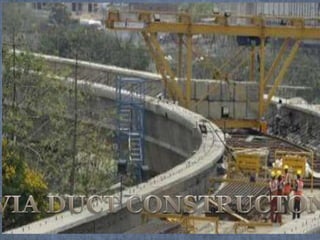
• Construction started on 10 June 2009 with the piling work for the
elevated viaduct between Koyambedu and Ashok Nagar stretch.
• The construction work on the project was suspended on 9 August
2012, following an accident that killed a worker and injured six others,
a day earlier.
• The project is estimated to cost around 146 billion (US$2.3 billion) for
the two corridors totaling 45 km.
• The estimated construction cost of Underground and Elevated Station
will be Rs1 billion and Rs3 billion respectively.
Construction History
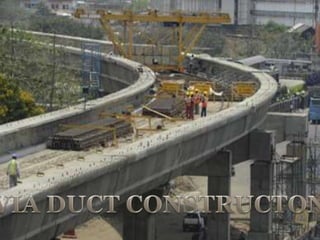
The lines of Chennai Metro are double-tracked ones. The average
height of the tracks will be 12 m, which increases at two points, namely,
above the Vadapalani flyover where it reaches about 18 m and over the
Kathipara grade separator where the height reaches a maximum of about
25 m.
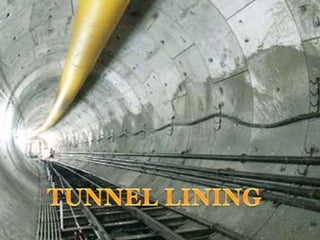
The underground stretch will run at a depth of 17 m below the
street level. The Metro corridor accommodates a complex structure over
the Kathipara grade separator. Technically called the balanced cantilever,
it is a bridge-like structure at a height of about 25 m above the street,
connecting the Metro corridor on both sides of the grade separator.
DESIGN OF METRO
CORRIDORS
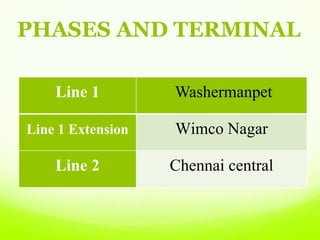
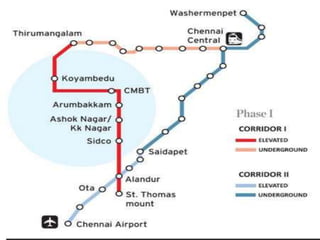
Line 1 Washermanpet
Line 1 Extension Wimco Nagar
Line 2 Chennai central
PHASES AND TERMINAL
Implementation of Phase 1
 The implementation of Phase 1 will be carried out in three
main stages (see Section 5):
 Stage 1: Commencement of services for the 11 km section
from Koyambedu to St. Thomas Mount (currently
scheduled for late 2013).
 Stage 1A: Commencement of services for an additional 8 km
of sections from Chennai Airport to Little Mount, and
Chennai Airport to Koyambedu (currently scheduled for
mid 2014)
 Stage 2: Commencement of full Phase 1 services (currently
scheduled for 2015)
METRO PROJECT DESIGN
& MANAGEMENT
OTHER TECHNICAL FEATURES
 Platform screen doors (PSD) in underground Stations
 Passenger information systems
 CCTV
 Operational System-wide safety
 Rolling stock (Air-Conditioned)
 Life Safety & Security
 Environmental sustainability
 Provisions for persons with disability:
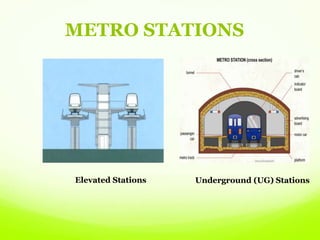
METRO STATIONS
Elevated Stations Underground (UG) Stations
ENTRANCES
Station entrances will be located with particular reference to
passenger catchment points and physical site constraints within the
right of way allocated to the CMRL system. Integrated entrances
and ticket offices will also be permitted. All entry points will be
assessed and addressed to flood control requirements on a station
by station basis. Station entrances will have provisions for closing
and securing the station during non-operational hours.
POWER SUPPLY
The power supply system and overhead equipment mainly
consists of:
 Three 110/33 kV & 110/25 kV AC Receiving Substations (RSS)
(Gas Insulated Substations), related Auxiliary Main
Substations (3), Traction Main Substations (TSS) (3), and civil
works
 All civil works and equipment for the 25 kV AC traction supply.
SIGNALING
 CATC - Continuous Automatic Train Control
System
 ATP - Automatic Train Protection
 ATO - Automatic Train Operation
 ATS - Automatic Train Supervision
 EI - Electronic Interlocking systems
LIFTS AND ESCALATORS
The number of lifts and escalators within the
Chennai Metro system will be approximately:
 Lifts: 120
 Escalators: 300
SCHEDULED FARES
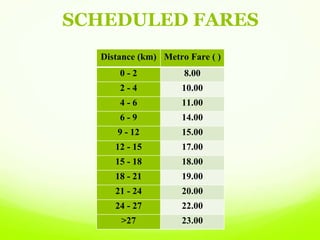
Distance (km) Metro Fare ( )
0 - 2 8.00
2 - 4 10.00
4 - 6 11.00
6 - 9 14.00
9 - 12 15.00
12 - 15 17.00
15 - 18 18.00
18 - 21 19.00
21 - 24 20.00
24 - 27 22.00
>27 23.00
STATIONS
A total of 41 stations have been planned along the two lines. As
many as 19 stations are underground and 12 are elevated. Of these,
the Chennai Central (underground) and Alandur (elevated) are common
for both the corridors and serve as interchange stations.
 Chennai Suburban Railway network:
 Chennai MRTS
 Chennai Metropolitan Transport Corporation bus terminuses
 Chennai International Airport
 Southern Railway
 State Express Transport Corporation (Tamil Nadu)
 Tamil Nadu State Transport Corporation
 Chennai Contract Carriage Bus Terminus
PROPOSED CONNECTIONS
OF METRO RAIL
As of 2011, four urban parks in the city has been taken over by
CMRL for construction-related activities. These have been closed to the
public since then. They include Corporation parks at Ashok Nagar, Thiru-
Vi-Ka Park in Shenoy Nagar, Nehru Park on Poonamallee High Road, and
May Day Park in Chintadripet. At the Ashok Nagar Park, the pillars of the
elevated corridor would come up on the edge of the park to provide
sufficient turning radius
PARKS TAKEN OVER FOR
CONSTRUCTION
• In August 2012, a construction worker was killed and six others
were seriously injured due to a crane boom failure
near Pachaiyappa's College.
• On 10 January 2013, a 22-year-old construction worker was
killed and three others were injured at a Metro Rail site on
Railway Station Road between Alandur and St. Thomas
Mount at around 3:45 am
ACCIDENTS DURING
CONSTRUCTION
Key Issues In Metro Rail
Projects
 Lack of funds planning as is known that such projects
require huge capital investments
 A long gestation period
 Complex technology
 The lack of integration between various systems of
mass transportation
 The absence of comprehensive traffic and
transportation planning.
Key issues cont.
 A metro model for a county would have to depend on its
logistics, financial resources
 Planning, construction, designing and management
of metros require :-extensive data, detailed surveys,
study of economic structure, profile of settlement
topography, travel preference, major traffic corridors.
 System needs to be made self-reliant and self-contained to
minimize O&M (operations & maintenance) cost.
 Technology with low initial cost but with high O & M cost
should be avoided.
COST FACTORS
 Metro projects are meant to cater to cities with more than
four million population
 Larger the underground and elevated proposal, larger
shall be the cost involved.
 Funding process is done through the PPP model (Public-
Private Partnership) as in Hyderabad and Mumbai or by
DMRC model by the state or the central government as in
Bengaluru, Chennai and Kolkata.
BENEFITS OF METRO RAIL
 Requires 1/5th energy per passenger km compared to
road-based transport system.
 Causes less noise, no air pollution and eco friendly
transport system.
 Occupies no road space if underground and only about
2.60 meters width of the road if elevated.
 Reduces journey time.
 Cost effective mass transport system.
 Reducing traffic transport problems.
 A cheap mode of transport, the MRTS helps in low energy
consumption
 It is eco-friendly (runs on electricity, thus minimizing air and sound
pollution)
 Averts the number of accidents
 Is efficient in terms of space occupancy and provides comfort with
ultra-modern coaches and modern systems like automatic ticketing,
advanced signaling systems, automatic train protection system and
integrated security systems.
Advantages of CMRL
Advantages Cont.…
 Services like ATMs, food outlets, cafés and convenience stores
at these stations make the journey more fruitful.
 Also such stations lead to nearby economic development.
 The international standard for MRTS with a maximum speed of
80kmph and average speed of around 34kmph helps in saving
of time.
 With proper designing, the peak hour capacity could be rated at
3-4 lakhs passengers per hour."
Disadvantages:
 The only disadvantage of metros is the slight congestion on roads at
the time of construction which has to be taken care of.
 The cost factor is another disadvantage, the solution for which is to
integrate metros with others systems considering the volume,
structure, availability of space and resources for traffic and
transportation.
The Future
 MRTS is the best way to decongest traffic. However, a number of
considerations should be kept in mind in order to run a successful
MRTS.
 "Viability of metro projects depend upon correct defining of traffic
corridors, technology adapted, availability of land, volume of traffic
carried, capacity utilization and acceptance of the mode by the
commuters,"
 Conclusively, transport needs to be made an integral part of urban
design/master plan of the city as it cannot be delineated to a separate
entity. A multi-modal transportation system would ensure the use of
MRTS to its best potential.
Cont..
 The uncertainty about MRTS, which has plagued the
importance of such systems in India seems to be resolving.
 Though the Kolkata metro was designed without a rule
book and the Delhi Metro was designed on international
norms
Chennai Metro is primarily a social project, it is recommended that
it should be implemented and operated under a SPV owned by GOI and
GOTN.
The transport problems of Chennai can be better addressed if an
integrated transport system is put in place in the city. With the introduction
of Chennai Metro, the city transport system can be designed in a way that
other modes of transport. should become complementary to each other.
This can be achieved in a better A Railway background would be an added
advantage. A Metro background would be most desirable. way if the Chennai
metro remains under the state control.
Suggestions
CONCLUSION
 Even though the Metro systems are more reliable,
comfortable and safer than road-based systems & it
reduces congestion on the roads, the systems planned
in India show cost overrunning and under utilization of
capacity.
 High capacity system does not necessarily generate
high demand.
 Immense thought & planing is needed for such
expensive and expansive projects.
THANK YOU!

Chennai metro rail

  • 1.
    Submitted by Arun SR Libin Paul Prabu Santana Pravin Ram Kumar Thayumanavan S K
  • 2.
    Introduction of Indian MetroRailway. How it began  India's 1st and Asia's 5th metro rail was introduced in Kolkata.  Over a length of 16.45 km and the work on this project was sanctioned on 1.6.1972  The construction work started in 1973-74.After crossing so many hurdles Calcutta Metro started its journey on October 24, 1984
  • 3.
    Why is itneeded ?  Unprecedented growth of personal vehicles.  Growing traffic congestion.  Air pollution and traffic accidents has become a major concern.  To avoid congestion at peak hours.  Time saving. Reduced fuel consumption.
  • 4.
    Indian Metro Railway EXISTINGMETRO RAILWAY  Kolkata Metro Rail.  Delhi Metro Rail.  Bangalore Metro Rail. FUTURE & PROPOSED METRO RAILWAY  Mumbai Metro Rail  Hyderabad Metro Rail.  Chennai Metro Rail.  Kochi Metro Rail
  • 5.
    Introduction On CMRL ChennaiMetropolis has been growing rapidly and the traffic volumes on the roads have also been increasing enormously. Chennai, the fourth-largest city in India, is the capital of the State of Tamil Nadu. The city and its surrounding metropolitan area have a population of nearly 8 million. This generates about 11 million passenger trips a day, with about 6 million vehicular trips. There is a strong need for an efficient transportation system in the city, and the people of Chennai have long felt the need for an efficient, economic, and reliable rail-based mass transit system that would augment and complement the existing modes of public transport. Hence the need for a new rail based rapid transport system has been felt and towards this objective the Government of Tamil Nadu have decided to implement the Chennai Metro Rail Project
  • 6.
    Introduction On CMRL Thisproject aims at providing the people of Chennai with a fast, reliable, convenient, efficient, modern and economical mode of public transport, which is properly integrated with other forms of public and private transport including buses, sub-urban trains and MRTS. The Government of Tamil Nadu created a Special Purpose Vehicle (SPV) for implementing the Chennai Metro Rail Project. This SPV named as "Chennai Metro Rail Limited" was incorporated on 03.12.2007 under the Companies Act. It has now been converted into a Joint Venture of Government of India and Government of Tamil Nadu with equal equity holding.
  • 7.
    A total of7 lines have been planned by the DMRC for the Chennai Metro network. Two routes are currently under construction as part of the first phase, with several planned for future phases of the metro network. Line 1 Tiruvottiyur Line 2 Chennai Central Line 3 Mogappair Line 4 Porur Line 5 Ring Road Line 6 Radhakrishnan Salai Line 7 Along NH5 Road Planning
  • 8.
    • Construction startedon 10 June 2009 with the piling work for the elevated viaduct between Koyambedu and Ashok Nagar stretch. • The construction work on the project was suspended on 9 August 2012, following an accident that killed a worker and injured six others, a day earlier. • The project is estimated to cost around 146 billion (US$2.3 billion) for the two corridors totaling 45 km. • The estimated construction cost of Underground and Elevated Station will be Rs1 billion and Rs3 billion respectively. Construction History
  • 9.
    The lines ofChennai Metro are double-tracked ones. The average height of the tracks will be 12 m, which increases at two points, namely, above the Vadapalani flyover where it reaches about 18 m and over the Kathipara grade separator where the height reaches a maximum of about 25 m. The underground stretch will run at a depth of 17 m below the street level. The Metro corridor accommodates a complex structure over the Kathipara grade separator. Technically called the balanced cantilever, it is a bridge-like structure at a height of about 25 m above the street, connecting the Metro corridor on both sides of the grade separator. DESIGN OF METRO CORRIDORS
  • 10.
    Line 1 Washermanpet Line1 Extension Wimco Nagar Line 2 Chennai central PHASES AND TERMINAL
  • 11.
    Implementation of Phase1  The implementation of Phase 1 will be carried out in three main stages (see Section 5):  Stage 1: Commencement of services for the 11 km section from Koyambedu to St. Thomas Mount (currently scheduled for late 2013).  Stage 1A: Commencement of services for an additional 8 km of sections from Chennai Airport to Little Mount, and Chennai Airport to Koyambedu (currently scheduled for mid 2014)  Stage 2: Commencement of full Phase 1 services (currently scheduled for 2015)
  • 12.
  • 13.
    OTHER TECHNICAL FEATURES Platform screen doors (PSD) in underground Stations  Passenger information systems  CCTV  Operational System-wide safety  Rolling stock (Air-Conditioned)  Life Safety & Security  Environmental sustainability  Provisions for persons with disability:
  • 14.
    METRO STATIONS Elevated StationsUnderground (UG) Stations
  • 15.
    ENTRANCES Station entrances willbe located with particular reference to passenger catchment points and physical site constraints within the right of way allocated to the CMRL system. Integrated entrances and ticket offices will also be permitted. All entry points will be assessed and addressed to flood control requirements on a station by station basis. Station entrances will have provisions for closing and securing the station during non-operational hours.
  • 16.
    POWER SUPPLY The powersupply system and overhead equipment mainly consists of:  Three 110/33 kV & 110/25 kV AC Receiving Substations (RSS) (Gas Insulated Substations), related Auxiliary Main Substations (3), Traction Main Substations (TSS) (3), and civil works  All civil works and equipment for the 25 kV AC traction supply.
  • 17.
    SIGNALING  CATC -Continuous Automatic Train Control System  ATP - Automatic Train Protection  ATO - Automatic Train Operation  ATS - Automatic Train Supervision  EI - Electronic Interlocking systems
  • 18.
    LIFTS AND ESCALATORS Thenumber of lifts and escalators within the Chennai Metro system will be approximately:  Lifts: 120  Escalators: 300
  • 19.
    SCHEDULED FARES Distance (km)Metro Fare ( ) 0 - 2 8.00 2 - 4 10.00 4 - 6 11.00 6 - 9 14.00 9 - 12 15.00 12 - 15 17.00 15 - 18 18.00 18 - 21 19.00 21 - 24 20.00 24 - 27 22.00 >27 23.00
  • 20.
    STATIONS A total of41 stations have been planned along the two lines. As many as 19 stations are underground and 12 are elevated. Of these, the Chennai Central (underground) and Alandur (elevated) are common for both the corridors and serve as interchange stations.
  • 21.
     Chennai SuburbanRailway network:  Chennai MRTS  Chennai Metropolitan Transport Corporation bus terminuses  Chennai International Airport  Southern Railway  State Express Transport Corporation (Tamil Nadu)  Tamil Nadu State Transport Corporation  Chennai Contract Carriage Bus Terminus PROPOSED CONNECTIONS OF METRO RAIL
  • 22.
    As of 2011,four urban parks in the city has been taken over by CMRL for construction-related activities. These have been closed to the public since then. They include Corporation parks at Ashok Nagar, Thiru- Vi-Ka Park in Shenoy Nagar, Nehru Park on Poonamallee High Road, and May Day Park in Chintadripet. At the Ashok Nagar Park, the pillars of the elevated corridor would come up on the edge of the park to provide sufficient turning radius PARKS TAKEN OVER FOR CONSTRUCTION
  • 23.
    • In August2012, a construction worker was killed and six others were seriously injured due to a crane boom failure near Pachaiyappa's College. • On 10 January 2013, a 22-year-old construction worker was killed and three others were injured at a Metro Rail site on Railway Station Road between Alandur and St. Thomas Mount at around 3:45 am ACCIDENTS DURING CONSTRUCTION
  • 29.
    Key Issues InMetro Rail Projects  Lack of funds planning as is known that such projects require huge capital investments  A long gestation period  Complex technology  The lack of integration between various systems of mass transportation  The absence of comprehensive traffic and transportation planning.
  • 30.
    Key issues cont. A metro model for a county would have to depend on its logistics, financial resources  Planning, construction, designing and management of metros require :-extensive data, detailed surveys, study of economic structure, profile of settlement topography, travel preference, major traffic corridors.  System needs to be made self-reliant and self-contained to minimize O&M (operations & maintenance) cost.  Technology with low initial cost but with high O & M cost should be avoided.
  • 31.
    COST FACTORS  Metroprojects are meant to cater to cities with more than four million population  Larger the underground and elevated proposal, larger shall be the cost involved.  Funding process is done through the PPP model (Public- Private Partnership) as in Hyderabad and Mumbai or by DMRC model by the state or the central government as in Bengaluru, Chennai and Kolkata.
  • 32.
    BENEFITS OF METRORAIL  Requires 1/5th energy per passenger km compared to road-based transport system.  Causes less noise, no air pollution and eco friendly transport system.  Occupies no road space if underground and only about 2.60 meters width of the road if elevated.  Reduces journey time.  Cost effective mass transport system.  Reducing traffic transport problems.
  • 33.
     A cheapmode of transport, the MRTS helps in low energy consumption  It is eco-friendly (runs on electricity, thus minimizing air and sound pollution)  Averts the number of accidents  Is efficient in terms of space occupancy and provides comfort with ultra-modern coaches and modern systems like automatic ticketing, advanced signaling systems, automatic train protection system and integrated security systems. Advantages of CMRL
  • 34.
    Advantages Cont.…  Serviceslike ATMs, food outlets, cafés and convenience stores at these stations make the journey more fruitful.  Also such stations lead to nearby economic development.  The international standard for MRTS with a maximum speed of 80kmph and average speed of around 34kmph helps in saving of time.  With proper designing, the peak hour capacity could be rated at 3-4 lakhs passengers per hour."
  • 35.
    Disadvantages:  The onlydisadvantage of metros is the slight congestion on roads at the time of construction which has to be taken care of.  The cost factor is another disadvantage, the solution for which is to integrate metros with others systems considering the volume, structure, availability of space and resources for traffic and transportation.
  • 36.
    The Future  MRTSis the best way to decongest traffic. However, a number of considerations should be kept in mind in order to run a successful MRTS.  "Viability of metro projects depend upon correct defining of traffic corridors, technology adapted, availability of land, volume of traffic carried, capacity utilization and acceptance of the mode by the commuters,"  Conclusively, transport needs to be made an integral part of urban design/master plan of the city as it cannot be delineated to a separate entity. A multi-modal transportation system would ensure the use of MRTS to its best potential.
  • 37.
    Cont..  The uncertaintyabout MRTS, which has plagued the importance of such systems in India seems to be resolving.  Though the Kolkata metro was designed without a rule book and the Delhi Metro was designed on international norms
  • 38.
    Chennai Metro isprimarily a social project, it is recommended that it should be implemented and operated under a SPV owned by GOI and GOTN. The transport problems of Chennai can be better addressed if an integrated transport system is put in place in the city. With the introduction of Chennai Metro, the city transport system can be designed in a way that other modes of transport. should become complementary to each other. This can be achieved in a better A Railway background would be an added advantage. A Metro background would be most desirable. way if the Chennai metro remains under the state control. Suggestions
  • 39.
    CONCLUSION  Even thoughthe Metro systems are more reliable, comfortable and safer than road-based systems & it reduces congestion on the roads, the systems planned in India show cost overrunning and under utilization of capacity.  High capacity system does not necessarily generate high demand.  Immense thought & planing is needed for such expensive and expansive projects.
  • 40.