Regional Planning Perspectives on Transit Restructuring Longer Term Development and Financial Implications
James Morrell Manager of Service Planning  NFTA Metro And Hal Morse Executive Director Greater Buffalo Niagara Regional Transportation Council
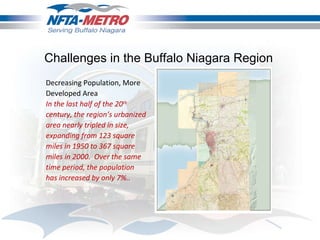
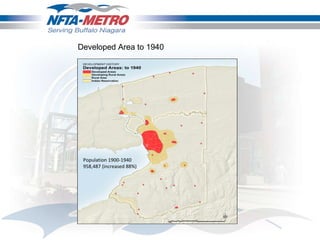
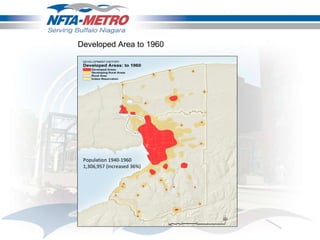
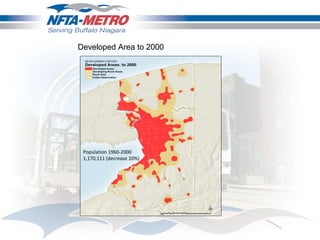
Decreasing Population, More Developed Area In the last half of the 20 th  century, the region’s urbanized area nearly tripled in size, expanding from 123 square miles in 1950 to 367 square miles in 2000.  Over the same time period, the population has increased by only 7%.. Challenges in the Buffalo Niagara Region
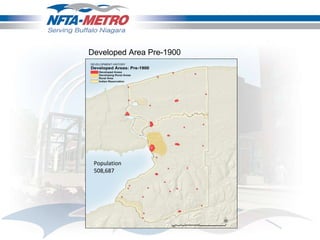
Developed Area Pre-1900 Population 508,687
Developed Area to 1940 Population 1900-1940 958,487 (increased 88%)
Developed Area to 1960 Population 1940-1960 1,306,957 (increased 36%)
Developed Area to 2000 Population 1960-2000 1,170,111 (decrease 10%)
Density Declines & Disinvestment Areas with the greatest densities have experienced the highest rates of decline. Where the loses have been greatest, declines have resulted in lower property values and local tax revenues, eroding demand for retail and commercial services, and housing deterioration and abandonment.  A recent study reports the following troubling statistic about regional imbalances: for every new household living in the area in the 1990s, four new homes were built.  Challenges for the Community
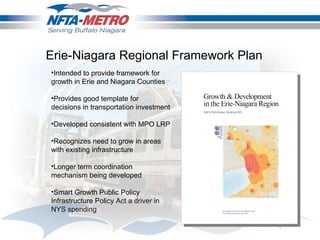
Intended to provide framework for growth in Erie and Niagara Counties Provides good template for decisions in transportation investment Developed consistent with MPO LRP Recognizes need to grow in areas with existing infrastructure Longer term coordination mechanism being developed Smart Growth Public Policy Infrastructure Policy Act a driver in NYS spending Erie-Niagara Regional Framework Plan
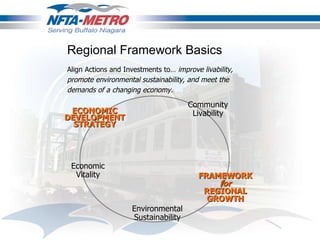
Regional Framework Basics Align Actions and Investments to…   improve livability, promote environmental sustainability, and meet the demands of a changing economy. ECONOMIC DEVELOPMENT STRATEGY FRAMEWORK for REGIONAL GROWTH Economic Vitality Community Livability Environmental Sustainability
 
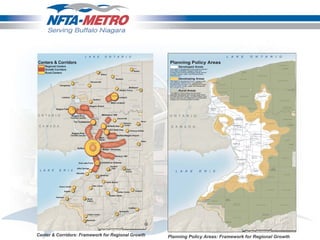
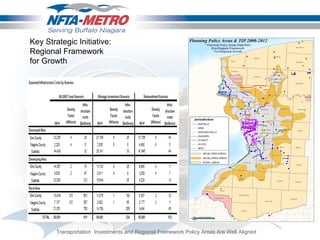
Key Strategic Initiative: Regional Framework for Growth Transportation  Investments and Regional Framework Policy Areas Are Well Aligned
Vital Centers Strategy Promoting investment in the region’s traditional centers of commerce, industry, and education. Early Ideas…   Priority Areas for Public Investment Incentives for Infill and Adaptive Reuse Framework Plan Strategies
Why is this Important? Good density can:  Enhance our economic competitiveness by attracting a diverse resident base Reduce pressure on local budgets  Reduce commuting time Protect the environment
Impact on Governmental Costs Declining population and expanding urbanized areas equals: Need for new infrastructure Need to maintain new and old infrastructure Longer average trip lengths and operating cost Lower densities and associated inefficiencies Impact on Government is fewer taxpayers, cost growth  What does this mean for Transit Authorities?
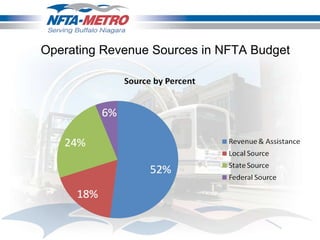
Typical Operating Fund Sources for Authorities Revenues and Assistance -Fees and services -Farebox Rental income Concessions Local Sources Sales Tax Mortgage tax 88c Local Government State Sources Federal Sources
Operating Revenue Sources in NFTA Budget
Urban City of Buffalo is a rich transit environment with many good corridors.  More focus given to improving these corridors, attracting more choice riders.  Key Improvements include: service frequencies, travel times, fleet, and facilities.  Linking city residents with suburban jobs is important for regional economy Most transit trips are for work or school/college. Need to simplify service to suburban job corridors and educational centers  May require some more flexible transit options  better matched to travel volumes.  Network connectivity needs to be improved. Key steps include: Improving service frequencies, use of consistent memory headways. Providing more direct links to key suburban hubs. Enhancing  transfer stop facilities. The Strategic Assessment Longer Term Region Building
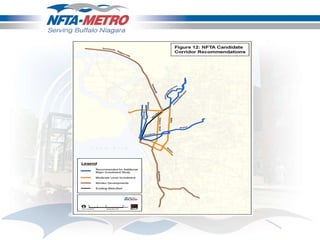
Implement ridership estimation and basic feasibility and cost benefit analysis of three high quality transit corridors that emerged as strong candidates for future major transit investment as follows:   Airport/Broadway Amherst/UB North Campus Delaware Avenue/Elmwood Avenue Initiate studies to consider various corridor transportation improvement options: Improvements to existing, Light Rail Transit (LRT), Bus Rapid Transit (BRT), Rapid Bus, Streetcar, Commuter Rail Next Steps in Building the Region and Transit Role
 
Strategic Framework Stronger Economy  Stronger Authority An updated transit service model: Provides structured approach to allocation of available resources to maximize system effectiveness.  Positions transit for a greater share of overall travel demand. Creates a market focused network that provides services to meet the various travel needs of the community.  Responds to both short and long term funding levels.  Identifies key corridors as priorities for transit investment .
Beyond The Service Plan What were other positive outcomes of the study? A redefinition of transit’s role in regional mobility and economic development  Reposition transit in “city-building” and regional development Future proofing: preparing the region for rising fuel prices and environmental initiatives  Develop closer links between NFTA and the community:  build advocacy and ownership
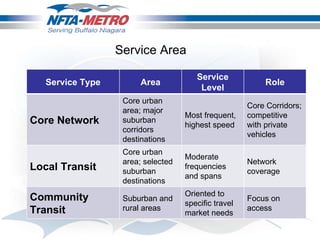
Service Area Service Type Area Service Level Role Core Network Core urban area; major suburban corridors destinations Most frequent, highest speed Core Corridors; competitive with private vehicles Local Transit Core urban area; selected suburban destinations Moderate frequencies and spans Network coverage Community Transit Suburban and rural areas Oriented to specific travel market needs Focus on access
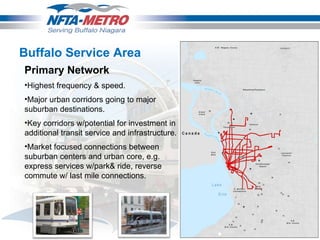
Buffalo Service Area Primary Network Highest frequency & speed. Major urban corridors going to major suburban destinations. Key corridors w/potential for investment in additional transit service and infrastructure. Market focused connections between suburban centers and urban core, e.g. express services w/park& ride, reverse commute w/ last mile connections.
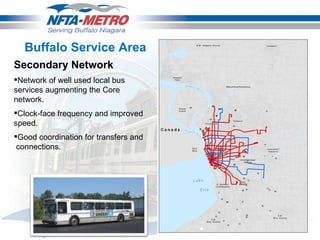
Buffalo Service Area Secondary Network Network of well used local bus services augmenting the Core network. Clock-face frequency and improved speed. Good coordination for transfers and  connections.
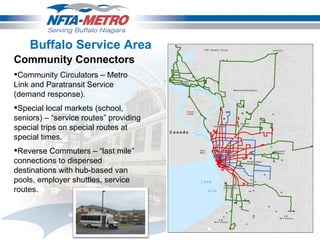
Buffalo Service Area Community Connectors Community Circulators – Metro Link and Paratransit Service (demand response). Special local markets (school, seniors) – “service routes” providing special trips on special routes at special times. Reverse Commuters – “last mile” connections to dispersed destinations with hub-based van pools, employer shuttles, service routes.
Public Informational Workshop  -  June 9, 2009, Public Information Meetings -  March 15, 2010, -  March 16, 2010 -  March 17, 2010 -  March 18, 2010 -  March 24, 2010 NFTA Advisory Committee on the Disabled Stakeholder Meeting -  April 1, 2010   Public Hearings -  May 24, 2010 -  May 25, 2010 -  May 26, 2010 -  May 27, 2010   Study information and opportunity to comment was on NFTA website throughout the study.   All public workshops, information meetings and hearings were advertised in newspapers, Metro rider alerts, NFTA website and news releases The Restructuring Proposals Community Review
Metro Service Restructuring – Summary of 300 Public Comments  Primary topics of comments received from public after restructuring.    Overcrowding during morning peak on several routes.  Reduced span of service, i.e., fewer early morning/late night trips primarily on weekends impacts ability to get to or from work.  Inconvenient connections or trip times and more transfers required.  Discontinued evening and weekend service , primarily in Cheektowaga(Route 1-William) and Lancaster(Routes 6/46 Sycamore). –  Service discontinued based on low ridership and high cost/passenger..   Discontinued service on some route segments, e.g. Route 24P-Genesee and 8B-Main.    Positive reaction to regular frequent headways on some routes.
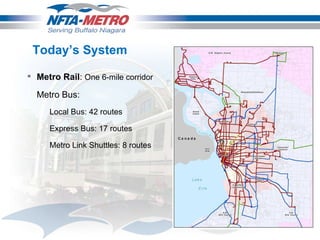
Metro Rail :  One 6-mile corridor Metro Bus:  Local Bus: 42 routes Express Bus: 17 routes Metro Link Shuttles: 8 routes Today’s System
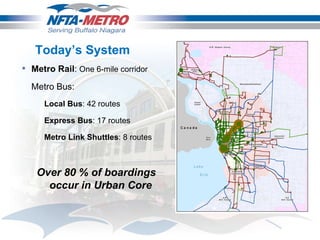
Today’s System Metro Rail :  One 6-mile corridor Metro Bus:  Local Bus : 42 routes Express Bus : 17 routes Metro Link Shuttles : 8 routes Over 80 % of boardings occur in Urban Core
Study Methodologies  New network plan developed from market and service findings  Market assessment included review of population and employment, demographics, existing rider profiles, travel patterns Service review included evaluation of existing system effectiveness and efficiency including detailed ridership analysis Both reviews identify opportunities and challenges in guiding restructuring efforts to enhance the system
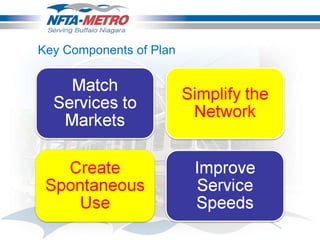
Key Components of Plan
Match Services to Markets The urban core is an area of proven transit success Transit potential limited to market based services and community connectors in suburban and rural communities where private car usage is most common The plan places great emphasis on investing in the urban core
Significant complexity resulted from the maintenance of historic service patterns and attempting to serve too many origins and destinations in suburban and rural areas Urban network relatively well structured, required minimal restructuring Suburban/rural routes characterized by multiple complex route patterns with significant resources serving very low ridership Fare structure was complicated by zone fares and transfer fees Simplify the Network The urban system needs to be marketed on its own strong merits
Create Spontaneous Use Service frequencies were universally uneven, primarily for efficiency and operational reasons making system very unpredictable  Even many of the strongest Metro routes had 15-minute headways only in peak periods, but they can also support 15 minute off-peak frequencies Uneven frequencies limited customer ability to use system as a network Plan recommended developing spontaneous use frequencies in the urban network
Improve Service Speeds System can increase operating speed by reducing unnecessary delay.  Plan recommended investment in key corridors: Continue working with City of Buffalo and other municipalities to update local traffic signal systems, and add transit signal priority  Transit priority measures at congestion points Refine bus stop locations and spacing Express services not very “express” (long routes, many stops) Plan recommended intercepting passengers at expressway Park and Rides (Next Implementation Phase) Plan recommended developing fast & frequent transit network
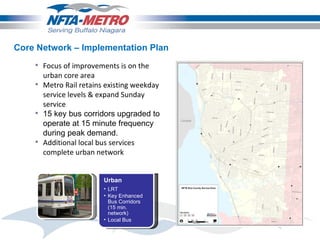
Focus of improvements is on the urban core area Metro Rail retains existing weekday service levels & expand Sunday service  15 key bus corridors upgraded to operate at 15 minute frequency during peak demand. Additional local bus services complete urban network Core Network – Implementation Plan Urban LRT Key Enhanced Bus Corridors (15 min. network) Local Bus
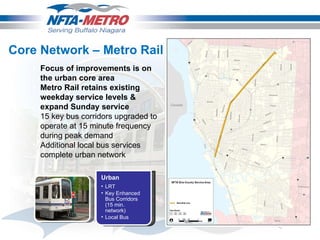
Core Network – Metro Rail Focus of improvements is on the urban core area Metro Rail retains existing weekday service levels & expand Sunday service  15 key bus corridors upgraded to operate at 15 minute frequency during peak demand Additional local bus services complete urban network Urban LRT Key Enhanced Bus Corridors (15 min. network) Local Bus
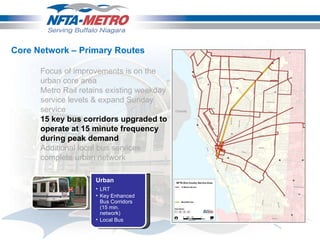
Core Network – Primary Routes Focus of improvements is on the urban core area Metro Rail retains existing weekday service levels & expand Sunday service  15 key bus corridors upgraded to operate at 15 minute frequency during peak demand Additional local bus services complete urban network Urban LRT Key Enhanced Bus Corridors (15 min. network) Local Bus
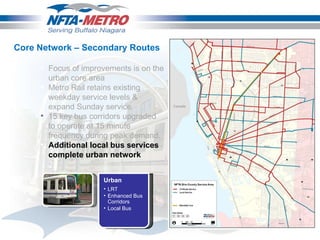
Focus of improvements is on the urban core area Metro Rail retains existing weekday service levels & expand Sunday service  15 key bus corridors upgraded to operate at 15 minute frequency during peak demand. Additional local bus services complete urban network Core Network – Secondary Routes Urban LRT Enhanced Bus Corridors Local Bus
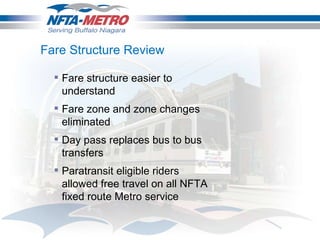
Fare Structure Review Fare structure easier to understand Fare zone and zone changes eliminated Day pass replaces bus to bus transfers Paratransit eligible riders allowed free travel on all NFTA fixed route Metro service
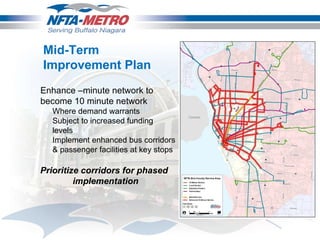
Mid-Term  Improvement Plan Enhance –minute network to become 10 minute network Where demand warrants Subject to increased funding levels Implement enhanced bus corridors & passenger facilities at key stops Prioritize corridors for phased implementation
Four historic major capital investment corridors and six major bus corridors reviewed for high-level transit investment, based on: Potential future demand (population/employment) Development potential Comparison with peer rail or BRT system conditions Three candidate corridor pairs emerged for detailed study Amherst/UB North (two options) Airport and/or Broadway Elmwood Ave or Delaware Ave Consider various corridor transit mode options Light Rail Transit (LRT), Bus Rapid Transit (BRT), Rapid Bus, Streetcar, Commuter Rail Long Term Plan (7-12yrs)
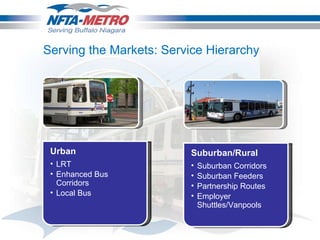
Serving the Markets: Service Hierarchy  Urban LRT Enhanced Bus Corridors Local Bus Suburban/Rural Suburban Corridors Suburban Feeders Partnership Routes Employer Shuttles/Vanpools
Was the Restructuring of Metro Service Successful? Trends, Observations and Actions Average weekday ridership up 6.7% and productivity (riders per revenue hour) is up 7.4%.  Refinements to restructured service to improve efficiency and respond to ridership demand continues. Improved service to suburban commercial corridors – area shopping malls.  Ridership up. Did not totally realize overall annual cost savings due to final “run” configuration. Did not implement “ALL” recommendations due to outside forces. Reduced ridership on express routes and productivity increased. Customers have adjusted and/or responded to restructured service.
Added service to alleviate overcrowding conditions on peak-period trips,  late evening and early morning work trips.       Adjusted routes to make better connections .      Positive reaction to regular frequent headways on some routes Continued refinements to restructured service to improve efficiency and respond to ridership demand continues. Customers have adjusted and/or responded to restructured service.  Was the Restructuring of Metro Service Successful? Trends, Observations and Actions
Continue to monitor service levels and apply new service standards to measure transit performance. Initiate route specific marketing/awareness activities for new service in coordination with other entities and organizations . Continue to grow system ridership Next Steps
Questions? Contact Information [email_address] [email_address]

NFTA Metro Route Restructuring

  • 1.
    Regional Planning Perspectiveson Transit Restructuring Longer Term Development and Financial Implications
  • 2.
    James Morrell Managerof Service Planning NFTA Metro And Hal Morse Executive Director Greater Buffalo Niagara Regional Transportation Council
  • 3.
    Decreasing Population, MoreDeveloped Area In the last half of the 20 th century, the region’s urbanized area nearly tripled in size, expanding from 123 square miles in 1950 to 367 square miles in 2000. Over the same time period, the population has increased by only 7%.. Challenges in the Buffalo Niagara Region
  • 4.
    Developed Area Pre-1900Population 508,687
  • 5.
    Developed Area to1940 Population 1900-1940 958,487 (increased 88%)
  • 6.
    Developed Area to1960 Population 1940-1960 1,306,957 (increased 36%)
  • 7.
    Developed Area to2000 Population 1960-2000 1,170,111 (decrease 10%)
  • 8.
    Density Declines &Disinvestment Areas with the greatest densities have experienced the highest rates of decline. Where the loses have been greatest, declines have resulted in lower property values and local tax revenues, eroding demand for retail and commercial services, and housing deterioration and abandonment. A recent study reports the following troubling statistic about regional imbalances: for every new household living in the area in the 1990s, four new homes were built. Challenges for the Community
  • 9.
    Intended to provideframework for growth in Erie and Niagara Counties Provides good template for decisions in transportation investment Developed consistent with MPO LRP Recognizes need to grow in areas with existing infrastructure Longer term coordination mechanism being developed Smart Growth Public Policy Infrastructure Policy Act a driver in NYS spending Erie-Niagara Regional Framework Plan
  • 10.
    Regional Framework BasicsAlign Actions and Investments to… improve livability, promote environmental sustainability, and meet the demands of a changing economy. ECONOMIC DEVELOPMENT STRATEGY FRAMEWORK for REGIONAL GROWTH Economic Vitality Community Livability Environmental Sustainability
  • 11.
  • 12.
    Key Strategic Initiative:Regional Framework for Growth Transportation Investments and Regional Framework Policy Areas Are Well Aligned
  • 13.
    Vital Centers StrategyPromoting investment in the region’s traditional centers of commerce, industry, and education. Early Ideas… Priority Areas for Public Investment Incentives for Infill and Adaptive Reuse Framework Plan Strategies
  • 14.
    Why is thisImportant? Good density can: Enhance our economic competitiveness by attracting a diverse resident base Reduce pressure on local budgets Reduce commuting time Protect the environment
  • 15.
    Impact on GovernmentalCosts Declining population and expanding urbanized areas equals: Need for new infrastructure Need to maintain new and old infrastructure Longer average trip lengths and operating cost Lower densities and associated inefficiencies Impact on Government is fewer taxpayers, cost growth What does this mean for Transit Authorities?
  • 16.
    Typical Operating FundSources for Authorities Revenues and Assistance -Fees and services -Farebox Rental income Concessions Local Sources Sales Tax Mortgage tax 88c Local Government State Sources Federal Sources
  • 17.
  • 18.
    Urban City ofBuffalo is a rich transit environment with many good corridors. More focus given to improving these corridors, attracting more choice riders. Key Improvements include: service frequencies, travel times, fleet, and facilities. Linking city residents with suburban jobs is important for regional economy Most transit trips are for work or school/college. Need to simplify service to suburban job corridors and educational centers May require some more flexible transit options better matched to travel volumes. Network connectivity needs to be improved. Key steps include: Improving service frequencies, use of consistent memory headways. Providing more direct links to key suburban hubs. Enhancing transfer stop facilities. The Strategic Assessment Longer Term Region Building
  • 19.
    Implement ridership estimationand basic feasibility and cost benefit analysis of three high quality transit corridors that emerged as strong candidates for future major transit investment as follows:   Airport/Broadway Amherst/UB North Campus Delaware Avenue/Elmwood Avenue Initiate studies to consider various corridor transportation improvement options: Improvements to existing, Light Rail Transit (LRT), Bus Rapid Transit (BRT), Rapid Bus, Streetcar, Commuter Rail Next Steps in Building the Region and Transit Role
  • 20.
  • 21.
    Strategic Framework StrongerEconomy Stronger Authority An updated transit service model: Provides structured approach to allocation of available resources to maximize system effectiveness. Positions transit for a greater share of overall travel demand. Creates a market focused network that provides services to meet the various travel needs of the community. Responds to both short and long term funding levels. Identifies key corridors as priorities for transit investment .
  • 22.
    Beyond The ServicePlan What were other positive outcomes of the study? A redefinition of transit’s role in regional mobility and economic development Reposition transit in “city-building” and regional development Future proofing: preparing the region for rising fuel prices and environmental initiatives Develop closer links between NFTA and the community: build advocacy and ownership
  • 23.
    Service Area ServiceType Area Service Level Role Core Network Core urban area; major suburban corridors destinations Most frequent, highest speed Core Corridors; competitive with private vehicles Local Transit Core urban area; selected suburban destinations Moderate frequencies and spans Network coverage Community Transit Suburban and rural areas Oriented to specific travel market needs Focus on access
  • 24.
    Buffalo Service AreaPrimary Network Highest frequency & speed. Major urban corridors going to major suburban destinations. Key corridors w/potential for investment in additional transit service and infrastructure. Market focused connections between suburban centers and urban core, e.g. express services w/park& ride, reverse commute w/ last mile connections.
  • 25.
    Buffalo Service AreaSecondary Network Network of well used local bus services augmenting the Core network. Clock-face frequency and improved speed. Good coordination for transfers and connections.
  • 26.
    Buffalo Service AreaCommunity Connectors Community Circulators – Metro Link and Paratransit Service (demand response). Special local markets (school, seniors) – “service routes” providing special trips on special routes at special times. Reverse Commuters – “last mile” connections to dispersed destinations with hub-based van pools, employer shuttles, service routes.
  • 27.
    Public Informational Workshop - June 9, 2009, Public Information Meetings - March 15, 2010, - March 16, 2010 - March 17, 2010 - March 18, 2010 - March 24, 2010 NFTA Advisory Committee on the Disabled Stakeholder Meeting - April 1, 2010   Public Hearings - May 24, 2010 - May 25, 2010 - May 26, 2010 - May 27, 2010   Study information and opportunity to comment was on NFTA website throughout the study.   All public workshops, information meetings and hearings were advertised in newspapers, Metro rider alerts, NFTA website and news releases The Restructuring Proposals Community Review
  • 28.
    Metro Service Restructuring– Summary of 300 Public Comments Primary topics of comments received from public after restructuring.   Overcrowding during morning peak on several routes. Reduced span of service, i.e., fewer early morning/late night trips primarily on weekends impacts ability to get to or from work. Inconvenient connections or trip times and more transfers required. Discontinued evening and weekend service , primarily in Cheektowaga(Route 1-William) and Lancaster(Routes 6/46 Sycamore). – Service discontinued based on low ridership and high cost/passenger..   Discontinued service on some route segments, e.g. Route 24P-Genesee and 8B-Main.   Positive reaction to regular frequent headways on some routes.
  • 29.
    Metro Rail : One 6-mile corridor Metro Bus: Local Bus: 42 routes Express Bus: 17 routes Metro Link Shuttles: 8 routes Today’s System
  • 30.
    Today’s System MetroRail : One 6-mile corridor Metro Bus: Local Bus : 42 routes Express Bus : 17 routes Metro Link Shuttles : 8 routes Over 80 % of boardings occur in Urban Core
  • 31.
    Study Methodologies New network plan developed from market and service findings Market assessment included review of population and employment, demographics, existing rider profiles, travel patterns Service review included evaluation of existing system effectiveness and efficiency including detailed ridership analysis Both reviews identify opportunities and challenges in guiding restructuring efforts to enhance the system
  • 32.
  • 33.
    Match Services toMarkets The urban core is an area of proven transit success Transit potential limited to market based services and community connectors in suburban and rural communities where private car usage is most common The plan places great emphasis on investing in the urban core
  • 34.
    Significant complexity resultedfrom the maintenance of historic service patterns and attempting to serve too many origins and destinations in suburban and rural areas Urban network relatively well structured, required minimal restructuring Suburban/rural routes characterized by multiple complex route patterns with significant resources serving very low ridership Fare structure was complicated by zone fares and transfer fees Simplify the Network The urban system needs to be marketed on its own strong merits
  • 35.
    Create Spontaneous UseService frequencies were universally uneven, primarily for efficiency and operational reasons making system very unpredictable Even many of the strongest Metro routes had 15-minute headways only in peak periods, but they can also support 15 minute off-peak frequencies Uneven frequencies limited customer ability to use system as a network Plan recommended developing spontaneous use frequencies in the urban network
  • 36.
    Improve Service SpeedsSystem can increase operating speed by reducing unnecessary delay. Plan recommended investment in key corridors: Continue working with City of Buffalo and other municipalities to update local traffic signal systems, and add transit signal priority Transit priority measures at congestion points Refine bus stop locations and spacing Express services not very “express” (long routes, many stops) Plan recommended intercepting passengers at expressway Park and Rides (Next Implementation Phase) Plan recommended developing fast & frequent transit network
  • 37.
    Focus of improvementsis on the urban core area Metro Rail retains existing weekday service levels & expand Sunday service 15 key bus corridors upgraded to operate at 15 minute frequency during peak demand. Additional local bus services complete urban network Core Network – Implementation Plan Urban LRT Key Enhanced Bus Corridors (15 min. network) Local Bus
  • 38.
    Core Network –Metro Rail Focus of improvements is on the urban core area Metro Rail retains existing weekday service levels & expand Sunday service 15 key bus corridors upgraded to operate at 15 minute frequency during peak demand Additional local bus services complete urban network Urban LRT Key Enhanced Bus Corridors (15 min. network) Local Bus
  • 39.
    Core Network –Primary Routes Focus of improvements is on the urban core area Metro Rail retains existing weekday service levels & expand Sunday service 15 key bus corridors upgraded to operate at 15 minute frequency during peak demand Additional local bus services complete urban network Urban LRT Key Enhanced Bus Corridors (15 min. network) Local Bus
  • 40.
    Focus of improvementsis on the urban core area Metro Rail retains existing weekday service levels & expand Sunday service 15 key bus corridors upgraded to operate at 15 minute frequency during peak demand. Additional local bus services complete urban network Core Network – Secondary Routes Urban LRT Enhanced Bus Corridors Local Bus
  • 41.
    Fare Structure ReviewFare structure easier to understand Fare zone and zone changes eliminated Day pass replaces bus to bus transfers Paratransit eligible riders allowed free travel on all NFTA fixed route Metro service
  • 42.
    Mid-Term ImprovementPlan Enhance –minute network to become 10 minute network Where demand warrants Subject to increased funding levels Implement enhanced bus corridors & passenger facilities at key stops Prioritize corridors for phased implementation
  • 43.
    Four historic majorcapital investment corridors and six major bus corridors reviewed for high-level transit investment, based on: Potential future demand (population/employment) Development potential Comparison with peer rail or BRT system conditions Three candidate corridor pairs emerged for detailed study Amherst/UB North (two options) Airport and/or Broadway Elmwood Ave or Delaware Ave Consider various corridor transit mode options Light Rail Transit (LRT), Bus Rapid Transit (BRT), Rapid Bus, Streetcar, Commuter Rail Long Term Plan (7-12yrs)
  • 44.
    Serving the Markets:Service Hierarchy Urban LRT Enhanced Bus Corridors Local Bus Suburban/Rural Suburban Corridors Suburban Feeders Partnership Routes Employer Shuttles/Vanpools
  • 45.
    Was the Restructuringof Metro Service Successful? Trends, Observations and Actions Average weekday ridership up 6.7% and productivity (riders per revenue hour) is up 7.4%. Refinements to restructured service to improve efficiency and respond to ridership demand continues. Improved service to suburban commercial corridors – area shopping malls. Ridership up. Did not totally realize overall annual cost savings due to final “run” configuration. Did not implement “ALL” recommendations due to outside forces. Reduced ridership on express routes and productivity increased. Customers have adjusted and/or responded to restructured service.
  • 46.
    Added service toalleviate overcrowding conditions on peak-period trips, late evening and early morning work trips.     Adjusted routes to make better connections .     Positive reaction to regular frequent headways on some routes Continued refinements to restructured service to improve efficiency and respond to ridership demand continues. Customers have adjusted and/or responded to restructured service. Was the Restructuring of Metro Service Successful? Trends, Observations and Actions
  • 47.
    Continue to monitorservice levels and apply new service standards to measure transit performance. Initiate route specific marketing/awareness activities for new service in coordination with other entities and organizations . Continue to grow system ridership Next Steps
  • 48.
    Questions? Contact Information[email_address] [email_address]