BUDGET
WRITING
BY: CHINAZOR ONOVO
FOR: PRESTON HEALTHCARE CONSULTING LTD.
DATE: 7TH APRIL 2017
Outline:
•Objectives
•Terminology
•Introduction
•Budget techniques
•What makes a good budget
•Types of budget
•Budget process
•Best practice in budget writing
•Conclusion
Objectives:
• To understand the different functions of every stage in budget writing.
•To know how to write activity budget.
•To know what makes a good budget.
•To know the best practices in writing a good budget.
Terminology
• Income and Expenditure: This budget lists all the incoming funds and
recurrent ( ie regularly occurring ) cost for a specified period.
• Capital: It’s a one off expenditure for items such as equipment, property,
vehicles or major building works, which will be used for several years.
• Zero -base: Where the budget is built from the scratch, and not based on
previous budget.
•Activity based : Where the budget is built up from a detailed activity plan.
Terminology contd.
•Donor: A donor in general is a person, organization or government who donates
something (Money or Assets) voluntarily.
Introduction:
Budget is an amount of money that a person or an organization plans to raise and
spend for a set purpose over a given period of time.
When writing a budget, different functions are expected namely:
• Planning
• Fundraising
• Project implementation
• Monitoring and Evaluation
Planning:
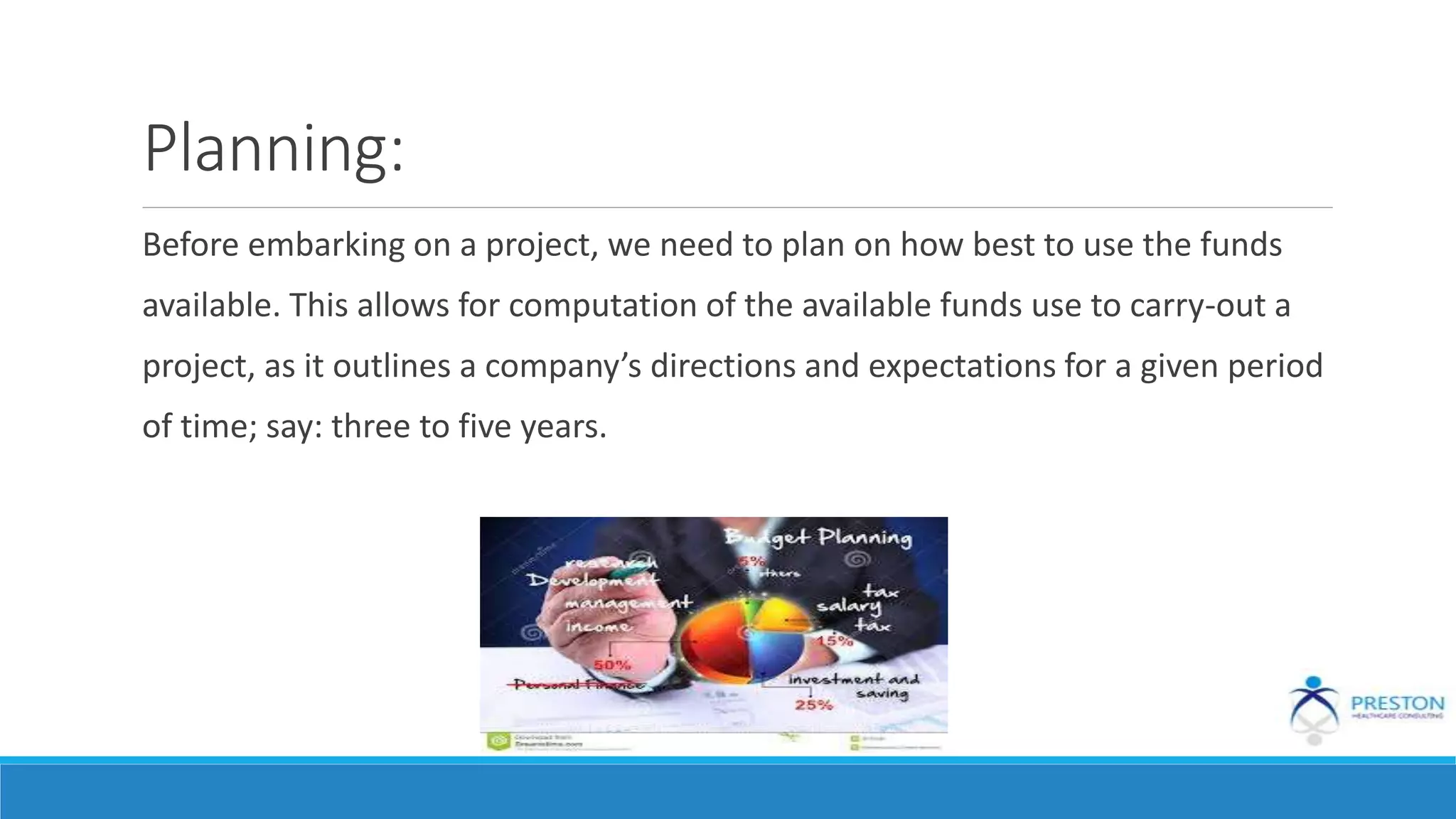
Before embarking on a project, we need to plan on how best to use the funds
available. This allows for computation of the available funds use to carry-out a
project, as it outlines a company’s directions and expectations for a given period
of time; say: three to five years.
Fundraising:
Fundraising is defined as the process of gathering voluntary contributions of money or
other resources, by requesting donations from individuals, businesses, charitable
foundations, or government agencies.
Typically, it refers to efforts to gather money for Non-Profit Organizations (NPOs).
Fundraising Contd.
For NGOs, budget is a critical part of any negotiation with donors. It sets out in
detail what the NGO will do with a grant, including what the money will be spent
on, and what results will be achieved.
Budget implementation:
•This is the phase where vision and plans become reality. The most
important tool for an on-going implementation is comparing the actual
costs against the budgeted costs, as an accurate budget is needed to
control the project.
Monitoring and evaluation:
The budget is used as a tool for monitoring and evaluating the success of the
project. It helps to answer the question “Did the project
achieve what it set out to achieve?”
Budget is being monitored to determine what changes need to be made as it
relates to a given project
Budgeting techniques
There are two main ways to build a budget and you should adopt the approach
which works for you given the skills and time available:
• Incremental
• Zero-base
Incremental budget:
Incremental budget is a budget prepared using a previous period’s budget or
actual performance as a basis with provision for inflation and known changes
in activity levels. It has advantage of being fairly simple and quick to implement.
Zero-based budgeting:
•This approach starts on a clean sheet or from “a zero base”. It ignores previous
budgets and starts with the next year’s targets and activities.
• Zero base requires the writer of the budget to justify all the resources
requirements, as every function within an organization is analyzed for its needs
and costs.
Contd.
Activity based budget:
•It is a special form of zero –based budgeting and is frequently used in NGO
sector to create project budget. It is a budget system under which costs are
associated with activities, and budgeted expenditures are then compiled based
on the expected activity level.
Budget writing with worksheet
• A budget worksheet is used in activity –based and zero-based budgeting. It is
usually done in an excel worksheet.
Items in the worksheet includes:
• Line reference: Is useful when discussing the budget and need to draw
attention to a particular line in the worksheet e.g. line 1.1
• Description: a detailed account of a certain aspects or features of the object(a
short description of each line.
• Unit type: Is a type that indicates the absence of specific value e.g. per night,
per day
Worksheet contd.
• No. Unit: Specifies the number of units required in the project e.g. 22
fieldworkers
• No. Times or Frequency: the number of time a value occurs, and it is useful where
items are described more than once.
• Unit Cost: This describes what each unit cost as defined in the budget. E.g the
cost of lunch for 22 fieldworkers on each day for 4 days at 50k per person
[22*4*50] N4400.
•Note: Comments column is to clarify what item is for and how quantities have
been arrived at.
Worksheet contd.
• Accounts Code: Is used in the organization’s accounting records ( ie as listed in
the Charts of accounts). (Optional)
•Donor Code: It is very useful to add another column which details the donor
code or line item reference as this makes it easy to transfer the budget figures
into the donor budget and reporting format.( Optional)
Example of a worksheet
Ref Description Unit type No.Unit No.Times Unit Cost Total Cost
1.1Hall for the workshop Days 4 1 25 100
1.2Tutors’ fees Days 4 2 100 800
1.3Tutors’ accommodation Night 5 2 50 500
1.4Lunch Person 22 4 5 440
1.5Course hand book Person 22 1 5 110
TOTAL 1950
What makes a good budget:
A good budget is that which clearly shows the need for individuals/organizations
to fulfil their management responsibilities.
The followings are some of the elements of what makes a good budget:
• Fit for purpose.
• Should have the right level of detail for the user.
• Costs are justifiable and accurate.
• Easy to use.
•
Contd.
• Calculations are clear.
• Include explanatory notes where needed.
Types of Budget
There are two types of Budget namely:
• Income & Expenditure budget.
• Capital budget.
Income and Expenditure:
It sets out the anticipated running costs of an organization and shows where the
funds will come from to cover the costs.
Capital budget:
It lists the expenditure you intend to make for the coming years on capital
Projects, and one-off items of equipment that will form part of the
organization’s fixed assets.
These usually involve major expenditure and non-recurrent costs, it is better to
list and monitor them separately.
Budgeting process
Budgeting process is a formal and structured foundational procedure by which
an organization or individual creates and manages a financial plan (budget).
It involves asking questions such as:
•What are the objectives of the projects?
•What activities will be involved in achieving this objectives?
•What resources will be needed to perform these activities?
Best practice in budget writing
The best practice is a technique or methodology that, through experience and
research , has proven to reliably lead to a desired result.
•Clarity: Since different people will need to use the budget for different
purposes, they should be able to understand it without any additional
explanation beyond what is written down.
•Budget heading:
When writing a budget it is important to pay attention to Charts of Accounts.
Contd.
This is because the budget line items also appear in the book of accounts and on
management reports, listing all the main types of income and expenditure that a
project or department might have in a typical year.
• Estimating costs:
Estimating costs are quantitative assessment of the likely cost of the resources
required to complete project activities.
Contd.
• Contingencies:
Are items included in the budget for unforeseen expenses. It is best to include
these for budget lines that might need “cushion” e.g. store items, fuel
rather than adding a bottom line percentage.
•Check your figures:
Check the figures for accuracy, and make sure you include all the resources
needed for the activity and if the total cost looks justifiable.
Conclusion
•Since budget writing is a financial plan that relates directly to the activities of
the organization, it is important to involve those who will be responsible for the
project implementation in writing the budget. If this is not done, the budget
could be less accurate .
•Budget writing tells your money where to go, otherwise you wonder where it
went……… J . Edgar Hoover
Budget writing

Budget writing

  • 1.
    BUDGET WRITING BY: CHINAZOR ONOVO FOR:PRESTON HEALTHCARE CONSULTING LTD. DATE: 7TH APRIL 2017
  • 2.
    Outline: •Objectives •Terminology •Introduction •Budget techniques •What makesa good budget •Types of budget •Budget process •Best practice in budget writing •Conclusion
  • 3.
    Objectives: • To understandthe different functions of every stage in budget writing. •To know how to write activity budget. •To know what makes a good budget. •To know the best practices in writing a good budget.
  • 4.
    Terminology • Income andExpenditure: This budget lists all the incoming funds and recurrent ( ie regularly occurring ) cost for a specified period. • Capital: It’s a one off expenditure for items such as equipment, property, vehicles or major building works, which will be used for several years. • Zero -base: Where the budget is built from the scratch, and not based on previous budget. •Activity based : Where the budget is built up from a detailed activity plan.
  • 5.
    Terminology contd. •Donor: Adonor in general is a person, organization or government who donates something (Money or Assets) voluntarily.
  • 6.
    Introduction: Budget is anamount of money that a person or an organization plans to raise and spend for a set purpose over a given period of time. When writing a budget, different functions are expected namely: • Planning • Fundraising • Project implementation • Monitoring and Evaluation
  • 7.
    Planning: Before embarking ona project, we need to plan on how best to use the funds available. This allows for computation of the available funds use to carry-out a project, as it outlines a company’s directions and expectations for a given period of time; say: three to five years.
  • 8.
    Fundraising: Fundraising is definedas the process of gathering voluntary contributions of money or other resources, by requesting donations from individuals, businesses, charitable foundations, or government agencies. Typically, it refers to efforts to gather money for Non-Profit Organizations (NPOs).
  • 9.
    Fundraising Contd. For NGOs,budget is a critical part of any negotiation with donors. It sets out in detail what the NGO will do with a grant, including what the money will be spent on, and what results will be achieved.
  • 10.
    Budget implementation: •This isthe phase where vision and plans become reality. The most important tool for an on-going implementation is comparing the actual costs against the budgeted costs, as an accurate budget is needed to control the project.
  • 11.
    Monitoring and evaluation: Thebudget is used as a tool for monitoring and evaluating the success of the project. It helps to answer the question “Did the project achieve what it set out to achieve?” Budget is being monitored to determine what changes need to be made as it relates to a given project
  • 12.
    Budgeting techniques There aretwo main ways to build a budget and you should adopt the approach which works for you given the skills and time available: • Incremental • Zero-base
  • 13.
    Incremental budget: Incremental budgetis a budget prepared using a previous period’s budget or actual performance as a basis with provision for inflation and known changes in activity levels. It has advantage of being fairly simple and quick to implement.
  • 14.
    Zero-based budgeting: •This approachstarts on a clean sheet or from “a zero base”. It ignores previous budgets and starts with the next year’s targets and activities. • Zero base requires the writer of the budget to justify all the resources requirements, as every function within an organization is analyzed for its needs and costs.
  • 15.
    Contd. Activity based budget: •Itis a special form of zero –based budgeting and is frequently used in NGO sector to create project budget. It is a budget system under which costs are associated with activities, and budgeted expenditures are then compiled based on the expected activity level.
  • 16.
    Budget writing withworksheet • A budget worksheet is used in activity –based and zero-based budgeting. It is usually done in an excel worksheet. Items in the worksheet includes: • Line reference: Is useful when discussing the budget and need to draw attention to a particular line in the worksheet e.g. line 1.1 • Description: a detailed account of a certain aspects or features of the object(a short description of each line. • Unit type: Is a type that indicates the absence of specific value e.g. per night, per day
  • 17.
    Worksheet contd. • No.Unit: Specifies the number of units required in the project e.g. 22 fieldworkers • No. Times or Frequency: the number of time a value occurs, and it is useful where items are described more than once. • Unit Cost: This describes what each unit cost as defined in the budget. E.g the cost of lunch for 22 fieldworkers on each day for 4 days at 50k per person [22*4*50] N4400. •Note: Comments column is to clarify what item is for and how quantities have been arrived at.
  • 18.
    Worksheet contd. • AccountsCode: Is used in the organization’s accounting records ( ie as listed in the Charts of accounts). (Optional) •Donor Code: It is very useful to add another column which details the donor code or line item reference as this makes it easy to transfer the budget figures into the donor budget and reporting format.( Optional)
  • 19.
    Example of aworksheet Ref Description Unit type No.Unit No.Times Unit Cost Total Cost 1.1Hall for the workshop Days 4 1 25 100 1.2Tutors’ fees Days 4 2 100 800 1.3Tutors’ accommodation Night 5 2 50 500 1.4Lunch Person 22 4 5 440 1.5Course hand book Person 22 1 5 110 TOTAL 1950
  • 20.
    What makes agood budget: A good budget is that which clearly shows the need for individuals/organizations to fulfil their management responsibilities. The followings are some of the elements of what makes a good budget: • Fit for purpose. • Should have the right level of detail for the user. • Costs are justifiable and accurate. • Easy to use. •
  • 21.
    Contd. • Calculations areclear. • Include explanatory notes where needed.
  • 22.
    Types of Budget Thereare two types of Budget namely: • Income & Expenditure budget. • Capital budget.
  • 23.
    Income and Expenditure: Itsets out the anticipated running costs of an organization and shows where the funds will come from to cover the costs.
  • 24.
    Capital budget: It liststhe expenditure you intend to make for the coming years on capital Projects, and one-off items of equipment that will form part of the organization’s fixed assets. These usually involve major expenditure and non-recurrent costs, it is better to list and monitor them separately.
  • 25.
    Budgeting process Budgeting processis a formal and structured foundational procedure by which an organization or individual creates and manages a financial plan (budget). It involves asking questions such as: •What are the objectives of the projects? •What activities will be involved in achieving this objectives? •What resources will be needed to perform these activities?
  • 26.
    Best practice inbudget writing The best practice is a technique or methodology that, through experience and research , has proven to reliably lead to a desired result. •Clarity: Since different people will need to use the budget for different purposes, they should be able to understand it without any additional explanation beyond what is written down. •Budget heading: When writing a budget it is important to pay attention to Charts of Accounts.
  • 27.
    Contd. This is becausethe budget line items also appear in the book of accounts and on management reports, listing all the main types of income and expenditure that a project or department might have in a typical year. • Estimating costs: Estimating costs are quantitative assessment of the likely cost of the resources required to complete project activities.
  • 28.
    Contd. • Contingencies: Are itemsincluded in the budget for unforeseen expenses. It is best to include these for budget lines that might need “cushion” e.g. store items, fuel rather than adding a bottom line percentage. •Check your figures: Check the figures for accuracy, and make sure you include all the resources needed for the activity and if the total cost looks justifiable.
  • 29.
    Conclusion •Since budget writingis a financial plan that relates directly to the activities of the organization, it is important to involve those who will be responsible for the project implementation in writing the budget. If this is not done, the budget could be less accurate . •Budget writing tells your money where to go, otherwise you wonder where it went……… J . Edgar Hoover