Award Number
ACI-1547611
Extended Developer
Support All Hands
Meeting
March 15th, 2017
2
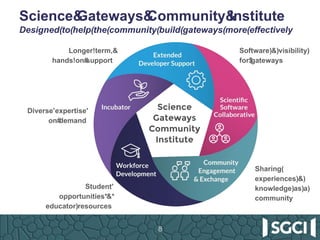
Science&Gateways&Community&Institute
Designed(to(help(the(community(build(gateways(more(effectively
8
Diverse'expertise'
on#demand
Longer!term,&
hands!on#support
Student'
opportunities*&*
educator)resources
Sharing(
experiences)&)
knowledge)as)a)
community
Software)&)visibility)
for$gateways
Extended Developer Support
• We are programmers, designers, architects,
hackers, problem solvers, engineers, makers,
advisors, gurus, etc.
• We help create new gateways
• We help improve existing gateways
3
Example EDS Consultations
• Use an existing framework like HUBzero, Agave,
Apache Airavata, Galaxy, Jupyter, etc to create a
new gateway.
• Help a client make technology choices for
building a gateway
• Help a client improve an existing gateway
• This may include technologies that you are not familiar
with.
4
What We Don’t Do: All the work
• EDS consultations are time and effort limited.
• Consultations should be about 6-12 months and
about 25% of your effort, on average
• The client must be involved at all steps, must be
able to use what we’ve done after the
consultation is over.
5
6
The EDS Process
Step 1: Clients Request Support
• http://sciencegateways.org/services/gateway-
services-request-form/
• If you know of any potential SGCI clients, send
them here.
7
Step 2: The Initial Interview
• Marlon conducts these.
• Goal is to understand the project and its
requirements
• What are the major deliverables?
• What is the timeline?
• Is the client ready for support?
• All consultations have a Google Drive folder
• Notes from initial and follow up interviews
• Copy of the work plan template
8
Step 3: Assign a Consultant
• Sometimes this is obvious
• Agave projects go to Agave developers, for example
• If you recruit a project, you will be assigned to it.
• Load balancing across EDS consultants
• Sometimes it is not obvious
• I will post these to the EDS staff list for volunteers.
9
Step 4: Hand Off Interview
• The consultant conduct a second interview with
the client
• I attend to help bridge the interviews.
• In some cases, this can be skipped.
10
Step 5: Work Plan
• More about this in a moment
• All projects should complete a work plan within
2-4 weeks.
• Work plans should last 6 months with possible 6
month extensions.
11
Step 6: Work
• Transfer the milestones from your work plan into
Jira
• Update milestones in Jira each month
12
Step 7: Stop Working
• All consultations come to an end after 6-12
months.
• Submit a brief final report
• Nancy Wilkins-Diehr will conduct exit interviews.
• Work can also end prematurely
• We couldn’t articulate a work plan
• The consultation just didn’t work out
• Other causes: tell me
13
How We Are Judged
• How many consultations have we conducted?
• Were we successful?
• Short term: did we accomplish the main deliverables?
• Long term: is the gateway sustained? Growing?
• Are there opportunities for more in-depth, funded
work?
• Did we get referrals?
14
15
The Work Plan
Work Plan Template
• https://docs.google.com/document/d/1aVmctdnm
E_tdXA1Z5IzfO52gvPOoS0Mf3HeHzRDNEUw/e
dit
• I will copy this into each consultation folder in
Google Drive for you and the client to edit.
16
Work Plan Section: Deliverables
• Each project should have 1-3 concrete
deliverables.
• These are specific things that the consultation
will accomplish in 6-12 months.
• We will identify these in the first interviews.
• Inability to do this is a red flag
17
Work Plan Section: Milestones
• You should have 1 milestone per month, about 6
milestones total.
• Milestones go into Jira.
• More about this later
• Milestones help you reach the deliverables.
• You should be able to know when you are done.
18
Work Plan Section: External Driving
Deliverables and Constraints
• Will the client be going on sabbatical in 2
months? Is the postdoc leaving? Does a postdoc
need to be hired? Is the grant ending? Is the
grant starting?
• These external factors can positively or
negatively affect the consultation, so we need to
make sure we know what they are.
19
Work Plan Section: Outreach
Deliverables
• Identify opportunities to publicize the work to the
gateway’s community
• These may help drive the work and the timeline.
20
Work Plan Sections: Metrics and
Analytics, Citations
• Metrics: The client should think about the right
way to measure the success of the gateway.
• We should help make recommendations
• The SGCI Incubator should provide general guidelines
• Citations:
• Gateways should cite the SGCI in papers. This helps
us track our long term impact.
• Gateways have multiple opportunities to do this
• Gateways conference series (SGCI sponsored)
• PEARC
21
Work Plan Section: Resources
• The client identifies who will be doing the work
from her/his team.
• This is short but very important.
• You identify here who you will be working with.
• Who answers your emails, etc?
22
23
SGCI Jira
Jira Overview
• Purpose: be a living version of the work plan
• Update it to help me know how things are going.
• Modify milestones as needed. The work plan isn’t set
in stone.
• All EDS consultations have two Jira entries.
• Do you have your account?
24
Consultation Epics
• I own this.
• It tracks the overall workflow of the consultation.
• It is linked to a Task
25
Jira Tasks
• You own this
• I create and assign it to you.
• Create a subtask for each milestone
• This includes technical and outreach milestones
• Update milestone subtasks each month at least.
• Close subtasks that are done.
• You can add or modify milestones
• But don’t delete
• Mark as “Won’t fix”
26
I have a few slides to prompt this.
27
What Are Your Questions
and Concerns?
Communication Flow
• After you are assigned to a client, I do not
directly discuss the consultation with the client.
• You are the main point of contact.
• Tell me if things are not going well.
• Client is unresponsive
• Deliverables are not realistic
• You need more help
• etc
• Tell me if things are going well
28
What If You Don’t Have a Project?
• Recruit clients
• We have other opportunities
• Develop technical material for outreach and training
• Some technical work within the SGCI itself
29
What’s the Best Way to Stay in Touch?
• I need to hear from you
• Progress, problems, plans
• One-on-one calls every 2-3 months?
• Regular team-wide calls?
• About 1/month
30
Other Topics
• Do you feel like you understand the overall
scope and goals the the SGCI?
• What can we do better?
31

SGCI Extended Developer Support All Hands 15march2017

  • 1.
    Award Number ACI-1547611 Extended Developer SupportAll Hands Meeting March 15th, 2017
  • 2.
  • 3.
    Extended Developer Support •We are programmers, designers, architects, hackers, problem solvers, engineers, makers, advisors, gurus, etc. • We help create new gateways • We help improve existing gateways 3
  • 4.
    Example EDS Consultations •Use an existing framework like HUBzero, Agave, Apache Airavata, Galaxy, Jupyter, etc to create a new gateway. • Help a client make technology choices for building a gateway • Help a client improve an existing gateway • This may include technologies that you are not familiar with. 4
  • 5.
    What We Don’tDo: All the work • EDS consultations are time and effort limited. • Consultations should be about 6-12 months and about 25% of your effort, on average • The client must be involved at all steps, must be able to use what we’ve done after the consultation is over. 5
  • 6.
  • 7.
    Step 1: ClientsRequest Support • http://sciencegateways.org/services/gateway- services-request-form/ • If you know of any potential SGCI clients, send them here. 7
  • 8.
    Step 2: TheInitial Interview • Marlon conducts these. • Goal is to understand the project and its requirements • What are the major deliverables? • What is the timeline? • Is the client ready for support? • All consultations have a Google Drive folder • Notes from initial and follow up interviews • Copy of the work plan template 8
  • 9.
    Step 3: Assigna Consultant • Sometimes this is obvious • Agave projects go to Agave developers, for example • If you recruit a project, you will be assigned to it. • Load balancing across EDS consultants • Sometimes it is not obvious • I will post these to the EDS staff list for volunteers. 9
  • 10.
    Step 4: HandOff Interview • The consultant conduct a second interview with the client • I attend to help bridge the interviews. • In some cases, this can be skipped. 10
  • 11.
    Step 5: WorkPlan • More about this in a moment • All projects should complete a work plan within 2-4 weeks. • Work plans should last 6 months with possible 6 month extensions. 11
  • 12.
    Step 6: Work •Transfer the milestones from your work plan into Jira • Update milestones in Jira each month 12
  • 13.
    Step 7: StopWorking • All consultations come to an end after 6-12 months. • Submit a brief final report • Nancy Wilkins-Diehr will conduct exit interviews. • Work can also end prematurely • We couldn’t articulate a work plan • The consultation just didn’t work out • Other causes: tell me 13
  • 14.
    How We AreJudged • How many consultations have we conducted? • Were we successful? • Short term: did we accomplish the main deliverables? • Long term: is the gateway sustained? Growing? • Are there opportunities for more in-depth, funded work? • Did we get referrals? 14
  • 15.
  • 16.
    Work Plan Template •https://docs.google.com/document/d/1aVmctdnm E_tdXA1Z5IzfO52gvPOoS0Mf3HeHzRDNEUw/e dit • I will copy this into each consultation folder in Google Drive for you and the client to edit. 16
  • 17.
    Work Plan Section:Deliverables • Each project should have 1-3 concrete deliverables. • These are specific things that the consultation will accomplish in 6-12 months. • We will identify these in the first interviews. • Inability to do this is a red flag 17
  • 18.
    Work Plan Section:Milestones • You should have 1 milestone per month, about 6 milestones total. • Milestones go into Jira. • More about this later • Milestones help you reach the deliverables. • You should be able to know when you are done. 18
  • 19.
    Work Plan Section:External Driving Deliverables and Constraints • Will the client be going on sabbatical in 2 months? Is the postdoc leaving? Does a postdoc need to be hired? Is the grant ending? Is the grant starting? • These external factors can positively or negatively affect the consultation, so we need to make sure we know what they are. 19
  • 20.
    Work Plan Section:Outreach Deliverables • Identify opportunities to publicize the work to the gateway’s community • These may help drive the work and the timeline. 20
  • 21.
    Work Plan Sections:Metrics and Analytics, Citations • Metrics: The client should think about the right way to measure the success of the gateway. • We should help make recommendations • The SGCI Incubator should provide general guidelines • Citations: • Gateways should cite the SGCI in papers. This helps us track our long term impact. • Gateways have multiple opportunities to do this • Gateways conference series (SGCI sponsored) • PEARC 21
  • 22.
    Work Plan Section:Resources • The client identifies who will be doing the work from her/his team. • This is short but very important. • You identify here who you will be working with. • Who answers your emails, etc? 22
  • 23.
  • 24.
    Jira Overview • Purpose:be a living version of the work plan • Update it to help me know how things are going. • Modify milestones as needed. The work plan isn’t set in stone. • All EDS consultations have two Jira entries. • Do you have your account? 24
  • 25.
    Consultation Epics • Iown this. • It tracks the overall workflow of the consultation. • It is linked to a Task 25
  • 26.
    Jira Tasks • Youown this • I create and assign it to you. • Create a subtask for each milestone • This includes technical and outreach milestones • Update milestone subtasks each month at least. • Close subtasks that are done. • You can add or modify milestones • But don’t delete • Mark as “Won’t fix” 26
  • 27.
    I have afew slides to prompt this. 27 What Are Your Questions and Concerns?
  • 28.
    Communication Flow • Afteryou are assigned to a client, I do not directly discuss the consultation with the client. • You are the main point of contact. • Tell me if things are not going well. • Client is unresponsive • Deliverables are not realistic • You need more help • etc • Tell me if things are going well 28
  • 29.
    What If YouDon’t Have a Project? • Recruit clients • We have other opportunities • Develop technical material for outreach and training • Some technical work within the SGCI itself 29
  • 30.
    What’s the BestWay to Stay in Touch? • I need to hear from you • Progress, problems, plans • One-on-one calls every 2-3 months? • Regular team-wide calls? • About 1/month 30
  • 31.
    Other Topics • Doyou feel like you understand the overall scope and goals the the SGCI? • What can we do better? 31