Change Management
Models, Processes and
Application
BY: DR. NKEMDILIM ENE
FOR: PRESTON HEALTHCARE CONSULTING LTD.
DATE: 9TH JUNE 2017
Outline
•Objectives
•Introduction
•Terminology and Principles
•History & Models
•Change Management Process
•Application
•Conclusion
•Further reading
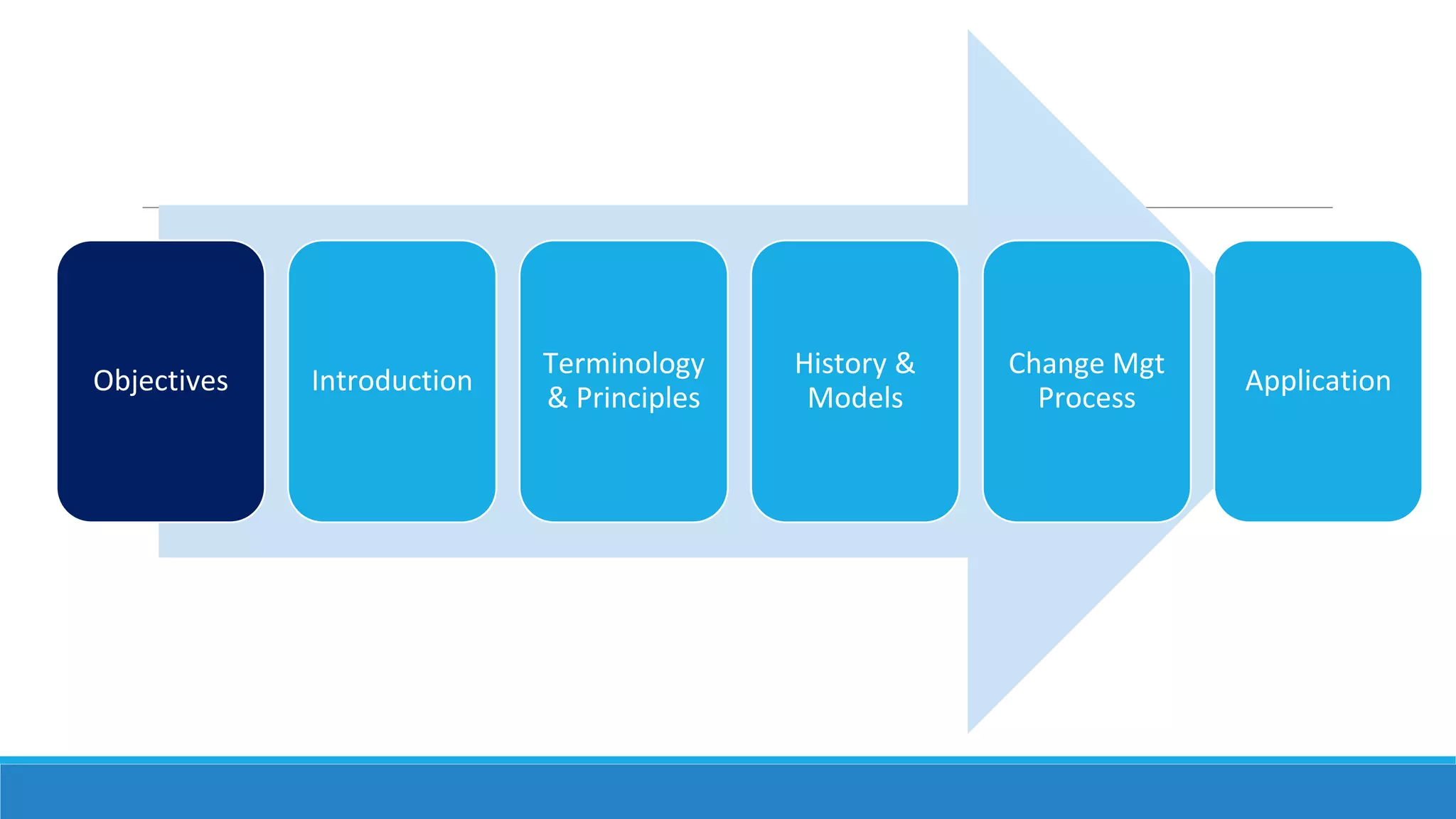
Objectives Introduction
Terminology
& Principles
History &
Models
Change Mgt
Process
Application
Objectives
Upon completion of this training presentation, participants should be able to:
▪ Define and Use basic change management terminology
▪ Compare and Contrast popular change management models
▪ Understand and Articulate steps in the Change Management Process Prince 2)
▪Apply change management principles to everyday work or personal life
Objectives Introduction
Terminology
& Principles
History &
Models
Change Mgt
Process
Application
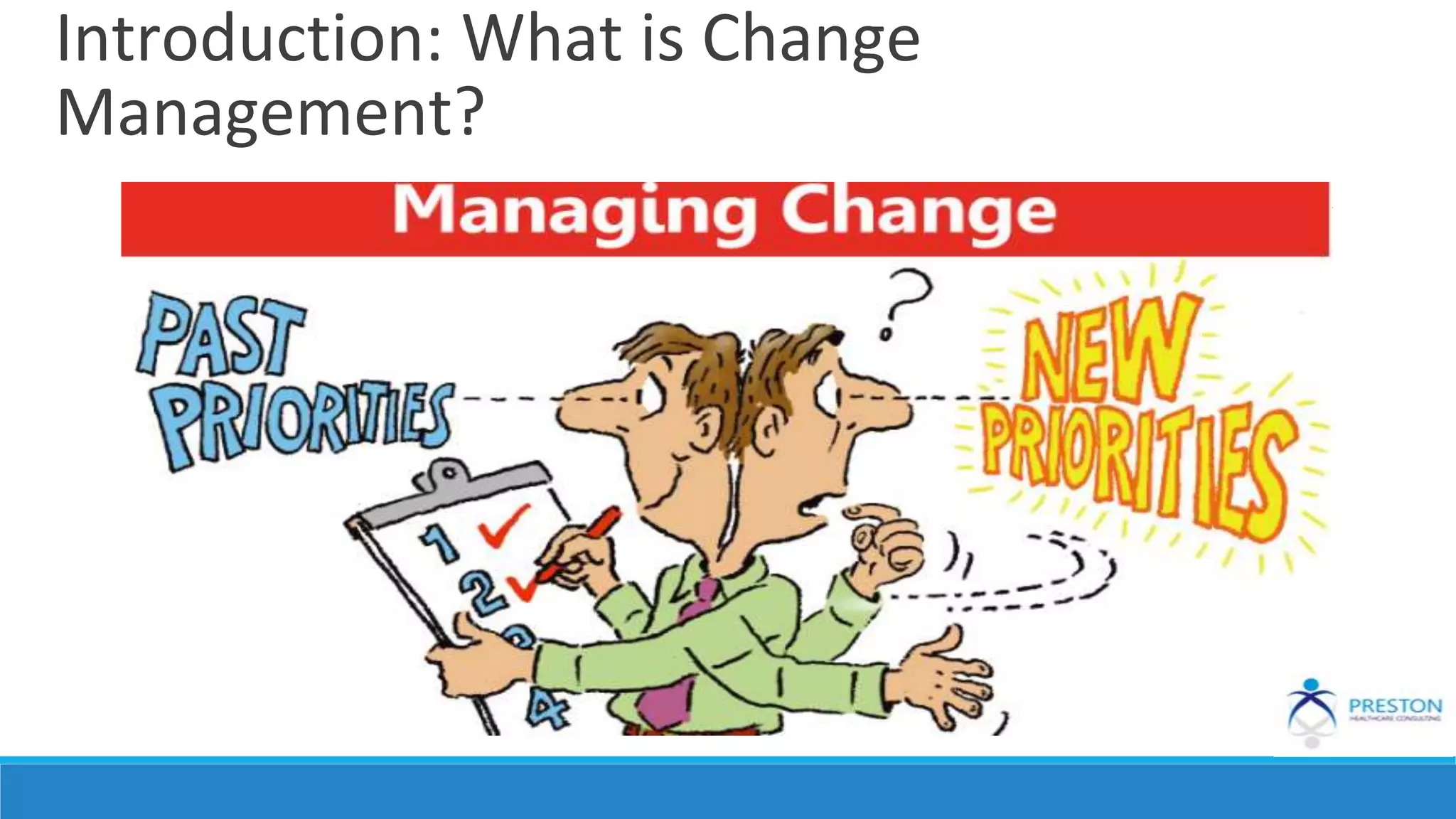
Introduction: What is Change
Management?
Introduction: What is Change Management?
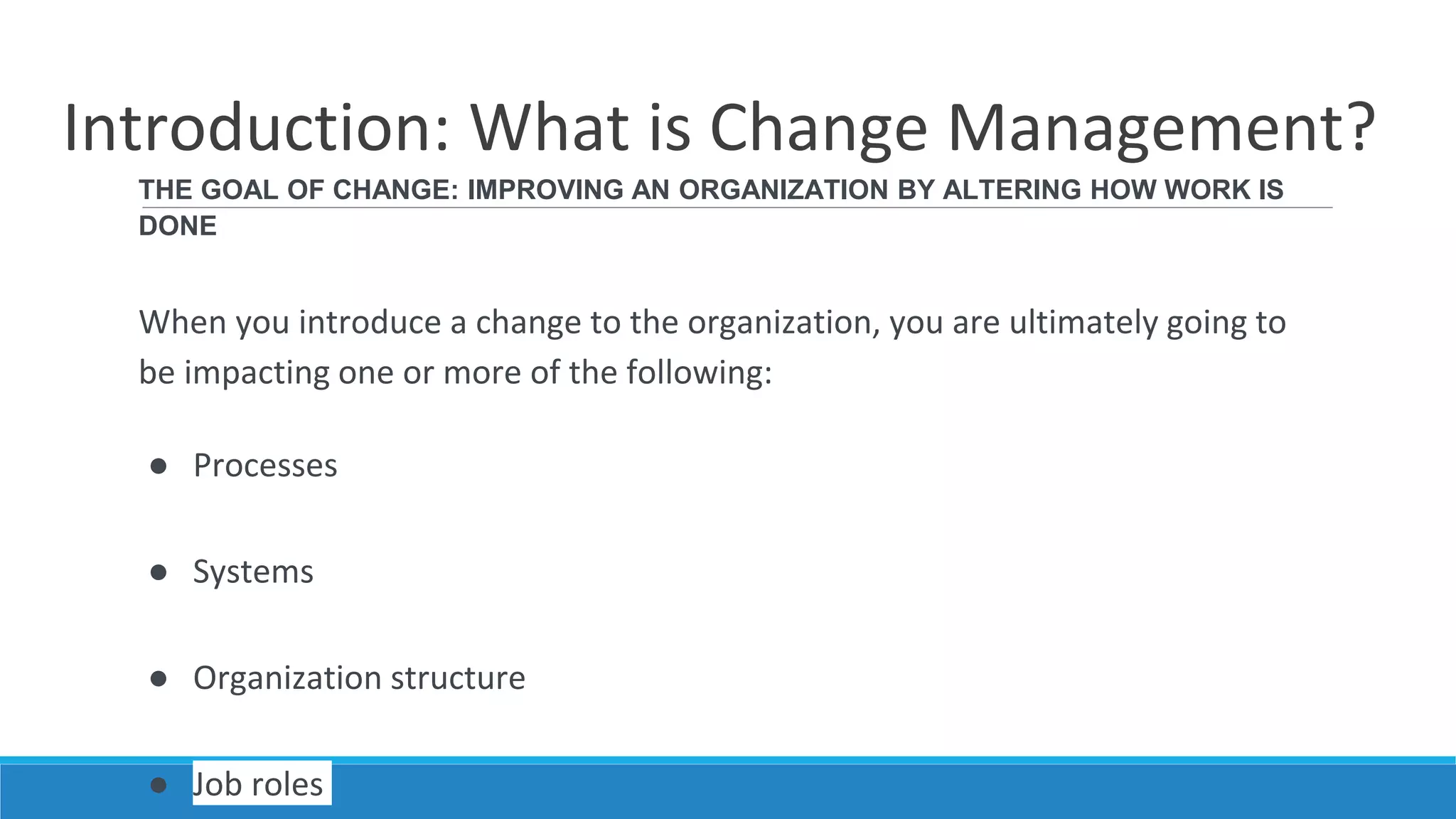
THE GOAL OF CHANGE: IMPROVING AN ORGANIZATION BY ALTERING HOW WORK IS
DONE
When you introduce a change to the organization, you are ultimately going to
be impacting one or more of the following:
● Processes
● Systems
● Organization structure
● Job roles
Introduction: What is Change Management?
Project management (change limited in scope and time for a desired outcome)
Project management is the application of knowledge, skills, tools and
techniques to execute activities to meet specific project requirements.
Project management is accomplished through the application and
integration of processes of initiating, planning, executing, monitoring,
controlling, and closing.
Objectives Introduction
Terminology
& Principles
History &
Models
Change Mgt
Process
Application
Terminology & Principles of CM
The definition of change management is the process of using specific
techniques or psychological tools in order to try to effectively institute
a shift in the way something is done within an organization or the
attitude within an organization.
Read more at http://www.yourdictionary.com/change-management#tzOKGRL5IyUUMDIq.99
Change management is the process, tools and techniques to manage
the people side of change to achieve the required business outcome.
Read more at https://www.prosci.com/change-management/thought-leadership-library/change-management-definition
Terminology & Principles of CM
Change management is the systematic approach to adjusting and
transitioning organisational processes, procedures, strategies, attitudes,
functions or technologies from their existing state to one that is
considered superior (Burnes, 2009; Cameron and Green, 2009).
Read more at: https://www.kbmanage.com/concept/change-management
Terminology & Principles of CM
Change Management Models are frameworks that have been developed
based on research and experience on how to best manage change within an
organization or in your personal life.
Change Management Processes include a sequence of steps or activities
that move a change from inception to delivery.
● Change Management Plans are developed to support a project to deliver a
change. It is typically created during the planning stage of a Change
Management Process.
Terminology & Principles of CM
Most Change Management efforts go through the following phases:
1. Planning (Start -up and Initiation)
2. Executing
3. monitoring (Execution oversight, routine reporting, budget tracking, etc)
4. controlling (management by stage, manage by exception, risk and issue mgt)
5. Closing
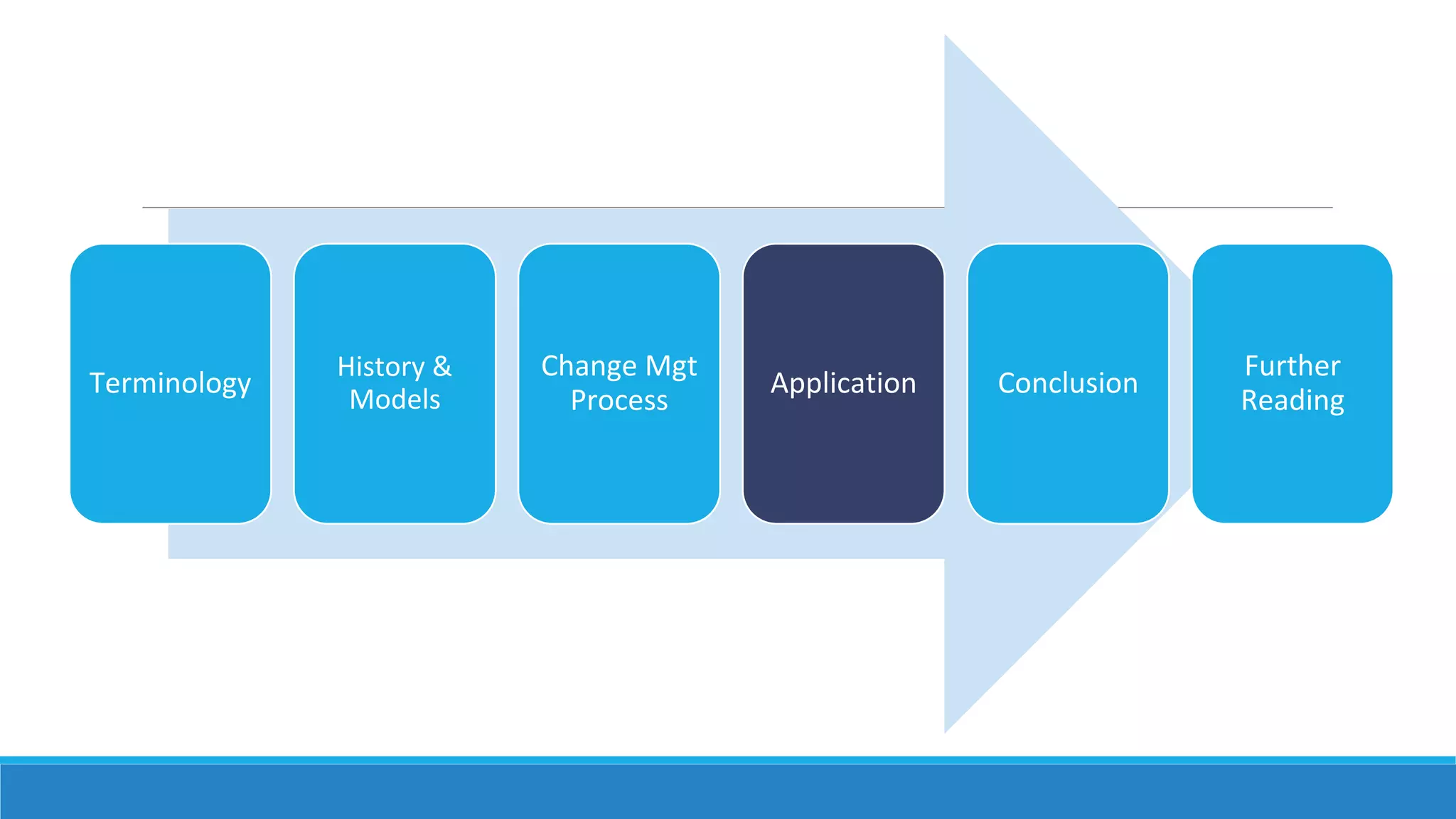
Introduction
Terminology
& Principles
History &
Models
Change Mgt
Process
Application Conclusion
History & Models of CM
The philosophies inherent in today's change management practices are structured to plan
(rather than react) to the challenge of organizational change. It's a growing industry with
thousands of books and numerous theoretical management frameworks that address
both the necessity and the pain involved in managing and planning for change.
The concept of change management dates back to the early to mid-1900s. Kurt Lewin’s
3-step model for change was developed in the 1940s; Edward Deming’s model was
developed in the 1950’s and Bridges’ Transition Model was developed in 1979.
History & Models of CM
Models : Deming Cycle
History & Models of CM
However, it wasn’t until the 1990s that change management
became well known in the business environment, and formal
organizational processes became available in the 2000s.
There are concrete reasons for accelerated growth in the change management
industry. Products, technology, or ideas that used to take years to design,
develop, test, and deploy are now being squeezed down to months or even
weeks. The evolving consumer expectations for better, faster, and cheaper
products also drive the need to reorganize the work culture to meet demand.
History & Models of CM
Prosci Adkar
Model:
Change management is the
process, tools and
techniques to manage the
people side of change to
achieve the required
business outcome.
History & Models of CM
Models : John Kotter
http://www.strategies-for-managing-change.com/john-kotter.html
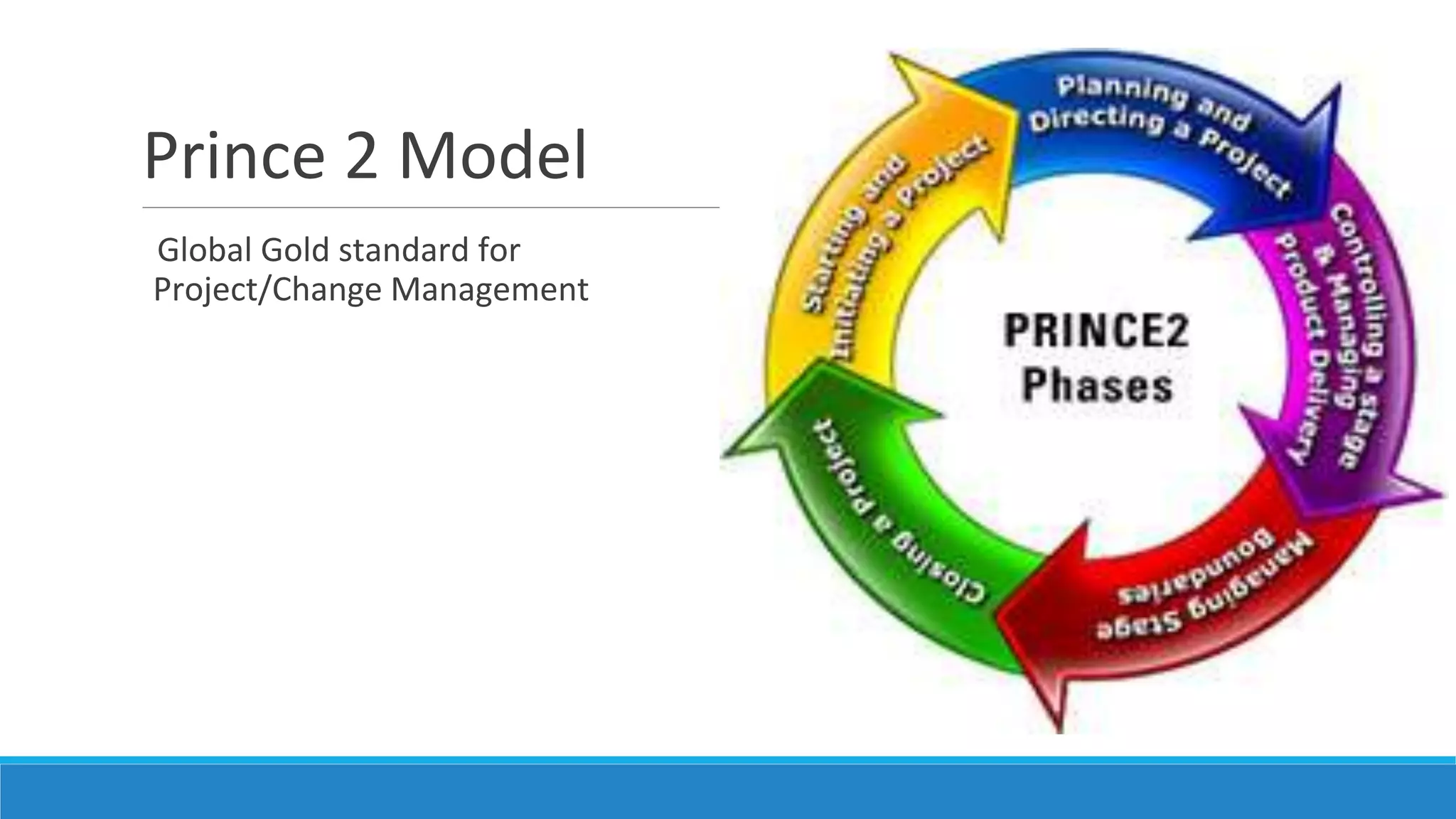
Prince 2 Model
Global Gold standard for
Project/Change Management
Terminology
History &
Models
Change Mgt
Process
Application Conclusion
Further
Reading
Change Management Process - Prince 2
Terminology
History &
Models
Change Mgt
Process
Application Conclusion
Further
Reading
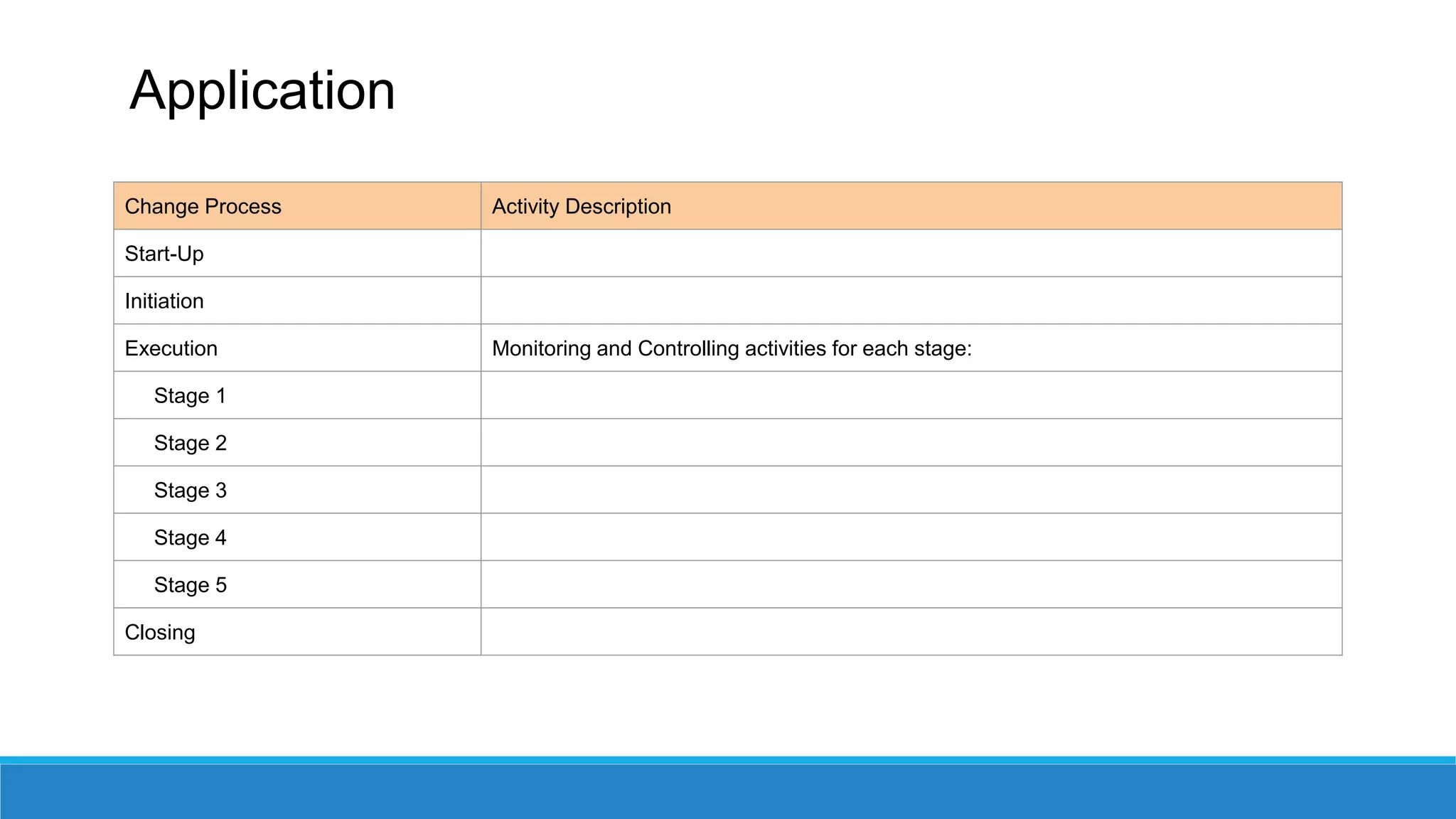
Change Process Activity Description
Start-Up
Initiation
Execution Monitoring and Controlling activities for each stage:
Stage 1
Stage 2
Stage 3
Stage 4
Stage 5
Closing
Application
Terminology
History &
Models
Change Mgt
Process
Application Conclusion
Further
Reading
Conclusion
Every change effort carries with it
potential risks. However, with
adequate planning, those risks can be
avoided and or managed.
Ultimately the main driver of change
is reward/benefit.
Conclusion
There are existing models and processes to guide
organizations and individuals navigating change.
Not changing is one of the biggest pitfalls or blind
spots for organizations.
Market relevance is sustained with a culture of
innovation and change.
Conclusion
Preston is committed to the Prince 2
model.
This model acknowledges the need to
clarify roles and responsibilities, as well as
a tight framework of processes for
execution and delivery of change
milestones
Terminology
History &
Models
Change Mgt
Process
Application Conclusion
Further
Reading
Further Reading
Change the culture, change the game : the breakthrough strategy for energizing your
organization and creating accountability for results: Roger Connors and Tom Smith, New York :
Portfolio Penguin, 2011, xiii, 222 p.
Change or die : how to transform your organization from the inside out / M. David Dealy with
Andrew R. Thomas, p. cm. ISBN 0-275-98405-2, HarperCollins e-books, 2009, 256 p.:
Beyond Change Management: How to Achieve Breakthrough Results Through Conscious
Change Leadership, 2nd Edition, Dean Anderson, Linda Ackerman Anderson; ISBN: 978-0-470-
64808-7, Pfeiffer, October 2010, 320 pages
Managing at the Speed of Change: How Resilient Managers Succeed and Prosper Where Others
Fail; Daryl R. Conner, ISBN: 978-0-471-97494-9, October 1997, 324 pages
Conclusion
•Make it
catchy.

Change management 3.pptx

  • 1.
    Change Management Models, Processesand Application BY: DR. NKEMDILIM ENE FOR: PRESTON HEALTHCARE CONSULTING LTD. DATE: 9TH JUNE 2017
  • 2.
    Outline •Objectives •Introduction •Terminology and Principles •History& Models •Change Management Process •Application •Conclusion •Further reading
  • 3.
    Objectives Introduction Terminology & Principles History& Models Change Mgt Process Application
  • 4.
    Objectives Upon completion ofthis training presentation, participants should be able to: ▪ Define and Use basic change management terminology ▪ Compare and Contrast popular change management models ▪ Understand and Articulate steps in the Change Management Process Prince 2) ▪Apply change management principles to everyday work or personal life
  • 5.
    Objectives Introduction Terminology & Principles History& Models Change Mgt Process Application
  • 6.
    Introduction: What isChange Management?
  • 7.
    Introduction: What isChange Management? THE GOAL OF CHANGE: IMPROVING AN ORGANIZATION BY ALTERING HOW WORK IS DONE When you introduce a change to the organization, you are ultimately going to be impacting one or more of the following: ● Processes ● Systems ● Organization structure ● Job roles
  • 8.
    Introduction: What isChange Management? Project management (change limited in scope and time for a desired outcome) Project management is the application of knowledge, skills, tools and techniques to execute activities to meet specific project requirements. Project management is accomplished through the application and integration of processes of initiating, planning, executing, monitoring, controlling, and closing.
  • 9.
    Objectives Introduction Terminology & Principles History& Models Change Mgt Process Application
  • 10.
    Terminology & Principlesof CM The definition of change management is the process of using specific techniques or psychological tools in order to try to effectively institute a shift in the way something is done within an organization or the attitude within an organization. Read more at http://www.yourdictionary.com/change-management#tzOKGRL5IyUUMDIq.99 Change management is the process, tools and techniques to manage the people side of change to achieve the required business outcome. Read more at https://www.prosci.com/change-management/thought-leadership-library/change-management-definition
  • 11.
    Terminology & Principlesof CM Change management is the systematic approach to adjusting and transitioning organisational processes, procedures, strategies, attitudes, functions or technologies from their existing state to one that is considered superior (Burnes, 2009; Cameron and Green, 2009). Read more at: https://www.kbmanage.com/concept/change-management
  • 12.
    Terminology & Principlesof CM Change Management Models are frameworks that have been developed based on research and experience on how to best manage change within an organization or in your personal life. Change Management Processes include a sequence of steps or activities that move a change from inception to delivery. ● Change Management Plans are developed to support a project to deliver a change. It is typically created during the planning stage of a Change Management Process.
  • 13.
    Terminology & Principlesof CM Most Change Management efforts go through the following phases: 1. Planning (Start -up and Initiation) 2. Executing 3. monitoring (Execution oversight, routine reporting, budget tracking, etc) 4. controlling (management by stage, manage by exception, risk and issue mgt) 5. Closing
  • 14.
  • 15.
    History & Modelsof CM The philosophies inherent in today's change management practices are structured to plan (rather than react) to the challenge of organizational change. It's a growing industry with thousands of books and numerous theoretical management frameworks that address both the necessity and the pain involved in managing and planning for change. The concept of change management dates back to the early to mid-1900s. Kurt Lewin’s 3-step model for change was developed in the 1940s; Edward Deming’s model was developed in the 1950’s and Bridges’ Transition Model was developed in 1979.
  • 16.
  • 17.
    History & Modelsof CM Models : Deming Cycle
  • 18.
    History & Modelsof CM However, it wasn’t until the 1990s that change management became well known in the business environment, and formal organizational processes became available in the 2000s. There are concrete reasons for accelerated growth in the change management industry. Products, technology, or ideas that used to take years to design, develop, test, and deploy are now being squeezed down to months or even weeks. The evolving consumer expectations for better, faster, and cheaper products also drive the need to reorganize the work culture to meet demand.
  • 19.
    History & Modelsof CM Prosci Adkar Model: Change management is the process, tools and techniques to manage the people side of change to achieve the required business outcome.
  • 20.
    History & Modelsof CM Models : John Kotter http://www.strategies-for-managing-change.com/john-kotter.html
  • 21.
    Prince 2 Model GlobalGold standard for Project/Change Management
  • 22.
  • 23.
  • 24.
  • 25.
    Change Process ActivityDescription Start-Up Initiation Execution Monitoring and Controlling activities for each stage: Stage 1 Stage 2 Stage 3 Stage 4 Stage 5 Closing Application
  • 26.
  • 27.
    Conclusion Every change effortcarries with it potential risks. However, with adequate planning, those risks can be avoided and or managed. Ultimately the main driver of change is reward/benefit.
  • 28.
    Conclusion There are existingmodels and processes to guide organizations and individuals navigating change. Not changing is one of the biggest pitfalls or blind spots for organizations. Market relevance is sustained with a culture of innovation and change.
  • 29.
    Conclusion Preston is committedto the Prince 2 model. This model acknowledges the need to clarify roles and responsibilities, as well as a tight framework of processes for execution and delivery of change milestones
  • 30.
  • 31.
    Further Reading Change theculture, change the game : the breakthrough strategy for energizing your organization and creating accountability for results: Roger Connors and Tom Smith, New York : Portfolio Penguin, 2011, xiii, 222 p. Change or die : how to transform your organization from the inside out / M. David Dealy with Andrew R. Thomas, p. cm. ISBN 0-275-98405-2, HarperCollins e-books, 2009, 256 p.: Beyond Change Management: How to Achieve Breakthrough Results Through Conscious Change Leadership, 2nd Edition, Dean Anderson, Linda Ackerman Anderson; ISBN: 978-0-470- 64808-7, Pfeiffer, October 2010, 320 pages Managing at the Speed of Change: How Resilient Managers Succeed and Prosper Where Others Fail; Daryl R. Conner, ISBN: 978-0-471-97494-9, October 1997, 324 pages
  • 32.