Lecture 5 
Firewall 
A firewall is a software program or device that monitors, and sometimes controls, all 
transmissions between an organization's internal network and the Internet. However 
large the network, a firewall is typically deployed on the network's edge to prevent 
inappropriate access to data behind the firewall. 
Types of Firewall 
· Host based Firewall (On a Single System(Window Firewall)) 
· Network based Firewall(For Whole Network) 
Firewall could be: 
· Software based (ISA Server(Proxy),Checkpoint) 
· Hardware based (Cisco Pix, Netgear Firewall) 
Firewall Types According to Mechanism 
Firewalls can be categorized into roughly three types: 
· Packet filter (Filtering According to IP i.e. Access list) 
· Application-level proxy (ISA Server for application level) 
· Stateful packet filtering(Monitor all Layers including connection states)
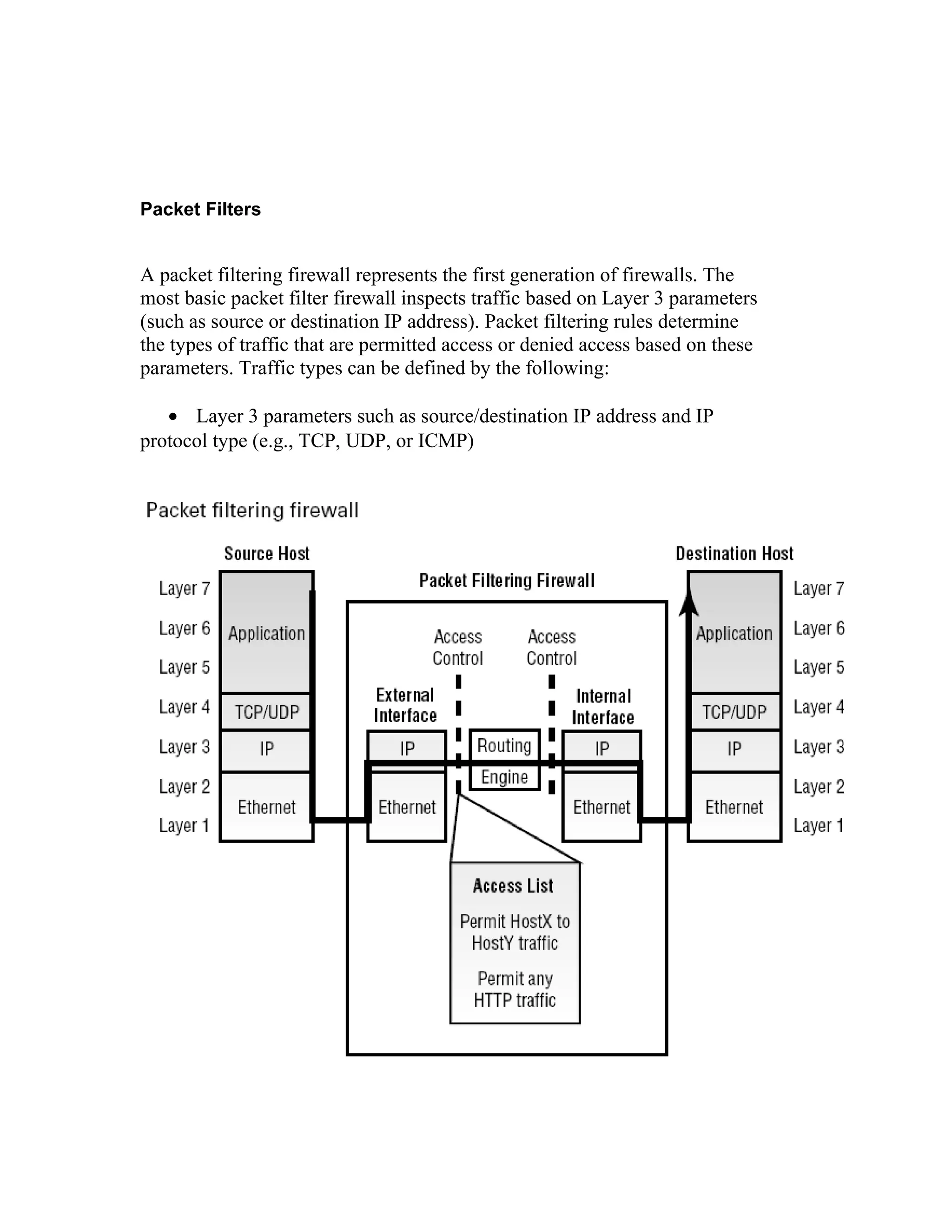
Packet Filters 
A packet filtering firewall represents the first generation of firewalls. The 
most basic packet filter firewall inspects traffic based on Layer 3 parameters 
(such as source or destination IP address). Packet filtering rules determine 
the types of traffic that are permitted access or denied access based on these 
parameters. Traffic types can be defined by the following: 
· Layer 3 parameters such as source/destination IP address and IP 
protocol type (e.g., TCP, UDP, or ICMP)
A packet filtering firewall is essentially a router with access control rules configured. 
Routers are normally configured via a command line interface that is complex to 
configure, with the configuration being stored as a list of configuration commands, which 
makes it difficult to visualize and manage your security policies. Routers also typically 
do not support logging locally as they do not possess sufficient file storage space, so 
logging is required to an external system, which makes it more complex to maintain logs 
for auditing and reporting purposes. 
A packet filtering firewall only operates up to Layer 3 (some can inspect 
Layer 4 parameters as well) of the OSI model. It does not understand the 
Higher layer levels such as the application layer (Layer 7) 
Application-Layer Gateways 
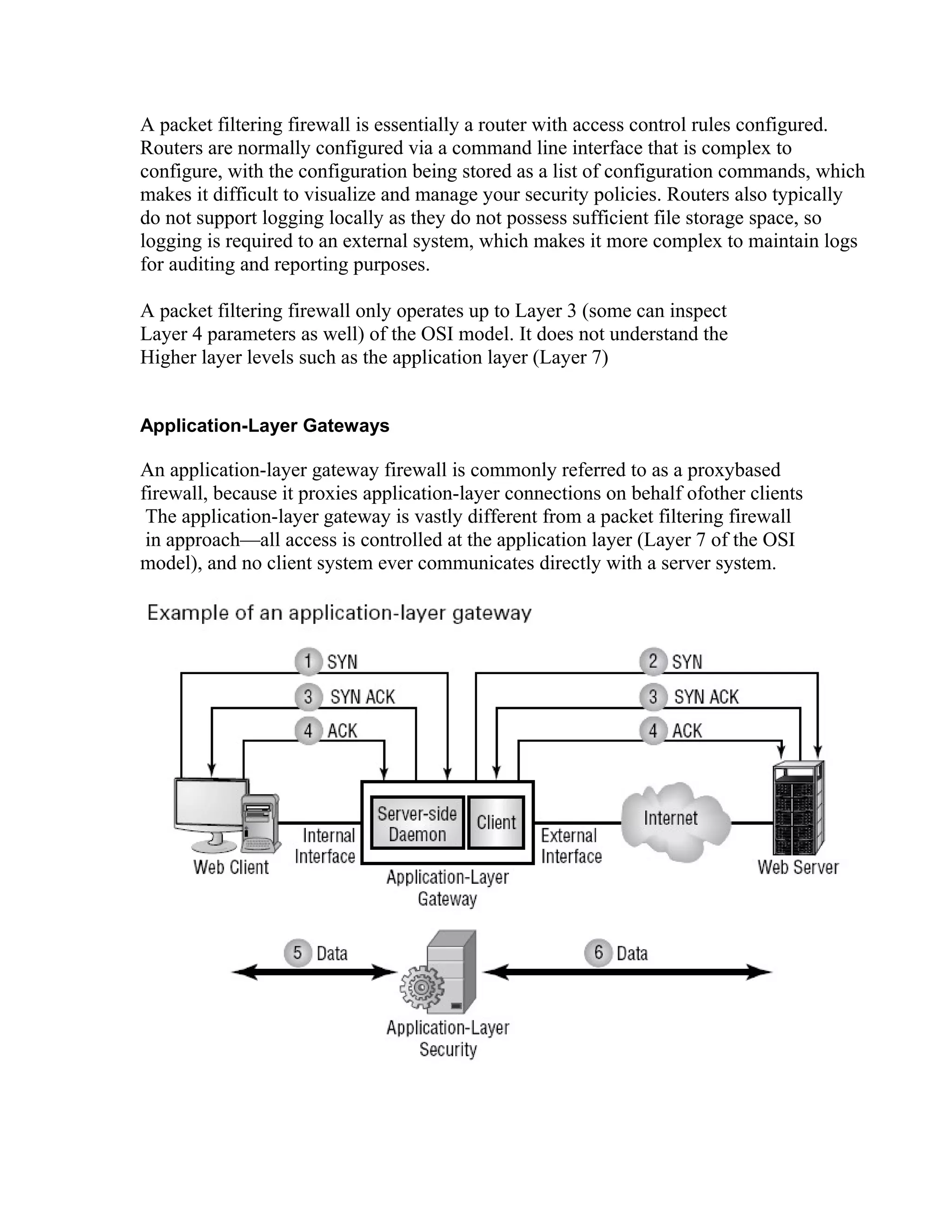
An application-layer gateway firewall is commonly referred to as a proxybased 
firewall, because it proxies application-layer connections on behalf ofother clients 
The application-layer gateway is vastly different from a packet filtering firewall 
in approach—all access is controlled at the application layer (Layer 7 of the OSI 
model), and no client system ever communicates directly with a server system.
1. The initial connection request packet from the web client is sent to the 
application-layer gateway—in essence the client is establishing a connection 
with the application-layer gateway. 
2. The application-layer gateway accepts or rejects the connection request 
based on the security policy configured. If the connection request is permitted, 
the application-layer gateway then establishes a new connection to the web 
server on behalf of the client 
. 
3. The web server receives the connection request and sends back a 
connection acknowledgment to the application-layer gateway. The 
application-layer gateway sends an acknowledgment on behalf of 
the web server to the web client 
4. The web client sends an acknowledgment packet (known as a TCP ACK) 
to the application-layer gateway, which indicates the connection setup 
is complete. The application-layer gateway sends an acknowledgment 
packet to the web server on behalf of the web client. 
5. The client starts sending data to the application-layer gateway (e.g., an 
HTTP GET request). The data is forwarded to a proxy web daemon(or service), 
which is essentially a web server running on the application layer 
gateway. Because the application-layer gateway is running a web 
server, it understands the HTTP requests from the client and can ensure 
the traffic sent from the client is proper web traffic that conforms 
to the HTTP protocol standard. Assuming the traffic from the web client 
is legitimate, the application-layer gateway then sends the data to 
the web server on behalf of the client. 
6. The web server processes the data received and responds to the data 
appropriately (in Figure 1.7, the client sends an HTTP GET request, 
and the server returns the web content associated with the URL). 
Return data is sent to the application-layer gateway, which ensures the 
traffic is legitimate. This data is then sent to the web client on behalf 
of the web server.
The application-layer gateway introduces a greater level of security than 
a packet filtering firewall, because all connections to the outside world are 
made by the application-layer gateway and the application-layer gateway 
ensures all received traffic from either client or server at the application layer 
is legitimate. With a packet filtering firewall, although the firewall may 
understand that traffic is from a particular application, it does not understand 
the application protocol and what is considered legitimate traffic. 
An application-layer gateway also becomes a target for attackers because the 
gateway is directly accepting connections from the outside world. The operating 
system on the application-layer gateway must be very secure; however, 
it is still vulnerable to buffer overflow attacks and other unknown software 
bugs that might give attackers access to the gateway. If an attacker manages 
to compromise an application-layer gateway, the security of the entire network 
has been breached as the attacker now has direct access to the internal 
network. 
Stateful Inspection Technology 
So what’s the alternative to packet filtering firewalls and application-level 
gateways? Stateful inspection operates in a manner similar to a packet 
filtering firewall, except that it possesses much more sophisticated access 
control algorithms. Both stateful inspection firewalls and packet filtering 
firewalls essentially provide security by making control decisions. An example 
of a control decision is whether to accept or reject a connection. Another 
example might be to encrypt a packet. Check Point FireWall-1 uses a 
patented and innovative stateful inspection technology, which is designed 
to provide the speed and efficiency of a packet filtering firewall and the 
application state awareness and high security provided by an applicationlayer 
gateway. 
On a packet filtering firewall, control decisions are made purely on the 
Layer 3 and/or Layer 4 parameters of each packet received. Each packet 
is either permitted or denied, and is processed independently of any other 
packet, with no logical relationship being established between packets that 
belong to the same connection. If the parameters match an allowed traffic 
type, a control decision is made to permit the traffic. A stateful inspection 
firewall on the other hand can make control decisions based on much more 
that just the information contained within each packet received. The following 
lists the types of information on which a stateful inspection firewall can 
make control decisions:
Communication information 
Information from the Layer 3 and Layer 4parameters of a packet (this is the only type 
of information a packetfiltering firewall makes decisions on). 
Communication-derived state 
Information derived from that passedwithin a connection. This can include 
Layer 3/4 information (such as TCPports, sequence numbers, and so on) through to 
Layer 7 information 
(such as dynamic port allocations for new connections). 
Application-derived state Information derived from other applications. 
For example, Check Point FireWall-1 possesses a user authentication service 
that allows users to be identified. Once a user has been successfully 
authenticated, this information can be passed to the stateful inspection 
engine, which allows access to authorized services for the users. This 
feature allows for access rules to be defined based on users or groups, 
rather than IP hosts or networks.
A Stateful inspection firewall provides the speed and flexibility of a packet 
filter firewall, as well as the high security of an application-layer gateway. 
This means that you gain the best of both worlds in a single, high-performance 
Platform. The following summarizes the advantages of a stateful inspection 
Firewall: 
_ High performance. 
_ Understands both transport-layer (e.g., TCP/UDP) and application layer 
(e.g., FTP) connections rather than just packets 
Understands application-layer protocols. 
· Maintains a dynamic connection table that is continuously updated 
with the state of each connection. This ensures the firewall enables the 
return traffic of allowed connections only as long as the connection is 
active, and also ensures that only legitimate traffic consistent with the 
expected state of the connection is permitted. 
· Fragment reassembly allows the firewall to reassemble fragmented 
packets and inspect them, defeating a common method used by 
attackers to bypass firewall security. 
· The underlying operating system of the firewall is protected, because the 
stateful inspection engine processes packets before they reach the TCP/IP 
stack of the operating system.

Firewall

  • 1.
    Lecture 5 Firewall A firewall is a software program or device that monitors, and sometimes controls, all transmissions between an organization's internal network and the Internet. However large the network, a firewall is typically deployed on the network's edge to prevent inappropriate access to data behind the firewall. Types of Firewall · Host based Firewall (On a Single System(Window Firewall)) · Network based Firewall(For Whole Network) Firewall could be: · Software based (ISA Server(Proxy),Checkpoint) · Hardware based (Cisco Pix, Netgear Firewall) Firewall Types According to Mechanism Firewalls can be categorized into roughly three types: · Packet filter (Filtering According to IP i.e. Access list) · Application-level proxy (ISA Server for application level) · Stateful packet filtering(Monitor all Layers including connection states)
  • 2.
    Packet Filters Apacket filtering firewall represents the first generation of firewalls. The most basic packet filter firewall inspects traffic based on Layer 3 parameters (such as source or destination IP address). Packet filtering rules determine the types of traffic that are permitted access or denied access based on these parameters. Traffic types can be defined by the following: · Layer 3 parameters such as source/destination IP address and IP protocol type (e.g., TCP, UDP, or ICMP)
  • 3.
    A packet filteringfirewall is essentially a router with access control rules configured. Routers are normally configured via a command line interface that is complex to configure, with the configuration being stored as a list of configuration commands, which makes it difficult to visualize and manage your security policies. Routers also typically do not support logging locally as they do not possess sufficient file storage space, so logging is required to an external system, which makes it more complex to maintain logs for auditing and reporting purposes. A packet filtering firewall only operates up to Layer 3 (some can inspect Layer 4 parameters as well) of the OSI model. It does not understand the Higher layer levels such as the application layer (Layer 7) Application-Layer Gateways An application-layer gateway firewall is commonly referred to as a proxybased firewall, because it proxies application-layer connections on behalf ofother clients The application-layer gateway is vastly different from a packet filtering firewall in approach—all access is controlled at the application layer (Layer 7 of the OSI model), and no client system ever communicates directly with a server system.
  • 4.
    1. The initialconnection request packet from the web client is sent to the application-layer gateway—in essence the client is establishing a connection with the application-layer gateway. 2. The application-layer gateway accepts or rejects the connection request based on the security policy configured. If the connection request is permitted, the application-layer gateway then establishes a new connection to the web server on behalf of the client . 3. The web server receives the connection request and sends back a connection acknowledgment to the application-layer gateway. The application-layer gateway sends an acknowledgment on behalf of the web server to the web client 4. The web client sends an acknowledgment packet (known as a TCP ACK) to the application-layer gateway, which indicates the connection setup is complete. The application-layer gateway sends an acknowledgment packet to the web server on behalf of the web client. 5. The client starts sending data to the application-layer gateway (e.g., an HTTP GET request). The data is forwarded to a proxy web daemon(or service), which is essentially a web server running on the application layer gateway. Because the application-layer gateway is running a web server, it understands the HTTP requests from the client and can ensure the traffic sent from the client is proper web traffic that conforms to the HTTP protocol standard. Assuming the traffic from the web client is legitimate, the application-layer gateway then sends the data to the web server on behalf of the client. 6. The web server processes the data received and responds to the data appropriately (in Figure 1.7, the client sends an HTTP GET request, and the server returns the web content associated with the URL). Return data is sent to the application-layer gateway, which ensures the traffic is legitimate. This data is then sent to the web client on behalf of the web server.
  • 5.
    The application-layer gatewayintroduces a greater level of security than a packet filtering firewall, because all connections to the outside world are made by the application-layer gateway and the application-layer gateway ensures all received traffic from either client or server at the application layer is legitimate. With a packet filtering firewall, although the firewall may understand that traffic is from a particular application, it does not understand the application protocol and what is considered legitimate traffic. An application-layer gateway also becomes a target for attackers because the gateway is directly accepting connections from the outside world. The operating system on the application-layer gateway must be very secure; however, it is still vulnerable to buffer overflow attacks and other unknown software bugs that might give attackers access to the gateway. If an attacker manages to compromise an application-layer gateway, the security of the entire network has been breached as the attacker now has direct access to the internal network. Stateful Inspection Technology So what’s the alternative to packet filtering firewalls and application-level gateways? Stateful inspection operates in a manner similar to a packet filtering firewall, except that it possesses much more sophisticated access control algorithms. Both stateful inspection firewalls and packet filtering firewalls essentially provide security by making control decisions. An example of a control decision is whether to accept or reject a connection. Another example might be to encrypt a packet. Check Point FireWall-1 uses a patented and innovative stateful inspection technology, which is designed to provide the speed and efficiency of a packet filtering firewall and the application state awareness and high security provided by an applicationlayer gateway. On a packet filtering firewall, control decisions are made purely on the Layer 3 and/or Layer 4 parameters of each packet received. Each packet is either permitted or denied, and is processed independently of any other packet, with no logical relationship being established between packets that belong to the same connection. If the parameters match an allowed traffic type, a control decision is made to permit the traffic. A stateful inspection firewall on the other hand can make control decisions based on much more that just the information contained within each packet received. The following lists the types of information on which a stateful inspection firewall can make control decisions:
  • 6.
    Communication information Informationfrom the Layer 3 and Layer 4parameters of a packet (this is the only type of information a packetfiltering firewall makes decisions on). Communication-derived state Information derived from that passedwithin a connection. This can include Layer 3/4 information (such as TCPports, sequence numbers, and so on) through to Layer 7 information (such as dynamic port allocations for new connections). Application-derived state Information derived from other applications. For example, Check Point FireWall-1 possesses a user authentication service that allows users to be identified. Once a user has been successfully authenticated, this information can be passed to the stateful inspection engine, which allows access to authorized services for the users. This feature allows for access rules to be defined based on users or groups, rather than IP hosts or networks.
  • 7.
    A Stateful inspectionfirewall provides the speed and flexibility of a packet filter firewall, as well as the high security of an application-layer gateway. This means that you gain the best of both worlds in a single, high-performance Platform. The following summarizes the advantages of a stateful inspection Firewall: _ High performance. _ Understands both transport-layer (e.g., TCP/UDP) and application layer (e.g., FTP) connections rather than just packets Understands application-layer protocols. · Maintains a dynamic connection table that is continuously updated with the state of each connection. This ensures the firewall enables the return traffic of allowed connections only as long as the connection is active, and also ensures that only legitimate traffic consistent with the expected state of the connection is permitted. · Fragment reassembly allows the firewall to reassemble fragmented packets and inspect them, defeating a common method used by attackers to bypass firewall security. · The underlying operating system of the firewall is protected, because the stateful inspection engine processes packets before they reach the TCP/IP stack of the operating system.