FIREWALLS
BY: FARWA IRFAN
Introduction
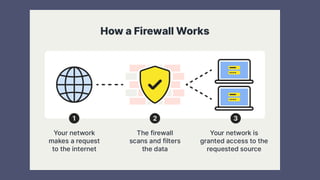
In the world of computer networks, a firewall acts like a security guard. Its job is
to watch over the flow of information between your computer or network and
the internet.It’s designed to block unauthorized access while allowing safe data
to pass through.
Essentially, a firewall helps keep your digital world safe from unwanted visitors
and potential threats, making it an essential part of today’s connected
environment. It monitors both incoming and outgoing traffic using a predefined
set of security to detect and prevent threats.
FIREWALLS
A firewall is a type of network security device
either hardware or software-based that filters
incoming and outgoing network traffic with
security policies accept , reject and drop.
• Accept:allow the traffic
• Reject: block the traffic but reply with an
“unreachable error”
•Drop:block the traffic with no reply
A firewall is essentially the wall that
separates a private internal network from the
open Internet at its very basic level.
Before Firewalls, network security was performed by Access Control Lists (ACLs)
residing on routers. ACLs are rules that determine whether network
access should be granted or denied to specific IP address. But ACLs cannot
determine the nature of the packet it is blocking. Also, ACL alone does not have
the capacity to keep threats out of the network. Hence, the Firewall was
introduced. Connectivity to the Internet is no longer optional for organizations.
However, accessing the Internet provides benefits to the organization; it also
enables the outside world to interact with the internal network of the organization.
This creates a threat to the organization. In order to secure the internal network
from unauthorized traffic, we need a Firewall.
Need For Firewall
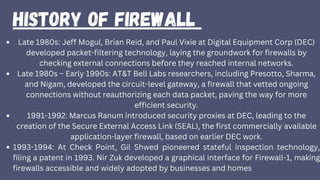
History of firewall
Late 1980s: Jeff Mogul, Brian Reid, and Paul Vixie at Digital Equipment Corp (DEC)
developed packet-filtering technology, laying the groundwork for firewalls by
checking external connections before they reached internal networks.
Late 1980s – Early 1990s: AT&T Bell Labs researchers, including Presotto, Sharma,
and Nigam, developed the circuit-level gateway, a firewall that vetted ongoing
connections without reauthorizing each data packet, paving the way for more
efficient security.
1991-1992: Marcus Ranum introduced security proxies at DEC, leading to the
creation of the Secure External Access Link (SEAL), the first commercially available
application-layer firewall, based on earlier DEC work.
1993-1994: At Check Point, Gil Shwed pioneered stateful inspection technology,
filing a patent in 1993. Nir Zuk developed a graphical interface for Firewall-1, making
firewalls accessible and widely adopted by businesses and homes
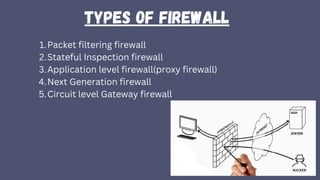
Types of Firewall
Packet filtering firewall
1.
Stateful Inspection firewall
2.
Application level firewall(proxy firewall)
3.
Next Generation firewall
4.
Circuit level Gateway firewall
5.
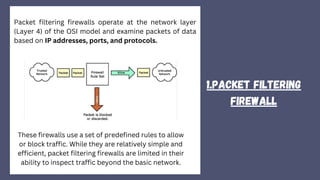
1.Packet filtering
firewall
Packet filtering firewalls operate at the network layer
(Layer 4) of the OSI model and examine packets of data
based on IP addresses, ports, and protocols.
These firewalls use a set of predefined rules to allow
or block traffic. While they are relatively simple and
efficient, packet filtering firewalls are limited in their
ability to inspect traffic beyond the basic network.
2.Stateful
Inspection firewall
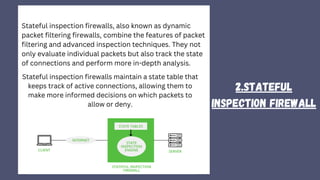
Stateful inspection firewalls, also known as dynamic
packet filtering firewalls, combine the features of packet
filtering and advanced inspection techniques. They not
only evaluate individual packets but also track the state
of connections and perform more in-depth analysis.
Stateful inspection firewalls maintain a state table that
keeps track of active connections, allowing them to
make more informed decisions on which packets to
allow or deny.
3.APPLICATION LAYER
FIREWALL
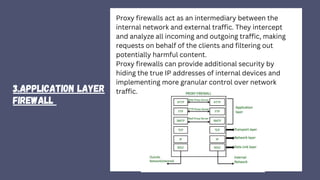
Proxy firewalls act as an intermediary between the
internal network and external traffic. They intercept
and analyze all incoming and outgoing traffic, making
requests on behalf of the clients and filtering out
potentially harmful content.
Proxy firewalls can provide additional security by
hiding the true IP addresses of internal devices and
implementing more granular control over network
traffic.
4.NEXT
GENERATION
FIREWALL
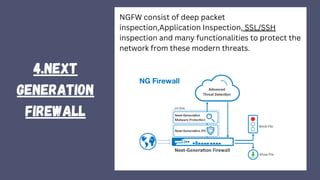
NGFW consist of deep packet
inspection,Application Inspection, SSL/SSH
inspection and many functionalities to protect the
network from these modern threats.
5.CIRCUIT LEVEL
GATEWAY FIREWALL
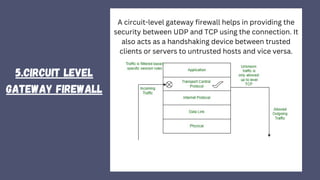
A circuit-level gateway firewall helps in providing the
security between UDP and TCP using the connection. It
also acts as a handshaking device between trusted
clients or servers to untrusted hosts and vice versa.
Firewalls
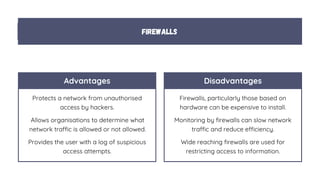
Provides the user with a log of suspicious
access attempts.
Advantages Disadvantages
Protects a network from unauthorised
access by hackers.
Firewalls, particularly those based on
hardware can be expensive to install.
Allows organisations to determine what
network traffic is allowed or not allowed.
Monitoring by firewalls can slow network
traffic and reduce efficiency.
Wide reaching firewalls are used for
restricting access to information.
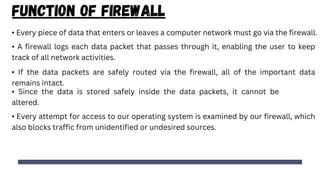
• Every piece of data that enters or leaves a computer network must go via the firewall.
• If the data packets are safely routed via the firewall, all of the important data
remains intact.
• A firewall logs each data packet that passes through it, enabling the user to keep
track of all network activities.
• Every attempt for access to our operating system is examined by our firewall, which
also blocks traffic from unidentified or undesired sources.
• Since the data is stored safely inside the data packets, it cannot be
altered.
Function of firewall
FIREWALLs in an information security.ppt

FIREWALLs in an information security.ppt

  • 1.
  • 2.
    Introduction In the worldof computer networks, a firewall acts like a security guard. Its job is to watch over the flow of information between your computer or network and the internet.It’s designed to block unauthorized access while allowing safe data to pass through. Essentially, a firewall helps keep your digital world safe from unwanted visitors and potential threats, making it an essential part of today’s connected environment. It monitors both incoming and outgoing traffic using a predefined set of security to detect and prevent threats.
  • 3.
    FIREWALLS A firewall isa type of network security device either hardware or software-based that filters incoming and outgoing network traffic with security policies accept , reject and drop. • Accept:allow the traffic • Reject: block the traffic but reply with an “unreachable error” •Drop:block the traffic with no reply A firewall is essentially the wall that separates a private internal network from the open Internet at its very basic level.
  • 4.
    Before Firewalls, networksecurity was performed by Access Control Lists (ACLs) residing on routers. ACLs are rules that determine whether network access should be granted or denied to specific IP address. But ACLs cannot determine the nature of the packet it is blocking. Also, ACL alone does not have the capacity to keep threats out of the network. Hence, the Firewall was introduced. Connectivity to the Internet is no longer optional for organizations. However, accessing the Internet provides benefits to the organization; it also enables the outside world to interact with the internal network of the organization. This creates a threat to the organization. In order to secure the internal network from unauthorized traffic, we need a Firewall. Need For Firewall
  • 5.
    History of firewall Late1980s: Jeff Mogul, Brian Reid, and Paul Vixie at Digital Equipment Corp (DEC) developed packet-filtering technology, laying the groundwork for firewalls by checking external connections before they reached internal networks. Late 1980s – Early 1990s: AT&T Bell Labs researchers, including Presotto, Sharma, and Nigam, developed the circuit-level gateway, a firewall that vetted ongoing connections without reauthorizing each data packet, paving the way for more efficient security. 1991-1992: Marcus Ranum introduced security proxies at DEC, leading to the creation of the Secure External Access Link (SEAL), the first commercially available application-layer firewall, based on earlier DEC work. 1993-1994: At Check Point, Gil Shwed pioneered stateful inspection technology, filing a patent in 1993. Nir Zuk developed a graphical interface for Firewall-1, making firewalls accessible and widely adopted by businesses and homes
  • 7.
    Types of Firewall Packetfiltering firewall 1. Stateful Inspection firewall 2. Application level firewall(proxy firewall) 3. Next Generation firewall 4. Circuit level Gateway firewall 5.
  • 8.
    1.Packet filtering firewall Packet filteringfirewalls operate at the network layer (Layer 4) of the OSI model and examine packets of data based on IP addresses, ports, and protocols. These firewalls use a set of predefined rules to allow or block traffic. While they are relatively simple and efficient, packet filtering firewalls are limited in their ability to inspect traffic beyond the basic network.
  • 9.
    2.Stateful Inspection firewall Stateful inspectionfirewalls, also known as dynamic packet filtering firewalls, combine the features of packet filtering and advanced inspection techniques. They not only evaluate individual packets but also track the state of connections and perform more in-depth analysis. Stateful inspection firewalls maintain a state table that keeps track of active connections, allowing them to make more informed decisions on which packets to allow or deny.
  • 10.
    3.APPLICATION LAYER FIREWALL Proxy firewallsact as an intermediary between the internal network and external traffic. They intercept and analyze all incoming and outgoing traffic, making requests on behalf of the clients and filtering out potentially harmful content. Proxy firewalls can provide additional security by hiding the true IP addresses of internal devices and implementing more granular control over network traffic.
  • 11.
    4.NEXT GENERATION FIREWALL NGFW consist ofdeep packet inspection,Application Inspection, SSL/SSH inspection and many functionalities to protect the network from these modern threats.
  • 12.
    5.CIRCUIT LEVEL GATEWAY FIREWALL Acircuit-level gateway firewall helps in providing the security between UDP and TCP using the connection. It also acts as a handshaking device between trusted clients or servers to untrusted hosts and vice versa.
  • 13.
    Firewalls Provides the userwith a log of suspicious access attempts. Advantages Disadvantages Protects a network from unauthorised access by hackers. Firewalls, particularly those based on hardware can be expensive to install. Allows organisations to determine what network traffic is allowed or not allowed. Monitoring by firewalls can slow network traffic and reduce efficiency. Wide reaching firewalls are used for restricting access to information.
  • 14.
    • Every pieceof data that enters or leaves a computer network must go via the firewall. • If the data packets are safely routed via the firewall, all of the important data remains intact. • A firewall logs each data packet that passes through it, enabling the user to keep track of all network activities. • Every attempt for access to our operating system is examined by our firewall, which also blocks traffic from unidentified or undesired sources. • Since the data is stored safely inside the data packets, it cannot be altered. Function of firewall