Establishing Serial Point-To-Point Connections 
Introducing Wide-Area Networks 
Lecture 8 
© 2006 Cisco Systems, Inc. All rights reserved. ICND v2.3—5-1
Outline 
• Overview 
• WAN Overview 
• WAN Connection Types 
• WAN Components 
• WAN Cabling 
• Layer 2 Encapsulation Protocols 
• Summary 
© 2006 Cisco Systems, Inc. All rights reserved. ICND v2.3—5-2
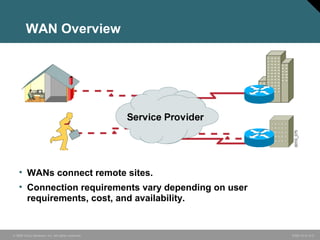
WAN Overview 
• WANs connect remote sites. 
• Connection requirements vary depending on user 
requirements, cost, and availability. 
© 2006 Cisco Systems, Inc. All rights reserved. ICND v2.3—5-3
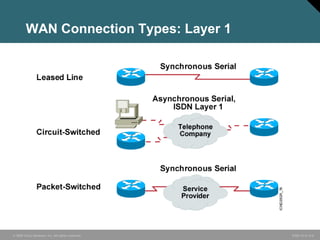
WAN Connection Types: Layer 1 
© 2006 Cisco Systems, Inc. All rights reserved. ICND v2.3—5-4
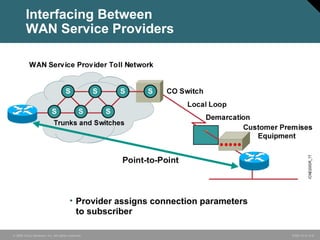
Interfacing Between 
WAN Service Providers 
• Provider assigns connection parameters 
to subscriber 
© 2006 Cisco Systems, Inc. All rights reserved. ICND v2.3—5-5
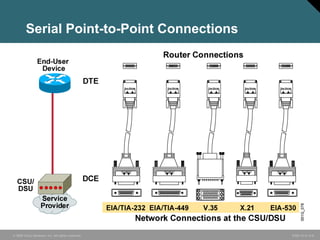
Serial Point-to-Point Connections 
© 2006 Cisco Systems, Inc. All rights reserved. ICND v2.3—5-6
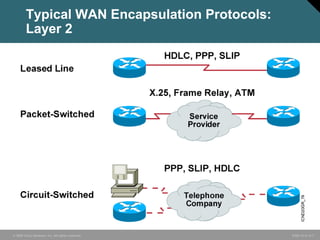
Typical WAN Encapsulation Protocols: 
Layer 2 
© 2006 Cisco Systems, Inc. All rights reserved. ICND v2.3—5-7
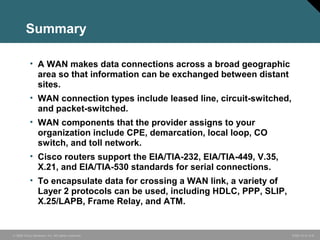
Summary 
• A WAN makes data connections across a broad geographic 
area so that information can be exchanged between distant 
sites. 
• WAN connection types include leased line, circuit-switched, 
and packet-switched. 
• WAN components that the provider assigns to your 
organization include CPE, demarcation, local loop, CO 
switch, and toll network. 
• Cisco routers support the EIA/TIA-232, EIA/TIA-449, V.35, 
X.21, and EIA/TIA-530 standards for serial connections. 
• To encapsulate data for crossing a WAN link, a variety of 
Layer 2 protocols can be used, including HDLC, PPP, SLIP, 
X.25/LAPB, Frame Relay, and ATM. 
© 2006 Cisco Systems, Inc. All rights reserved. ICND v2.3—5-8
© 2006 Cisco Systems, Inc. All rights reserved. ICND v2.3—5-9

Wide area networks

  • 1.
    Establishing Serial Point-To-PointConnections Introducing Wide-Area Networks Lecture 8 © 2006 Cisco Systems, Inc. All rights reserved. ICND v2.3—5-1
  • 2.
    Outline • Overview • WAN Overview • WAN Connection Types • WAN Components • WAN Cabling • Layer 2 Encapsulation Protocols • Summary © 2006 Cisco Systems, Inc. All rights reserved. ICND v2.3—5-2
  • 3.
    WAN Overview •WANs connect remote sites. • Connection requirements vary depending on user requirements, cost, and availability. © 2006 Cisco Systems, Inc. All rights reserved. ICND v2.3—5-3
  • 4.
    WAN Connection Types:Layer 1 © 2006 Cisco Systems, Inc. All rights reserved. ICND v2.3—5-4
  • 5.
    Interfacing Between WANService Providers • Provider assigns connection parameters to subscriber © 2006 Cisco Systems, Inc. All rights reserved. ICND v2.3—5-5
  • 6.
    Serial Point-to-Point Connections © 2006 Cisco Systems, Inc. All rights reserved. ICND v2.3—5-6
  • 7.
    Typical WAN EncapsulationProtocols: Layer 2 © 2006 Cisco Systems, Inc. All rights reserved. ICND v2.3—5-7
  • 8.
    Summary • AWAN makes data connections across a broad geographic area so that information can be exchanged between distant sites. • WAN connection types include leased line, circuit-switched, and packet-switched. • WAN components that the provider assigns to your organization include CPE, demarcation, local loop, CO switch, and toll network. • Cisco routers support the EIA/TIA-232, EIA/TIA-449, V.35, X.21, and EIA/TIA-530 standards for serial connections. • To encapsulate data for crossing a WAN link, a variety of Layer 2 protocols can be used, including HDLC, PPP, SLIP, X.25/LAPB, Frame Relay, and ATM. © 2006 Cisco Systems, Inc. All rights reserved. ICND v2.3—5-8
  • 9.
    © 2006 CiscoSystems, Inc. All rights reserved. ICND v2.3—5-9
  • 10.
    © 2006 CiscoSystems, Inc. All rights reserved. ICND v2.3—5-9