Lecture-1
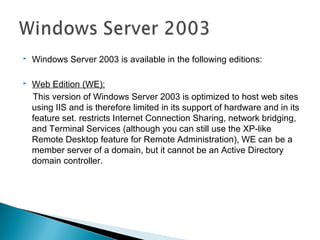
 Windows Server 2003 is available in the following editions: 
 Web Edition (WE): 
This version of Windows Server 2003 is optimized to host web sites 
using IIS and is therefore limited in its support of hardware and in its 
feature set. restricts Internet Connection Sharing, network bridging, 
and Terminal Services (although you can still use the XP-like 
Remote Desktop feature for Remote Administration), WE can be a 
member server of a domain, but it cannot be an Active Directory 
domain controller.
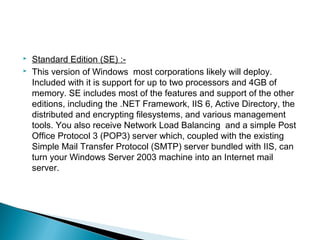
 Standard Edition (SE) :- 
 This version of Windows most corporations likely will deploy. 
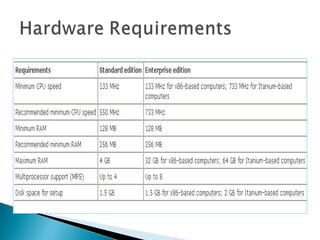
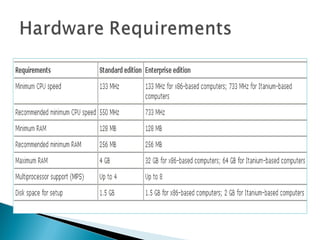
Included with it is support for up to two processors and 4GB of 
memory. SE includes most of the features and support of the other 
editions, including the .NET Framework, IIS 6, Active Directory, the 
distributed and encrypting filesystems, and various management 
tools. You also receive Network Load Balancing and a simple Post 
Office Protocol 3 (POP3) server which, coupled with the existing 
Simple Mail Transfer Protocol (SMTP) server bundled with IIS, can 
turn your Windows Server 2003 machine into an Internet mail 
server.
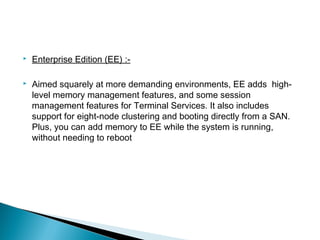
 Enterprise Edition (EE) :- 
 Aimed squarely at more demanding environments, EE adds high-level 
memory management features, and some session 
management features for Terminal Services. It also includes 
support for eight-node clustering and booting directly from a SAN. 
Plus, you can add memory to EE while the system is running, 
without needing to reboot
 Datacenter Edition (DE) :- 
This performance- and scalability-enhanced Windows Server 2003 
edition supports from 8 to 32 processors and features 64GB of 
memory and from two to eight node clusters. With the exception of 
more extensive firewalling features, DE is identical to EE.
 windows server 2003
 windows server 2003

windows server 2003

  • 1.
  • 2.
     Windows Server2003 is available in the following editions:  Web Edition (WE): This version of Windows Server 2003 is optimized to host web sites using IIS and is therefore limited in its support of hardware and in its feature set. restricts Internet Connection Sharing, network bridging, and Terminal Services (although you can still use the XP-like Remote Desktop feature for Remote Administration), WE can be a member server of a domain, but it cannot be an Active Directory domain controller.
  • 3.
     Standard Edition(SE) :-  This version of Windows most corporations likely will deploy. Included with it is support for up to two processors and 4GB of memory. SE includes most of the features and support of the other editions, including the .NET Framework, IIS 6, Active Directory, the distributed and encrypting filesystems, and various management tools. You also receive Network Load Balancing and a simple Post Office Protocol 3 (POP3) server which, coupled with the existing Simple Mail Transfer Protocol (SMTP) server bundled with IIS, can turn your Windows Server 2003 machine into an Internet mail server.
  • 4.
     Enterprise Edition(EE) :-  Aimed squarely at more demanding environments, EE adds high-level memory management features, and some session management features for Terminal Services. It also includes support for eight-node clustering and booting directly from a SAN. Plus, you can add memory to EE while the system is running, without needing to reboot
  • 5.
     Datacenter Edition(DE) :- This performance- and scalability-enhanced Windows Server 2003 edition supports from 8 to 32 processors and features 64GB of memory and from two to eight node clusters. With the exception of more extensive firewalling features, DE is identical to EE.