Fire Protection Systems
Third Edition
Chapter 7 — Automatic Fire Sprinkler Systems
Objectives
‣ Describe an automatic fire sprinkler system.
‣ Discuss the myths and realities associated with automatic fire
sprinkler system operation.
‣ List and describe the different components that make up an
automatic fire sprinkler system.
Objectives
‣ List and describe the different types of automatic fire sprinkler
system heads.
‣ Describe the different types of automatic fire sprinkler systems
and the best applications for those systems.
‣ State the factors that determine requirements to install
automatic fire sprinkler systems.
Objectives
‣ Discuss the design concepts behind automatic fire sprinkler
systems.
‣ List and describe different occupancy and commodity
classifications.
‣ Discuss the inspection and testing requirements for automatic
fire sprinkler systems.
Introduction
‣ Automatic fire sprinkler systems
‣ Networks of underground and overhead piping fed by
automatic water supply.
‣ Expenses related to water damage from sprinkler systems are
higher than those related to fire damage.
Introduction
‣ Effectiveness in property protection: The basis for a fire
sprinkler system is to keep a fire at a relatively small size and
under control.
‣ Effectiveness in life safety: The purpose of a commercial or
industrial fire sprinkler system is to provide both life safety and
property protection.
Fire Sprinkler System Components
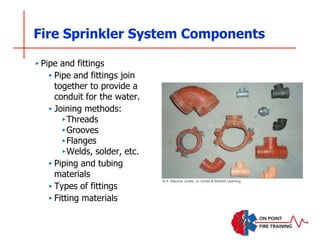
‣ Pipe and fittings
‣ Pipe and fittings join
together to provide a
conduit for the water.
‣ Joining methods:
‣Threads
‣Grooves
‣Flanges
‣Welds, solder, etc.
‣ Piping and tubing
materials
‣ Types of fittings
‣ Fitting materials
© A. Maurice Jones, Jr./Jones & Bartlett Learning
Fire Sprinkler System Components
‣ Gauges
‣ Small but important component
‣Water gauges
‣Air gauges
‣ Should not be subjected to freezing temperatures
‣ Should have a shut-off valve, and should be capable of
draining
Fire Sprinkler System Components
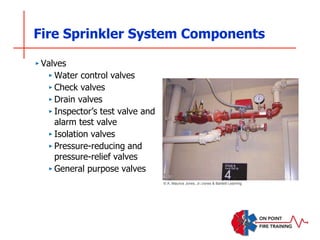
‣ Valves
‣ Water control valves
‣ Check valves
‣ Drain valves
‣ Inspector’s test valve and
alarm test valve
‣ Isolation valves
‣ Pressure-reducing and
pressure-relief valves
‣ General purpose valves
© A. Maurice Jones, Jr./Jones & Bartlett Learning
Fire Sprinkler System Components
‣ Pipe support and stabilization assemblies
‣ Piping is held in place by the following:
‣Bracing, guides, and restraints
‣Hanger assemblies
‣Fasteners
‣ With exceptions, all components must be made of ferrous
materials that can handle heat.
‣ NFPA 13:
‣Provides the maximum allowable spacing requirements
for various types of sprinkler heads.
Fire Sprinkler System Components
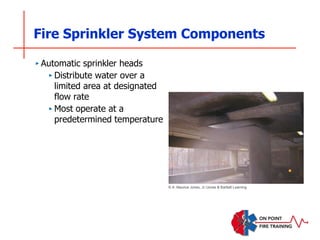
‣ Automatic sprinkler heads
‣ Distribute water over a
limited area at designated
flow rate
‣ Most operate at a
predetermined temperature
© A. Maurice Jones, Jr./Jones & Bartlett Learning
Fire Sprinkler System Components
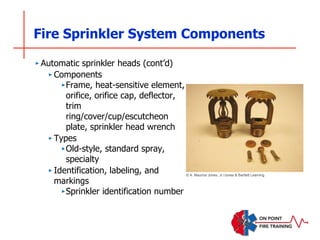
‣ Automatic sprinkler heads (cont’d)
‣ Components
‣Frame, heat-sensitive element,
orifice, orifice cap, deflector,
trim
ring/cover/cup/escutcheon
plate, sprinkler head wrench
‣ Types
‣Old-style, standard spray,
specialty
‣ Identification, labeling, and
markings
‣Sprinkler identification number
© A. Maurice Jones, Jr./Jones & Bartlett Learning
Types of Systems
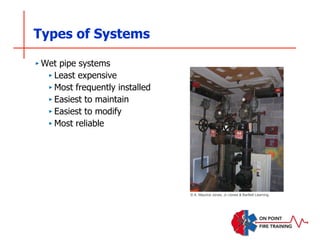
‣ Wet pipe systems
‣ Least expensive
‣ Most frequently installed
‣ Easiest to maintain
‣ Easiest to modify
‣ Most reliable
© A. Maurice Jones, Jr./Jones & Bartlett Learning
Types of Systems
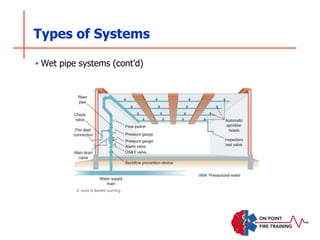
‣ Wet pipe systems (cont’d)
© Jones & Bartlett Learning.
Types of Systems
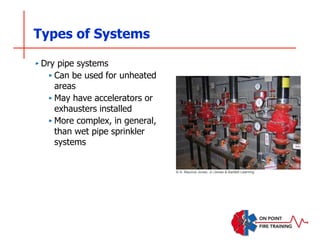
‣ Dry pipe systems
‣ Can be used for unheated
areas
‣ May have accelerators or
exhausters installed
‣ More complex, in general,
than wet pipe sprinkler
systems
© A. Maurice Jones, Jr./Jones & Bartlett Learning
Types of Systems
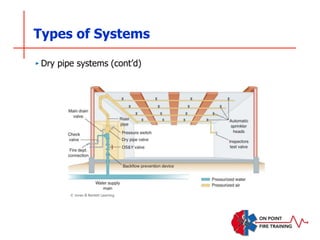
‣ Dry pipe systems (cont’d)
© Jones & Bartlett Learning
Types of Systems
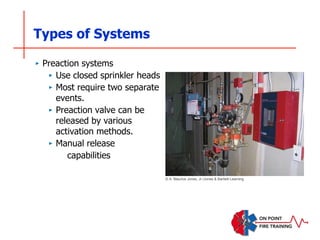
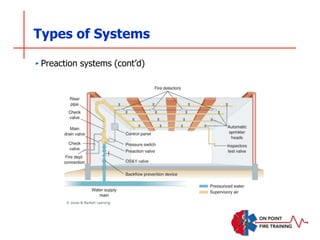
‣ Preaction systems
‣ Use closed sprinkler heads
‣ Most require two separate
events.
‣ Preaction valve can be
released by various
activation methods.
‣ Manual release
capabilities
© A. Maurice Jones, Jr./Jones & Bartlett Learning
Types of Systems
‣ Preaction systems (cont’d)
© Jones & Bartlett Learning
Types of Systems
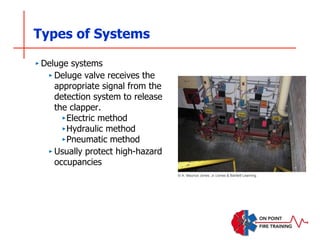
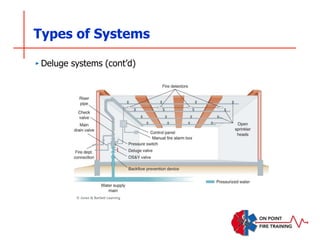
‣ Deluge systems
‣ Deluge valve receives the
appropriate signal from the
detection system to release
the clapper.
‣Electric method
‣Hydraulic method
‣Pneumatic method
‣ Usually protect high-hazard
occupancies
© A. Maurice Jones, Jr./Jones & Bartlett Learning
Types of Systems
‣ Deluge systems (cont’d)
© Jones & Bartlett Learning
Types of Systems
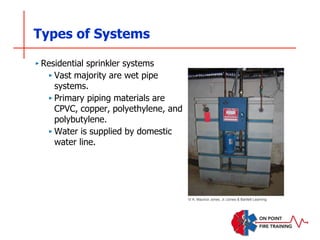
‣ Residential sprinkler systems
‣ Vast majority are wet pipe
systems.
‣ Primary piping materials are
CPVC, copper, polyethylene, and
polybutylene.
‣ Water is supplied by domestic
water line.
© A. Maurice Jones, Jr./Jones & Bartlett Learning
Required Installations
‣ Model codes by the NFPA and ICC establish requirements.
‣ Primarily based on use and occupancy conditions
‣ Specific thresholds
‣Occupant load
‣Building height
‣Storage conditions
‣Number of levels above or below exit discharge
‣ Thresholds can influence design of a building under certain
conditions.
Design and Installation Standards
‣ Overview
‣ Published fire sprinkler system design and installation
standards are available from model code and insurance
organizations.
‣NFPA 13
‣NFPA 13D
‣NFPA 13R
Design and Installation Standards
‣ NFPA 13, Standard for the Installation of Sprinkler Systems
‣ Performance objective
‣Maintain control of a fire to the point that emergency
responders can complete the suppression activity
‣ Same for all occupancy, commodity, and storage conditions
‣ Widely used
Design and Installation Standards
‣ NFPA 13D, Standard for the Installation of Sprinkler Systems in
One- and Two-Family Dwellings and Manufactured Homes
‣ System must:
‣Be economically viable
‣Provide sufficient time for escape or rescue
‣Prevent flashover
‣ Revisions use data to develop requirements for residential
sprinkler heads.
Design and Installation Standards
‣ NFPA 13R, Standard for the Installation of Sprinkler Systems in
Low-Rise Residential Occupancies
‣ Loosely follows NFPA 13 requirements
‣ Follows NFPA 13D concepts of placing sprinkler heads
‣ Has evolved to deal with technological advances
Design and Installation Standards
‣ Other fire sprinkler standards
‣ Used when:
‣Level of hazard exceeding the scope of NFPA 13
‣Specific design requirements for a hazard
‣The approving authority requires the use of a different
standard
‣ NFPA 30, 30B, 214, 804
‣ Insurance providers may develop own standards.
‣ Design professional determines best to use.
Design Concepts for Automatic Fire
Sprinkler Systems
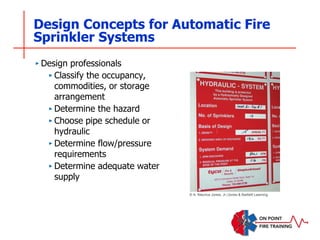
‣ Design professionals
‣ Classify the occupancy,
commodities, or storage
arrangement
‣ Determine the hazard
‣ Choose pipe schedule or
hydraulic
‣ Determine flow/pressure
requirements
‣ Determine adequate water
supply
© A. Maurice Jones, Jr./Jones & Bartlett Learning
Design Concepts for Automatic Fire
Sprinkler Systems
‣ The basis for designing an NFPA 13 system
‣ The professional must determine three factors:
‣The hazard
‣The design density required to protect the hazard
‣The water supply necessary to support the system
demand
‣ When these are determined, designer provides best system
to control/extinguish a fire.
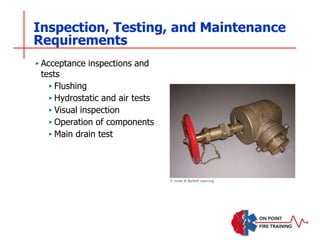
Inspection, Testing, and Maintenance
Requirements
‣ Acceptance inspections and
tests
‣ Flushing
‣ Hydrostatic and air tests
‣ Visual inspection
‣ Operation of components
‣ Main drain test
© Jones & Bartlett Learning
Inspection, Testing, and Maintenance
Requirements
‣ Periodic inspection, testing, and maintenance
‣ Testing should be in accordance with the established
intervals listed in NFPA 25.
‣ Impairments to a fire sprinkler system result from the
following:
‣Component failure
‣Lack of proper inspection, testing, and maintenance

1540 Ch 7 PowerPoint.pptx

  • 1.
    Fire Protection Systems ThirdEdition Chapter 7 — Automatic Fire Sprinkler Systems
  • 2.
    Objectives ‣ Describe anautomatic fire sprinkler system. ‣ Discuss the myths and realities associated with automatic fire sprinkler system operation. ‣ List and describe the different components that make up an automatic fire sprinkler system.
  • 3.
    Objectives ‣ List anddescribe the different types of automatic fire sprinkler system heads. ‣ Describe the different types of automatic fire sprinkler systems and the best applications for those systems. ‣ State the factors that determine requirements to install automatic fire sprinkler systems.
  • 4.
    Objectives ‣ Discuss thedesign concepts behind automatic fire sprinkler systems. ‣ List and describe different occupancy and commodity classifications. ‣ Discuss the inspection and testing requirements for automatic fire sprinkler systems.
  • 5.
    Introduction ‣ Automatic firesprinkler systems ‣ Networks of underground and overhead piping fed by automatic water supply. ‣ Expenses related to water damage from sprinkler systems are higher than those related to fire damage.
  • 6.
    Introduction ‣ Effectiveness inproperty protection: The basis for a fire sprinkler system is to keep a fire at a relatively small size and under control. ‣ Effectiveness in life safety: The purpose of a commercial or industrial fire sprinkler system is to provide both life safety and property protection.
  • 7.
    Fire Sprinkler SystemComponents ‣ Pipe and fittings ‣ Pipe and fittings join together to provide a conduit for the water. ‣ Joining methods: ‣Threads ‣Grooves ‣Flanges ‣Welds, solder, etc. ‣ Piping and tubing materials ‣ Types of fittings ‣ Fitting materials © A. Maurice Jones, Jr./Jones & Bartlett Learning
  • 8.
    Fire Sprinkler SystemComponents ‣ Gauges ‣ Small but important component ‣Water gauges ‣Air gauges ‣ Should not be subjected to freezing temperatures ‣ Should have a shut-off valve, and should be capable of draining
  • 9.
    Fire Sprinkler SystemComponents ‣ Valves ‣ Water control valves ‣ Check valves ‣ Drain valves ‣ Inspector’s test valve and alarm test valve ‣ Isolation valves ‣ Pressure-reducing and pressure-relief valves ‣ General purpose valves © A. Maurice Jones, Jr./Jones & Bartlett Learning
  • 10.
    Fire Sprinkler SystemComponents ‣ Pipe support and stabilization assemblies ‣ Piping is held in place by the following: ‣Bracing, guides, and restraints ‣Hanger assemblies ‣Fasteners ‣ With exceptions, all components must be made of ferrous materials that can handle heat. ‣ NFPA 13: ‣Provides the maximum allowable spacing requirements for various types of sprinkler heads.
  • 11.
    Fire Sprinkler SystemComponents ‣ Automatic sprinkler heads ‣ Distribute water over a limited area at designated flow rate ‣ Most operate at a predetermined temperature © A. Maurice Jones, Jr./Jones & Bartlett Learning
  • 12.
    Fire Sprinkler SystemComponents ‣ Automatic sprinkler heads (cont’d) ‣ Components ‣Frame, heat-sensitive element, orifice, orifice cap, deflector, trim ring/cover/cup/escutcheon plate, sprinkler head wrench ‣ Types ‣Old-style, standard spray, specialty ‣ Identification, labeling, and markings ‣Sprinkler identification number © A. Maurice Jones, Jr./Jones & Bartlett Learning
  • 13.
    Types of Systems ‣Wet pipe systems ‣ Least expensive ‣ Most frequently installed ‣ Easiest to maintain ‣ Easiest to modify ‣ Most reliable © A. Maurice Jones, Jr./Jones & Bartlett Learning
  • 14.
    Types of Systems ‣Wet pipe systems (cont’d) © Jones & Bartlett Learning.
  • 15.
    Types of Systems ‣Dry pipe systems ‣ Can be used for unheated areas ‣ May have accelerators or exhausters installed ‣ More complex, in general, than wet pipe sprinkler systems © A. Maurice Jones, Jr./Jones & Bartlett Learning
  • 16.
    Types of Systems ‣Dry pipe systems (cont’d) © Jones & Bartlett Learning
  • 17.
    Types of Systems ‣Preaction systems ‣ Use closed sprinkler heads ‣ Most require two separate events. ‣ Preaction valve can be released by various activation methods. ‣ Manual release capabilities © A. Maurice Jones, Jr./Jones & Bartlett Learning
  • 18.
    Types of Systems ‣Preaction systems (cont’d) © Jones & Bartlett Learning
  • 19.
    Types of Systems ‣Deluge systems ‣ Deluge valve receives the appropriate signal from the detection system to release the clapper. ‣Electric method ‣Hydraulic method ‣Pneumatic method ‣ Usually protect high-hazard occupancies © A. Maurice Jones, Jr./Jones & Bartlett Learning
  • 20.
    Types of Systems ‣Deluge systems (cont’d) © Jones & Bartlett Learning
  • 21.
    Types of Systems ‣Residential sprinkler systems ‣ Vast majority are wet pipe systems. ‣ Primary piping materials are CPVC, copper, polyethylene, and polybutylene. ‣ Water is supplied by domestic water line. © A. Maurice Jones, Jr./Jones & Bartlett Learning
  • 22.
    Required Installations ‣ Modelcodes by the NFPA and ICC establish requirements. ‣ Primarily based on use and occupancy conditions ‣ Specific thresholds ‣Occupant load ‣Building height ‣Storage conditions ‣Number of levels above or below exit discharge ‣ Thresholds can influence design of a building under certain conditions.
  • 23.
    Design and InstallationStandards ‣ Overview ‣ Published fire sprinkler system design and installation standards are available from model code and insurance organizations. ‣NFPA 13 ‣NFPA 13D ‣NFPA 13R
  • 24.
    Design and InstallationStandards ‣ NFPA 13, Standard for the Installation of Sprinkler Systems ‣ Performance objective ‣Maintain control of a fire to the point that emergency responders can complete the suppression activity ‣ Same for all occupancy, commodity, and storage conditions ‣ Widely used
  • 25.
    Design and InstallationStandards ‣ NFPA 13D, Standard for the Installation of Sprinkler Systems in One- and Two-Family Dwellings and Manufactured Homes ‣ System must: ‣Be economically viable ‣Provide sufficient time for escape or rescue ‣Prevent flashover ‣ Revisions use data to develop requirements for residential sprinkler heads.
  • 26.
    Design and InstallationStandards ‣ NFPA 13R, Standard for the Installation of Sprinkler Systems in Low-Rise Residential Occupancies ‣ Loosely follows NFPA 13 requirements ‣ Follows NFPA 13D concepts of placing sprinkler heads ‣ Has evolved to deal with technological advances
  • 27.
    Design and InstallationStandards ‣ Other fire sprinkler standards ‣ Used when: ‣Level of hazard exceeding the scope of NFPA 13 ‣Specific design requirements for a hazard ‣The approving authority requires the use of a different standard ‣ NFPA 30, 30B, 214, 804 ‣ Insurance providers may develop own standards. ‣ Design professional determines best to use.
  • 28.
    Design Concepts forAutomatic Fire Sprinkler Systems ‣ Design professionals ‣ Classify the occupancy, commodities, or storage arrangement ‣ Determine the hazard ‣ Choose pipe schedule or hydraulic ‣ Determine flow/pressure requirements ‣ Determine adequate water supply © A. Maurice Jones, Jr./Jones & Bartlett Learning
  • 29.
    Design Concepts forAutomatic Fire Sprinkler Systems ‣ The basis for designing an NFPA 13 system ‣ The professional must determine three factors: ‣The hazard ‣The design density required to protect the hazard ‣The water supply necessary to support the system demand ‣ When these are determined, designer provides best system to control/extinguish a fire.
  • 30.
    Inspection, Testing, andMaintenance Requirements ‣ Acceptance inspections and tests ‣ Flushing ‣ Hydrostatic and air tests ‣ Visual inspection ‣ Operation of components ‣ Main drain test © Jones & Bartlett Learning
  • 31.
    Inspection, Testing, andMaintenance Requirements ‣ Periodic inspection, testing, and maintenance ‣ Testing should be in accordance with the established intervals listed in NFPA 25. ‣ Impairments to a fire sprinkler system result from the following: ‣Component failure ‣Lack of proper inspection, testing, and maintenance