Fire Detection and Suppression Chapter 6 Automatic Sprinkler Systems
Sprinkler Systems Purpose : Discharge an extinguishing agent onto a fire while the fire is in the incipient stage *  Should be  simple ,  reliable ,  automatic , & use a readily available and inexpensive extinguishing agent Understanding sprinkler system operation is important so that firefighting operations in sprinklered buildings can be carried out in the most efficient manner.
Sprinkler System Effectiveness Reliability factor of 96% when sprinkler system is installed & maintained properly. In 75% of the reported fires in sprinklered buildings, the fire was controlled by 10 or fewer sprinkler heads. There has never been a multiple loss of life (3 or more deaths) due to fire and smoke in a building protected by a sprinkler system except in the case of intimate contact with the fire or an explosion.
Reasons that sprinkler systems fail to protect: improper maintenance inadequate or inoperative water supply incorrect system design obstructions in system partial protection
Reasons for Installation 1.  Code requirements 2.  Insurance incentives 3.  Fire protection of life & property 4.  Flexibility in building design
Standard NFPA 13 - Standard for the Installation  of Sprinkler Systems
Sprinkler System Components 1.  Water Supply 2.  Distribution piping 3.  Nozzles a.k.a. Sprinkler Heads 4.  Valves 3.  Nozzles a.k.a. Sprinkler Heads
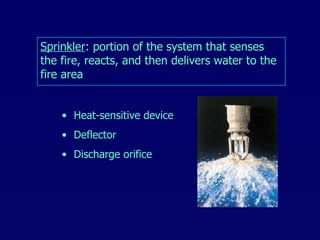
Sprinkler : portion of the system that senses the fire, reacts, and then delivers water to the fire area Heat-sensitive device Deflector Discharge orifice
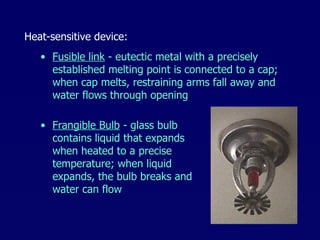
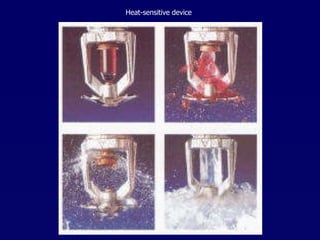
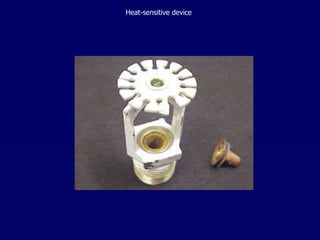
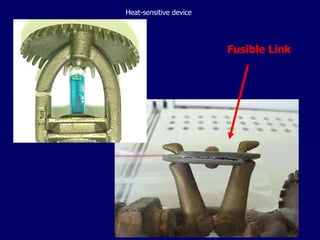
Fusible link  - eutectic metal with a precisely established melting point is connected to a cap; when cap melts, restraining arms fall away and water flows through opening Heat-sensitive device: Frangible Bulb  - glass bulb contains liquid that expands when heated to a precise temperature; when liquid expands, the bulb breaks and water can flow
Heat-sensitive device
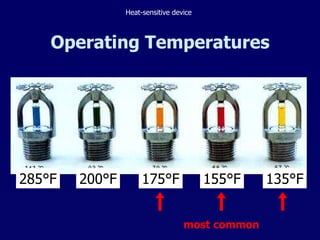
Operating Temperatures 135°F 155°F 175°F 200°F 285°F Heat-sensitive device most common
Fusible Link Heat-sensitive device
Response Time Index (RTI) : speed of operation of a sprinkler head; smaller # means faster response There will be a delay between the time when the air reaches a certain temperature and when the sprinkler head operates Same as “thermal lag” in heat detectors The surface area, mass, and thermal properties of the heat sensing device determine how quickly it will operate ESFR (Early Suppression Fast Response) Sprinkler Heads : Superior design with a very low RTI resulting in 5-10x faster response than standard sprinkler heads  Heat-sensitive device
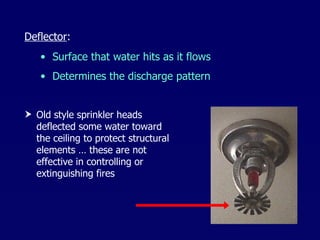
Surface that water hits as it flows Determines the discharge pattern Deflector : Old style sprinkler heads deflected some water toward the ceiling to protect structural elements … these are not effective in controlling or extinguishing fires
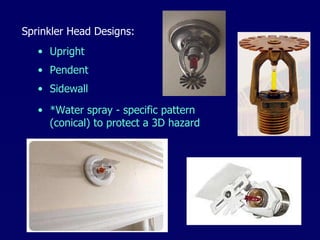
Upright Sprinkler Head Designs: Pendent Sidewall *Water spray - specific pattern (conical) to protect a 3D hazard
Standard size is  1 / 2 ” opening Flow 15-50 gpm Large- and Small-Orifice sprinklers do exist Discharge Orifice :
Sprinkler System Components 1.  Water Supply 2.  Distribution piping 3.  Nozzles a.k.a. Sprinkler Heads 4.  Valves 2.  Distribution Piping
Sprinkler System Piping Material: Ferrous metal (a.k.a. Steel, Black Steel)  - most common, heavy, corrodes Copper Tubing  - lighter, resists corrosion, less FL, expensive Galvanized  - steel or iron coated with zinc to protect against corrosion Plastic (PVC)  - lightest, least expensive, cannot within high ambient temps, needs fire resistant covering
Sprinkler System Piping Size: Hydraulically calculated  - mathematical formulas used to calculate flow volume and pressure determine pipe size; requires initial $$$ for engineer but saves money in long run Pipe Schedule Method  - pipe size (diameter & thickness of pipe wall) determined by # of sprinkler heads to be supplied, excellent performance, may be more $$$
Sprinkler System Piping Terminology: Water supply main System riser Spring-up Riser Feed main Cross main Branch line
Sprinkler System Components 1.  Water Supply 2.  Distribution piping 3.  Nozzles a.k.a. Sprinkler Heads 4.  Valves 4.  Valves
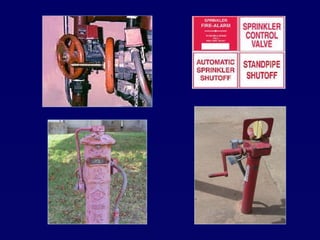
Sprinkler System Valves Control valve  - shuts off main water supply; normally kept in OPEN position Check valves  - ensures water flows in only ONE direction Automatic Drain valves  - allow water to automatically flow out of the piping; used to drain FDCs Operating valves: Alarm check valves  - opens when water begins to flow out of a sprinkler head & allows water to flow into small pipe which activates an alarm; needs a retard chamber to prevent accidental alarms
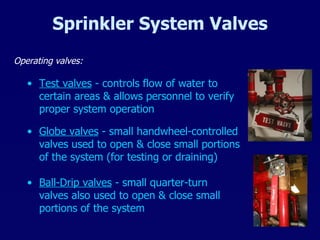
Sprinkler System Valves Operating valves: Globe valves  - small handwheel-controlled valves used to open & close small portions of the system (for testing or draining) Ball-Drip valves  - small quarter-turn valves also used to open & close small portions of the system Test valves  - controls flow of water to certain areas & allows personnel to verify proper system operation
 
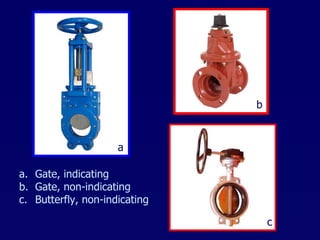
Gate, indicating Gate, non-indicating Butterfly, non-indicating a b c
Sprinkler System Components 1.  Water Supply 2.  Distribution piping 3.  Nozzles a.k.a. Sprinkler Heads 4.  Valves 1.  Water Supply
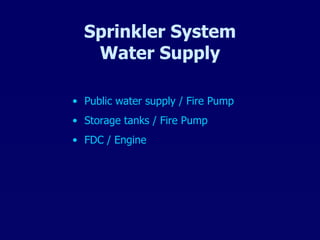
Sprinkler System Water Supply Public water supply / Fire Pump Storage tanks / Fire Pump FDC / Engine

2.5 suppression.sprinklers.wk12a

  • 1.
    Fire Detection andSuppression Chapter 6 Automatic Sprinkler Systems
  • 2.
    Sprinkler Systems Purpose: Discharge an extinguishing agent onto a fire while the fire is in the incipient stage * Should be simple , reliable , automatic , & use a readily available and inexpensive extinguishing agent Understanding sprinkler system operation is important so that firefighting operations in sprinklered buildings can be carried out in the most efficient manner.
  • 3.
    Sprinkler System EffectivenessReliability factor of 96% when sprinkler system is installed & maintained properly. In 75% of the reported fires in sprinklered buildings, the fire was controlled by 10 or fewer sprinkler heads. There has never been a multiple loss of life (3 or more deaths) due to fire and smoke in a building protected by a sprinkler system except in the case of intimate contact with the fire or an explosion.
  • 4.
    Reasons that sprinklersystems fail to protect: improper maintenance inadequate or inoperative water supply incorrect system design obstructions in system partial protection
  • 5.
    Reasons for Installation1. Code requirements 2. Insurance incentives 3. Fire protection of life & property 4. Flexibility in building design
  • 6.
    Standard NFPA 13- Standard for the Installation of Sprinkler Systems
  • 7.
    Sprinkler System Components1. Water Supply 2. Distribution piping 3. Nozzles a.k.a. Sprinkler Heads 4. Valves 3. Nozzles a.k.a. Sprinkler Heads
  • 8.
    Sprinkler : portionof the system that senses the fire, reacts, and then delivers water to the fire area Heat-sensitive device Deflector Discharge orifice
  • 9.
    Fusible link - eutectic metal with a precisely established melting point is connected to a cap; when cap melts, restraining arms fall away and water flows through opening Heat-sensitive device: Frangible Bulb - glass bulb contains liquid that expands when heated to a precise temperature; when liquid expands, the bulb breaks and water can flow
  • 10.
  • 11.
  • 12.
    Operating Temperatures 135°F155°F 175°F 200°F 285°F Heat-sensitive device most common
  • 13.
  • 14.
    Response Time Index(RTI) : speed of operation of a sprinkler head; smaller # means faster response There will be a delay between the time when the air reaches a certain temperature and when the sprinkler head operates Same as “thermal lag” in heat detectors The surface area, mass, and thermal properties of the heat sensing device determine how quickly it will operate ESFR (Early Suppression Fast Response) Sprinkler Heads : Superior design with a very low RTI resulting in 5-10x faster response than standard sprinkler heads Heat-sensitive device
  • 15.
    Surface that waterhits as it flows Determines the discharge pattern Deflector : Old style sprinkler heads deflected some water toward the ceiling to protect structural elements … these are not effective in controlling or extinguishing fires
  • 16.
    Upright Sprinkler HeadDesigns: Pendent Sidewall *Water spray - specific pattern (conical) to protect a 3D hazard
  • 17.
    Standard size is 1 / 2 ” opening Flow 15-50 gpm Large- and Small-Orifice sprinklers do exist Discharge Orifice :
  • 18.
    Sprinkler System Components1. Water Supply 2. Distribution piping 3. Nozzles a.k.a. Sprinkler Heads 4. Valves 2. Distribution Piping
  • 19.
    Sprinkler System PipingMaterial: Ferrous metal (a.k.a. Steel, Black Steel) - most common, heavy, corrodes Copper Tubing - lighter, resists corrosion, less FL, expensive Galvanized - steel or iron coated with zinc to protect against corrosion Plastic (PVC) - lightest, least expensive, cannot within high ambient temps, needs fire resistant covering
  • 20.
    Sprinkler System PipingSize: Hydraulically calculated - mathematical formulas used to calculate flow volume and pressure determine pipe size; requires initial $$$ for engineer but saves money in long run Pipe Schedule Method - pipe size (diameter & thickness of pipe wall) determined by # of sprinkler heads to be supplied, excellent performance, may be more $$$
  • 21.
    Sprinkler System PipingTerminology: Water supply main System riser Spring-up Riser Feed main Cross main Branch line
  • 22.
    Sprinkler System Components1. Water Supply 2. Distribution piping 3. Nozzles a.k.a. Sprinkler Heads 4. Valves 4. Valves
  • 23.
    Sprinkler System ValvesControl valve - shuts off main water supply; normally kept in OPEN position Check valves - ensures water flows in only ONE direction Automatic Drain valves - allow water to automatically flow out of the piping; used to drain FDCs Operating valves: Alarm check valves - opens when water begins to flow out of a sprinkler head & allows water to flow into small pipe which activates an alarm; needs a retard chamber to prevent accidental alarms
  • 24.
    Sprinkler System ValvesOperating valves: Globe valves - small handwheel-controlled valves used to open & close small portions of the system (for testing or draining) Ball-Drip valves - small quarter-turn valves also used to open & close small portions of the system Test valves - controls flow of water to certain areas & allows personnel to verify proper system operation
  • 25.
  • 26.
    Gate, indicating Gate,non-indicating Butterfly, non-indicating a b c
  • 27.
    Sprinkler System Components1. Water Supply 2. Distribution piping 3. Nozzles a.k.a. Sprinkler Heads 4. Valves 1. Water Supply
  • 28.
    Sprinkler System WaterSupply Public water supply / Fire Pump Storage tanks / Fire Pump FDC / Engine

Editor's Notes

  • #7 Three basic purposes of private water supply systems: To provide water solely for fire protection To provide water for sanitary purposes and fire protection To provide water for fire protection and manufacturing processes Three basic purposes of private water supply systems: To provide water solely for fire protection To provide water for sanitary purposes and fire protection To provide water for fire protection and manufacturing processes