Rohan Porwal
Sachin Mansharamani
Construction Technology and Management
VNIT
Introduction
Drozer is a tractor unit that has a blade attached to its
front.
The dozer has no set volumetric capacity
The amount of material, it moves is dependent on the
quantity that will remain in front of the blade during
push.
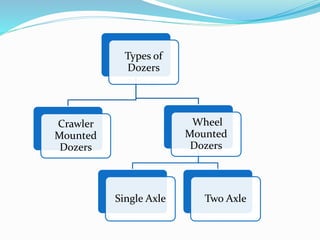
Types of
Dozers
Crawler
Mounted
Dozers
Wheel
Mounted
Dozers
Single Axle Two Axle
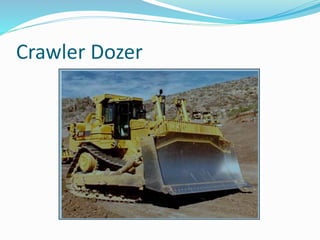
Crawler Dozer
Wheel Dozer
Dozers Uses
Dozers are self contained units that are designed to provide
tractive force for drawbar work.
Consistent with there purpose as a unit for drawbar work
they are low center of gravity machines. This is a prerequisite
of good machine
The larger the difference between the line of force
transmission from the machine and the line of resisting
force the less affective the utilization of developed power
Applications
• Land Clearing
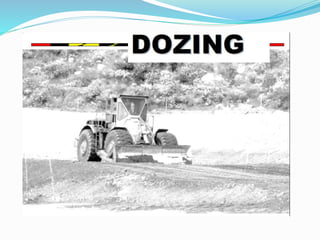
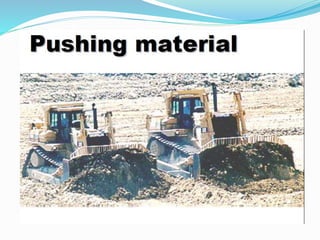
• Dozing(Pushing material)
• Ripping
• Towing other pieces of
construction equipment
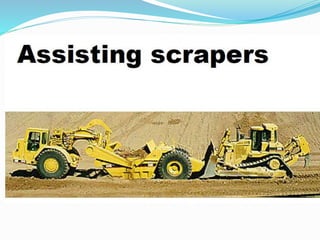
• Assisting scappers in loading
Blades
• Horse Power Per Foot (Hp/ft) Provides an
indication of the ability of the blade to
penetrate and obtain a load.
• The higher this ratio the more aggressive
the blade
• Horse power per loose cubic yard (hp/lcy)
measures the blade’s ability to push a load
• The higher ratio means that the bull dozer
can push a load at a greater speed
Blades Adjustments
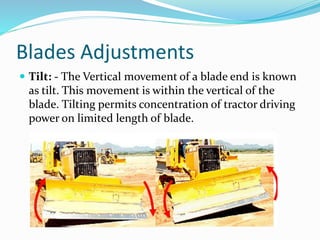
 Tilt: - The Vertical movement of a blade end is known
as tilt. This movement is within the vertical of the
blade. Tilting permits concentration of tractor driving
power on limited length of blade.
Blade Adjustment
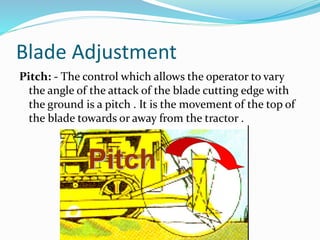
Pitch: - The control which allows the operator to vary
the angle of the attack of the blade cutting edge with
the ground is a pitch . It is the movement of the top of
the blade towards or away from the tractor .
Blade Adjustment
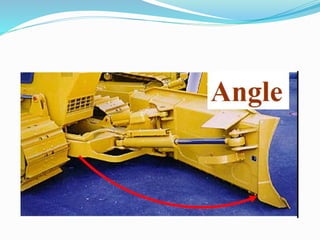
 Angling: - Turning the blade so that it is not
perpendicular to the direction of the tracors travel is
angling. This cause the pushed material to roll of the
trailing end of the blade. Rolling material of one end
of the blade is called “side casting”.
Dozer Production Estimating
 A bulldozer has no set volumetric capacity
 There is no hopper or bowl to load.
 The amount of material that the dozer moves depend
on the quantity which will remain in front of the blade
during the push
 The factors that control dozer production rate are: -
1. Blade type
2. Type and Condition of material
3. Cycle time
Dozer Production Estimate
 The load that the blade carry can be estimated by
several methods: -
1. Manufacturer’s blade rating
2. Previous experience (Similar material, equipment
and work condition)
3. Field Measurement
Field Measurement
A procedure for measuring Blade Load: -
 Obtain a Normal Load :
 A dozer push a normal Blade load on a level area
 Stop the Dozer’ s Forward motion. While rising the
blade, move forward slightly to create a symmetrical
pile.
 Reverse and move away from the pile.
Field Measurement
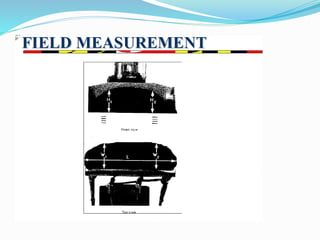
 Measure the height(H) of the pile at the inside edge of
each rack.
 Measure the width(W) of the pile at the inside edge of
each rack.
 Measure the greatest length (L) of the pile. This will
not necessarily be at the middle.
Computation of Blade Load
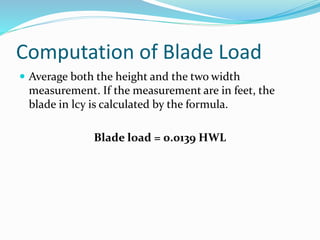
 Average both the height and the two width
measurement. If the measurement are in feet, the
blade in lcy is calculated by the formula.
Blade load = 0.0139 HWL
Cycle Time
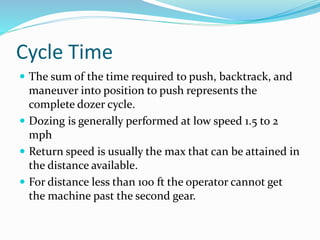
 The sum of the time required to push, backtrack, and
maneuver into position to push represents the
complete dozer cycle.
 Dozing is generally performed at low speed 1.5 to 2
mph
 Return speed is usually the max that can be attained in
the distance available.
 For distance less than 100 ft the operator cannot get
the machine past the second gear.
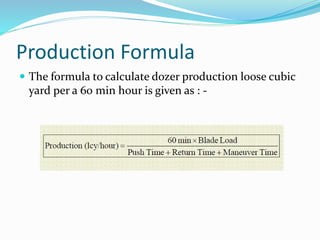
Production Formula
 The formula to calculate dozer production loose cubic
yard per a 60 min hour is given as : -
Thank You

Construction Equipment

  • 1.
    Rohan Porwal Sachin Mansharamani ConstructionTechnology and Management VNIT
  • 2.
    Introduction Drozer is atractor unit that has a blade attached to its front. The dozer has no set volumetric capacity The amount of material, it moves is dependent on the quantity that will remain in front of the blade during push.
  • 3.
  • 4.
  • 5.
  • 6.
    Dozers Uses Dozers areself contained units that are designed to provide tractive force for drawbar work. Consistent with there purpose as a unit for drawbar work they are low center of gravity machines. This is a prerequisite of good machine The larger the difference between the line of force transmission from the machine and the line of resisting force the less affective the utilization of developed power
  • 7.
    Applications • Land Clearing •Dozing(Pushing material) • Ripping • Towing other pieces of construction equipment • Assisting scappers in loading
  • 11.
    Blades • Horse PowerPer Foot (Hp/ft) Provides an indication of the ability of the blade to penetrate and obtain a load. • The higher this ratio the more aggressive the blade • Horse power per loose cubic yard (hp/lcy) measures the blade’s ability to push a load • The higher ratio means that the bull dozer can push a load at a greater speed
  • 12.
    Blades Adjustments  Tilt:- The Vertical movement of a blade end is known as tilt. This movement is within the vertical of the blade. Tilting permits concentration of tractor driving power on limited length of blade.
  • 13.
    Blade Adjustment Pitch: -The control which allows the operator to vary the angle of the attack of the blade cutting edge with the ground is a pitch . It is the movement of the top of the blade towards or away from the tractor .
  • 14.
    Blade Adjustment  Angling:- Turning the blade so that it is not perpendicular to the direction of the tracors travel is angling. This cause the pushed material to roll of the trailing end of the blade. Rolling material of one end of the blade is called “side casting”.
  • 16.
    Dozer Production Estimating A bulldozer has no set volumetric capacity  There is no hopper or bowl to load.  The amount of material that the dozer moves depend on the quantity which will remain in front of the blade during the push  The factors that control dozer production rate are: - 1. Blade type 2. Type and Condition of material 3. Cycle time
  • 17.
    Dozer Production Estimate The load that the blade carry can be estimated by several methods: - 1. Manufacturer’s blade rating 2. Previous experience (Similar material, equipment and work condition) 3. Field Measurement
  • 18.
    Field Measurement A procedurefor measuring Blade Load: -  Obtain a Normal Load :  A dozer push a normal Blade load on a level area  Stop the Dozer’ s Forward motion. While rising the blade, move forward slightly to create a symmetrical pile.  Reverse and move away from the pile.
  • 19.
    Field Measurement  Measurethe height(H) of the pile at the inside edge of each rack.  Measure the width(W) of the pile at the inside edge of each rack.  Measure the greatest length (L) of the pile. This will not necessarily be at the middle.
  • 20.
    Computation of BladeLoad  Average both the height and the two width measurement. If the measurement are in feet, the blade in lcy is calculated by the formula. Blade load = 0.0139 HWL
  • 22.
    Cycle Time  Thesum of the time required to push, backtrack, and maneuver into position to push represents the complete dozer cycle.  Dozing is generally performed at low speed 1.5 to 2 mph  Return speed is usually the max that can be attained in the distance available.  For distance less than 100 ft the operator cannot get the machine past the second gear.
  • 23.
    Production Formula  Theformula to calculate dozer production loose cubic yard per a 60 min hour is given as : -
  • 24.