
FIRE SPREAD
Types of fire spread
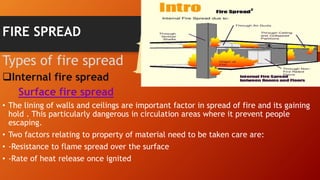
Internal fire spread
Surface fire spread
• The lining of walls and ceilings are important factor in spread of fire and its gaining
hold . This particularly dangerous in circulation areas where it prevent people
escaping.
• Two factors relating to property of material need to be taken care are:
• -Resistance to flame spread over the surface
• -Rate of heat release once ignited
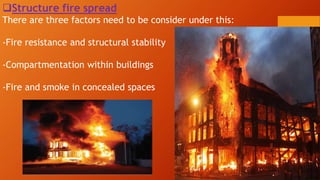
Structure fire spread
There are three factors need to be consider under this:
-Fire resistance and structural stability
-Compartmentation within buildings
-Fire and smoke in concealed spaces
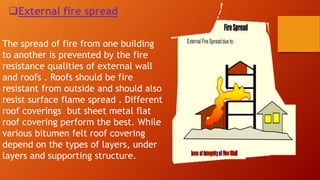
External fire spread
The spread of fire from one building
to another is prevented by the fire
resistance qualities of external wall
and roofs . Roofs should be fire
resistant from outside and should also
resist surface flame spread . Different
roof coverings but sheet metal flat
roof covering perform the best. While
various bitumen felt roof covering
depend on the types of layers, under
layers and supporting structure.
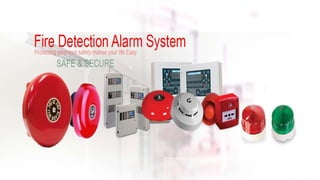
FIRE DETECTION
AND
ALARM SYSTEM
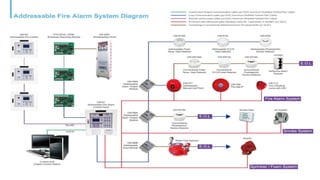
Block diagram of FDA system
Input
Devices
Output
Devices
Control
Panel
Input Devices
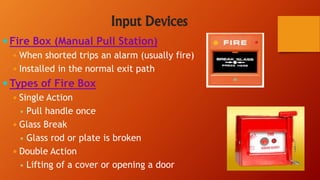
 Fire Box (Manual Pull Station)
 When shorted trips an alarm (usually fire)
 Installed in the normal exit path
 Types of Fire Box
 Single Action
 Pull handle once
 Glass Break
 Glass rod or plate is broken
 Double Action
 Lifting of a cover or opening a door
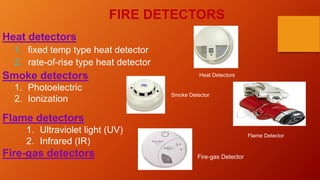
Heat detectors
1. fixed temp type heat detector
2. rate-of-rise type heat detector
Smoke detectors
1. Photoelectric
2. Ionization
Flame detectors
1. Ultraviolet light (UV)
2. Infrared (IR)
Fire-gas detectors
FIRE DETECTORS
Heat Detectors
Smoke Detector
Flame Detector
Fire-gas Detector
Fixed temp. heat detectors
Detect heat by one or more of 3 primary principles of physics:
Expansion of heated material
Melting of heated material
Changes in resistance of heated material
Rate-of-rise heat detectors
 Operate on the principle that the temperature in a room will increase faster from fire than from
atmospheric temperature
 Will initiate an alarm when the rise in temp. exceeds 12-15F (7-8C) per minute
 Alarm can be initiated at a temp. far below that required for a fixed-temp. device
◦ Reliable devices, not subject to false activations
◦ But if not properly installed, they can be activated under non fire conditions (eg. detector located
too close to doorway and subject to extreme fluctuations in temperatures)
 Pneumatic rate-of-rise spot detector
 Pneumatic rate-of-rise line detector
 Thermoelectric detector
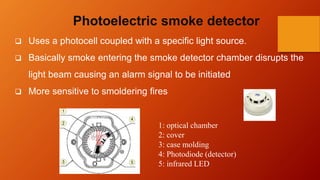
Photoelectric smoke detector
 Uses a photocell coupled with a specific light source.
 Basically smoke entering the smoke detector chamber disrupts the
light beam causing an alarm signal to be initiated
 More sensitive to smoldering fires
1: optical chamber
2: cover
3: case molding
4: Photodiode (detector)
5: infrared LED
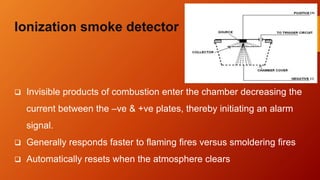
Ionization smoke detector
 Invisible products of combustion enter the chamber decreasing the
current between the –ve & +ve plates, thereby initiating an alarm
signal.
 Generally responds faster to flaming fires versus smoldering fires
 Automatically resets when the atmosphere clears
Fire-gas Detectors
• Monitors levels of carbon dioxide and carbon
monoxide (common to all fires)
• More discriminating than other detectors – can
be designed to be sensitive only to gases
produced by specific types of hostile fires and
ignores gases produced by friendly fires
• Not many in use – very specialized applications
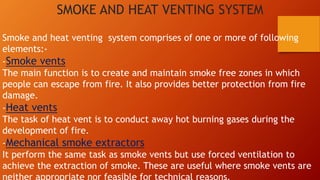
SMOKE AND HEAT VENTING SYSTEM
Smoke and heat venting system comprises of one or more of following
elements:-
-Smoke vents
The main function is to create and maintain smoke free zones in which
people can escape from fire. It also provides better protection from fire
damage.
-Heat vents
The task of heat vent is to conduct away hot burning gases during the
development of fire.
-Mechanical smoke extractors
It perform the same task as smoke vents but use forced ventilation to
achieve the extraction of smoke. These are useful where smoke vents are
The working principle of smoke and heat venting system lies
in the property of hot gases to rise. The effectiveness of the
system depends on :
-the aerodynamic efficiency of the air venting
-the effect of wind
-the size of air vents
-the activation of air vents
-the location of the installation relative to the general arrangement and
size of the building
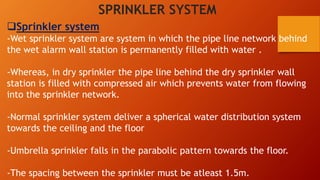
Sprinkler system
-Wet sprinkler system are system in which the pipe line network behind
the wet alarm wall station is permanently filled with water .
-Whereas, in dry sprinkler the pipe line behind the dry sprinkler wall
station is filled with compressed air which prevents water from flowing
into the sprinkler network.
-Normal sprinkler system deliver a spherical water distribution system
towards the ceiling and the floor
-Umbrella sprinkler falls in the parabolic pattern towards the floor.
-The spacing between the sprinkler must be atleast 1.5m.
SPRINKLER SYSTEM
OPEN NOZZLE SYSTEM
Sprinkler system with open nozzle are water distribution system with fixed
pipelines to which open nozzles are attached at regular intervals when on
standby the pipe network is not filled with water.
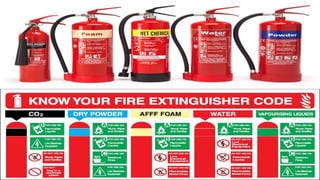
Fire Extinguisher Classification
• Through the classification system, extinguishing agents matched to fire
hazards
• Classification designated with letters
• Class A fires: ordinary combustibles
• Class B fires. flammable and combustible liquids and gases
• Class C fires: energized electrical equipment
• Class D fires: combustible metals
• Class K fires: cooking media
-Interior stair shall be constructed of non combustile
material throughout.
-the staircase shall not be arranged around a lift
shaft unless it is entirely enclosed by a material of
fire resistance.
-the width of staircase should not be less than
75cm.
-the escape stairs shall have straight flights with
25cm treads and riser not more than 19cm
-handrails shall be provided with the minimum
height of 90cm.
-the internal enclosing walls of staircase shall be of
brick or RCC having fire resistance of not less than
2hours
STAIRWAYS
Fire safety

Fire safety

  • 1.
    FIRE SPREAD Types offire spread Internal fire spread Surface fire spread • The lining of walls and ceilings are important factor in spread of fire and its gaining hold . This particularly dangerous in circulation areas where it prevent people escaping. • Two factors relating to property of material need to be taken care are: • -Resistance to flame spread over the surface • -Rate of heat release once ignited
  • 2.
    Structure fire spread Thereare three factors need to be consider under this: -Fire resistance and structural stability -Compartmentation within buildings -Fire and smoke in concealed spaces
  • 3.
    External fire spread Thespread of fire from one building to another is prevented by the fire resistance qualities of external wall and roofs . Roofs should be fire resistant from outside and should also resist surface flame spread . Different roof coverings but sheet metal flat roof covering perform the best. While various bitumen felt roof covering depend on the types of layers, under layers and supporting structure.
  • 4.
  • 5.
    Block diagram ofFDA system Input Devices Output Devices Control Panel
  • 6.
    Input Devices  FireBox (Manual Pull Station)  When shorted trips an alarm (usually fire)  Installed in the normal exit path  Types of Fire Box  Single Action  Pull handle once  Glass Break  Glass rod or plate is broken  Double Action  Lifting of a cover or opening a door
  • 7.
    Heat detectors 1. fixedtemp type heat detector 2. rate-of-rise type heat detector Smoke detectors 1. Photoelectric 2. Ionization Flame detectors 1. Ultraviolet light (UV) 2. Infrared (IR) Fire-gas detectors FIRE DETECTORS Heat Detectors Smoke Detector Flame Detector Fire-gas Detector
  • 9.
    Fixed temp. heatdetectors Detect heat by one or more of 3 primary principles of physics: Expansion of heated material Melting of heated material Changes in resistance of heated material
  • 10.
    Rate-of-rise heat detectors Operate on the principle that the temperature in a room will increase faster from fire than from atmospheric temperature  Will initiate an alarm when the rise in temp. exceeds 12-15F (7-8C) per minute  Alarm can be initiated at a temp. far below that required for a fixed-temp. device ◦ Reliable devices, not subject to false activations ◦ But if not properly installed, they can be activated under non fire conditions (eg. detector located too close to doorway and subject to extreme fluctuations in temperatures)  Pneumatic rate-of-rise spot detector  Pneumatic rate-of-rise line detector  Thermoelectric detector
  • 11.
    Photoelectric smoke detector Uses a photocell coupled with a specific light source.  Basically smoke entering the smoke detector chamber disrupts the light beam causing an alarm signal to be initiated  More sensitive to smoldering fires 1: optical chamber 2: cover 3: case molding 4: Photodiode (detector) 5: infrared LED
  • 12.
    Ionization smoke detector Invisible products of combustion enter the chamber decreasing the current between the –ve & +ve plates, thereby initiating an alarm signal.  Generally responds faster to flaming fires versus smoldering fires  Automatically resets when the atmosphere clears
  • 13.
    Fire-gas Detectors • Monitorslevels of carbon dioxide and carbon monoxide (common to all fires) • More discriminating than other detectors – can be designed to be sensitive only to gases produced by specific types of hostile fires and ignores gases produced by friendly fires • Not many in use – very specialized applications
  • 14.
    SMOKE AND HEATVENTING SYSTEM Smoke and heat venting system comprises of one or more of following elements:- -Smoke vents The main function is to create and maintain smoke free zones in which people can escape from fire. It also provides better protection from fire damage. -Heat vents The task of heat vent is to conduct away hot burning gases during the development of fire. -Mechanical smoke extractors It perform the same task as smoke vents but use forced ventilation to achieve the extraction of smoke. These are useful where smoke vents are
  • 15.
    The working principleof smoke and heat venting system lies in the property of hot gases to rise. The effectiveness of the system depends on : -the aerodynamic efficiency of the air venting -the effect of wind -the size of air vents -the activation of air vents -the location of the installation relative to the general arrangement and size of the building
  • 17.
    Sprinkler system -Wet sprinklersystem are system in which the pipe line network behind the wet alarm wall station is permanently filled with water . -Whereas, in dry sprinkler the pipe line behind the dry sprinkler wall station is filled with compressed air which prevents water from flowing into the sprinkler network. -Normal sprinkler system deliver a spherical water distribution system towards the ceiling and the floor -Umbrella sprinkler falls in the parabolic pattern towards the floor. -The spacing between the sprinkler must be atleast 1.5m. SPRINKLER SYSTEM
  • 21.
    OPEN NOZZLE SYSTEM Sprinklersystem with open nozzle are water distribution system with fixed pipelines to which open nozzles are attached at regular intervals when on standby the pipe network is not filled with water.
  • 23.
    Fire Extinguisher Classification •Through the classification system, extinguishing agents matched to fire hazards • Classification designated with letters • Class A fires: ordinary combustibles • Class B fires. flammable and combustible liquids and gases • Class C fires: energized electrical equipment • Class D fires: combustible metals • Class K fires: cooking media
  • 26.
    -Interior stair shallbe constructed of non combustile material throughout. -the staircase shall not be arranged around a lift shaft unless it is entirely enclosed by a material of fire resistance. -the width of staircase should not be less than 75cm. -the escape stairs shall have straight flights with 25cm treads and riser not more than 19cm -handrails shall be provided with the minimum height of 90cm. -the internal enclosing walls of staircase shall be of brick or RCC having fire resistance of not less than 2hours STAIRWAYS